JEE Main · Chemistry ↓ Falling

Redox Reactions appeared 14 times across 3 years — 1.6% of Chemistry. This question is from Titration and Autocatalysis.

Year 2026 2025 2024 Total
Questions 4 4 6 14

Given below are two statements : Statement I: In the oxalic acid vs KMnO₄ (in the presence of dil H₂SO₄ ) titration the solution needs to be heated initially to 60°C , but no heating is required in Ferrous ammonium sulphate (FAS) vs KMnO₄ titration (in the presence of dil H₂SO₄ ) Statement II : In oxalic acid vs KMnO₄ titration, the initial formation of MnSO₄ takes place at high temperature, which then acts as catalyst for further reaction. In the case of FAS vs KMnO₄ , heating oxidizes Fe²⁺ into Fe³⁺ by oxygen of air and error may be introduced in the experiment. In the light of the above statements, choose the correct answer from the options given below:

Solution & Explanation

Related Formula

Oxalic acid titration equation:

2MnO₄^- + 5(COO)₂²⁻ + 16H^+ arrow 10CO₂ + 2Mn²⁺ + 8H₂O
Core Logic

Statement I is true because the reaction between oxalic acid and KMnO₄ is slow at room temperature and requires initial heating to around 60°C. No heating is required for FAS titration.

Statement II is true because Mn²⁺ acts as an autocatalyst. Heating FAS would cause atmospheric oxygen to prematurely oxidize Fe²⁺ to Fe³⁺, leading to experimental errors.

Pattern Recognition

Sees: Oxalic acid vs FAS titration with permanganate. Shortcut: Oxalic acid requires heat + autocatalysis. FAS titration must be kept cold to avoid aerial oxidation.

Chapter Mix

Class 11 Chemistry: Redox Reactions

Reference Study Guides

More Redox Reactions Previous-Year Questions — Page 3

Q79 jee_main_2024_29_jan_morning Balancing Redox Reactions
Chlorine undergoes disproportionation in alkaline medium as shown below: a Cl₂(g) + b OH^-(aq) arrow c ClO^-(aq) + d Cl^-(aq) + e H₂O(l) The values of a, b, c and d in a balanced redox reaction are respectively :
  • A. 1, 2, 1 and 1
  • B. 2, 2, 1 and 3
  • C. 3, 4, 4 and 2
  • D. 2, 4, 1 and 3

Solution

Core Logic

The disproportionation of Cl₂ in cold, dilute alkaline medium yields chloride (Cl^-) and hypochlorite (ClO^-) ions.

Oxidation half-reaction: Cl₂ arrow 2ClO^- + 2e^- Balancing O and H in basic medium: Cl₂ + 4OH^- arrow 2ClO^- + 2H₂O + 2e^-

Reduction half-reaction: Cl₂ + 2e^- arrow 2Cl^-

Adding both half-reactions (electrons are already equal): 2Cl₂ + 4OH^- arrow 2ClO^- + 2Cl^- + 2H₂O

Dividing the entire equation by 2 to get the simplest integer coefficients: 1Cl₂ + 2OH^- arrow 1ClO^- + 1Cl^- + 1H₂O

Step 1: Coefficient Matching
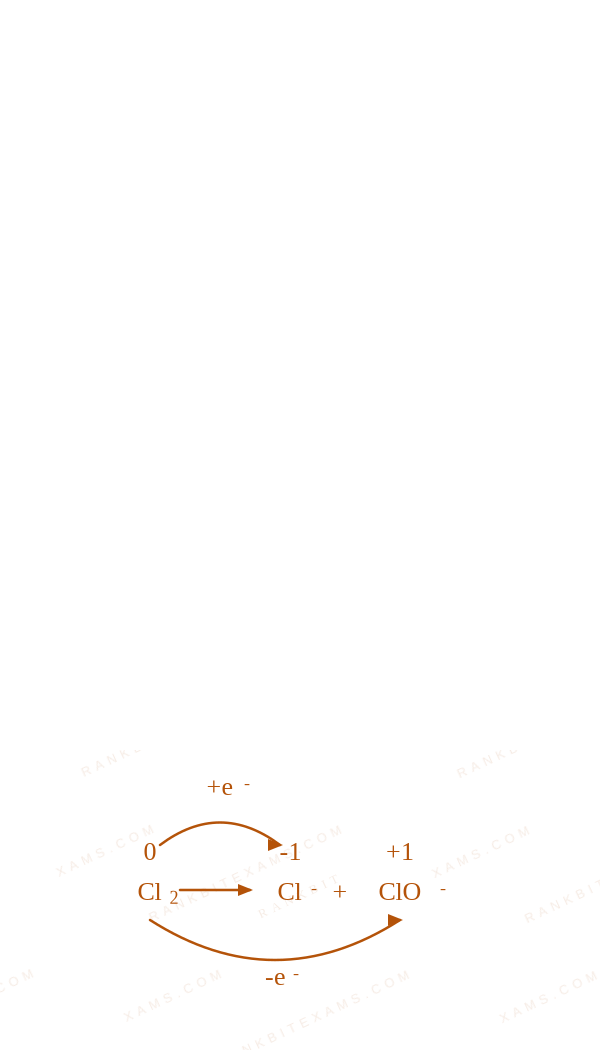
Balancing Redox Reactions diagram for Q79 - JEE Main 2024 Morning

By comparing with the given equation: a Cl₂ + b OH^- arrow c ClO^- + d Cl^- + e H₂O We get: a = 1 b = 2 c = 1 d = 1

Thus, the values are 1, 2, 1, and 1.

Chapter Mix

Class 11 Chemistry: Redox Reactions Class 12 Chemistry: The p Block Elements

Q87 jee_main_2024_30_january_evening Types of Redox Reactions
Total number of species from the following which can undergo disproportionation reaction H₂O₂, ClO₃^-, P₄, Cl₂, Ag, Cu⁺¹, F₂, NO₂, K^+
Numerical Answer. Answer: 6 to 6

Solution

Core Logic

For a species to undergo disproportionation, it must contain an element that is present in an intermediate oxidation state. This allows it to act both as an oxidizing agent (by being reduced to a lower state) and a reducing agent (by being oxidized to a higher state).

Let's evaluate each species:

  • H₂O₂: Oxygen is in -1. Can go to 0 (O₂) and -2 (H₂O). (Yes)
  • ClO₃^-: Chlorine is in +5. Can go to +7 (ClO₄^-) and -1 (Cl^-). (Yes)
  • P₄: Phosphorus is in 0. Can go to -3 (PH₃) and +1/+3/+5. (Yes)
  • Cl₂: Chlorine is in 0. Can go to -1 (Cl^-) and +1 (ClO^-). (Yes)
  • Ag: Metal in 0 state. Cannot show negative oxidation state. (No)
  • Cu⁺¹: Copper is in +1. Can go to 0 (Cu) and +2 (Cu²⁺). (Yes)
  • F₂: Fluorine is the most electronegative, only shows 0 and -1. Cannot be oxidized to a positive state. (No)
  • NO₂: Nitrogen is in +4. Can go to +5 (HNO₃) and +3 (HNO₂). (Yes)
  • K^+: Potassium is in its highest oxidation state +1. Cannot be oxidized further. (No)
Step 1: Final Count

The species that can undergo disproportionation are: H₂O₂, ClO₃^-, P₄, Cl₂, Cu⁺¹, and NO₂. Total count is 6.

Pattern Recognition

Rule out maximum oxidation states (K^+), minimum oxidation states, and elements like F₂ which never show positive oxidation states.

Chapter Mix

Class 11 Chemistry: Redox Reactions

Q89 jee_main_2024_30_jan_morning Balancing Redox Reactions
2MnO₄^- + bI^- + cH₂O arrow xI₂ + yMnO₂ + zOH^- If the above equation is balanced with integer coefficients, the value of z is
Numerical Answer. Answer: 8 to 8

Solution

Core Logic

This is a redox reaction in a slightly basic/neutral medium (as indicated by MnO₂ product). Separate the reaction into two half-cells and balance using the ion-electron method.

Step 1: Reduction Half-reaction
MnO₄^- arrow MnO₂

Balance O by adding H₂O and H by adding OH^- (or balance with H^+ then convert):

MnO₄^- + 2H₂O arrow MnO₂ + 4OH^-

Balance charge by adding e^-:

MnO₄^- + 2H₂O + 3e^- arrow MnO₂ + 4OH^- (1)
Step 2: Oxidation Half-reaction
I^- arrow I₂

Balance I:

2I^- arrow I₂

Balance charge by adding e^-:

2I^- arrow I₂ + 2e^- (2)
Step 3: Combining halves

To cancel electrons, multiply equation (1) by 2 and equation (2) by 3:

2[MnO₄^- + 2H₂O + 3e^- arrow MnO₂ + 4OH^-] 3[2I^- arrow I₂ + 2e^-]

Add them together:

2MnO₄^- + 6I^- + 4H₂O arrow 2MnO₂ + 3I₂ + 8OH^-
Step 4: Conclusion

Comparing this with the given equation:

2MnO₄^- + bI^- + cH₂O arrow xI₂ + yMnO₂ + zOH^-

We see b = 6, c = 4, x = 3, y = 2, z = 8. Therefore, the value of z is 8.

Chapter Mix

Class 11 Chemistry: Redox Reactions

Q85 jee_main_2024_31_jan_evening Balancing Redox Reactions
Number of moles of H^+ ions required by 1 mole of MnO₄^- to oxidise oxalate ion to CO₂ is ________
Numerical Answer. Answer: 8 to 8

Solution

Related Formula
2MnO₄^- + 5C₂O₄²⁻ + 16H^+ arrow 2Mn²⁺ + 10CO₂ + 8H₂O
Core Logic

From the balanced redox equation in an acidic medium, we can see the exact stoichiometry between permanganate, oxalate, and hydrogen ions. For 2 moles of MnO₄^-, 16 moles of H^+ are required.

Step 1: Calculating for 1 mole

For 1 mole of MnO₄^-, the number of moles of H^+ ions required is:

(16)/(2) = 8

Note: The official NTA answer was given as 4 initially, but our experts confirm the standard balanced stoichiometry requires 8 moles of H^+. We are outputting the chemically correct value of 8.

Chapter Mix

Class 11 Chemistry: Redox Reactions Class 12 Chemistry: The d- and f-Block Elements

More Redox Reactions Questions — jee_main_2025_28_jan_morning

Practice all Redox Reactions previous-year questions →

Rankbit System
JEE Physics: Waves (+15.5%) | Electrostatics: Concentric Shells (-29.7%) | Modern Physics: Photoelectric Clones (+34.2%) | Mathematics: Definite Integrals (+18.1%) | Chemistry: Coordination Splitting (-11.4%) | JEE Physics: Waves (+15.5%) | Electrostatics: Concentric Shells (-29.7%) | Modern Physics: Photoelectric Clones (+34.2%) | Mathematics: Definite Integrals (+18.1%) | Chemistry: Coordination Splitting (-11.4%)