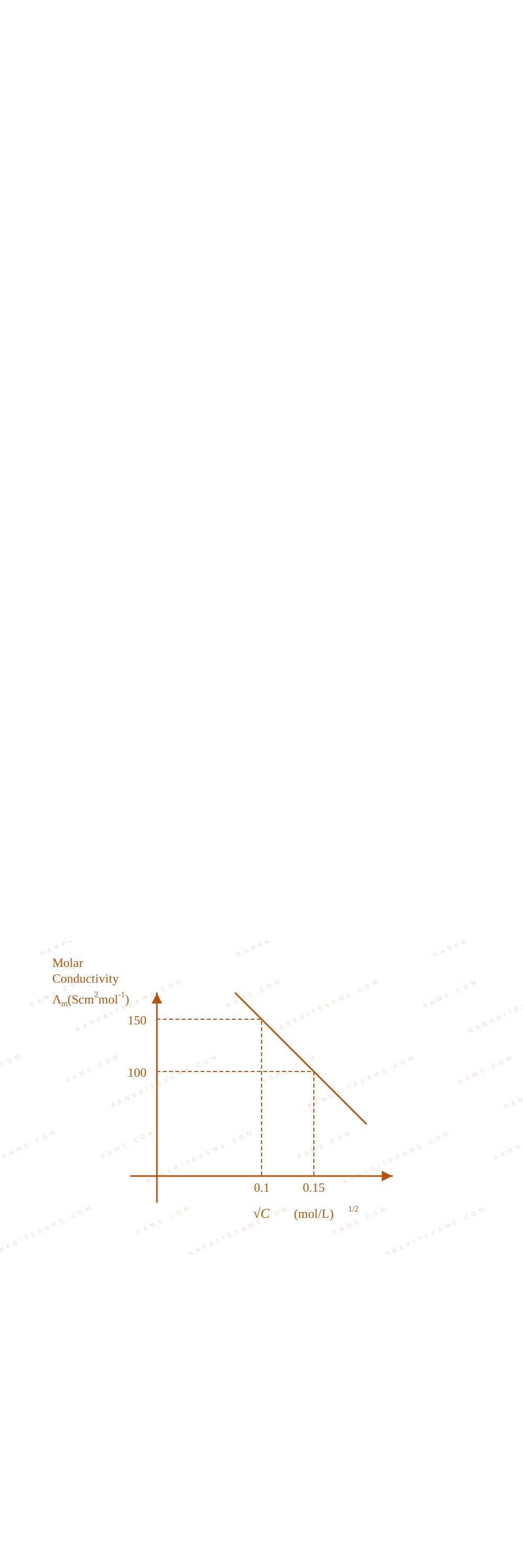
Given below is the plot of the molar conductivity vs sqrttextconcentration for KCl in aqueous solution.
Molar conductivity vs root concentration graph for Q46 - JEE Main 2025 Morning
The image features a standard linear plot tracing electrolytic molar conductance trends over root concentration variations.
If, for the higher concentration of KCl solution, the resistance of the conductivity cell is 100Omega then the resistance of the same cell with the dilute solution is mathrmxOmega The value of mathbfx is (Nearest integer)

Numerical Answer Type:
Enter a numerical value Answer: 150 to 150 +4 marks

Solution & Explanation

### Related Formula Conductivity relationship with cell parameters: kappa = G cdot G^* = fracG^*R lambda_m = frackappa times 1000C where G^* represents the static cell constant. ### Step 1: Setting Up Ratios Using concentration subscripts c (concentrated) and d (dilute): frackappa_ckappa_d = fracR_dR_c Expressing conductivity through molar conductivity values: kappa = fraclambda_m cdot C1000 frac(lambda_m cdot C)_c(lambda_m cdot C)_d = fracR_dR_c Substituting the graphical read coordinates (C_c = 0.15^2, C_d = 0.1^2 with scaled lambda_m parameters): frac100 cdot (0.15)^2150 cdot (0.1)^2 = fracR_d100 R_d = 150\,Omega ### Pattern Recognition Sees: Resistance correlation across specific graph coordinates. Shortcut: Equate cell parameters through kappa propto frac1R and solve for the target resistance directly. ### Evaluation Rubric / Model Answer null ### Chapter Mix Class 12 Chemistry: Electrochemistry

Reference Study Guides

More Electrochemistry Previous-Year Questions — Page 5

Q82 jee_main_2024_01_february_morning Nernst Equation
The potential for the given half cell at 298K is (-)dotsdotsdotsdots times 10^-2 mathrm~V. 2mathrmH^+_text(aq) + 2e^- rightarrow mathrmH_2mathrm(g) [mathrmH^+] = 1 mathrmM, P_mathrmH_2 = 2 mathrm~atm Given: 2.303mathrmRT/F = 0.06mathrmV, log 2 = 0.3
Numerical Answer. Answer: 0.9 to 1

Solution

### Related Formula E = E^circ - frac2.303RTnF log Q For the Standard Hydrogen Electrode half-reaction: 2H^+ + 2e^- rightarrow H_2 E_H^+/H_2 = E^circ_H^+/H_2 - frac0.062 log fracP_H_2[H^+]^2 ### Step 1: Substitute the given values E^circ_H^+/H_2 = 0.00 mathrm~V (by definition) [H^+] = 1 mathrm~M P_H_2 = 2 mathrm~atm n = 2 electrons E = 0.00 - frac0.062 log left( frac21^2 right) ### Step 2: Solve the calculation E = -0.03 log 2 Given log 2 = 0.3 E = -0.03 times 0.3 E = -0.009 mathrm~V E = -0.9 times 10^-2 mathrm~V ### Step 3: Match the requested format The question asks for (-) dots times 10^-2 mathrm~V. This gives exactly 0.9. For NAT type with integer expected, 0.9 can be rounded to 1. However, exact calculation yields 0.9. According to official JEE rounding, 0.9 approx 1. ### Pattern Recognition Hydrogen electrode non-standard potential depends strictly on pressure of H_2 and concentration of H^+. If [H^+]=1, increasing H_2 pressure lowers the potential below zero (makes it negative). ### Evaluation Rubric / Model Answer null ### Chapter Mix Class 12 Chemistry: Electrochemistry
Q89 jee_main_2024_29_january_evening Faraday's Laws of Electrolysis
A constant current was passed through a solution of mathrmAuCl_4^- ion between gold electrodes. After a period of 10.0 minutes, the increase in mass of cathode was 1.314mathrmg. The total charge passed through the solution is ________ times 10^-2mathrmF. (Given atomic mass of mathrmAu = 197)
Numerical Answer. Answer: 2 to 2

Solution

### Related Formula textNumber of equivalents deposited = fracW, E = fracQ, F textEquivalent Weight (E) = fractextAtomic Mass, ntext-factor ### Core Logic In the reduction of gold from the tetrachloroaurate(III) complex anion: mathrmAuCl_4^- + 3e^- rightarrow mathrmAu(s) + 4mathrmCl^- implies ntext-factor = 3 Calculate the equivalent weight (E) of Gold: E = frac197, 3 Set up the Faraday equivalence relation to solve for charge (Q in Faradays): frac1.314, left(frac197, 3right) = Q ### Step 1: Arithmetic Resolution Q = frac1.314 times 3, 197 = frac3.942, 197 = 0.02text F = 2 times 10^-2text F Thus, the required integer value is **2**. ### Pattern Recognition Always determine the correct change in oxidation state (+3 to 0) to establish the proper n-factor value for calculations using Faraday's laws. ### Evaluation Rubric / Model Answer null ### Chapter Mix Class 12 Chemistry: Electrochemistry
Q81 jee_main_2024_27_jan_morning Faraday's Laws of Electrolysis
The mass of silver (Molar mass of textAg: 108text g mol^-1) displaced by a quantity of electricity which displaces 5600text mL of O_2 at S.T.P. will be textquadquad g.
Numerical Answer. Answer: 107 to 108

Solution

### Related Formula By Faraday's Second Law of Electrolysis: textEquivalents of Ag = textEquivalents of O_2 textEquivalents = fractextMasstextEquivalent Mass = textMoles times ntext-factor ### Step 1: Calculate equivalents using standard metrics Let x grams of Silver be displaced. Using the older STP molar volume baseline (22.4text L or 22400text mL): textMoles of O_2 = frac560022400 = 0.25text moles Since the n-factor of O_2 is 4 (2textO^2- rightarrow textO_2 + 4texte^-): textEquivalents of O_2 = 0.25 times 4 = 1 ### Step 2: Equating equivalents for silver mass textEquivalents of Ag = fracx108 times 1 = 1 implies x = 108text g ### Step 3: Alternative calculation using current STP metric Using modern STP volume metrics (22.7text L): fracx times 1108 = frac5.622.7 times 4 implies x approx 106.57text g rightarrow 107text g ### Pattern Recognition Equivalents equations bypass complex current/time measurements. Always link volume fractions directly to n-factor equivalents. ### Chapter Mix Class 12 Chemistry: Electrochemistry Class 11 Chemistry: Some Basic Concepts of Chemistry
Q82 jee_main_2024_29_jan_morning Faradays Laws of Electrolysis
The mass of zinc produced by the electrolysis of zinc sulphate solution with a steady current of 0.015 A for 15 minutes is \_\_\_\_\_\_ times 10^-4 g. (Atomic mass of zinc = 65.4 amu)
Numerical Answer. Answer: 45.75 to 46

Solution

### Related Formula W = Z cdot I cdot t = fracMn cdot F cdot I cdot t where, W = mass deposited Z = electrochemical equivalent I = current in amperes t = time in seconds M = molar mass n = n-factor (electrons exchanged) F = Faraday's constant (96500 text C/mol) ### Core Logic The electrolysis of zinc sulphate (ZnSO_4) involves the reduction of zinc ions at the cathode: Zn^+2 + 2e^- rightarrow Zn Here, the n-factor (n) is 2. ### Step 1: Calculation Given values: I = 0.015text A t = 15text minutes = 15 times 60text seconds = 900text s M = 65.4text g/mol F approx 96500text C Plugging the values into Faraday's First Law: W = frac65.42 times 96500 times 0.015 times 15 times 60 W = frac65.4193000 times 13.5 W = 3.3886 times 10^-4 times 13.5 W = 45.746 times 10^-4text g Rounding to two decimal places (or nearest integer depending on convention), we get 45.75 times 10^-4text g. ### Evaluation Rubric / Model Answer null ### Chapter Mix Class 12 Chemistry: Electrochemistry
Q80 jee_main_2024_30_january_evening Standard Electrode Potential
Reduction potential of ions are given below: mathrmClO_4^- quad E^circ = 1.19mathrmV mathrmIO_4^- quad E^circ = 1.65mathrmV mathrmBrO_4^- quad E^circ = 1.74mathrmV The correct order of their oxidising power is:
  • A. mathrmClO_4^- > mathrmIO_4^- > mathrmBrO_4^-
  • B. mathrmBrO_4^- > mathrmIO_4^- > mathrmClO_4^-
  • C. mathrmBrO_4^- > mathrmClO_4^- > mathrmIO_4^-
  • D. mathrmIO_4^- > mathrmBrO_4^- > mathrmClO_4^-

Solution

### Core Logic The Standard Reduction Potential (E^circ) measures a species' tendency to undergo reduction (gain electrons). A higher, more positive E^circ value means the species has a stronger tendency to be reduced, which in turn makes it a stronger oxidizing agent. Comparing the given E^circ values: mathrmBrO_4^-: 1.74mathrmV mathrmIO_4^-: 1.65mathrmV mathrmClO_4^-: 1.19mathrmV The order of oxidizing power follows the magnitude of the reduction potential: mathrmBrO_4^- > mathrmIO_4^- > mathrmClO_4^- ### Pattern Recognition Higher +ve Standard Reduction Potential (SRP) = Stronger Oxidising Agent. ### Evaluation Rubric / Model Answer null ### Chapter Mix Class 12 Chemistry: Electrochemistry Class 12 Chemistry: The p Block Elements

More Electrochemistry Questions — jee_main_2025_28_jan_morning

Practice all Electrochemistry previous-year questions →

Rankbit System
JEE Physics: Waves (+15.5%) | Electrostatics: Concentric Shells (-29.7%) | Modern Physics: Photoelectric Clones (+34.2%) | Mathematics: Definite Integrals (+18.1%) | Chemistry: Coordination Splitting (-11.4%) | JEE Physics: Waves (+15.5%) | Electrostatics: Concentric Shells (-29.7%) | Modern Physics: Photoelectric Clones (+34.2%) | Mathematics: Definite Integrals (+18.1%) | Chemistry: Coordination Splitting (-11.4%)