JEE Main · Chemistry → Steady

Electrochemistry appeared 40 times across 3 years — 4.7% of Chemistry. This question is from Molar Conductivity and Cell Resistance.

Year 2026 2025 2024 Total
Questions 13 19 8 40

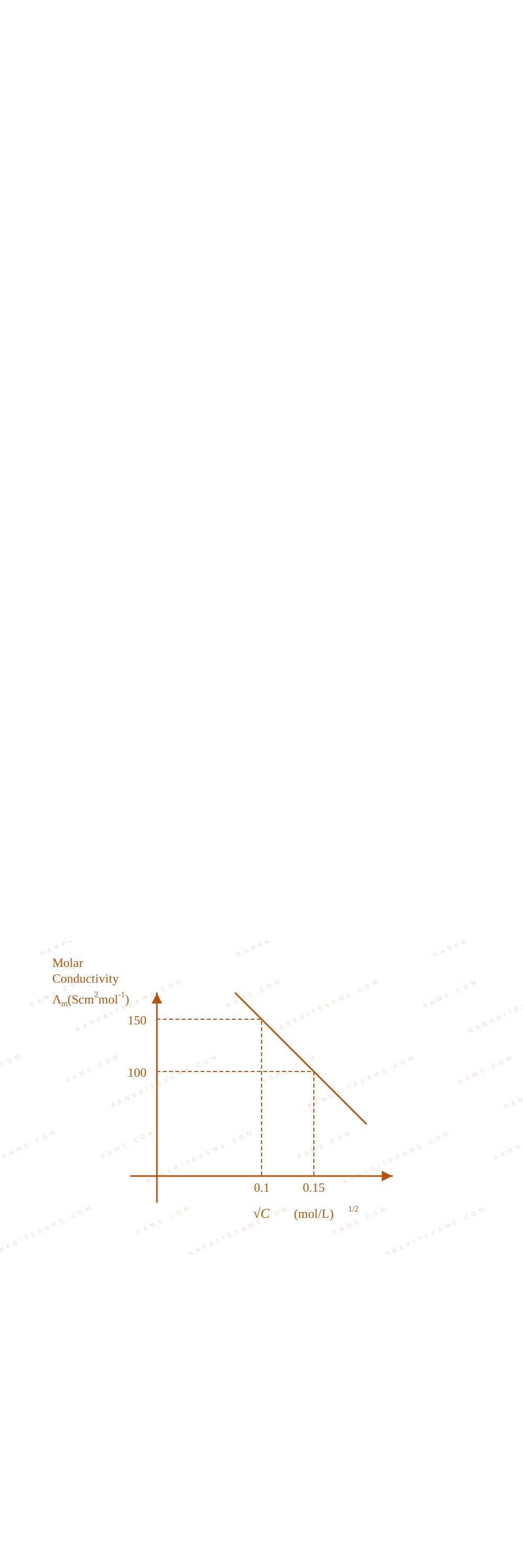
Given below is the plot of the molar conductivity vs concentration for KCl in aqueous solution.
Molar conductivity vs root concentration graph for Q46 - JEE Main 2025 Morning
The image features a standard linear plot tracing electrolytic molar conductance trends over root concentration variations.
If, for the higher concentration of KCl solution, the resistance of the conductivity cell is 100Ω then the resistance of the same cell with the dilute solution is xΩ The value of x is (Nearest integer)

Numerical Answer Type:
Enter a numerical value Answer: 150 to 150 +4 marks

Solution & Explanation

Related Formula

Conductivity relationship with cell parameters:

κ = G · G^* = (G^*)/(R) λm = (κ × 1000)/(C)

where G^* represents the static cell constant.

Step 1: Setting Up Ratios

Using concentration subscripts c (concentrated) and d (dilute):

(κc)/(κd) = (Rd)/(Rc)

Expressing conductivity through molar conductivity values:

κ = (λm · C)/(1000) ((λm · C)c)/((λm · C)d) = (Rd)/(Rc)

Substituting the graphical read coordinates (Cc = 0.15², Cd = 0.1² with scaled λm parameters):

(100 · (0.15)²)/(150 · (0.1)²) = (Rd)/(100) Rd = 150 Ω
Pattern Recognition

Sees: Resistance correlation across specific graph coordinates. Shortcut: Equate cell parameters through κ ∝ (1)/(R) and solve for the target resistance directly.

Chapter Mix

Class 12 Chemistry: Electrochemistry

Reference Study Guides

More Electrochemistry Previous-Year Questions — Page 3

Q72 jee_main_2026_28_january_morning Nernst Equation and Electron Transfer
Consider the following redox reaction taking place in acidic medium BH₄⁻(aq) + ClO₃⁻(aq) arrow H₂BO₃⁻(aq) + Cl⁻(aq) If the Nernst equation for the above balanced reaction is Ecell = Ecell° - (RT)/(nF) ln Q, Then the value of n is _____.
Numerical Answer. Answer: 24 to 24

Solution

Core Logic

To find 'n', the number of moles of electrons transferred, we must balance the overall redox equation and calculate the net electron exchange.

Step 1: Assign Oxidation States

In BH₄^-, Hydrogen is -1 (hydride), so Boron is +3. In H₂BO₃^-, Boron is +3. The oxidation state of B doesn't change, but H oxidizes from -1 to +1 (in water/acid).\nAlternatively, treat the whole moiety:\nOxidation half-reaction: BH₄^- + 3H₂O arrow H₂BO₃^- + 8H^+ + 8e^-\nIn ClO₃^-, Chlorine is +5. In Cl^-, Chlorine is -1.\nReduction half-reaction: ClO₃^- + 6H^+ + 6e^- arrow Cl^- + 3H₂O

Step 2: Balance Electrons

Multiply the oxidation half-reaction by 3 and the reduction half-reaction by 4 to equalize electrons transferred:\n3 × (BH₄^- + 3H₂O arrow H₂BO₃^- + 8H^+ + 8e^-) 24e^-\n4 × (ClO₃^- + 6H^+ + 6e^- arrow Cl^- + 3H₂O) 24e^-\nThe lowest common multiple of electrons exchanged is 24.

Final Conclusion

The balanced equation transfers 24 electrons, so n = 24 in the Nernst equation.

Pattern Recognition

The total electrons 'n' in the Nernst equation is always the lowest common multiple of electrons from the balanced oxidation and reduction half-reactions.

Chapter Mix

Class 12 Chemistry: Electrochemistry Class 11 Chemistry: Redox Reactions

Q73 jee_main_2026_28_january_evening Molar Conductivity And Kohlrausch Law
For strong electrolyte Λm increases slowly with dilution and can be represented by the equation Λm = Λm° - Ac1/2 Molar conductivity values of the solutions of strong electrolyte AB at 18°C are given below :
c [mol L⁻¹]0.040.090.160.25
Λm [S cm² mol⁻¹]96.195.795.394.9
The value of constant A based on the above data [in S cm² mol⁻¹/(mol/L)1/2] unit is ____.
Numerical Answer. Answer: 4 to 4

Solution

Related Formula

Λm = Λm° - A√(c) (Debye-Huckel-Onsager equation)

Core Logic

Using the equation for the first set of values (c = 0.04, √(c) = 0.2): 96.1 = Λm° - A(0.2) --- (1)

Using the equation for the second set of values (c = 0.09, √(c) = 0.3): 95.7 = Λm° - A(0.3) --- (2)

Step 1: Solve for A

Subtract eq (2) from eq (1): 96.1 - 95.7 = A(0.3) - A(0.2) 0.4 = 0.1A A = (0.4)/(0.1) = 4

Pattern Recognition

Direct linear interpolation. Change in Λm over change in √(c) gives the slope (which is A).

Chapter Mix

Class 12 Chemistry: Electrochemistry

Q74 jee_main_2026_28_january_evening Nernst Equation
A volume of x mL of 5 M NaHCO₃ solution was mixed with 10 mL of 2 M H₂CO₃ solution to make an electrolytic buffer. If the same buffer was used in the following electrochemical cell to record a cell potential of 235.3 mV, then the value of x = ____ mL (nearest integer). Sn(s) | Sn(OH)₆²⁻(0.5 M) | HSnO₂⁻(0.05 M) | OH⁻ || Bi₂O₃(s) | Bi(s) Consider upto one place of decimal for intermediate calculations Given : E_HSnO₂⁻|Sn(OH)₆²⁻o = -0.9 V E_Bi₂O₃|Bio = -0.44 V pKa_(H₂CO₃) = 6.11 (2.303RT)/(F) = 0.059 V Antilog(1.29) = 19.5
Numerical Answer. Answer: 78 to 78

Solution

Related Formula
Ecell = Ecell° - (0.059)/(n) Q pH = pKₐ + [Salt][Acid]
Core Logic

Note: In the question paper, EHSnO₂^-/[Sn(OH)₆]²⁻° = -0.9 V is given, but standard NTA solution requires assuming E[Sn(OH)₆]²⁻/HSnO₂^-° = -0.9 V for standard operation. (Our Ans. is Bonus due to this discrepancy, NTA Answer is 78). We will solve using the assumed valid logic.

Ecell° = Ecathode° - Eanode° = -0.44 - (-0.90) = 0.46 V

Oxidation Half: HSnO₂^- + H₂O + 3OH^- arrow [Sn(OH)₆]²⁻ + 2e^- Reduction Half: Bi₂O₃ + 3H₂O + 6e^- arrow 2Bi + 6OH^- Overall: 3HSnO₂^- + Bi₂O₃ + 6H₂O + 3OH^- arrow 3[Sn(OH)₆]²⁻ + 2Bi Here n = 6.

Nernst Eq: Ecell = Ecell° - (0.059)/(6) ([Sn(OH)₆]²⁻)³([HSnO₂^-]³ [OH^-]³) 0.2353 = 0.46 - (0.059)/(6) ((0.5)³)/((0.05)³ [OH^-]³) 0.2353 = 0.46 - (0.059)/(2) (10)/([OH^-]) ( (10)/([OH^-]) ) = ((0.46 - 0.2353) × 2)/(0.059) = (0.2247 × 2)/(0.059) = 7.6

Step 1: Calculate pH

(10) - [OH^-] = 7.6 1 + pOH = 7.6 pOH = 6.6 pH = 14 - 6.6 = 7.4

Step 2: Buffer Equation

Using Henderson-Hasselbalch equation for buffer of NaHCO₃ and H₂CO₃: pH = pKₐ + nsaltnacid 7.4 = 6.11 + (5x)/(10 × 2) 1.29 = (5x)/(20) = (x)/(4) Taking antilog: (x)/(4) = Antilog(1.29) = 19.5 x = 19.5 × 4 = 78 mL

Pattern Recognition

Merge Nernst equation finding unknown concentration with Buffer equations. Determine overall cell reaction to find exact stoichiometry and 'n' electrons for Nernst.

Chapter Mix

Class 12 Chemistry: Electrochemistry Class 11 Chemistry: Equilibrium
Q47 jee_main_2025_02_april_evening Conductivity and Molar Conductivity
0.2% (w/v) solution of NaOH is measured to have resistivity 870.0~mΩ~m. The molar conductivity of the solution will be × 10²~ mS~dm²~mol⁻¹. (Nearest integer)
Numerical Answer. Answer: 23 to 23

Solution

Related Formula
κ = (1)/(ρ) Λm = (κ)/(M)
Core Logic

To compute the molar conductivity, we first calculate the molarity of the solution and the conductivity of the electrolyte from the given resistivity.

Step 1: Calculate Molarity (M)

0.2% (w/v) NaOH means 0.2~g of NaOH is present in 100~mL of solution.

Molar mass of NaOH = 23 + 16 + 1 = 40~ g~mol⁻¹ Molarity M = Mass of soluteMolar mass × 1000VmL = (0.2)/(40) × (1000)/(100) = 0.05~ mol~L⁻¹ = 0.05~ mol~dm⁻³
Step 2: Calculate Conductivity (kappa) in dm Units

Given resistivity ρ = 870.0~mΩ~m = 870 × 10⁻³~Ω~m = 0.87~Ω~m.

Since 1~m = 10~dm:

ρ = 0.87~Ω × (10~dm) = 8.7~Ω~dm

Now, conductivity κ is:

κ = (1)/(ρ) = (1)/(8.7)~Ω⁻¹~dm⁻¹
Step 3: Calculate Molar Conductivity (Lambda_m)
Λm = (κ)/(M) = (1)/(8.7)~ S~dm⁻¹0.05~ mol~dm⁻³ = (1)/(8.7 × 0.05) = (1)/(0.435) ≈ 2.29885~ S~dm²~mol⁻¹

Converting S to mS (1~S = 10³~mS):

Λm = 2.29885 × 10³~ mS~dm²~mol⁻¹ = 22.9885 × 10²~ mS~dm²~mol⁻¹

Rounding off to the nearest integer gives 23.

Pattern Recognition

Ensure careful handling of volumetric conversions. Since concentration is expressed in moles per liter (equivalent to dm⁻³), expressing conductivity in terms of dm⁻¹ directly eliminates the need for arbitrary 1000 multiplication factors.

Chapter Mix

Class 12 Chemistry: Electrochemistry

Q jee_main_2025_02_april_morning Nernst Equation and Salt Hydrolysis pH
Consider the following electrochemical cell at standard condition. Au(s) QH₂, Q NH₄X (0.01 M) Ag^+ (1 M) Ag(s) Ecell = +0.4 V The couple QH₂ / Q represents quinhydrone electrode, the half cell reaction is given below:
Quinhydrone half cell reduction equation diagram for Q47
The diagram displays the balanced chemical equation for quinhydrone reduction, consuming two electrons and two protons to yield hydroquinone.
[ Given: EAg^+ / Ag^o = +0.8 V and (2.303 RT)/(F) = 0.06 V ] The pKb value of the ammonium halide salt (NH₄X) used here is _____.
Numerical Answer. Answer: 6 to 6

Solution

Related Formula

Nernst equation for the net combined redox cell expression:

E = E^° - (0.06)/(2) ( [H^+]²[Ag^+]²)

Hydrolysis equation for a salt composed of a weak base and strong acid:

pH = 7 - (1)/(2)pKb - (1)/(2)
Core Logic

Let's compute the operational values line-by-row:

  • Combined redox process: QH₂ + 2Ag^+ arrow Q + 2Ag + 2H^+.
  • Standard cell potential difference: E^°cell = E^°Ag^+/Ag - E^°Q/QH₂ = 0.8 - 0.7 = +0.1~V.
  • Apply Nernst adjustments using known concentrations ([Ag^+] = 1~M):
0.4 = 0.1 - 0.06 [H^+] 0.3 = 0.06 × pH pH = 5
Step 1: Salt Hydrolysis Substitution

Substitute the determined pH along with salt molarity (C = 0.01~M = 10⁻²~M) into the hydrolysis equation:

5 = 7 - (1)/(2)pKb - (1)/(2) (10⁻²) 5 = 7 - (1)/(2)pKb - (1)/(2)(-2) 5 = 7 - (1)/(2)pKb + 1 5 = 8 - (1)/(2)pKb (1)/(2)pKb = 3 pKb = 6
Pattern Recognition

Quinhydrone electrodes act as excellent pH indicators in electrochemical cells. Note that each change of 1 pH unit shifts the cell output potential by exactly 0.06~V at standard ambient conditions.

Chapter Mix

Class 12 Chemistry: Electrochemistry Class 11 Chemistry: Equilibrium

More Electrochemistry Questions — jee_main_2025_28_jan_morning

Practice all Electrochemistry previous-year questions →

Rankbit System
JEE Physics: Waves (+15.5%) | Electrostatics: Concentric Shells (-29.7%) | Modern Physics: Photoelectric Clones (+34.2%) | Mathematics: Definite Integrals (+18.1%) | Chemistry: Coordination Splitting (-11.4%) | JEE Physics: Waves (+15.5%) | Electrostatics: Concentric Shells (-29.7%) | Modern Physics: Photoelectric Clones (+34.2%) | Mathematics: Definite Integrals (+18.1%) | Chemistry: Coordination Splitting (-11.4%)
