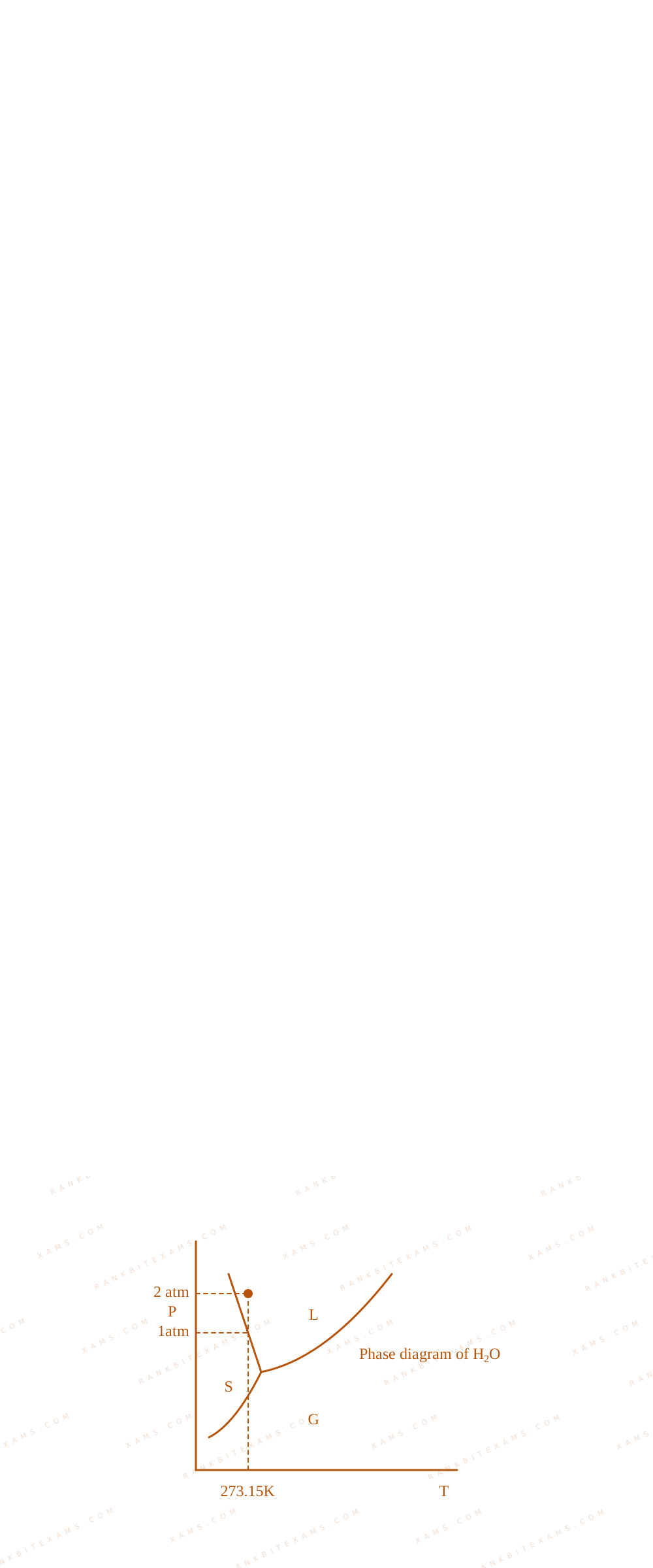
Ice and water are placed in a closed container at a pressure of 1 atm and temperature 273.15K . If pressure of the system is increased 2 times, keeping temperature constant, then identify correct observation from following:

Solution & Explanation

Core Logic

Water has a unique property where the density of the liquid phase is greater than the density of the solid phase (ice). Consequently, the molar volume of ice is larger than that of liquid water:

Vm(ice) > Vm(water)

According to Le Chatelier's Principle, increasing the pressure favors the phase that occupies a smaller volume to alleviate the applied stress. Thus, shifting the system forward converts ice into liquid water:

Phase shift diagram for Q34 - JEE Main 2025 Morning

If the pressure is increased considerably (such as doubling it to 2 atm) at 273.15K, the melting point decreases, causing the entire solid phase (ice) to disappear completely.

Pattern Recognition

Sees: Ice-water system under pressure change. Trap: Assuming that an increase in pressure always favors the solid phase. Water has an anomalous phase curve with a negative slope.

Chapter Mix

Class 11 Chemistry: Chemical Thermodynamics

More Chemical Thermodynamics Previous-Year Questions — Page 2

Q75 jee_main_2026_22_january_morning Gibbs Energy and Equilibrium Constant
Dissociation of a gas A₂ takes place according to the following chemical reactions. At equilibrium, the total pressure is 1 bar at 300K. A₂(g) leftharpoons 2A(g) The standard Gibbs energy of formation of the involved substances has been provided below:
SubstanceΔ Gf° / kJ mol⁻¹
A₂-100.00
A-50.832
The degree of dissociation of A₂(g) is given by (x × 10⁻²)1/2 where x = ____. (Nearest integer). [Given: R = 8 J mol⁻¹K⁻¹, 2 = 0.3010, 3 = 0.48]
Numerical Answer. Answer: 33 to 33

Solution

Related Formula
Δ G°reaction = Σ Δ G°f(products) - Σ Δ G°f(reactants) Δ G° = -RT ln Kₚ Kₚ = (4α² P₀)/(1 - α²)
Core Logic

First, find standard Gibbs free energy of the reaction:

Δ G°reaction = 2 × Δ G°f(A) - Δ G°f(A₂) Δ G° = 2(-50.832) - (-100.00) = -101.664 + 100.00 = -1.664 kJ mol⁻¹ Δ G° = -1664 J mol⁻¹

Use this to find Kₚ:

-1664 = -8 × 300 × ln Kₚ 1664 = 2400 ln Kₚ ln Kₚ = (1664)/(2400) = 0.6933

Since ln 2 ≈ 0.693, we have: Kₚ = 2

Step 1: Calculate Degree of Dissociation

For the reaction A₂ leftharpoons 2A, with initial moles 1 and degree of dissociation α: Moles at equilibrium: 1-α (for A₂) and 2α (for A). Total moles = 1+α.

Kₚ = (PA)²PA₂ = (((2α)/(1+α) P₀)²)/((1-α)/(1+α) P₀) = (4α² P₀)/(1 - α²)

Given total pressure P₀ = 1 bar and Kₚ = 2:

2 = (4α² (1))/(1 - α²) 2 - 2α² = 4α² 6α² = 2 α² = (1)/(3) α = 1√(3)
Step 2: Match to Given Format

We are given α = (x × 10⁻²)1/2. Squaring both sides:

α² = x × 10⁻² (1)/(3) = x × 10⁻² x = (100)/(3) = 33.33
Step 3: Rounding

Nearest integer is 33.

Pattern Recognition

Whenever Δ G° yields an RT ln Kₚ around 0.693, Kₚ is 2. The formula Kₚ = 4α²/(1-α²) for A₂ leftharpoons 2A at P=1 is standard and should be memorized.

Chapter Mix

Class 11 Chemistry: Thermodynamics Class 11 Chemistry: Equilibrium
Q72 jee_main_2026_22_january_evening Born-Haber Cycle and Lattice Enthalpy
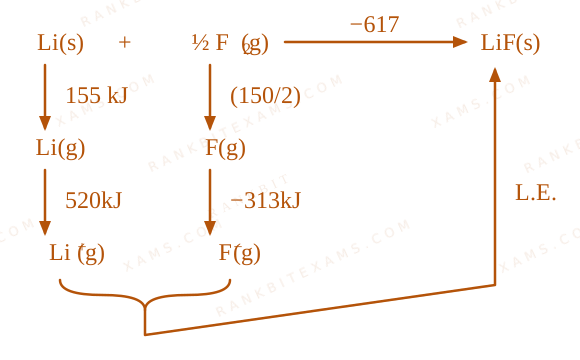
If the enthalpy of sublimation of Li is 155 kJ mol⁻¹, enthalpy of dissociation of F₂ is 150 kJ mol⁻¹, ionization enthalpy of Li is 520 kJ mol⁻¹, electron gain enthalpy of F is -313 kJ mol⁻¹, standard enthalpy of formation of LiF is -594 kJ mol⁻¹. The magnitude of lattice enthalpy of LiF is ____ kJ mol⁻¹ (Nearest integer).
Numerical Answer. Answer: 1031 to 1031

Solution

Related Formula
Δf H⁰ = Δsub H + IE + (1)/(2)Δbond H + Δeg H + L.E.
Core Logic

Step 1: Substitute given thermodynamic cycle values into Born-Haber equation:

-594 = 155 + 520 + (150)/(2) + (-313) + L.E. -594 = 155 + 520 + 75 - 313 + L.E. -594 = 437 + L.E. L.E. = -594 - 437 = -1031 kJ mol⁻¹

Step 2: Magnitude of lattice enthalpy is 1031 kJ mol⁻¹.

Born-Haber cycle diagram for LiF for Q72 - JEE Main 2026 Evening

Pattern Recognition

Sees: Born-Haber cycle parameters for ionic solid. Shortcut: Add sublimation, ionization, half-dissociation, and electron gain enthalpies, then subtract from formation enthalpy.

Chapter Mix

Class 11 Chemistry: Thermodynamics

Q58 jee_main_2026_23_january_morning First Law of Thermodynamics and Sign Conventions
A cup of water at 5°C (system) is placed in a microwave oven and the oven is turned on for one minute during which, the water begins to boil. Which of the following option is true?
  • A. q = +ve, w = 0, Δ U = -ve
  • B. q = +ve, w = -ve, Δ U = +ve
  • C. q = -ve, w = -ve, Δ U = -ve
  • D. q = +ve, w = -ve, Δ U = -ve

Solution

Related Formula
Δ U = q + w

where: Δ U = change in internal energy q = heat added to system w = work done on the system

Core Logic

Analyze the state changes step-by-step applying IUPAC sign conventions for thermodynamics.

First Law of Thermodynamics and Sign Conventions diagram for Q58 - JEE Main 2026 Morning

Step 1: Heat Transfer

Since heat is supplied by the microwave oven to the water (system), the system absorbs heat. Thus, q = +ve.

Step 2: Work Done

As water boils, it converts from liquid to vapor, which implies a massive volume expansion. Work is done by the system against the atmosphere. Thus, work done on the system is negative: w = -ve.

Step 3: Internal Energy Change

The temperature of water increases from 5^° C to 100^° C, and liquid converts to gas. The internal energy of steam at 100^° C is much greater than that of liquid water at 5^° C. Hence, Δ U = +ve.

Pattern Recognition

Heating + Boiling inherently means heat is entering (q > 0), expanding volume pushes outward doing work (w < 0), and increasing thermal energy raises the internal state function (Δ U > 0).

Chapter Mix

Class 11 Chemistry: Thermodynamics

Q63 jee_main_2026_24_january_morning Work Done in Isothermal Processes
Match the List-I with List-II
List-I (Isothermal process for ideal gas system)List-II Work done (Vf > Vᵢ)
A. Reversible expansionI. w = 0
B. Free expansionII. w = -nRT ln (Vf)/(Vᵢ)
C. Irreversible expansionIII. w = -pₑₓ(Vf - Vᵢ)
D. Irreversible compressionIV. w = -pₑₓ(Vᵢ - Vf)
Choose the correct answer from the options given below :
  • A. A-IV, B-I, C-III, D-II
  • B. A-IV, B-II, C-III, D-I
  • C. A-I, B-III, C-II, D-IV
  • D. A-II, B-I, C-III, D-IV

Solution

Related Formula
WRev = -∫ Pgas dV WIrrev = -Pₑₓₜ Δ V
Core Logic

(A) Reversible isothermal expansion:

WRev = -nRT ln [ (Vf)/(Vᵢ) ]

Matches with II.

(B) Free expansion (expansion into vacuum):

Pₑₓₜ = 0

W = 0 Matches with I.

(C) Irreversible expansion against constant external pressure:

Wirrev = -Pₑₓₜ Δ V Wirrev = -Pₑₓₜ (Vf - Vᵢ)

Matches with III.

(D) Irreversible compression: Same core formula but since it is a compression from Vf back to Vᵢ, the volume change term flips to Δ V = (Vᵢ - Vf), leading to:

Wirrev = -Pₑₓₜ (Vᵢ - Vf)

Matches with IV.

Work done expression mapping

Step 1: Final Conclusion

The correct matches are A-II, B-I, C-III, D-IV.

Pattern Recognition

Free expansion always implies zero work because Pₑₓₜ = 0. Reversible implies a continuous integration over volume resulting in the natural log formula.

Chapter Mix

Class 11 Chemistry: Thermodynamics

Q67 jee_main_2026_24_january_evening Enthalpy of Atomization and Bond Enthalpy
The heat of atomisation of methane and ethane are 'x' kJ mol ⁻¹ and 'y' kJ mol ⁻¹ respectively. The longest wavelength ( λ ) of light capable of breaking the C-C bond can be expressed in SI unit as:
  • A. hc1000( y-6x4)⁻¹
  • B. NAhc250(4y-6x)
  • C. NAhc250(y-6x)
  • D. NAhc(y-(6x)/(4))⁻¹

Solution

Related Formula
E = (hc)/(λ) λ = (hc)/(E)

Where E is the energy required to break one bond.

Core Logic

For Methane (CH₄): CH₄(g) arrow C(g) + 4H(g) ΔᵣH = x kJ / mole The energy is used to break 4 C-H bonds: 4 × εC-H = 1000x J / mole

For Ethane (C₂H₆): C₂H₆(g) arrow 2C(g) + 6H(g) ΔᵣH = y kJ / mole The energy is used to break 1 C-C bond and 6 C-H bonds: εC-C + 6 × εC-H = 1000y J / mole

Step 1: Extract C-C Bond Energy

From methane: εC-H = (1000x)/(4) = 250x J / mole Substitute into ethane equation: εC-C + 6 × (250x) = 1000y εC-C = 1000y - 1500x = [y - (3x)/(2)] × 1000 J / mole

Step 2: Wavelength Calculation

The energy calculated above is per mole. Energy required to break one C-C bond is: E = εC-CNA

Now, equating this to photon energy: εC-CNA = (hc)/(λ) λ = hc · NAεC-C

Substitute εC-C: λ = hc · NA[y - (3x)/(2)] × 1000 λ = hc · NA(2y - 3x)/(2) × 1000 λ = 2 · hc · NA1000(2y - 3x) = hc · NA500(2y - 3x) = hc · NA250(4y - 6x)

Pattern Recognition

Always convert molar quantities to per-bond (atomic scale) quantities by dividing by Avogadro's number (NA) when equating macroscopic enthalpy data to single photon quantum limits (hc/λ). Don't forget to multiply kJ to J by 1000 for standard SI unit consistency.

Chapter Mix

Class 11 Chemistry: Thermodynamics Class 11 Chemistry: Structure of Atom

More Chemical Thermodynamics Questions — jee_main_2025_28_jan_morning

Practice all Chemical Thermodynamics previous-year questions →

Rankbit System
JEE Physics: Waves (+15.5%) | Electrostatics: Concentric Shells (-29.7%) | Modern Physics: Photoelectric Clones (+34.2%) | Mathematics: Definite Integrals (+18.1%) | Chemistry: Coordination Splitting (-11.4%) | JEE Physics: Waves (+15.5%) | Electrostatics: Concentric Shells (-29.7%) | Modern Physics: Photoelectric Clones (+34.2%) | Mathematics: Definite Integrals (+18.1%) | Chemistry: Coordination Splitting (-11.4%)
