The formation enthalpies, Δ Hf for H(g) and O(g) are 220.0 and 250.0~kJ~mol⁻¹ , respectively, at 298.15K , and Δ Hf⁻ for H₂O(g) is -242.0kJ mol⁻¹ at the same temperature. The average bond enthalpy of the O-H bond in water at 298.15K is ___________________________________________________ (nearest integer).

Numerical Answer Type:
Enter a numerical value Answer: 466 to 466 +4 marks

Solution & Explanation

Related Formula

Reaction enthalpy based on atomization processes:

Δᵣ H = Σ Δf H(products) - Σ Δf H(reactants)
Step 1: Map the Dissociation Reaction

Consider the dissociation of gas phase water molecules into constituent gaseous atoms:

H₂O(g) arrow 2H(g) + O(g)

The total energy required corresponds to breaking exactly two O-H bonds:

Δᵣ H = 2 × B.E.(O-H)
Step 2: Calculate Δᵣ H

Using the enthalpies of formation:

Δᵣ H = [2 × Δf H(H(g)) + Δf H(O(g))] - Δf H(H₂O(g)) Δᵣ H = [2 × 220.0 + 250.0] - (-242.0) Δᵣ H = [440.0 + 250.0] + 242.0 = 690.0 + 242.0 = 932.0 kJ mol⁻¹
Step 3: Solve for Single Bond Enthalpy
2 × B.E.(O-H) = 932.0 B.E.(O-H) = (932.0)/(2) = 466 kJ mol⁻¹
Pattern Recognition

Sees: Atomization state values used to evaluate single bond metrics. Shortcut: Remember Total Dissociation Energy = Σ Δf H(atoms) - Δf H(molecule). Halving the result gives the average bond enthalpy.

Chapter Mix

Class 11 Chemistry: Chemical Thermodynamics

Reference Study Guides

More Chemical Thermodynamics Previous-Year Questions — Page 9

Q83 jee_main_2024_30_january_evening Hess's Law of Constant Heat Summation
Two reactions are given below: 2Fe(s) + (3)/(2)O2(g) arrow Fe₂O3(s), Δ H° = -822 kJ/mol C(s) + (1)/(2)O2(g) arrow CO(g), Δ H° = -110 kJ/mol Then enthalpy change for following reaction 3C(s) + Fe₂O3(s) arrow 2Fe(s) + 3CO(g)
Numerical Answer. Answer: 492 to 492

Solution

Related Formula

According to Hess's Law, the net enthalpy change of a reaction is the sum of the enthalpy changes of the individual steps into which it can be divided.

Core Logic

Let the given reactions be: (1) 2Fe(s) + (3)/(2)O2(g) arrow Fe₂O3(s), Δ H₁ = -822 kJ/mol (2) C(s) + (1)/(2)O2(g) arrow CO(g), Δ H₂ = -110 kJ/mol

Target Reaction (3):

3C(s) + Fe₂O3(s) arrow 2Fe(s) + 3CO(g), Δ H₃ = ?

To construct the target reaction:

  • We need 3 CO(g) on the product side, so we multiply reaction (2) by 3.
  • We need Fe₂O3(s) on the reactant side and 2 Fe(s) on the product side, so we reverse reaction (1).
Step 1: Calculate Net Enthalpy

Target Reaction (3) = 3 × (2) - (1)

Δ H₃ = 3 × Δ H₂ - Δ H₁ Δ H₃ = 3(-110) - (-822) Δ H₃ = -330 + 822 = 492 kJ/mol
Chapter Mix

Class 11 Chemistry: Thermodynamics
Q jee_main_2024_30_jan_morning Work Done in Cyclic Process
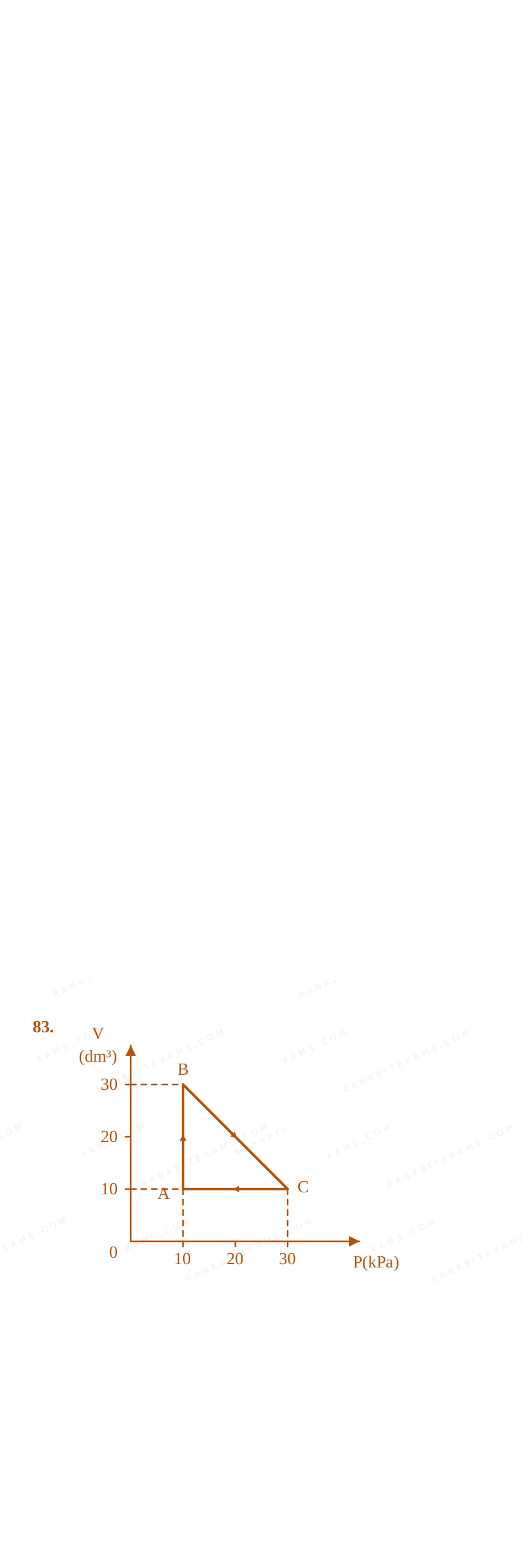
An ideal gas undergoes a cyclic transformation starting from the point A and coming back to the same point by tracing the path Aarrow Barrow Carrow A as shown in the diagram. The total work done in the process is ________ J.
Work Done in Cyclic Process diagram for Q83 - JEE Main 2024 Morning
The image is a graph of Volume (dm3) vs Pressure (kPa) showing a triangular cyclic process starting from A(10,10) to B(10,30) to C(30,10) and back to A.
Numerical Answer. Answer: 200 to 200

Solution

Related Formula
Wcyclic = Area enclosed in P-V graph
Core Logic

The work done in a cyclic process is equal to the magnitude of the area enclosed by the cycle on a Pressure-Volume graph. Note that the provided graph is Volume (V) on the y-axis versus Pressure (P) on the x-axis. The path A arrow B arrow C arrow A is traced in a clockwise direction on the V-P graph. Clockwise on a V-P graph corresponds to anti-clockwise on a standard P-V graph, meaning net expansion work is done by the gas, making it positive conventionally (or negative depending on chemistry sign convention, but magnitude is asked for).

Step 1: Calculating Area

The enclosed region is a right-angled triangle. Base of triangle on P-axis = 30 - 10 = 20 kPa Height of triangle on V-axis = 30 - 10 = 20 dm³

Area = (1)/(2) × base × height Area = (1)/(2) × 20 × 20 = 200 kPa ³
Step 2: Unit conversion

1 kPa = 10³ Pa 1 dm³ = 1 Litre = 10⁻³ m³

W = 200 × 10³ Pa × 10⁻³ m³ W = 200 J
Pattern Recognition

1 kPa · 1 L = 1 Joule. This direct conversion saves time without converting explicitly to standard SI units (Pa and m³).

Chapter Mix

Class 11 Chemistry: Thermodynamics

Q90 jee_main_2024_31_jan_evening Work Done in Isothermal Reversible Expansion
If 5 moles of an ideal gas expands from 10 L to a volume of 100 L at 300 K under isothermal and reversible condition then work w, is -x J. The value of x is ________ (Given R = 8.314 J K⁻¹mol⁻¹)
Numerical Answer. Answer: 28720 to 28721

Solution

Related Formula
W = -2.303 nRT ( (V₂)/(V₁) )
Core Logic

For an isothermal and reversible expansion of an ideal gas, work is done by the system on the surroundings, hence it is negative by IUPAC convention. Given: n = 5 moles R = 8.314 J K⁻¹mol⁻¹ T = 300 K V₁ = 10 L V₂ = 100 L

Step 1: Calculating Work Done
W = -2.303 × 5 × 8.314 × 300 × ( (100)/(10) ) W = -2.303 × 5 × 8.314 × 300 × (10) W = -2.303 × 12471 × 1 W = -28720.713 J
Step 2: Final Formatting

The question asks for work w = -x J. So x = 28720.713, which rounds to 28721.

Chapter Mix

Class 11 Chemistry: Thermodynamics

Q88 jee_main_2024_31_jan_morning Gibbs Free Energy and Equilibrium
Consider the following reaction at 298 K. (3)/(2)O2(g) leftharpoons O3(g). Kₚ = 2.47 × 10⁻²⁹ ΔᵣG for the reaction is ________ kJ. (Given R = 8.314 J K⁻¹ mol⁻¹)
Numerical Answer. Answer: 163 to 164

Solution

Related Formula
ΔᵣG = -RT ln Kₚ
Step 1: Calculation
ΔᵣG = -8.314 × 10⁻³ kJ K⁻¹ mol⁻¹ × 298 K × ln(2.47 × 10⁻²⁹) = -8.314 × 10⁻³ × 298 × (-65.87) = 163.19 kJ
Step 2: Nearest Integer

Rounding 163.19 to the nearest integer gives 163.

Chapter Mix

Class 11 Chemistry: Thermodynamics

More Chemical Thermodynamics Questions — jee_main_2025_28_jan_morning

Practice all Chemical Thermodynamics previous-year questions →

Rankbit System
JEE Physics: Waves (+15.5%) | Electrostatics: Concentric Shells (-29.7%) | Modern Physics: Photoelectric Clones (+34.2%) | Mathematics: Definite Integrals (+18.1%) | Chemistry: Coordination Splitting (-11.4%) | JEE Physics: Waves (+15.5%) | Electrostatics: Concentric Shells (-29.7%) | Modern Physics: Photoelectric Clones (+34.2%) | Mathematics: Definite Integrals (+18.1%) | Chemistry: Coordination Splitting (-11.4%)