JEE Main · Chemistry ↓ Falling

Biomolecules appeared 35 times across 3 years — 4.1% of Chemistry. This question is from Reactions of Glucose and Starch.

Year 2026 2025 2024 Total
Questions 9 18 8 35

Given below are two statements : Statement I : D-glucose pentaacetate reacts with 2, 4-dinitrophenylhydrazine. Statement II : Starch, on heating with concentrated sulfuric acid at 100°C and 2-3 atmosphere pressure produces glucose. In the light of the above statements, choose the correct answer from the options given below

Solution & Explanation

Core Logic

Statement I is false because glucose pentaacetate fixes the cyclic hemiacetal system structure securely into an unreactive ester configuration. As a result, it cannot revert to an open-chain form containing a free aldehyde group, meaning it does not react with carbonyl reagents like 2,4-DNP.

Statement II is true because starch, a polysaccharide composed of glucose monomer blocks, undergoes acid-catalyzed hydrolysis to yield glucose when heated under pressure.

Pattern Recognition

Sees: Pentacetate reactivity vs polysaccharide hydrolysis. Shortcut: Acetylation locks the cyclic structure of glucose, preventing reactions that require an open-chain carbonyl group (like 2,4-DNP).

Chapter Mix

Class 12 Chemistry: Biomolecules

Reference Study Guides

More Biomolecules Previous-Year Questions — Page 5

Q50 jee_main_2025_04_april_morning Nucleic Acids
The total number of hydrogen bonds of a DNA-double Helix strand whose one strand has the following sequence of bases is: 5' - G - G - C - A - A - A - T - C - G - G - C - T - A - 3'
Numerical Answer. Answer: 33 to 33

Solution

Related Formula
G-C base pairing 3 Hydrogen bonds A-T base pairing 2 Hydrogen bonds
Core Logic

Let's audit the nucleotide base distribution across the given single strand structure:

5' - G - G - C - A - A - A - T - C - G - G - C - T - A - 3'
  • Count the Guanine (G) and Cytosine (C) bases:
  • Bases present: G₁, G₂, C₃, C₈, G₉, G₁₀, C₁₁ Total of 7 bases. Each G-C interaction forms 3 hydrogen bonds:

BondsG-C = 7 × 3 = 21
  • Count the Adenine (A) and Thymine (T) bases:
  • Bases present: A₄, A₅, A₆, T₇, T₁₂, A₁₃ Total of 6 bases. Each A-T interaction forms 2 hydrogen bonds:

BondsA-T = 6 × 2 = 12

Summing them up yields the total hydrogen bonds in the helix:

Total H-bonds = 21 + 12 = 33
Pattern Recognition

Quick check optimization: Total Bonds = 3 × (#G + #C) + 2 × (#A + #T).

Chapter Mix

Class 12 Chemistry: Biomolecules

Q26 jee_main_2025_07_april_evening Proteins and Amino Acids
Given below are two statements: Statement (I): On hydrolysis, oligo peptides give rise to fewer number of α-amino acids while proteins give rise to a large number of β-amino acids. Statement (II): Natural proteins are denatured by acids which convert the water soluble form of fibrous proteins to their water insoluble form. In the light of the above statements, choose the most appropriate answer from the options given below:
  • A. Both statement I and statement II are correct
  • B. Statement I is incorrect but Statement II is correct
  • C. Both statement I and statement II are incorrect
  • D. Statement I is correct but Statement II is incorrect

Solution

Related Formula
Protein Hydrolysis Peptides Hydrolysis α-amino acids
Core Logic

Statement (I) is incorrect because the complete hydrolysis of both oligopeptides and proteins yields α-amino acids, not β-amino acids.

Statement (II) is incorrect because fibrous proteins are inherently water-insoluble structural materials. Denaturation typically disrupts the tertiary and secondary structures of water-soluble globular proteins, making them insoluble.

Step 1: Final Conclusion

Since both Statement I and Statement II are false, option (3) is the correct choice.

Pattern Recognition

All naturally occurring proteins are polymers of α-amino acids, so any statement mentioning β-amino acids as direct translation products can be confidently ruled out. Fibrous proteins (like keratin or collagen) are structural and always insoluble, unlike globular proteins.

Chapter Mix

Class 12 Chemistry: Biomolecules

Q44 jee_main_2025_24_jan_evening Structure of Nucleic Acids
Match List-I with List-II tracking nitrogenous bases structures:
List-I (Base)List-II (Chemical Structure Diagram)
(A) Adenine(I)
Structure of Nucleic Acids diagram for Q44 - JEE Main 2025 Evening
The Match List contains nitrogenous bases aligned with their corresponding biochemical molecular ring structures.
(B) Cytosine(II)
Structure of Nucleic Acids diagram for Q44 - JEE Main 2025 Evening
The Match List contains nitrogenous bases aligned with their corresponding biochemical molecular ring structures.
(C) Thymine(III)
Structure of Nucleic Acids diagram for Q44 - JEE Main 2025 Evening
The Match List contains nitrogenous bases aligned with their corresponding biochemical molecular ring structures.
(D) Uracil(IV)
Structure of Nucleic Acids diagram for Q44 - JEE Main 2025 Evening
The Match List contains nitrogenous bases aligned with their corresponding biochemical molecular ring structures.
Choose the correct answer from the options given below :
  • A. \text{(A)-(III), (B)-(IV), (C)-(II), (D)-(I)}
  • B. \text{(A)-(III), (B)-(I), (C)-(IV), (D)-(II)}
  • C. \text{(A)-(IV), (B)-(III), (C)-(II), (D)-(I)}
  • D. \text{(A)-(III), (B)-(IV), (C)-(I), (D)-(II)}

Solution

Core Logic

Let's identify the chemical structures of the nitrogenous bases used in nucleic acids:

* (A) Adenine: A purine derivative featuring a characteristic fused bicyclic ring system with an amino substituent at position 6 (6-aminopurine) arrow (III). * (B) Cytosine: A pyrimidine monocyclic derivative with an amino group at position 4 and a carbonyl group at position 2 (4-amino-2-oxo-pyrimidine) arrow (IV). * (C) Thymine: Found in DNA, this pyrimidine derivative features a methyl substituent at position 5 along with carbonyl groups at positions 2 and 4 (5-methyl-2,4-dioxo-pyrimidine) arrow (II). * (D) Uracil: Found in RNA, this pyrimidine derivative lacks the methyl group found in thymine, featuring just carbonyl groups at positions 2 and 4 (2,4-dioxo-pyrimidine) arrow (I).

Matching these structures gives the sequence: (A)-(III), (B)-(IV), (C)-(II), (D)-(I).

Step-by-Step Structural Validation

The biochemical structures correspond to the following configurations:

Structure of Nucleic Acids solution diagram for Q44 - JEE Main 2025 Evening
The Match List contains nitrogenous bases aligned with their corresponding biochemical molecular ring structures.
Structure of Nucleic Acids solution diagram for Q44 - JEE Main 2025 Evening
The Match List contains nitrogenous bases aligned with their corresponding biochemical molecular ring structures.
Structure of Nucleic Acids solution diagram for Q44 - JEE Main 2025 Evening
The Match List contains nitrogenous bases aligned with their corresponding biochemical molecular ring structures.
Structure of Nucleic Acids solution diagram for Q44 - JEE Main 2025 Evening
The Match List contains nitrogenous bases aligned with their corresponding biochemical molecular ring structures.

Pattern Recognition

Quick identification keys:

  • Bicyclic ring = Adenine
  • Monocyclic ring with a -CH₃ group = Thymine
  • Monocyclic ring without a -CH₃ group = Uracil
  • Monocyclic ring with an amino group (-NH₂) = Cytosine
Chapter Mix

Class 12 Chemistry: Biomolecules

Q36 jee_main_2025_24_jan_morning Carbohydrates - Nucleic Acids component
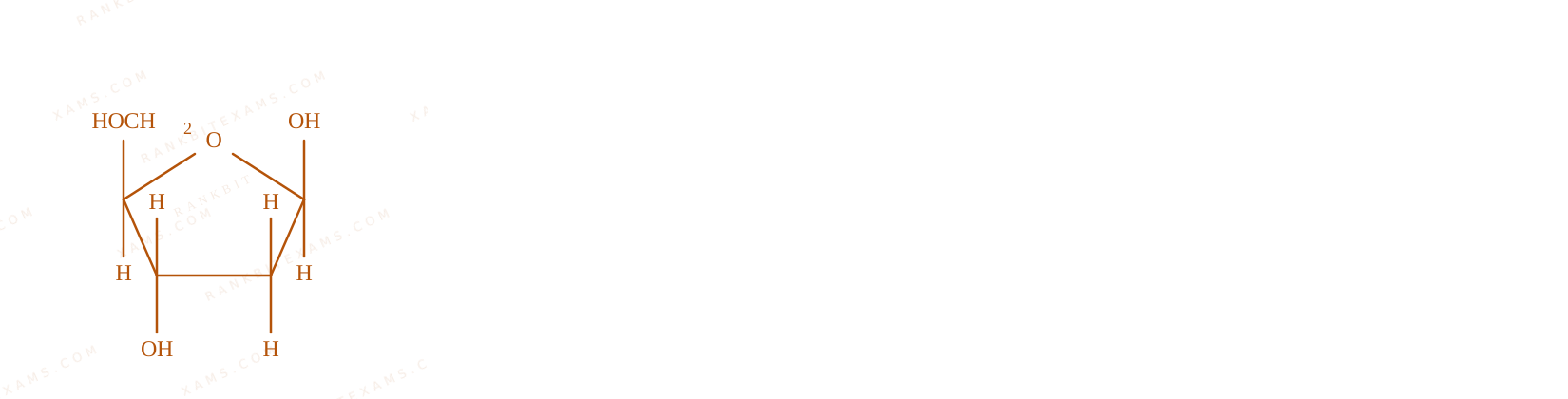
The carbohydrates "Ribose" present in DNA, is A. A pentose sugar B. present in pyranose from C. in "D" configuration D. a reducing sugar, when free E. in α -anomeric form Choose the correct answer from the options given below:
  • A. A, C and D Only
  • B. A, B and E Only
  • C. B, D and E Only
  • D. A, D and E Only

Solution

Core Logic

The specific carbohydrate residue present across backbone units in DNA molecules is β-2-deoxy-D-ribose. Its spatial parameters satisfy the following conditions:

  • It is a 5-carbon pentose sugars skeleton structure (A).
  • It maintains a canonical D configuration pathway sequence (C).
  • When localized in free, open unlinked molecular solutions, it standardly functions as a reducing carbohydrate assembly agent (D).
  • It exists predominantly in a furanose cycle form inside DNA, rather than a pyranose ring.
    Carbohydrates - Nucleic Acids component diagram for Q36 - JEE Main 2025 Morning
    Carbohydrates - Nucleic Acids component diagram for Q36 - JEE Main 2025 Morning
Pattern Recognition

Ribose in nucleic acids occurs primarily as a five-membered furanose ring configuration system.

Chapter Mix

Class 12 Chemistry: Biomolecules

Q28 jee_main_2025_28_jan_evening Carbohydrates and Glycosidic Linkages
Match List-I with List-II
List-I (Saccharides)List-II (Glycosidic-linkages found)
(A) Sucrose(I) α 1-4
(B) Maltose(II) α 1-4 and α 1-6
(C) Lactose(III) α 1 - β 2
(D) Amylopectin(IV) β 1-4
Choose the correct answer from the options given below :
  • A. (A)-(III), (B)-(I), (C)-(IV), (D)-(II)
  • B. (A)-(IV), (B)-(II), (C)-(I), (D)-(III)
  • C. (A)-(II), (B)-(IV), (C)-(III), (D)-(I)
  • D. (A)-(I), (B)-(II), (C)-(III), (D)-(IV)

Solution

Related Formula

Glycosidic linkages define the connectivity between monosaccharide units in disaccharides and polysaccharides.

Core Logic

Analyzing each saccharide configuration:

  • Sucrose: Formed by α-D-glucose and β-D-fructose via a α 1 - β 2 glycosidic linkage.
  • Maltose: Composed of two α-D-glucose units connected by a α 1-4 glycosidic linkage.
  • Lactose: Composed of β-D-galactose and β-D-glucose via a β 1-4 glycosidic linkage.
  • Amylopectin: A branched polymer of glucose with linear α 1-4 linkages and branching at α 1-6 positions.
Step 1: Final Mapping

Matching pairs lead to: (A)-(III), (B)-(I), (C)-(IV), (D)-(II).

Pattern Recognition

Remember shortcuts for common linkages:

  • Sucrose is a non-reducing sugar involving the anomeric carbons of both units (α 1 - β 2).
  • Lactose has a β-linkage (β 1-4).
  • Amylopectin represents branched starch (α 1-4 and α 1-6).
Chapter Mix

Class 12 Chemistry: Biomolecules

More Biomolecules Questions — jee_main_2025_28_jan_morning

Practice all Biomolecules previous-year questions →

Rankbit System
JEE Physics: Waves (+15.5%) | Electrostatics: Concentric Shells (-29.7%) | Modern Physics: Photoelectric Clones (+34.2%) | Mathematics: Definite Integrals (+18.1%) | Chemistry: Coordination Splitting (-11.4%) | JEE Physics: Waves (+15.5%) | Electrostatics: Concentric Shells (-29.7%) | Modern Physics: Photoelectric Clones (+34.2%) | Mathematics: Definite Integrals (+18.1%) | Chemistry: Coordination Splitting (-11.4%)