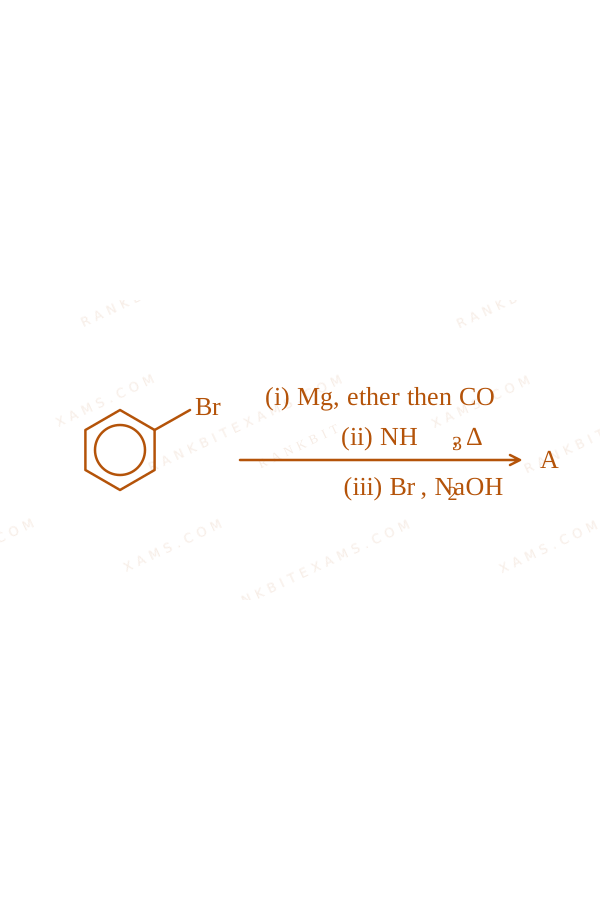
Consider the following sequence of reactions :
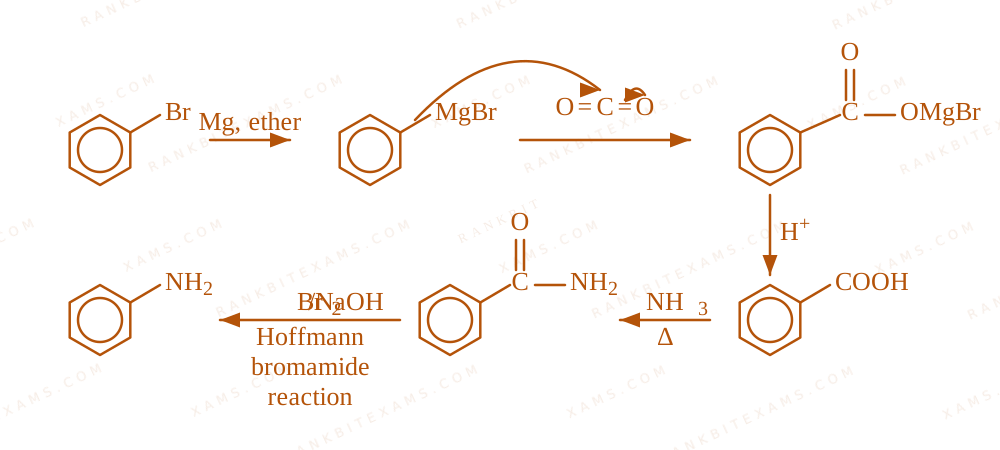
The flowchart tracks a chemical conversion starting from chlorobenzene down to final compound B.
11.25 mg of chlorobenzene will produce x × 10⁻¹$\mathrm{x} \times 10^{-1}$ mg of product B.
(Consider the reactions result in complete conversion.)
[Given molar mass of C, H, O, N and Cl as 12, 1, 16, 14 and 35.5g mol⁻¹$35.5\mathrm{g\,mol}^{-1}$ respectively]
Numerical Answer Type:
Enter a numerical valueAnswer: 93 to 93+4 marks
Solution & Explanation
Core Logic
The reaction sequence details the functional conversion of chlorobenzene down to product B (aniline, with a molar mass of 93 g mol⁻¹$93\,\mathrm{g\,mol}^{-1}$).
Following stoichiometric preservation:
moles of chlorobenzene = moles of Aniline (B)$$\text{moles of chlorobenzene} = \text{moles of Aniline (B)}$$
Molar mass of chlorobenzene (C₆H₅Cl$\mathrm{C}_6\mathrm{H}_5\mathrm{Cl}$) = 112.5 g mol⁻¹$112.5\,\mathrm{g\,mol}^{-1}$.
The flowchart tracks a chemical conversion starting from chlorobenzene down to final compound B.
Keywords:#chlorobenzene will produce product B#JEE Main 2025 Morning Q49#Amines Stoichiometry JEE Main 2025#Organic Synthesis Mass JEE Main 2025#Aromatic transformation#Stoichiometry step#Synthesis flow
More Amines Previous-Year Questions — Page 7
Q70jee_main_2024_01_february_morningNomenclature of Amines
Given below are two statements:
Statement (I) : Aminobenzene and aniline are same organic compounds.
Statement (II) : Aminobenzene and aniline are different organic compounds.
In the light of the above statements, choose the most appropriate answer from the options given below:
A.Both Statement I and Statement II are correct$\text{Both Statement I and Statement II are correct}$
B.Statement I is correct but Statement II is incorrect$\text{Statement I is correct but Statement II is incorrect}$
C.Statement I is incorrect but Statement II is correct$\text{Statement I is incorrect but Statement II is correct}$
D.Both Statement I and Statement II are incorrect$\text{Both Statement I and Statement II are incorrect}$
Solution
Core Logic
Aniline is the common name for the simplest aromatic amine, which consists of a phenyl group attached to an amino group (C₆H₅NH₂$C_6H_5NH_2$).
According to IUPAC nomenclature, the amino group attached to a benzene ring can also be called aminobenzene.
Step 1: Statement Validation
Statement I: True. Aminobenzene is just the systematic IUPAC name for aniline.
Statement II: False. They refer to the exact same molecule.
Pattern Recognition
Common names for simple aromatic compounds are often accepted as IUPAC names. Aniline = Benzenamine = Aminobenzene.
Given below are two statements:
Statement (I): The NH₂$NH_2$ group in Aniline is ortho and para directing and a powerful activating group.
Statement (II): Aniline does not undergo Friedel-Craft's reaction (alkylation and acylation).
In the light of the above statements, choose the most appropriate answer from the options given below:
A.Both Statement I and Statement II are correct$\text{Both Statement I and Statement II are correct}$
B.Both Statement I and Statement II are incorrect$\text{Both Statement I and Statement II are incorrect}$
C.Statement I is incorrect but Statement II is correct.$\text{Statement I is incorrect but Statement II is correct.}$
D.Statement I is correct but Statement II is incorrect$\text{Statement I is correct but Statement II is incorrect}$
Solution
Core Logic
Statement (I): The -NH₂$-NH_2$ group has a lone pair of electrons on nitrogen, which undergoes resonance with the benzene ring (strong +M effect). This strongly activates the ring towards electrophilic substitution and directs incoming electrophiles to the ortho and para positions.
Statement (II): Friedel-Crafts alkylation and acylation require a Lewis acid catalyst like anhydrous AlCl₃$AlCl_3$. Aniline is a Lewis base (due to the lone pair on N) and reacts with the Lewis acid AlCl₃$AlCl_3$ to form a stable salt/complex (C₆H₅ +NH₂-AlCl₃^-$C_6H_5\overset{+}{N}H_2-AlCl_3^-$). This removes the lone pair from resonance and converts the -NH₂$-NH_2$ group into a strongly deactivating group, thereby halting the Friedel-Crafts reaction.
Step 1: Evaluate Statements
Statement I is correct.
Statement II is correct.
Pattern Recognition
Aniline NEVER undergoes Friedel-Crafts because the base (NH₂$NH_2$) reacts with the catalyst (AlCl₃$AlCl_3$) before the reaction can proceed.
Chapter Mix
Class 12 Chemistry: Amines
Q68jee_main_2024_29_jan_morningElectrophilic Substitution in Amines
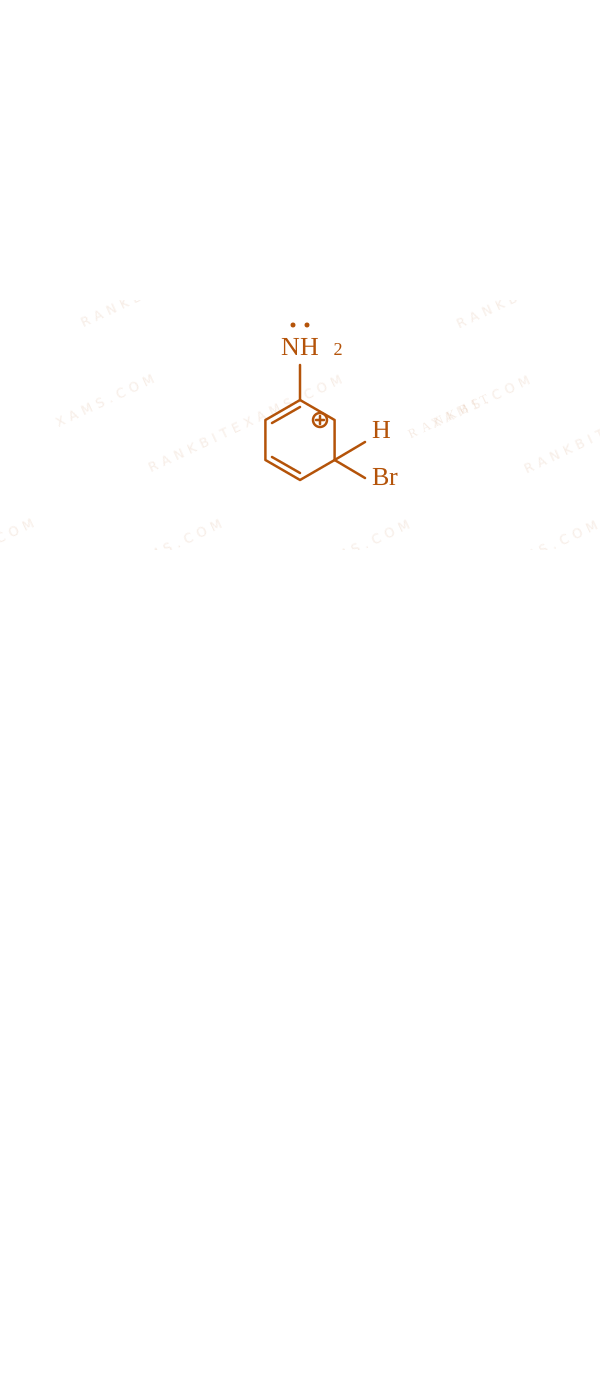
The arenium ion which is not involved in the bromination of Aniline is.
A. ""
B. ""
C. ""
D. ""
Solution
Core Logic
Aniline undergoes electrophilic aromatic substitution (like bromination). The -NH₂$-NH_2$ group is a strongly activating group and directs incoming electrophiles to the ortho and para positions due to resonance electron donation (+M$M$ effect).
When an electrophile (Br^+$Br^+$) attacks the ring, an intermediate arenium ion (sigma complex) is formed.
If attack occurs at the ortho or para position, the positive charge is delocalized onto the carbon atom bearing the -NH₂$-NH_2$ group. The lone pair on nitrogen can then stabilize this positive charge via resonance, forming a highly stable resonance structure (an octet-complete intermediate).
If attack occurs at the meta position, the positive charge delocalizes only over the remaining ring carbons and never rests on the carbon bearing the -NH₂$-NH_2$ group. Thus, it misses the extra stabilization provided by the nitrogen lone pair.
Because the meta attack intermediate is less stable compared to ortho/para attack, and the -NH₂$-NH_2$ is strictly o/p directing, the meta-arenium ion is NOT a primary intermediate involved in standard bromination pathways of neutral aniline.
Step 2: Conclusion
Option 3 displays the arenium ion resulting from a meta-attack (positive charge skips the -NH₂$-NH_2$ substituted carbon).
Electrophilic Substitution in Amines diagram for Q68 - JEE Main 2024 Morning
Since -NH₂$-NH_2$ is ortho/para directing, the meta-arenium ion will not be formed.
Chapter Mix
Class 12 Chemistry: Amines
Qjee_main_2024_30_january_eveningDiazonium Salts
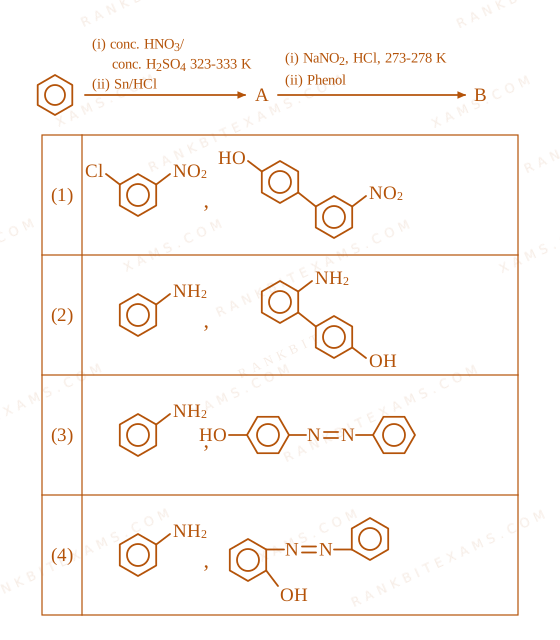
The products A and B formed in the following reaction scheme are respectively
The diagram shows a reaction pathway for synthesizing product A and B.
A.
B.
C.
D.
Solution
Core Logic
Step 1: Nitration of benzene using conc. HNO₃$HNO_3$ and conc. H₂SO₄$H_2SO_4$ gives nitrobenzene.
Step 2: Reduction of nitrobenzene with Sn/HCl$Sn/HCl$ yields aniline.
Step 3: Aniline reacts with NaNO₂/HCl$NaNO_2/HCl$ at 0-5^° C$0-5^\circ C$ to form benzene diazonium chloride (Product A).
Step 4: Benzene diazonium chloride undergoes a coupling reaction with phenol (typically in a mildly alkaline medium) to form p-hydroxyazobenzene, an orange dye (Product B).
The diagram shows a reaction pathway for synthesizing product A and B.
Practice past-year questions one chapter at a time. Pick an exam → subject → chapter and get every PYQ for that topic — pulled together from all past papers — with the chapter's key formulas alongside.