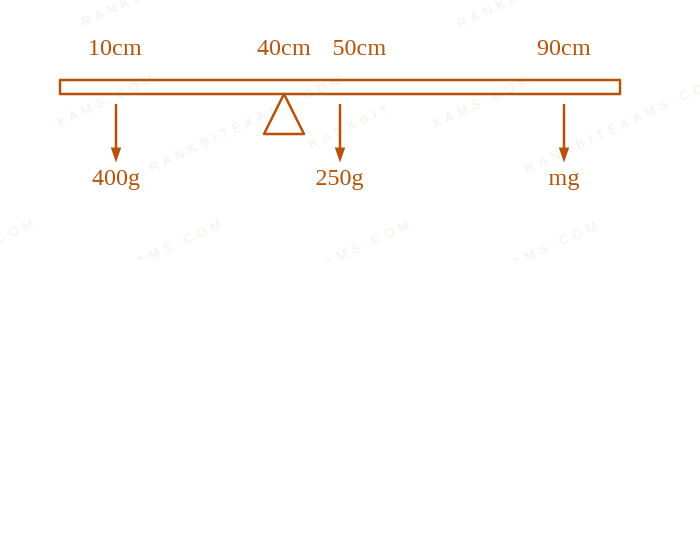
A uniform rod of mass 250g$250\mathrm{g}$ having length 100cm$100\mathrm{cm}$ is balanced on a sharp edge at 40cm$40\mathrm{cm}$ mark[cite: 150, 151]. A mass of 400g$400\mathrm{g}$ is suspended at 10cm$10\mathrm{cm}$ mark. To maintain the balance of the rod, the mass to be suspended at 90cm$90\mathrm{cm}$ mark, is [cite: 154, 156]
A.300g$300\mathrm{g}$
B.190g$190\mathrm{g}$
C.200g$200\mathrm{g}$
D.290g$290\mathrm{g}$
Solution & Explanation
Related Formula
For rotational equilibrium, the \sum of all counter-clockwise torques about the pivot point must exactly balance the \sum of all clockwise torques:
The rod is uniform, meaning its mass (250 g$250\text{ g}$) acts exactly at its geometric center of mass, the 50 cm$50\text{ cm}$ mark[cite: 150, 151]. Let the pivot point be the sharp edge at the 40 cm$40\text{ cm}$ mark .
Calculate the relative lever arms from the pivot [cite: 775, 776, 777]:
400 g$400\text{ g}$ mass at 10 cm$10\text{ cm}$ mark: lever arm = 40 - 10 = 30 cm$= 40 - 10 = 30\text{ cm}$ (counter-clockwise)
250 g$250\text{ g}$ rod mass at 50 cm$50\text{ cm}$ mark: lever arm = 50 - 40 = 10 cm$= 50 - 40 = 10\text{ cm}$ (clockwise)
Unknown mass M$M$ at 90 cm$90\text{ cm}$ mark: lever arm = 90 - 40 = 50 cm$= 90 - 40 = 50\text{ cm}$ (clockwise)
The structural layout of forces acting on the balanced rod system is shown below:
Torque and Equilibrium balancing diagram for Q17
Pattern Recognition
Never forget to include the weight of a uniform rod itself in equilibrium equations. It is a common oversight to omit the rod's mass, which always acts at its geometric center.
Chapter Mix
Class 11 Physics: System of Particles and Rotational Motion
Keywords:#balancing a uniform rod torque equation#JEE Main 2025 Evening Q17#System of Particles and Rotational Motion JEE Main 2025#center of mass rotational equilibrium

More System of Particles and Rotational Motion Previous-Year Questions — Page 10
Qjee_main_2025_29_jan_morningTorque
The coordinates of a particle with respect to origin in a given reference frame is (1, 1, 1) meters. If a force of F = i - j + k$\vec{\mathrm{F}} = \hat{\mathrm{i}} -\hat{\mathrm{j}} +\hat{\mathrm{k}}$ acts on the particle, then the magnitude of torque (with respect to origin) in z$z$ -direction is
Numerical Answer.Answer: 2 to 2
Solution
Related Formula
τ = r × F$$\vec{\tau} = \vec{r} \times \vec{F}$$
Core Logic
Given position vector r = i + j + k$\vec{r} = \hat{i} + \hat{j} + \hat{k}$ and force F = i - j + k$\vec{F} = \hat{i} - \hat{j} + \hat{k}$:
The absolute magnitude of the torque component in the z$z$-direction equals 2 ~N · m$2 \mathrm{~N \cdot m}$.
Chapter Mix
Class 11 Physics: System of Particles and Rotational Motion
Qjee_main_2024_01_february_morningCentre of Mass
The identical spheres each of mass 2M are placed at the corners of a right angled triangle with mutually perpendicular sides equal to 4~m$4\mathrm{~m}$ each. Taking point of intersection of these two sides as origin, the magnitude of position vector of the centre of mass of the system is 4√(2)x$\frac{4\sqrt{2}}{x}$, where the value of x$x$ is ______.
Matching this directly with the given template 4√(2)x$\frac{4\sqrt{2}}{x}$ shows that x = 3$x = 3$.
Pattern Recognition
Since the mass layout is completely symmetric along both right-angle legs, the COM coordinates are identical (xCOM = yCOM$x_{\text{COM}} = y_{\text{COM}}$).
Chapter Mix
Class 11 Physics: System of Particles and Rotational Motion
Q60jee_main_2024_29_january_eveningAngular Momentum of a Particle
A body of mass 5 kg$5\text{ kg}$ moving with a uniform speed 3√(2) ms⁻¹$3\sqrt{2}\text{ ms}^{-1}$ in X–Y plane along the line y = x + 4$y = x + 4$. The angular momentum of the particle about the origin will be ______ kg m²s⁻¹$\text{kg m}^2\text{s}^{-1}$.
Numerical Answer.Answer: 60 to 60
Solution
Related Formula
The magnitude of the angular momentum L$L$ of a particle of mass m$m$ moving with velocity v$v$ is:
L = m v d$L = m v d$
where:
d$d$ is the perpendicular distance from the axis of rotation (origin) to the line of motion of the particle.
Core Logic
Given parameters:
Mass, m = 5 kg$m = 5\text{ kg}$
Velocity, v = 3√(2) ms⁻¹$v = 3\sqrt{2}\text{ ms}^{-1}$
Line of motion: y = x + 4 x - y + 4 = 0$y = x + 4 \implies x - y + 4 = 0$
Step 1: Calculate Perpendicular Distance
The perpendicular distance d$d$ from the origin (0,0)$(0,0)$ to the line Ax + By + C = 0$Ax + By + C = 0$ is:
Instead of complicated vector cross products, find the perpendicular distance of the straight line from the origin using standard coordinate geometry. L = mvd$L = mvd$ is extremely fast and reliable.
Chapter Mix
Class 11 Physics: System of Particles and Rotational Motion
Qjee_main_2024_27_jan_morningMoment of Inertia
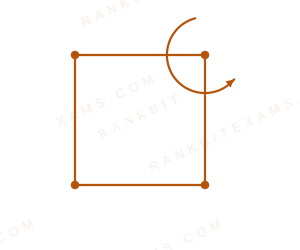
Four particles each of mass 1 kg$1\text{ kg}$ are placed at four corners of a square of side 2 m$2\text{ m}$. The moment of inertia of the system about an axis perpendicular to its plane and passing through one of its vertices is ______ kg ²$\text{kg}\cdot\text{m}^{2}$.
{{IMG}}
Moment of Inertia
Numerical Answer.Answer: 16 to 16
Solution
Related Formula
I = Σ mᵢ rᵢ²$$I = \sum m_i r_i^2$$
Core Logic
Let the axis pass through vertex 1. Evaluate distances (r$r$) for each corner particle:
For a standard planar configuration system, total orthogonal moment components map predictably via basic summation configurations matching 4ma²$4ma^2$ exactly.
Chapter Mix
Class 11 Physics: System of Particles and Rotational Motion
More System of Particles and Rotational Motion Questions — jee_main_2025_28_jan_evening
Practice past-year questions one chapter at a time. Pick an exam → subject → chapter and get every PYQ for that topic — pulled together from all past papers — with the chapter's key formulas alongside.