JEE Main · Physics ↑ Rising

Electromagnetic Induction appeared 28 times across 3 years — 3.2% of Physics. This question is from Motional EMF.

Year 2026 2025 2024 Total
Questions 12 6 10 28

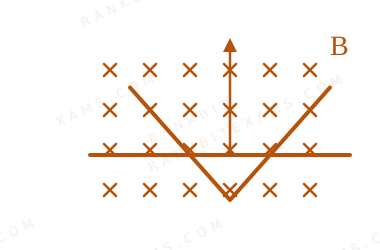
A conducting \bar moves on two conducting rails as shown in the figure. A constant magnetic field B \exists into the page. The \bar starts to move from the vertex at time t = 0 with a constant velocity. If the induced EMF is E ∝ tⁿ , then value of n is
Motional EMF diagram for Q21 - JEE Main 2025 Evening
A linear conductor \bar moving laterally across V-shaped intersecting conducting guide rails.

Numerical Answer Type:
Enter a numerical value Answer: 1 +4 marks

Solution & Explanation

Related Formula

The motional EMF induced across a moving conductor of instantaneous length inside a perpendicular uniform magnetic field is given by:

E = B · · v
Core Logic

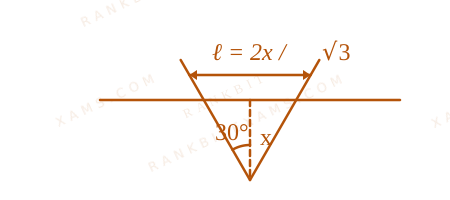
Let the V-shaped guide rails form an \angle, so that the instantaneous length of the conducting \bar grows linearly with its horizontal position distance x from the vertex [cite: 782, 791]:

∝ x

Since the \bar moves with a constant velocity v, its displacement position at any time t is :

x = v · t ∝ v · t

Substituting this time-dependent length into the induced EMF expression :

E = B · · v E ∝ B · (v · t) · v E ∝ t¹

Comparing this to the given relation E ∝ tⁿ gives the exponent[cite: 188, 791]:

n = 1

Step 1: Geometric Analysis

The expanding circuit loop configuration across time is shown below:

Motional EMF geometric analysis diagram for Q21
A linear conductor \bar moving laterally across V-shaped intersecting conducting guide rails.

Pattern Recognition

For \parallel rails, the length remains constant, meaning induced EMF is independent of time (E ∝ t⁰). For V-shaped divergent rails, the effective length increases linearly with distance, making the induced EMF directly proportional to time (E ∝ t¹).

Chapter Mix

Class 12 Physics: Electromagnetic Induction

Reference Study Guides

More Electromagnetic Induction Previous-Year Questions — Page 2

Q50 jee_main_2026_22_january_morning Energy Density in Inductor
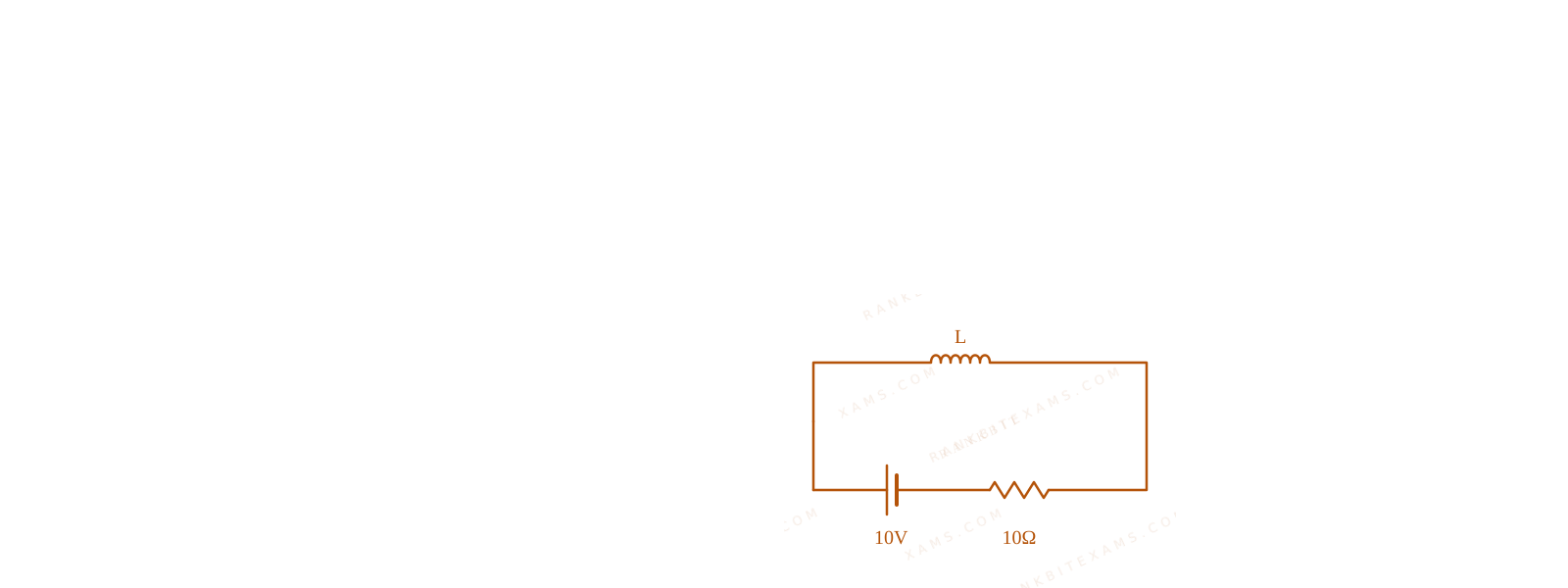
Inductance of a coil with 10⁴ turns is 10 mH and it is connected to a dc source of 10 V with internal resistance of 10~Ω. The energy density in the inductor when the current reaches ( 1e) of its maximum value is α π × 1e² ~J / m³. The value of α is \_\_\_\_. (μ₀ = 4π × 10⁻⁷ Tm / A)
Numerical Answer. Answer: 20 to 20

Solution

Related Formula
Ed = (B²)/(2μ₀), B = μ₀ n I
Core Logic

Solution inductor energy density diagram for Q50 - JEE Main 2026 Morning

Maximum current:

I₀ = (10)/(10) = 1 A

Current at given instant:

I = (I₀)/(e) = (1)/(e)

Energy density expression:

Ed = (μ₀ n² I²)/(2) = 4π × 10⁻⁷ × (10⁴)² × (1/e)²2 = (20π)/(e²) J/m³

Therefore, α = 20.

Pattern Recognition

Sees: Energy density in inductor at exponential current growth stage. Shortcut: Express magnetic field B in terms of turns density n and current I, substitute into energy density formula Ed = (B²)/(2μ₀). Check: Numerical answer is 20. ✓

Chapter Mix

Class 12 Physics: Electromagnetic Induction
Q38 jee_main_2026_22_january_evening Transient Behavior in LR Circuits
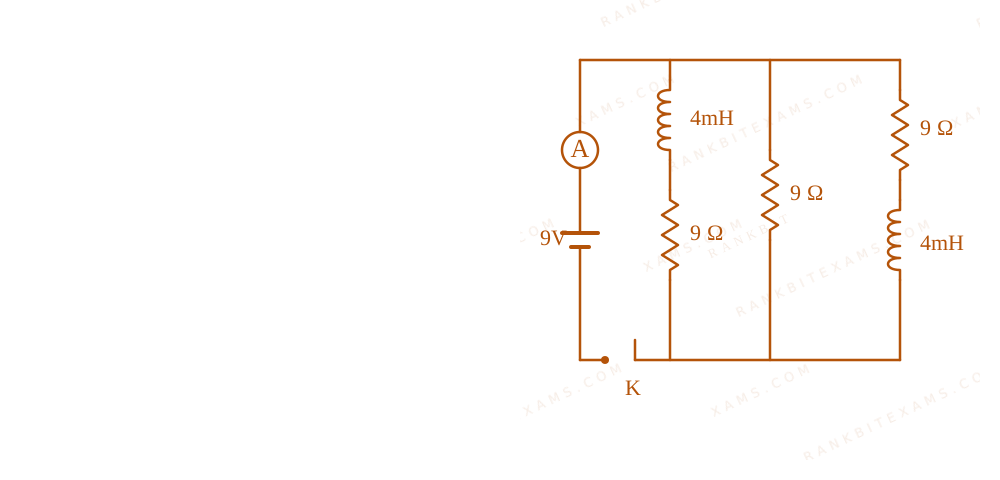
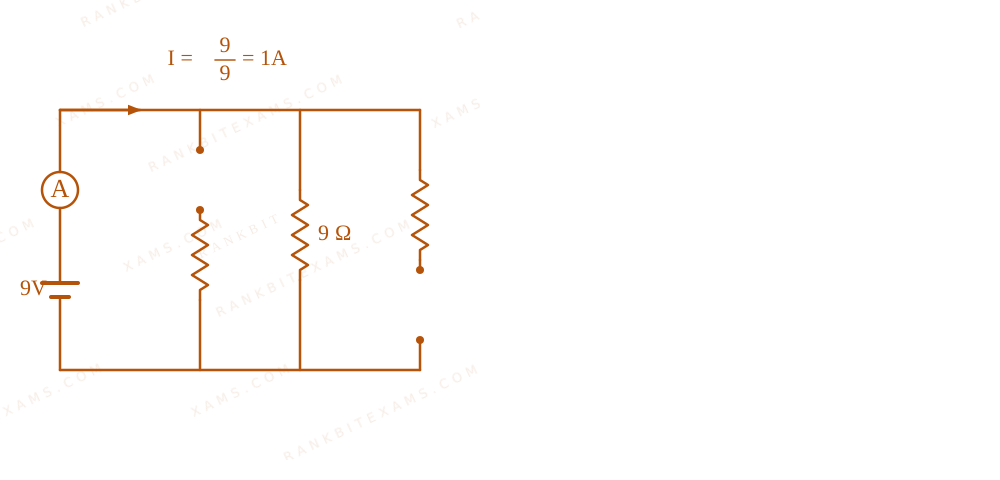
Figure shows the circuit that contains three resistances (9 Ω each) and two inductors (4 mH each). The reading of ammeter at the moment switch K is turned ON, is ____ A.
LR circuit diagram with ammeter for Q38 - JEE Main 2026 Evening
The figure shows a circuit powered by a 9V battery with three 9-ohm resistors and two 4mH inductors connected in parallel branches.
  • A. 1
  • B. zero
  • C. 3
  • D. 2

Solution

Related Formula
I(t=0^+) for an ideal inductor = 0 (Open Circuit)
Core Logic

At t = 0 (immediately after closing switch K), inductors oppose any instant change in current and behave as open circuits (IL = 0).

Removing the branches containing the 4 ~mH inductors leaves only the middle branch containing a single 9 Ω resistor connected to the 9 ~V battery.

Calculating total initial current I measured by the ammeter:

I = (V)/(R) = 9 ~V9 Ω = 1 ~A

Equivalent circuit diagram at t=0 for Q38 - JEE Main 2026 Evening
The figure shows a circuit powered by a 9V battery with three 9-ohm resistors and two 4mH inductors connected in parallel branches.

Step 1: Final Conclusion

The reading of the ammeter at the moment switch K is turned ON is 1 ~A.

Pattern Recognition

LR Circuit Transient Rule: At t=0, Replace Inductor arrow Open Circuit. At t=∞, Replace Inductor arrow Short Circuit wire.

Chapter Mix

Class 12 Physics: Electromagnetic Induction
Q46 jee_main_2026_22_january_evening Induced EMF in Rotating Loop
A conducting circular loop is rotated about its diameter at a constant angular speed of 100 rad/s in a magnetic field of 0.5T perpendicular to the axis of rotation. When the loop is rotated by 30° from the horizontal position, the induced EMF is 15.4 mV. The radius of the loop is ____ mm. (Take π = (22)/(7))
Numerical Answer. Answer: 14 to 14

Solution

Related Formula
E = B A ω (ω t)
Core Logic

Given B = 0.5 ~T, ω = 100 ~rad/s, θ = ω t = 30^° and E = 15.4 × 10⁻³ ~V:

15.4 × 10⁻³ = B (π r²) ω (30^°) 15.4 × 10⁻³ = 0.5 × ((22)/(7) r²) × 100 × (1)/(2) 15.4 × 10⁻³ = (550)/(7) r² r² = 15.4 × 10⁻³ × 7550 = 107.8 × 10⁻³550 = 1.96 × 10⁻⁴ ~m² r = 1.96 × 10⁻⁴ = 1.4 × 10⁻² ~m = 14 ~mm
Step 1: Final Conclusion

The radius of the circular loop is 14 ~mm.

Pattern Recognition

AC Generator induced EMF formula: E = B A ω θ. Substitute 30^° = 1/2 and solve directly for radius r.

Chapter Mix

Class 12 Physics: Electromagnetic Induction

Q41 jee_main_2026_23_january_morning Motional EMF
A 20 m long uniform copper wire held horizontally is allowed to fall under the gravity (g = 10 m/s²) through a uniform horizontal magnetic field of 0.5 Gauss perpendicular to the length of the wire. The induced EMF across the wire it travels a vertical distance of 200 m is ____ mV.
  • A. 0.2√(10)
  • B. 20√(10)
  • C. 2 √(10)
  • D. 200√(10)

Solution

Related Formula

v = √(2gh)

ε = Bvl
Step 1: Calculate Velocity

Falling freely under gravity for 200 m: v = √(2gh)

v = √(2 × 10 × 200) = √(4000) = 20√(10) m/s
Step 2: Calculate Motional EMF

Convert magnetic field to Tesla: 0.5 Gauss = 0.5 × 10⁻⁴ T. The velocity, magnetic field, and length are mutually perpendicular.

ε = Bvl ε = (0.5 × 10⁻⁴) × (20√(10)) × 20 ε = (10 × 10⁻⁴) × 20√(10) ε = 200√(10) × 10⁻⁴ V ε = 20√(10) × 10⁻³ V = 20√(10) mV
Pattern Recognition

Sees: "wire falling in horizontal magnetic field" → find velocity using kinematics v = √(2gh), then just plug into standard motional EMF ε = Bvl. Remember to convert Gauss to Tesla.

Chapter Mix

Class 12 Physics: Electromagnetic Induction Class 11 Physics: Motion in a Straight Line

Q46 jee_main_2026_23_january_morning Motional EMF
A simple pendulum made of mass 10 g and a metallic wire of length 10 cm is suspended vertically in a uniform magnetic field of 2 T. The magnetic field direction is perpendicular to the plane of oscillations of the pendulum. If the pendulum is released from an angle of 60° with vertical, then maximum induced EMF between the point of suspension and point of oscillation is ____ mV. (Take g = 10 m/s²)
Numerical Answer. Answer: 100 to 100

Solution

Related Formula
ε = (1)/(2) Bω l² mgl(1 - θ) = (1)/(2)(ml²)ω²
Core Logic

The metallic string of the pendulum cuts the perpendicular magnetic field lines as it swings. The induced EMF along the length of a rotating rod is maximum when its angular velocity ω is maximum. This maximum ω occurs at the lowest point of the swing.

Step 1: Find Maximum Angular Velocity

Using conservation of mechanical energy from extreme to mean position:

mgl(1 - 60°) = (1)/(2) I ω² mgl(1 - (1)/(2)) = (1)/(2)(ml²)ω² (1)/(2)mgl = (1)/(2)ml²ω² ω = √((g)/(l))
Step 2: Substitute Values

Given l = 10 cm = 0.1 m and g = 10 m/s².

ω = √((10)/(0.1)) = √(100) = 10 rad/s
Step 3: Calculate Maximum EMF
ε = (1)/(2) B ω l² ε = (1)/(2) (2 T)(10 rad/s)(0.1 m)² ε = 10 × 0.01 = 0.1 V

Convert to millivolts:

ε = 100 mV
Pattern Recognition

Sees: "pendulum wire in magnetic field" → It's just a rotating rod! EMF is (1)/(2) B ω l². Find max ω via energy conservation at the lowest point.

Chapter Mix

Class 12 Physics: Electromagnetic Induction Class 11 Physics: Work, Energy and Power

More Electromagnetic Induction Questions — jee_main_2025_28_jan_evening

Practice all Electromagnetic Induction previous-year questions →

Rankbit System
JEE Physics: Waves (+15.5%) | Electrostatics: Concentric Shells (-29.7%) | Modern Physics: Photoelectric Clones (+34.2%) | Mathematics: Definite Integrals (+18.1%) | Chemistry: Coordination Splitting (-11.4%) | JEE Physics: Waves (+15.5%) | Electrostatics: Concentric Shells (-29.7%) | Modern Physics: Photoelectric Clones (+34.2%) | Mathematics: Definite Integrals (+18.1%) | Chemistry: Coordination Splitting (-11.4%)