JEE Main · Physics ↑ Rising

Electromagnetic Induction appeared 28 times across 3 years — 3.2% of Physics. This question is from Motional EMF.

Year 2026 2025 2024 Total
Questions 12 6 10 28

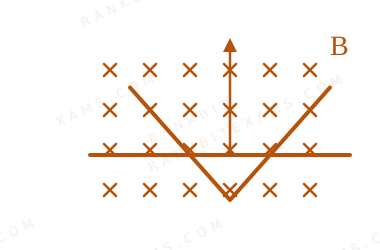
A conducting \bar moves on two conducting rails as shown in the figure. A constant magnetic field B \exists into the page. The \bar starts to move from the vertex at time t = 0 with a constant velocity. If the induced EMF is E ∝ tⁿ , then value of n is
Motional EMF diagram for Q21 - JEE Main 2025 Evening
A linear conductor \bar moving laterally across V-shaped intersecting conducting guide rails.

Numerical Answer Type:
Enter a numerical value Answer: 1 +4 marks

Solution & Explanation

Related Formula

The motional EMF induced across a moving conductor of instantaneous length inside a perpendicular uniform magnetic field is given by:

E = B · · v
Core Logic

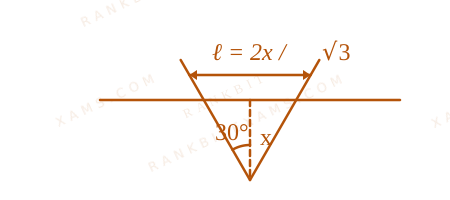
Let the V-shaped guide rails form an \angle, so that the instantaneous length of the conducting \bar grows linearly with its horizontal position distance x from the vertex [cite: 782, 791]:

∝ x

Since the \bar moves with a constant velocity v, its displacement position at any time t is :

x = v · t ∝ v · t

Substituting this time-dependent length into the induced EMF expression :

E = B · · v E ∝ B · (v · t) · v E ∝ t¹

Comparing this to the given relation E ∝ tⁿ gives the exponent[cite: 188, 791]:

n = 1

Step 1: Geometric Analysis

The expanding circuit loop configuration across time is shown below:

Motional EMF geometric analysis diagram for Q21
A linear conductor \bar moving laterally across V-shaped intersecting conducting guide rails.

Pattern Recognition

For \parallel rails, the length remains constant, meaning induced EMF is independent of time (E ∝ t⁰). For V-shaped divergent rails, the effective length increases linearly with distance, making the induced EMF directly proportional to time (E ∝ t¹).

Chapter Mix

Class 12 Physics: Electromagnetic Induction

Reference Study Guides

More Electromagnetic Induction Previous-Year Questions — Page 3

Q41 jee_main_2026_23_january_evening Faraday's Law of Induction
A circular loop of radius 7 cm is placed in uniform magnetic field of 0.2 T directed perpendicular to plane of loop. The loop is converted into a square loop in 0.5 s. The EMF induced in the loop is ____ mV.
  • A. 6.6
  • B. 13.2
  • C. 8.25
  • D. 1.32

Solution

Related Formula
EMF = (Δ φ)/(Δ t) = B (A₁ - A₂)/(Δ t)
Core Logic

The magnetic field is constant, but the area changes as the circle deforms into a square. Length of the wire is conserved. Circumference of circular loop = 2π r ≈ 14π cm.

Side length of the new square loop:

4a = 14π a = (7π)/(2) cm
Step 1: Calculate Change in Area
Δ A = Acircle - Asquare A₁ = π r² = π (7)² = 49π cm² A₂ = a² = ( (7π)/(2) )² = (49π²)/(4) cm² Δ A = ( 49π - (49π²)/(4) ) × 10⁻⁴ m²
Step 2: Calculate Flux Change and EMF
Δ φ = B Δ A = 0.2 ( 49π - (49π²)/(4) ) × 10⁻⁴

Using π ≈ 3.1415: 49π ≈ 153.938 (49π²)/(4) ≈ 120.89 Δ A ≈ 33.04 × 10⁻⁴ m²

Wait, taking standard approximations:

Δ φ = 0.2 × 33.07 × 10⁻⁴ = 6.614 × 10⁻⁴ Wb EMF = (Δ φ)/(Δ t) = 6.614 × 10⁻⁴0.5 = 13.228 × 10⁻⁴ V EMF = 1.32 mV
Pattern Recognition

When a loop is deformed into a different shape, perimeter is conserved. For a given perimeter, a circle always encloses maximum area. Subtracting the new area from the old area immediately gives the Δ A driving the induced EMF.

Chapter Mix

Class 12 Physics: Electromagnetic Induction
Q42 jee_main_2026_23_january_evening Mutual Inductance
Suppose a long solenoid of 100 cm length, radius 2 cm having 500 turns per unit length, carries a current I = 10 (ω t) A, where ω = 1000 rad/s . A circular conducting loop (B) of radius 1 cm coaxially slid through the solenoid at a speed v = 1 cm/s . The r.m.s. current through the loop when the coil B is inserted 10 cm inside the solenoid is α/√(2) . The value of α is ____. [Resistance of the loop = 10Ω ]
  • A. 197
  • B. 80
  • C. 280
  • D. 100

Solution

Related Formula
ε = - A (dB)/(dt)

B = μ₀ n I

irms = εrmsR
Core Logic

Since the loop B is well inside the long solenoid (10 cm deep into a 100 cm length), the magnetic field is uniform across its cross-section and approximately equal to the ideal solenoid field B = μ₀ n I. Here n = 500 turns/m. The sliding velocity v just means it's moving through a uniform field region, so motional EMF does not contribute to the flux change; only the transformer EMF (time-varying B field) creates the induced current.

Step 1: Calculate Induced EMF
I = I₀ ω t (dI)/(dt) = I₀ ω ω t ε = A (dB)/(dt) = A μ₀ n (dI)/(dt) = (π r²) μ₀ n (I₀ ω ω t)
Step 2: Calculate RMS Current

Peak EMF ε₀ = π r² μ₀ n I₀ ω.

i₀ = (ε₀)/(R) = (π r² μ₀ n I₀ ω)/(R) irms = i₀√(2) = π r² μ₀ n I₀ ω√(2) R
Step 3: Numerical Substitution
irms = π × (10⁻²)² × (4π × 10⁻⁷) × 500 × 10 × 1000√(2) × 10 irms = π × 10⁻⁴ × 4π × 10⁻⁷ × 5 × 10⁶√(2) × 10 irms = 20π² × 10⁻⁶ × 10√(2) × 10 = 20π²√(2) × 10⁻⁶ A

Using π² ≈ 9.87, 20π² ≈ 197.39. Thus, irms ≈ 197√(2). α = 197.

Pattern Recognition

Motion parallel to uniform field lines inside an ideal solenoid induces no motional EMF. Only the time derivative of the AC current (dI)/(dt) contributes to Faraday induction.

Chapter Mix

Class 12 Physics: Electromagnetic Induction Class 12 Physics: Alternating Current
Q8 jee_main_2025_02_april_evening Self Induction and Energy Stored
A solenoid having area A and length l is filled with a material having relative permeability 2. The magnetic energy stored in the solenoid is :
  • A. (B² A l)/(μ₀)
  • B. (B² A l)/(2 μ₀)
  • C. B² A l
  • D. (B² A l)/(4 μ₀)

Solution

Related Formula
  • Magnetic Energy Density (energy per unit volume):
um = (B²)/(2 μ) = (B²)/(2 μᵣ μ₀)
  • Total Energy stored:
U = um × V = um × (A l)
Core Logic

We are given:

  • Relative permeability μᵣ = 2
  • Permeability of the filled core medium μ = μᵣ μ₀ = 2 μ₀
  • Substitute μᵣ = 2 into the energy density expression:

um = (B²)/(2 (2 μ₀)) = (B²)/(4 μ₀)

Multiply by the total volume of the solenoid (V = A l):

U = um · V = (B²)/(4 μ₀) A l
Pattern Recognition

Sees: Magnetic energy stored in a solenoid with medium relative permeability. Trap: Placing the relative permeability μᵣ in the numerator of the formula instead of the denominator. Shortcut: Magnetic energy density is always inversely proportional to permeability. With medium μ = 2μ₀, energy density is halved compared to free space, giving (B²)/(4μ₀). Multiply by volume Al to get (B² Al)/(4μ₀).

Chapter Mix

Class 12 Physics: Electromagnetic Induction Class 12 Physics: Magnetism and Matter

Q jee_main_2025_04_april_morning Motional Electromotive Force
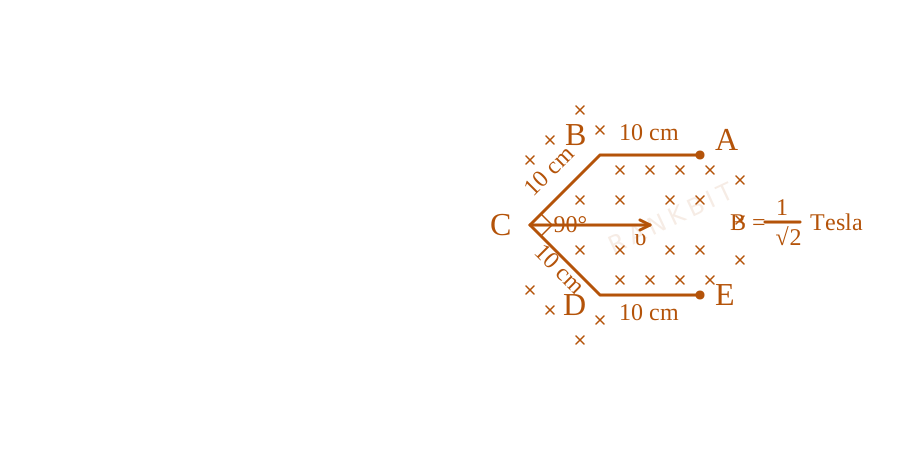
Conductor wire ABCDE with each arm 10~cm in length is placed in magnetic field of 1√(2)~Tesla, perpendicular to its plane. When conductor is pulled towards right with constant velocity of 10~cm/s, induced emf between points A and E is ________ mV.
Conductor wire path geometry layout for Q25 - JEE Main 2025 Morning
The figure outlines a segmented conductive wire trail pulled laterally through an orthogonal inward magnetic field matrix region.
Numerical Answer. Answer: 10 to 10

Solution

Related Formula

Motional electromotive force formula:

ε = B v leff

where leff is the perpendicular component of the straight-line displacement vector connecting the endpoints A and E (lAE) relative to velocity v.

Core Logic

In a uniform magnetic field, the motional EMF induced in any arbitrary conductor wire depends solely on the straight-line displacement vector connecting its endpoints, rather than the detailed path:

ε = ( v × B) · leff

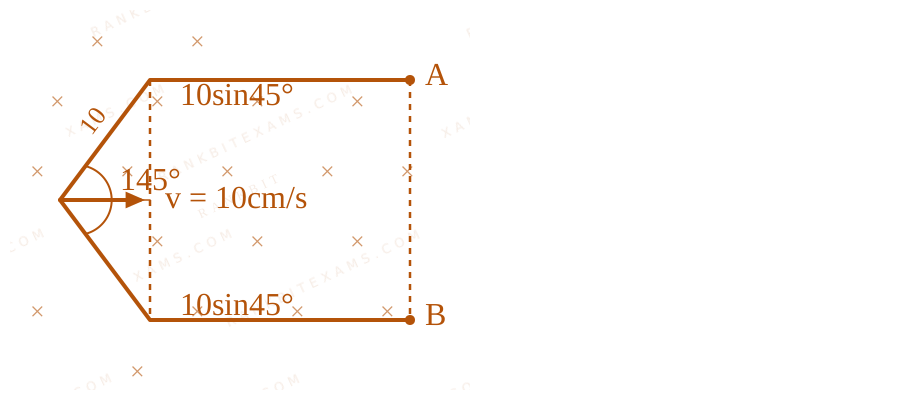
Effective vector length translation resolution mapping for Q25 - JEE Main 2025 Morning
The figure outlines a segmented conductive wire trail pulled laterally through an orthogonal inward magnetic field matrix region.

Step 1: Compute Effective Length

From the geometry of the symmetric wire segments oriented at 45° to the horizontal:

leff = 2 × (10 45°) = 2 × 10 × 1√(2) = 10√(2) cm = 0.1√(2) m
Step 2: Calculate Induced EMF

Substitute the given parameters into the motional EMF expression:

ε = B v leff ε = ( 1√(2)) × (0.1 m/s) × (0.1√(2) m) ε = 1√(2) × 0.1 × 0.1√(2) = 0.01 V = 10 mV
Pattern Recognition

In a uniform magnetic field, motional EMF is path-independent. Replace any zig-zag or curved conductor with an equivalent straight line joining the two endpoints perpendicular to the velocity vector.

Evaluation Rubric / Model Answer

10

Chapter Mix

Class 12 Physics: Electromagnetic Induction

Q1 jee_main_2025_28_jan_evening Motional EMF
A uniform magnetic field of 0.4 T acts perpendicular to a circular copper disc 20 ~cm in radius. The disc is having a uniform angular velocity of 10 π rad s⁻¹ about an axis through its centre and perpendicular to the disc. What is the potential difference developed between the axis of the disc and the rim? ( π = 3.14 )
  • A. 0.0628 V
  • B. 0.5024 V
  • C. 0.2512 V
  • D. 0.1256 V

Solution

Related Formula

The induced electromotive force (EMF) developed between the center and the rim of a rotating disc in a perpendicular magnetic field is given by:

E = (1)/(2) B ω R²
Core Logic

Given parameters from the problem statement [cite: 655, 657, 658]:

  • Magnetic field, B = 0.4 T
  • Radius of the disc, R = 20 cm = 0.2 m
  • Angular velocity, \omega = 10\pi \text{ rad s}^{-1}
  • Substituting the values into the governing formula:

E = (1)/(2) × 0.4 × (10 × 3.14) × (0.2)² E = 0.2 × 31.4 × 0.04 E = 0.2512 V
Step 1: Evaluation

The potential difference developed between the axis of the disc and the rim is precisely 0.2512 V.

Pattern Recognition

For any rotating conductor of length R or a continuous disc rotating about its center in a perpendicular magnetic field, the induced EMF is mathematically equivalent to a single radial rod sweeping the area, leading directly to the formula (1)/(2)Bω R².

Chapter Mix

Class 12 Physics: Electromagnetic Induction

More Electromagnetic Induction Questions — jee_main_2025_28_jan_evening

Practice all Electromagnetic Induction previous-year questions →

Rankbit System
JEE Physics: Waves (+15.5%) | Electrostatics: Concentric Shells (-29.7%) | Modern Physics: Photoelectric Clones (+34.2%) | Mathematics: Definite Integrals (+18.1%) | Chemistry: Coordination Splitting (-11.4%) | JEE Physics: Waves (+15.5%) | Electrostatics: Concentric Shells (-29.7%) | Modern Physics: Photoelectric Clones (+34.2%) | Mathematics: Definite Integrals (+18.1%) | Chemistry: Coordination Splitting (-11.4%)