Identify correct statements:
(A) Primary amines do not give diazonium salts when treated with NaNO₃$NaNO_{3}$ in acidic condition.
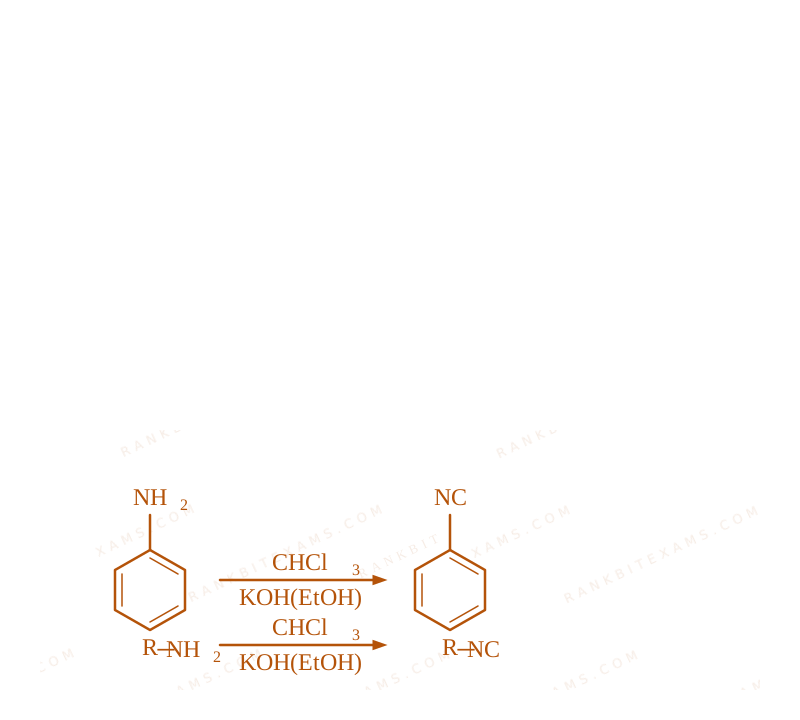
(B) Aliphatic and aromatic primary amines on heating with CHCl₃$CHCl_{3}$ and ethanolic KOH form carbylamines.
(C) Secondary and tertiary amines also give carbylamine test.
(D) Benzenesulfonyl chloride is known as Hinsberg's reagent.
(E) Tertiary amines reacts with benzenesulfonyl chloride very easily.
Choose the correct answer from the options given below :
A.(B) and (D) only
B.(A) and (B) only
C.(D) and (E) only
D.(B) and (C) only
Solution & Explanation
Related Formula
The Carbylamine reaction is specific to primary amines:
(A) Primary aromatic amines form stable diazonium salts with NaNO₂/HCl$NaNO_2/HCl$ at low temperatures, making this statement false.
(B) Both aliphatic and aromatic primary amines undergo the carbylamine test to produce foul-smelling isocyanides. This is correct.
(C) Secondary and tertiary amines do not undergo the carbylamine reaction, making this statement false.
(D) Benzenesulfonyl chloride (C₆H₅SO₂Cl$C_6H_5SO_2Cl$) is the definition of Hinsberg's reagent. This is correct.
(E) Tertiary amines do not possess an acidic hydrogen on nitrogen and do not react with Hinsberg's reagent under standard analytical testing conditions, making this statement false.
Step 1: Selecting Correct Entries
Statements (B) and (D) are verified as true.
Reaction equations summary for primary amine classification
Pattern Recognition
Hinsberg's reagent and the carbylamine test are key analytical methods used to differentiate primary, secondary, and tertiary amines. The carbylamine test is strictly positive only for primary (1^°$1^\circ$) amine groups.
Keywords:#Carbylamine test primary amines#JEE Main 2025 Evening Q43#Hinsberg reagent chemical definition#Amine analytical identification steps
More Amines Previous-Year Questions — Page 2
Q74jee_main_2026_22_january_eveningBenzoylation Reaction Stoichiometry and Yield
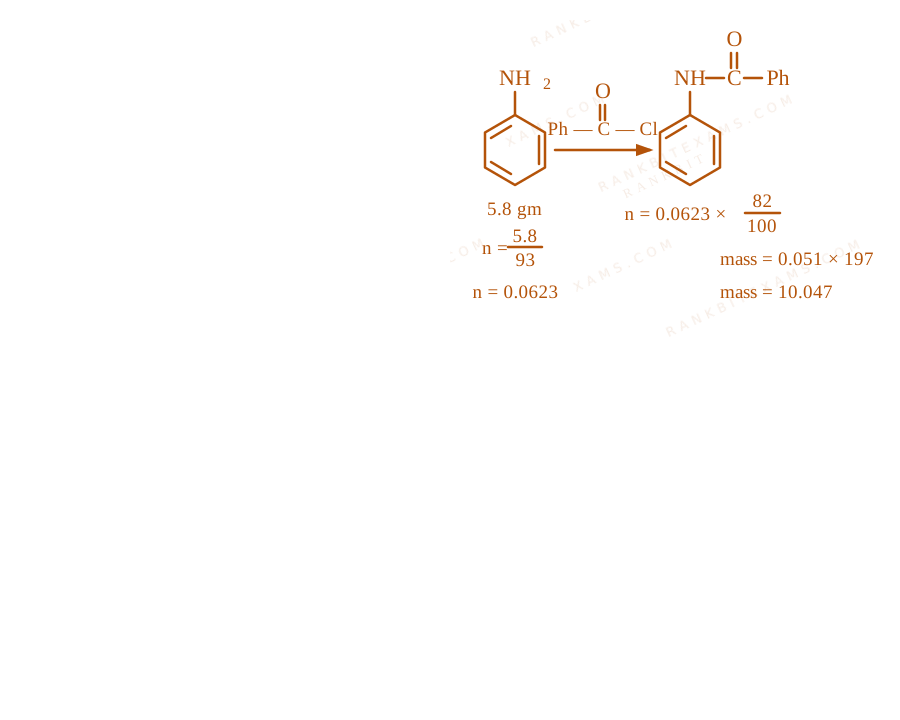
The mass of benzanilide obtained from the benzoylation reaction of 5.8 g$5.8\text{ g}$ of aniline, if yield of product is 82%, is ____ g (nearest integer).
(Given molar mass in g mol⁻¹$\text{g mol}^{-1}$ H:1, C:12, N:14, O:16)
Q57jee_main_2026_23_january_morningReactions of Aromatic Amines
Consider the following sequence of reactions.
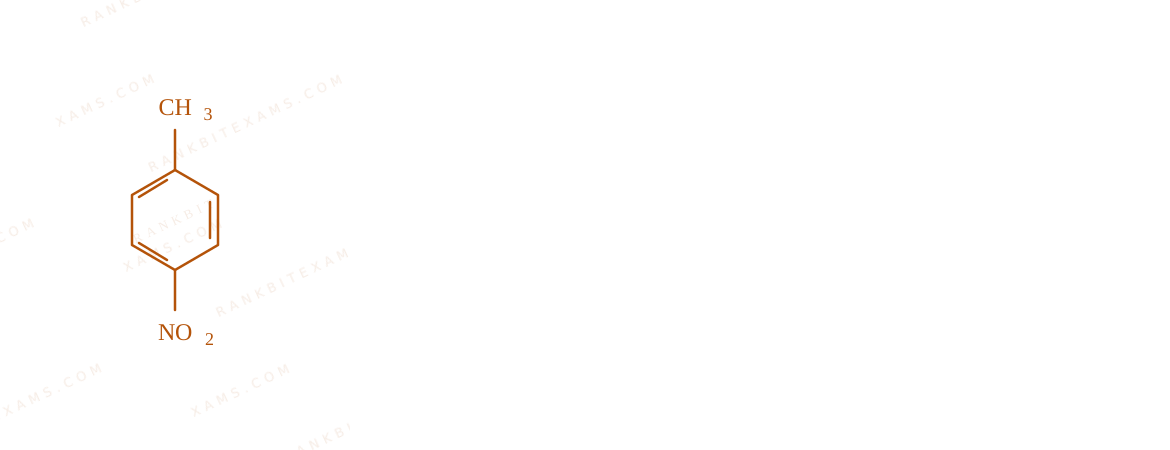
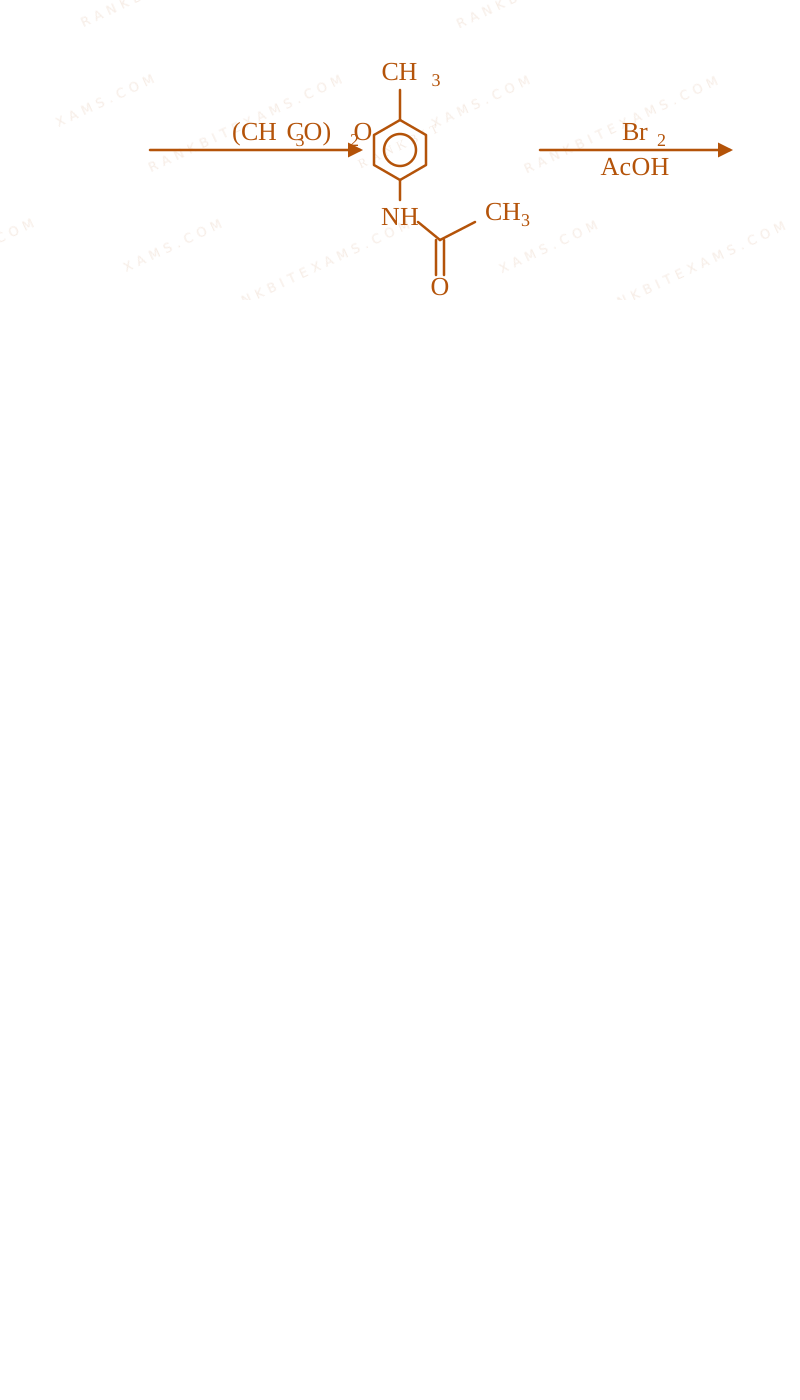
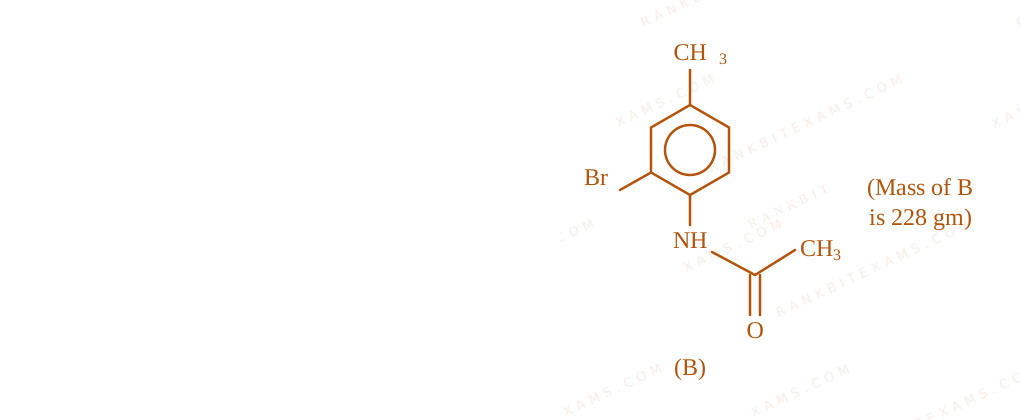
The image illustrates the multi-step conversion of 4-nitrotoluene into a brominated acetanilide derivative.
Assuming that the reaction proceeds to completion, then 137 mg of 4-nitrotoluene will produce ____mg of B.
(Given molar mass in g mol⁻¹$^{-1}$ H : 1, C : 12, N : 14, O : 16, Br : 80)
A.301$\text{301}$
B.146$\text{146}$
C.228$\text{228}$
D.208$\text{208}$
Solution
Core Logic
Follow the sequence of chemical transformations to determine the structure of product B, then apply stoichiometry based on moles of the starting material to find its final mass.
Step 1: Reaction Sequence Analysis
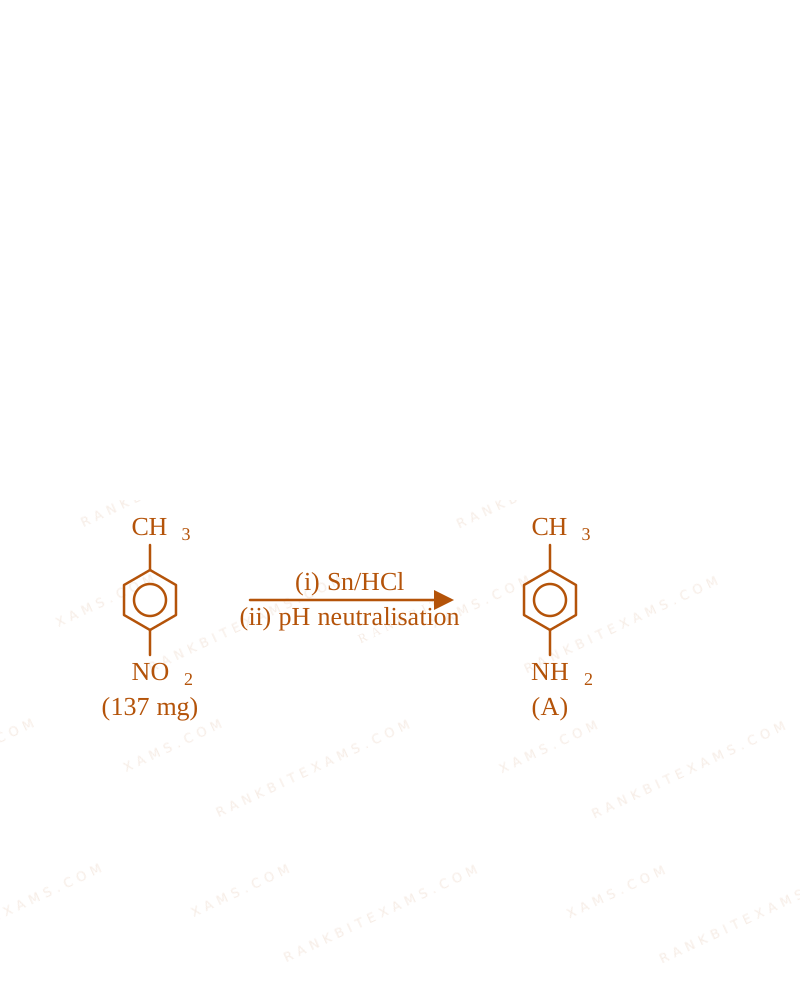
Reaction 1: Reduction of 4-nitrotoluene using Sn, HCl / Δ$Sn, HCl / \Delta$ followed by pH neutralization converts the -NO₂$-NO_2$ group to an -NH₂$-NH_2$ group, forming 4-methylaniline (p-toluidine).
The image illustrates the multi-step conversion of 4-nitrotoluene into a brominated acetanilide derivative.
Step 2: Acetylation
Reaction 2 (forming A): The aniline group is protected by reaction with acetic anhydride (CH₃CO)₂O$(CH_3CO)_2O$, forming an acetanilide derivative (N-(4-methylphenyl)acetamide).
The image illustrates the multi-step conversion of 4-nitrotoluene into a brominated acetanilide derivative.
Step 3: Bromination
Reaction 3 (forming B): Bromination using Br₂ / AcOH$Br_2 / AcOH$. The -NHCOCH₃$-NHCOCH_3$ group is strongly activating and ortho-directing, while the -CH₃$-CH_3$ group is weakly activating and ortho-directing. The incoming -Br$-Br$ will substitute ortho to the -NHCOCH₃$-NHCOCH_3$ group due to dominant directing influence.
The image illustrates the multi-step conversion of 4-nitrotoluene into a brominated acetanilide derivative.
Step 4: Stoichiometric Calculation
Molar mass of 4-nitrotoluene (C₇H₇NO₂$C_7H_7NO_2$) = 137 g/mol$137 \text{ g/mol}$.
Molar mass of product B (C₉H₁₀BrNO$C_9H_{10}BrNO$) = 228 g/mol$228 \text{ g/mol}$.
Since the stoichiometry is 1:1 and yields are 100%, moles of B = 0.001 mol$0.001 \text{ mol}$.
Mass of B = 0.001 mol × 228 g/mol = 0.228 g = 228 mg$0.001 \text{ mol} \times 228 \text{ g/mol} = 0.228 \text{ g} = 228 \text{ mg}$.
Pattern Recognition
When dealing with multi-step synthesis yield questions, immediately check the initial and final molar masses if the reaction achieves 100% completion. Often, 1 mole of reactant gives 1 mole of product.
Chapter Mix
Class 12 Chemistry: Amines
Q68jee_main_2026_23_january_morningHoffmann Bromamide Degradation and Carbylamine Reaction
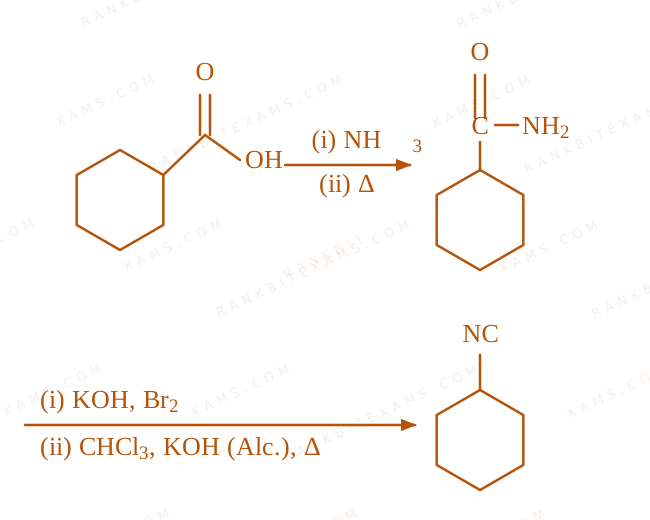
Compound 'P' undergoes the following sequence of reactions :
P [(ii)Δ](i)NH₃ Q [(ii)CHCl₃,KOH (alc),Δ](i)KOH, Br₂ Cyclohexyl isocyanide$P \xrightarrow[\text{(ii)}\Delta]{\text{(i)}\text{NH}_3} Q \xrightarrow[\text{(ii)}\text{CHCl}_3,\text{KOH (alc)},\Delta]{\text{(i)}\text{KOH, Br}_2} \text{Cyclohexyl isocyanide}$
'P' is :
A.(1)$(1)$
B.(2)$(2)$
C.(3)$(3)$
D.(4)$(4)$
Solution
Core Logic
Work backwards from the final product, cyclohexyl isocyanide.
Step 1: Carbylamine Reaction
The step (ii) CHCl₃, KOH (alc), Δ$(ii) \text{ } CHCl_3, KOH (alc), \Delta$ is the Carbylamine reaction. It converts a primary amine into an isocyanide. Therefore, the intermediate formed right before this step must be Cyclohexylamine (Cyclohexyl-NH₂$Cyclohexyl-NH_2$).
Hoffmann Bromamide Degradation and Carbylamine Reaction diagram for Q68 - JEE Main 2026 Morning
Step 2: Hoffmann Bromamide Degradation
The step (i) KOH, Br₂$(i) \text{ } KOH, Br_2$ is Hoffmann Bromamide Degradation. It converts an amide into a primary amine with one carbon less. Since the amine is Cyclohexylamine, the precursor 'Q' must be Cyclohexanecarboxamide.
Step 3: Finding 'P'
The reaction P NH₃, Δ Q$P \xrightarrow{NH_3, \Delta} Q$ converts a carboxylic acid into an amide. Therefore, 'P' must be Cyclohexanecarboxylic acid.
Pattern Recognition
Isocyanide (-NC$-NC$) final product arrow$\rightarrow$ Primary amine precursor arrow$\rightarrow$ Amide precursor via Hoffmann Bromamide arrow$\rightarrow$ Carboxylic acid via NH₃/Δ$NH_3/\Delta$.
Chapter Mix
Class 12 Chemistry: Amines
Class 12 Chemistry: Aldehydes Ketones and Carboxylic Acids
Q69jee_main_2026_23_january_eveningPreparation of Amines
Given below are two statements:
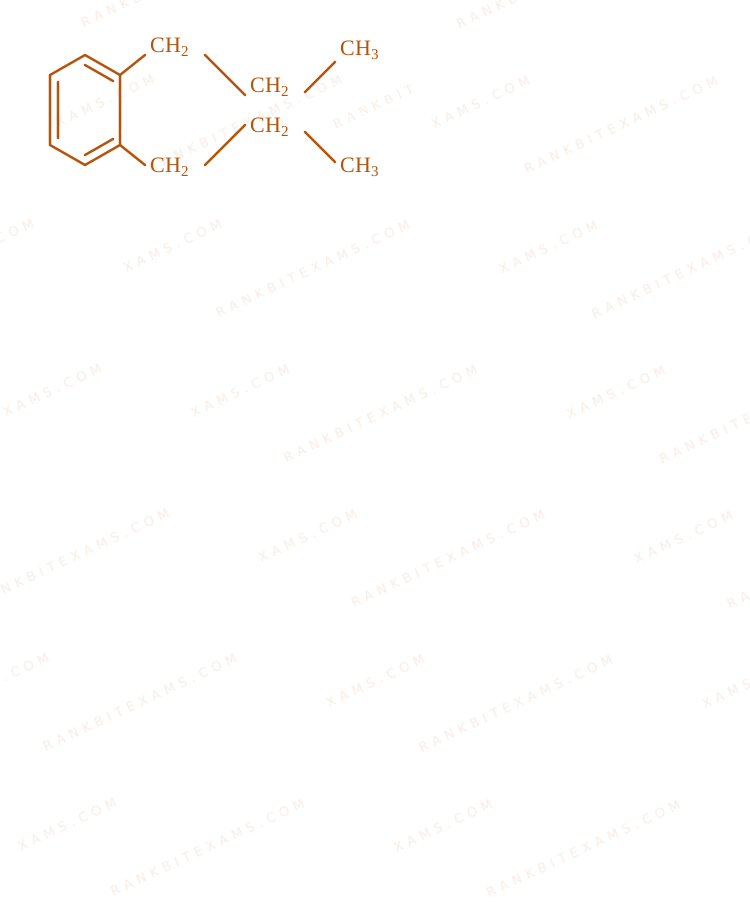
Statement I: Preparation of Amines can be synthesized from Preparation of Amines in the order i) Acidic KMnO₄$KMnO_4$, ii) Ammonia, iii) Bromine and alkali
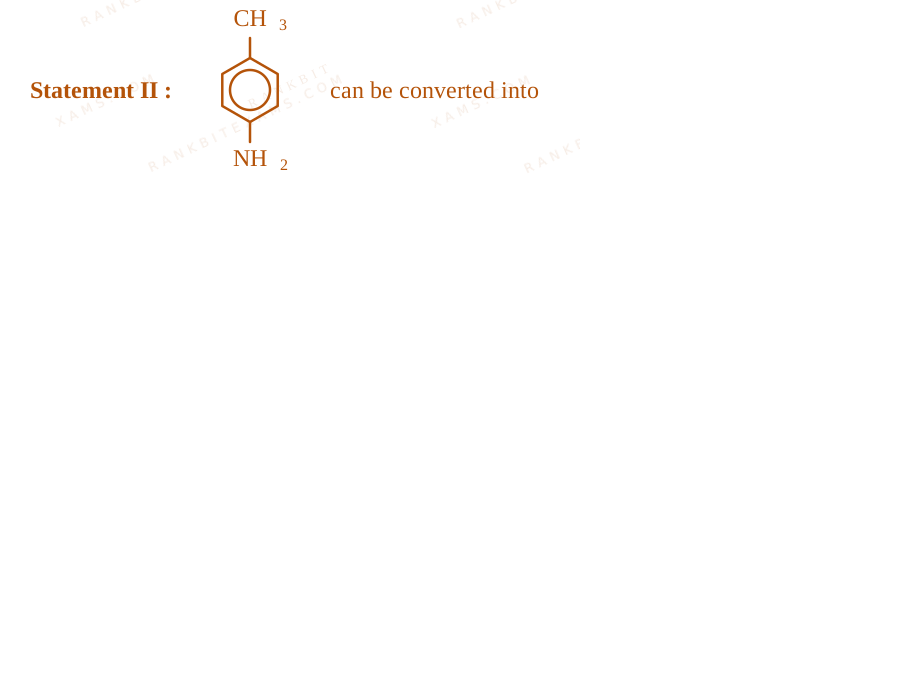
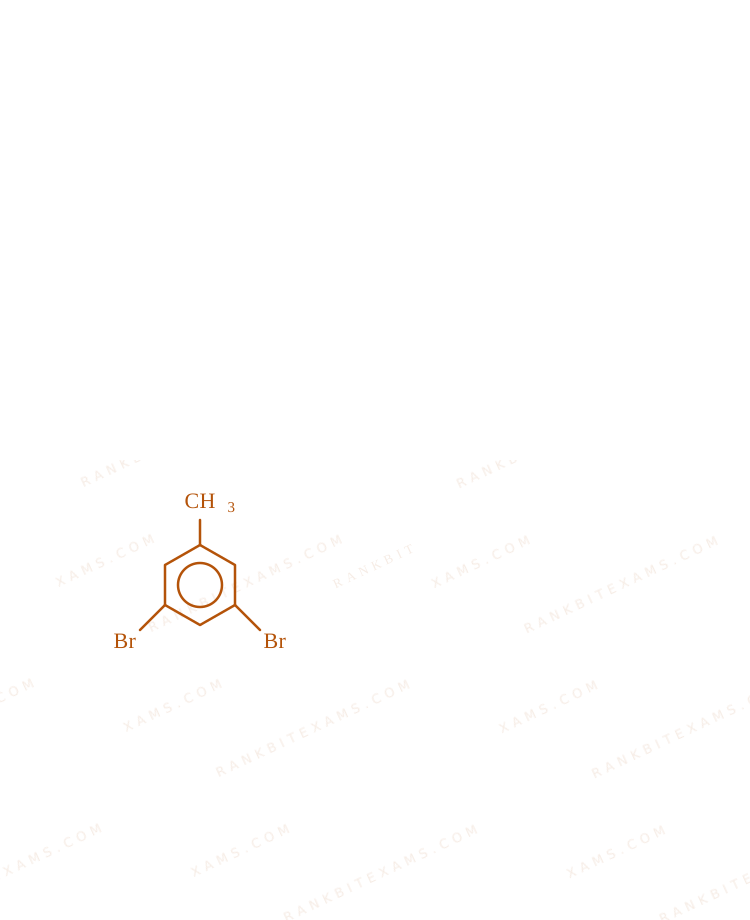
Statement II: Preparation of AminesPreparation of Amines
In the light of the above statements, choose the correct answer from the options given below
A.Both Statement I and Statement II are false$\text{Both Statement I and Statement II are false}$
B.Statement I is true but Statement II is false$\text{Statement I is true but Statement II is false}$
C.Both Statement I and Statement II are true$\text{Both Statement I and Statement II are true}$
D.Statement I is false but Statement II is true$\text{Statement I is false but Statement II is true}$
Solution
Core Logic
Statement I analysis:
The target is to convert an ethyl side chain (propylbenzene) into an aniline derivative.
Step 1: Treatment with acidic KMnO₄$KMnO_4$ oxidizes any alkyl side chain with at least one benzylic hydrogen fully into a carboxylic acid group (benzoic acid derivative).
Step 2: Reaction with Ammonia (NH₃$NH_3$) converts the carboxylic acid into an amide.
Step 3: Bromine and alkali (Br₂ + KOH$Br_2 + KOH$) trigger a Hoffmann bromamide degradation, chopping off the carbonyl carbon and leaving an amine (NH₂$NH_2$). This correctly yields the target structure. Statement I is True.
Step 1: Statement II Analysis
Statement II analysis:
The goal is to convert p-toluidine to 3,5-dibromotoluene.
Step 1: Bromine water (Br₂ + H₂O$Br_2 + H_2O$) performs electrophilic aromatic substitution on the highly activated ring due to the -NH₂$-NH_2$ group. It polybrominates the ortho and para positions relative to -NH₂$-NH_2$. Since para is blocked by the methyl group, it brominates both ortho positions, yielding 2,6-dibromo-4-methylaniline.
Step 2: Diazotization with NaNO₂ + HCl$NaNO_2 + HCl$ at 0-5°C$0-5^{\circ}\text{C}$ converts the -NH₂$-NH_2$ group into a diazonium salt (-N₂^+Cl^-$-N_2^+Cl^-$).
Step 3: Aqueous H₃PO₂$H_3PO_2$ (hypophosphorous acid) acts as a reducing agent, replacing the diazonium group with a Hydrogen atom. This successfully yields 3,5-dibromotoluene (since the numbering shifts). Statement II is True.
Pattern Recognition
Hoffmann bromamide degradation strictly steps down an amide to an amine by eliminating the carbonyl C$C$. Deamination of aniline derivatives via diazonium salt followed by reduction (H₃PO₂$H_3PO_2$ or EtOH) is the standard method for synthesizing specific meta-substituted benzenes where direct electrophilic meta-substitution fails.
Chapter Mix
Class 12 Chemistry: Amines
Q70jee_main_2026_23_january_eveningChemical Reactions of Amines
A student has been given a compound "x" of molecular formula -C₆H₇N$C_{6}H_{7}N$. 'x' is sparingly soluble in water. However, on addition of dilute mineral acid, 'x' becomes soluble in water. 'x' when treated with CHCl₃$CHCl_{3}$ and KOH (alc.) 'y' is produced. 'y' has a specific unpleasant smell. On treatment with benzenesulphonyl chloride, 'x' gives a compound 'z' which is soluble in alkali. The number of different "H" atoms present in 'z' is:-
A.5$5$
B.8$8$
C.4$4$
D.7$7$
Solution
Core Logic
Identify compound 'x':
Molecular formula C₆H₇N$C_6H_7N$ indicates a high degree of unsaturation (Degree of Unsaturation = 6 - 7/2 + 1/2 + 1 = 4$6 - 7/2 + 1/2 + 1 = 4$), characteristic of a benzene ring. Given it dissolves in dilute mineral acid (due to protonation forming a salt), it's a basic amine. Since it produces an unpleasant-smelling compound 'y' with CHCl₃$CHCl_3$ and alc. KOH, it gives a positive carbylamine test, meaning 'x' is a primary amine. Thus, 'x' is Aniline (Ph-NH₂$Ph-NH_2$).
Compound 'y' is phenyl isocyanide (Ph-NC$Ph-NC$).
Step 1: Identifying compound 'z'
Reaction with benzenesulphonyl chloride (Hinsberg's reagent):
Aniline reacts with Ph-SO₂Cl$Ph-SO_2Cl$ to form N$N$-phenylbenzenesulfonamide, which is 'z'.
Structure of 'z': Ph-NH-SO₂-Ph$Ph-NH-SO_2-Ph$.
Because 'z' has an acidic proton on the nitrogen, it is soluble in alkali, confirming our deduction.
Step 2: Counting different "H" atoms
Let's map the types of Hydrogen atoms (chemically distinct environments by symmetry) on the molecule 'z' (Ph-NH-SO₂-Ph$Ph-NH-SO_2-Ph$):
The single hydrogen attached to the Nitrogen (N-H$N-H$): 1 type.
The first phenyl ring (from aniline) has symmetry down the 1,4-axis. It has ortho-H, meta-H, and para-H. That yields 3 distinct types of H.
The second phenyl ring (from sulfonyl chloride) also has symmetry down its 1,4-axis. It has ortho-H, meta-H, and para-H. That yields 3 distinct types of H.
Total number of different H atoms = 1 + 3 + 3 = 7$1 + 3 + 3 = 7$.
Pattern Recognition
Whenever you see CHCl₃$CHCl_3$ + alc. KOH producing an foul smell, it's definitively the Carbylamine test marking a primary amine. Soluble in alkali after Hinsberg's reagent confirms it's a 1°$1^{\circ}$ amine.
Chapter Mix
Class 12 Chemistry: Amines
More Amines Questions — jee_main_2025_28_jan_evening
Practice past-year questions one chapter at a time. Pick an exam → subject → chapter and get every PYQ for that topic — pulled together from all past papers — with the chapter's key formulas alongside.