JEE Main · Physics → Steady

System of Particles and Rotational Motion appeared 58 times across 3 years — 6.7% of Physics. This question is from Rolling Motion.

Year 2026 2025 2024 Total
Questions 20 27 11 58

A uniform solid cylinder of mass 'm' and radius 'r' rolls along an inclined rough plane of inclination 45° If it starts to roll from rest from the top of the plane then the linear acceleration of the cylinder axis will be :-

Solution & Explanation

Related Formula

The linear acceleration a for pure rolling motion down an incline profile is:

a = g θ1 + Imr²
Core Logic

For a uniform solid cylinder, the moment of inertia around its central axis is:

I = (1)/(2)mr² Imr² = (1)/(2)
Step 1: Calculating Acceleration

Substitute θ = 45° and the cylinder inertial factor into the formula :

a = g 45°1 + (1)/(2) = g√(2)(3)/(2) a = 2g3√(2) = √(2)g3
Pattern Recognition

Solid cylinder rolls with acceleration matching (2)/(3) g θ. Since 45° = 1√(2), this simplifies directly to √(2)g3.

Chapter Mix

Class 11 Physics: System of Particles and Rotational Motion

Reference Study Guides

More System of Particles and Rotational Motion Previous-Year Questions — Page 9

Q25 jee_main_2025_07_april_evening Moment of Inertia of a Disc with Cavity
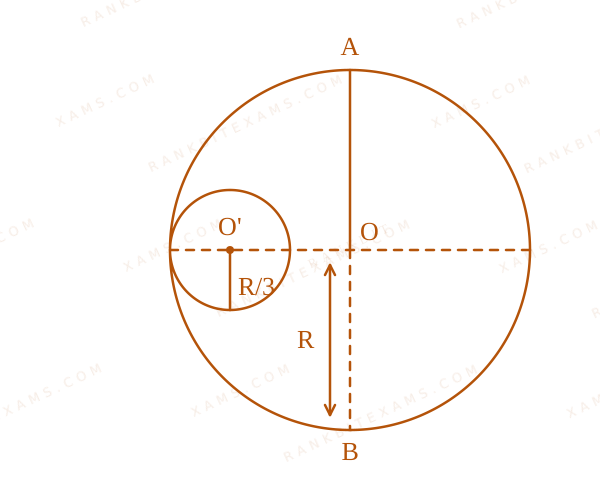
M and R be the mass and radius of a disc. A small disc of radius R/3 is removed from the bigger disc as shown in figure. The moment of inertia of remaining part of bigger disc about an axis AB passing through the centre O and perpendicular to the plane of disc is 4xMR² The value of x is
Moment of Inertia diagram for Q25 - JEE Main 2025 Evening
The graphic depicts a flat circular uniform disk of radius R with a smaller circular cut-out cavity of radius R/3 touching the perimeter.
[cite: 197, 198, 199, 200, 208]
Numerical Answer. Answer: 9 to 9

Solution

Related Formula

Idisc = (1)/(2) M R² [cite: 833]

I = Icm + M d² (Parallel Axis Theorem) [cite: 848]

Core Logic

Let the original mass density per unit area be σ. Without any cavity, the moment of inertia is: [cite: 198, 833]

I₁ = (MR²)/(2) [cite: 833]

The mass of the removed small section scales directly with its cut-out area profile: [cite: 198, 834]

m = (M)/(π R²) × π ((R)/(3))² = (M)/(9) [cite: 198, 834, 844]

The center of mass of the removed disk sits at a distance d = R - (R)/(3) = (2R)/(3) away from the primary center O[cite: 198, 205, 848]. Calculating its partial moment of inertia about O via the parallel axis theorem: [cite: 199, 848]

I₂ = (m r²)/(2) + m d² = ((M)/(9)((R)/(3))²)/(2) + (M)/(9)((2R)/(3))² [cite: 848]

I₂ = (MR²)/(162) + (4MR²)/(81) = (MR² + 8MR²)/(162) = (9MR²)/(162) = (MR²)/(18) [cite: 848, 850]

Subtracting the removed component from the original configuration: [cite: 851]

I = I₁ - I₂ = (MR²)/(2) - (MR²)/(18) = (9MR² - MR²)/(18) = (8MR²)/(18) = (4)/(9)MR² [cite: 851]

Matching this with (4)/(x)MR², we find x = 9[cite: 200, 208, 851, 853].

Pattern Recognition

For uniform planar surfaces, mass always scales squarely with linear dimension changes (r arrow (r)/(3) m arrow (m)/(9))[cite: 198, 834, 844]. Always apply the parallel axis theorem to bring the component values to a unified reference point before executing addition or subtraction[cite: 848, 851].

Chapter Mix

Class 11 Physics: System of Particles and Rotational Motion
Q4 jee_main_2025_24_jan_evening Rolling Motion
A solid sphere is rolling without slipping on a horizontal plane. The ratio of the linear kinetic energy of the centre of mass of the sphere and rotational kinetic energy is:
  • A. (2)/(5)
  • B. (5)/(2)
  • C. (3)/(4)
  • D. (4)/(3)

Solution

Related Formula
Klinear = (1)/(2) m vcm² Krotational = (1)/(2) I ω²
Core Logic

For a solid sphere, the moment of inertia about the center of mass is I = (2)/(5)mR². Since it rolls without slipping, the condition vcm = ω R holds.

Substituting I and ω into the ratio:

KlinearKrotational = (1)/(2) m vcm²(1)/(2) ((2)/(5)mR²) ( vcmR)² KlinearKrotational = (1)/((2)/(5)) = (5)/(2)
Pattern Recognition

The ratio of translational to rotational kinetic energy for any rolling body is given by mR²Icm. For a solid sphere, this becomes (1)/(2/5) = (5)/(2).

Chapter Mix

Class 11 Physics: System of Particles and Rotational Motion
Q9 jee_main_2025_24_jan_evening Rolling on an Inclined Plane
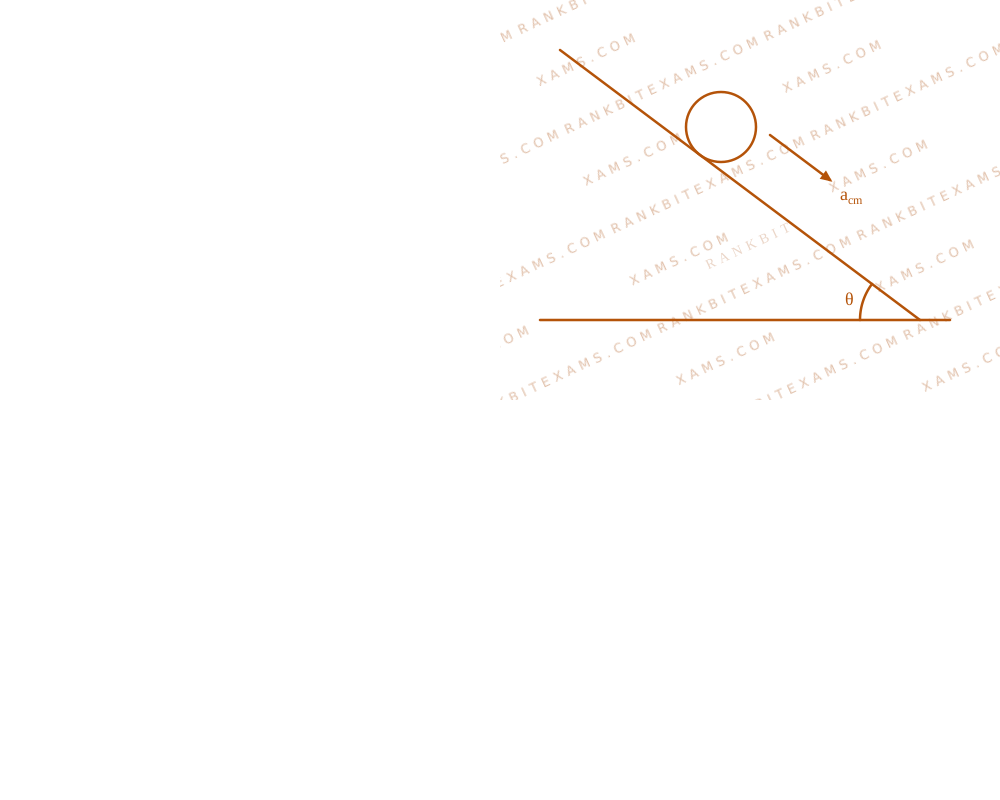
A solid sphere and a hollow sphere of the same mass and of same radius are rolled on an inclined plane. Let the time taken to reach the bottom by the solid sphere and the hollow sphere be t₁ and t₂, respectively, then
  • A. t₁ < t₂
  • B. t₁ = t₂
  • C. t₁ = 2t₂
  • D. t₁ > t₂

Solution

Related Formula
t = 2 acm acm = g θ1 + IcmMR²
Core Logic

For a solid sphere: Isolid = (2)/(5)MR² a₁ = (g θ)/(1 + 2/5) = (5)/(7)g θ.

For a hollow sphere: Ihollow = (2)/(3)MR² a₂ = (g θ)/(1 + 2/3) = (3)/(5)g θ.

Comparing accelerations: a₁ > a₂

Since acceleration of the solid sphere is greater, it takes less time to descend the incline: t₁ < t₂

Sphere rolling down an incline schematic Q9

Pattern Recognition

Smaller moment of inertia mass distribution (more concentrated at the center) yields larger acceleration down an incline, meaning a quicker descent.

Chapter Mix

Class 11 Physics: System of Particles and Rotational Motion

Q jee_main_2025_24_jan_morning Angular Momentum
An object of mass 'm' is projected from origin in a vertical xy plane at an angle 45° with the x-axis with an initial velocity v₀ The magnitude and direction of the angular momentum of the object with respect to origin, when it reaches at the maximum height, will be [g is acceleration due to gravity]
  • A. mv₀³2√(2)g along negative z-axis
  • B. mv₀³2√(2)g along positive z-axis
  • C. mv₀³4√(2)g along positive z-axis
  • D. mv₀³4√(2)g along negative z-axis

Solution

Related Formula

The definition of angular momentum vector L relative to the origin is:

L = r × p = m( r × v)

In scalar form for a horizontal speed component at a maximum altitude H:

L = m vₓ H

Core Logic

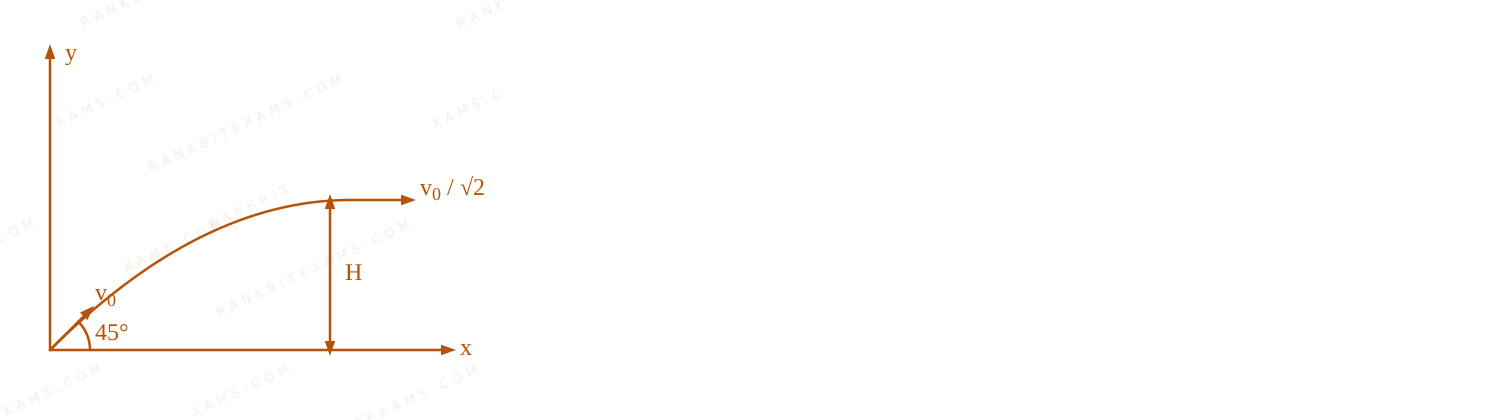
At maximum height, the vertical speed component drops to zero, and the projectile travels entirely horizontally along the curve profile as shown in

Angular Momentum diagram for Q8 - JEE Main 2025 Morning
:

vₓ = v₀ 45° = v₀√(2) H = v₀² ² 45°2g = v₀²4g
Step 1: Calculating Magnitude and Vector Direction

Evaluate the horizontal vector cross components:

L = m ( v₀√(2)) ( v₀²4g) = mv₀³4√(2)g

Using the right-hand rule, r points into quadrant-1 while velocity points towards + i. Therefore, r × v tracks clockwise, yielding a negative k orientation (along the negative z-axis).

Pattern Recognition

At peak height, always map L using m · vpeak · ymax. This scalar form simplifies the calculation significantly.

Chapter Mix

Class 11 Physics: System of Particles and Rotational Motion

More System of Particles and Rotational Motion Questions — jee_main_2025_24_jan_morning

Practice all System of Particles and Rotational Motion previous-year questions →

Rankbit System
JEE Physics: Waves (+15.5%) | Electrostatics: Concentric Shells (-29.7%) | Modern Physics: Photoelectric Clones (+34.2%) | Mathematics: Definite Integrals (+18.1%) | Chemistry: Coordination Splitting (-11.4%) | JEE Physics: Waves (+15.5%) | Electrostatics: Concentric Shells (-29.7%) | Modern Physics: Photoelectric Clones (+34.2%) | Mathematics: Definite Integrals (+18.1%) | Chemistry: Coordination Splitting (-11.4%)