Solution
Related Formula
Idisc = (1)/(2) M R² [cite: 833]
I = Icm + M d² (Parallel Axis Theorem) [cite: 848]
Core Logic
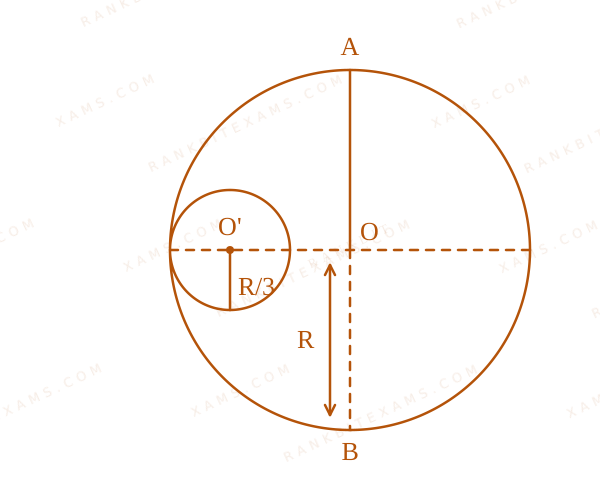
Let the original mass density per unit area be σ. Without any cavity, the moment of inertia is: [cite: 198, 833]
I₁ = (MR²)/(2) [cite: 833]
The mass of the removed small section scales directly with its cut-out area profile: [cite: 198, 834]
m = (M)/(π R²) × π ((R)/(3))² = (M)/(9) [cite: 198, 834, 844]
The center of mass of the removed disk sits at a distance d = R - (R)/(3) = (2R)/(3) away from the primary center O[cite: 198, 205, 848]. Calculating its partial moment of inertia about O via the parallel axis theorem: [cite: 199, 848]
I₂ = (m r²)/(2) + m d² = ((M)/(9)((R)/(3))²)/(2) + (M)/(9)((2R)/(3))² [cite: 848]
I₂ = (MR²)/(162) + (4MR²)/(81) = (MR² + 8MR²)/(162) = (9MR²)/(162) = (MR²)/(18) [cite: 848, 850]
Subtracting the removed component from the original configuration: [cite: 851]
I = I₁ - I₂ = (MR²)/(2) - (MR²)/(18) = (9MR² - MR²)/(18) = (8MR²)/(18) = (4)/(9)MR² [cite: 851]
Matching this with (4)/(x)MR², we find x = 9[cite: 200, 208, 851, 853].
Pattern Recognition
For uniform planar surfaces, mass always scales squarely with linear dimension changes (r arrow (r)/(3) m arrow (m)/(9))[cite: 198, 834, 844]. Always apply the parallel axis theorem to bring the component values to a unified reference point before executing addition or subtraction[cite: 848, 851].
Chapter Mix
Class 11 Physics: System of Particles and Rotational Motion