JEE Main · Physics → Steady

Electrostatics appeared 79 times across 3 years — 9.1% of Physics. This question is from Gauss's Law and Electric Flux.

Year 2026 2025 2024 Total
Questions 24 39 16 79

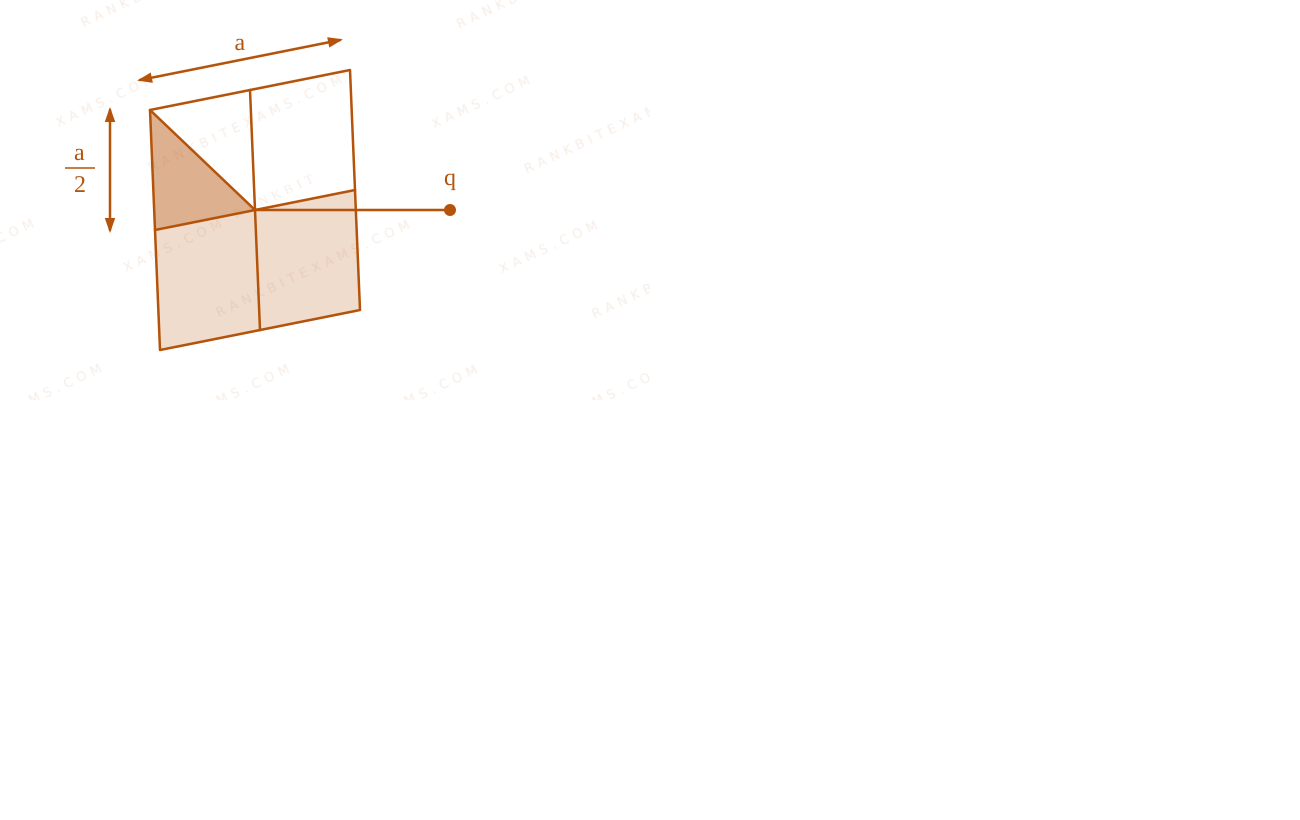
A square loop of sides a = 1 m is held normally in front of a point charge q = 1C The flux of the electric field through the shaded region is (5)/(p) × (1)/(ε₀) (Nm²)/(C) , where the value of p is .
Gauss's Law and Electric Flux diagram for Q21 - JEE Main 2025 Morning
The diagram illustrates a square loop divided into 8 symmetric parts with a point charge positioned in front of its center.

Numerical Answer Type:
Enter a numerical value Answer: 48 to 48 +4 marks

Solution & Explanation

Related Formula

By Gauss's Law, the total flux emitted by a point charge q through a completely enclosing symmetric cube container surface is:

Φtotal = qε₀
Core Logic

Assuming the charge resides at a symmetric center distance (a)/(2) relative to the loop face, this square loop represents one of the six identical faces of an enclosing cube system. Thus, the flux passing through the entire square loop face is:

Φsquare = (1)/(6) Φtotal = q6ε₀
Step 1: Symmetric Partitioning

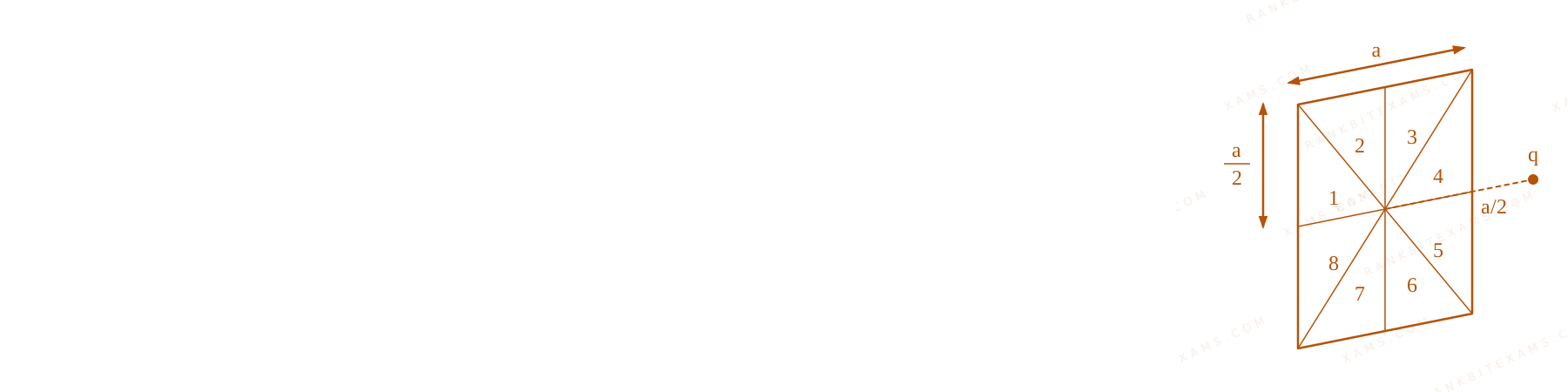
As shown in the solution schematic

Gauss's Law and Electric Flux diagram for Q21 - JEE Main 2025 Morning
The diagram illustrates a square loop divided into 8 symmetric parts with a point charge positioned in front of its center.
, the square face can be divided into 8 identical symmetric right-angled triangle sections by drawing its diagonals and medians. Each individual part intercepts an equal portion of the flux field :

Φₚₐᵣₜ = (1)/(8) Φsquare = (1)/(8) ( q6ε₀) = q48ε₀

The shaded region covers exactly 5 of these individual triangle parts :

Φshaded = 5 × Φₚₐᵣₜ = (5)/(48) × qε₀

Comparing this result with the given expression (5)/(p) × 1ε₀ , we find:

p = 48

Pattern Recognition

Exploit geometric symmetry to break solid angles down into equal fractions, avoiding complex surface integration.

Chapter Mix

Class 12 Physics: Electrostatics

More Electrostatics Previous-Year Questions — Page 8

Q9 jee_main_2025_08_april_evening Electric Charge and Properties
Two metal spheres of radius R and 3R have same surface charge density σ. If they are brought in contact and then separated, the surface charge density on smaller and bigger sphere becomes σ₁ and σ₂, respectively. The ratio σ₁σ₂ is:
  • A. (1)/(9)
  • B. 9
  • C. (1)/(3)
  • D. 3

Solution

Related Formula
V = (σ r)/(ε₀)

where, V = electrostatic potential of a conducting sphere σ = surface charge density r = radius of the sphere

Core Logic

For any conducting sphere, the potential on its surface is related to its surface charge density by:

V = (k Q)/(r) = (1)/(4πε₀) (σ (4π r²))/(r) = (σ r)/(ε₀)

When the two spheres of radii r₁ = R and r₂ = 3R are brought into contact, charge flows between them until they reach an identical electric potential:

V₁ = V₂

Step 1: Ratio Calculation

Equate the potentials of the two spheres after separation:

(σ₁ r₁)/(ε₀) = (σ₂ r₂)/(ε₀) σ₁ R = σ₂ (3R) (σ₁)/(σ₂) = (3R)/(R) = 3
Pattern Recognition

Sees: "Conducting spheres brought in contact" → Electric potentials become equal: V₁ = V₂. Shortcut: Since V ∝ σ r, equal potential directly implies σ₁ r₁ = σ₂ r₂. Thus, the ratio of final densities is simply the inverse ratio of their radii: (σ₁)/(σ₂) = (r₂)/(r₁) = (3)/(1) = 3. This bypasses computing the individual final charges entirely! ✓

Chapter Mix

Class 12 Physics: Electrostatics

Q23 jee_main_2025_08_april_evening Capacitance
Space between the plates of a parallel plate capacitor of plate area 4~cm² and separation of (d) 1.77~mm, is filled with uniform dielectric materials with dielectric constants (3 and 5) as shown in figure. Another capacitor of capacitance 7.5~pF is connected in parallel with it. The effective capacitance of this combination is ________ ~pF.
Capacitance parallel plate dielectric diagram for Q23 - JEE Main 2025 Evening
This diagram shows a parallel plate capacitor filled with two layers of dielectric constant k=5 and k=3, each having thickness d/2.
(Given ε₀ = 8.85× 10⁻¹²~F/m)
Numerical Answer. Answer: 15 to 15

Solution

Related Formula
C = k (ε₀ A)/(t) 1Cₛₑᵣᵢₑₛ = (1)/(C₁) + (1)/(C₂) Cparallel = Ceq + Cₚ
Core Logic

The dielectrics k₁ = 5 and k₂ = 3 split the capacitor separation horizontally into two layers, each of thickness (d)/(2). Thus, they act as two capacitors connected in series:

  • Capacitor 1: C₁ = k₁ (ε₀ A)/(d/2) = 5 × (2 ε₀ A)/(d) = 10 (ε₀ A)/(d)
  • Capacitor 2: C₂ = k₂ (ε₀ A)/(d/2) = 3 × (2 ε₀ A)/(d) = 6 (ε₀ A)/(d)
Step 1: Compute Base Capacitance Factor

First, find the term (ε₀ A)/(d) in SI units:

  • A = 4~cm² = 4 × 10⁻⁴~m²
  • d = 1.77~mm = 1.77 × 10⁻³~m
  • ε₀ = 8.85 × 10⁻¹²~F/m
(ε₀ A)/(d) = 8.85 × 10⁻¹² × 4 × 10⁻⁴1.77 × 10⁻³ = 35.4 × 10⁻¹⁶1.77 × 10⁻³ = 20 × 10⁻¹³~F = 2~pF

Now find C₁ and C₂:

  • C₁ = 10 × 2~pF = 20~pF
  • C₂ = 6 × 2~pF = 12~pF
  • Calculate their series equivalent Ceq:

Ceq = (C₁ C₂)/(C₁ + C₂) = (20 × 12)/(20 + 12) = (240)/(32) = 7.5~pF
Step 2: Add Parallel Capacitor

Another capacitor of Cₚ = 7.5~pF is connected in parallel with the combination:

Cfinal = Ceq + Cₚ = 7.5~pF + 7.5~pF = 15~pF
Pattern Recognition

Sees: Dielectric boundary parallel to the plates → Series capacitors. Trap: Don't treat horizontally split layers as parallel; split in distance d means series, while split in area A means parallel. Shortcut: Notice (35.4)/(1.77) is exactly 20. This makes the numerical calculations incredibly clean! ✓

Chapter Mix

Class 12 Physics: Electrostatics
Q3 jee_main_2025_29_jan_evening Electric Dipole in Uniform Electric Field
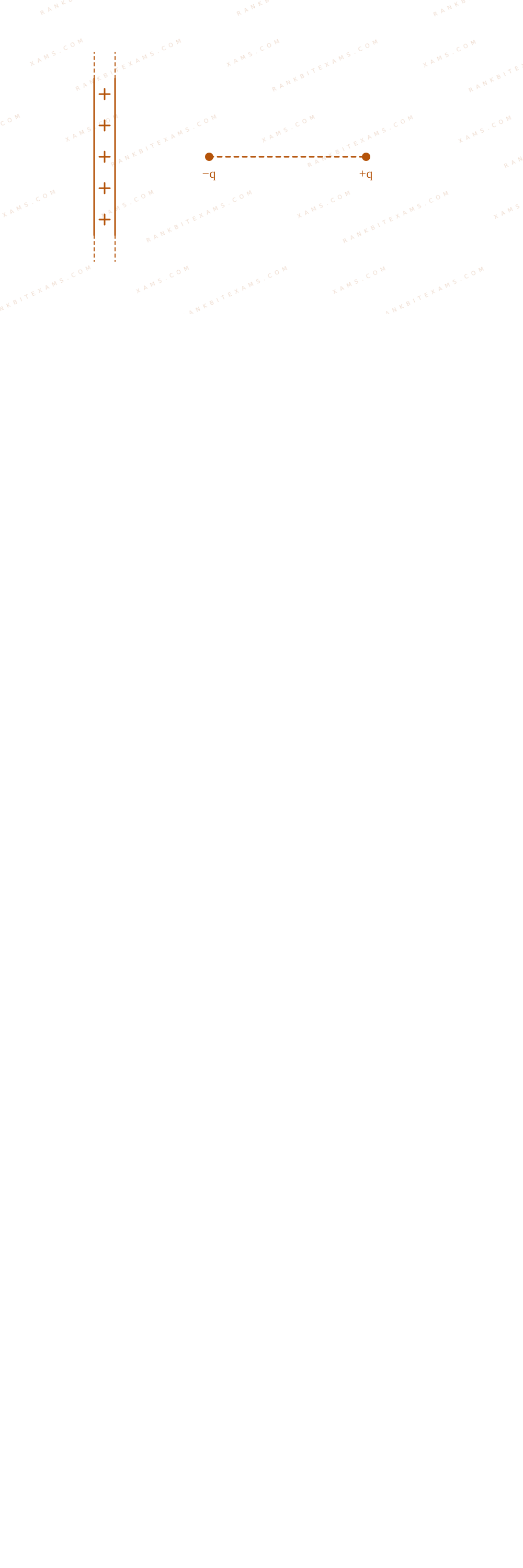
An electric dipole is placed at a distance of 2~cm from an infinite plane sheet having positive charge density σ₀. Choose the correct option from the following.
Electric Dipole in Uniform Electric Field diagram for Q3 - JEE Main 2025 Evening
The diagram illustrates an electric dipole with charges -q and +q aligned parallel to an infinite plane sheet of positive charge density.
  • A. Torque on dipole is zero and net force is directed away from the sheet.
  • B. Torque on dipole is zero and net force acts towards the sheet.
  • C. Potential energy of dipole is minimum and torque is zero.
  • D. Potential energy and torque both are maximum

Solution

Related Formula
E = (σ₀)/(2ε₀) τ = p × E U = - p · E
Core Logic

An infinite plane sheet produces a uniform electric field E directed normally away from the sheet.

As shown in the image layout, the dipole moment vector p (pointing from -q to +q) is oriented parallel to the electric field vectors E:

θ = 0°
  • Torque evaluation:
τ = pE (0°) = 0
  • Potential Energy evaluation:
U = -pE (0°) = -pE (Minimum)
  • Net Force evaluation:
  • Since the electric field is uniform, the force on +q balances the force on -q, meaning Fₙₑₜ = 0.

Pattern Recognition

When a dipole aligns perfectly with a uniform electric field (p ∥ E), it reaches stable equilibrium. Stable equilibrium fundamentally means minimum potential energy (U = -pE) and zero torque.

Chapter Mix

Class 12 Physics: Electrostatics

Q5 jee_main_2025_29_jan_evening Gauss's Law and Flux
A point charge causes an electric flux of -2 × 10⁴ ~Nm²C⁻¹ to pass through a spherical Gaussian surface of 8.0~cm radius, centred on the charge. The value of the point charge is : (Given ε₀ = 8.85 × 10⁻¹² ~C²N⁻¹m⁻²)
  • A. -17.7 × 10⁻⁸ ~C
  • B. -15.7 × 10⁻⁸ ~C
  • C. 17.7 × 10⁻⁸ ~C
  • D. 15.7 × 10⁻⁸ ~C

Solution

Related Formula
φ = qenclosedε₀

where, φ = net electric flux through the closed surface qenclosed = net charge enclosed by the surface ε₀ = permittivity of free space

Core Logic

According to Gauss's Law, the total electric flux through a closed surface depends only on the charge enclosed inside it, completely independent of the radius of the surface.

Rearranging the formula to solve for q:

q = φ · ε₀

Substitute the given values:

q = (-2 × 10⁴ ~Nm²C⁻¹) × (8.85 × 10⁻¹² ~C²N⁻¹m⁻²) q = -17.7 × 10⁻⁸ ~C
Pattern Recognition

Distractor alert: The radius (8.0~cm) is extra data meant to mislead. Gauss's flux depends entirely on the magnitude of the enclosed charge, not the physical surface area configuration.

Chapter Mix

Class 12 Physics: Electrostatics

Q14 jee_main_2025_29_jan_evening Sharing of Charges and Loss of Energy
A capacitor, C₁ = 6 is charged to a potential difference of V₀ = 5V using a 5V battery. The battery is removed and another capacitor, C₂ = 12 is inserted in place of the battery. When the switch 'S' is closed, the charge flows between the capacitors for some time until equilibrium condition is reached. What are the charges (q₁ and q₂) on the capacitors C₁ and C₂ when equilibrium condition is reached.
Sharing of Charges and Loss of Energy diagram for Q14 - JEE Main 2025 Evening
The circuit diagram displays two capacitors C1 and C2 with a switch S used to establish parallel connectivity between them.
  • A. q₁ = 15 , q₂ = 30
  • B. q₁ = 30 , q₂ = 15
  • C. q₁ = 10 , q₂ = 20
  • D. q₁ = 20 , q₂ = 10

Solution

Related Formula
Qtotal = C₁ V₀ Vc = QtotalC₁ + C₂

q = C · Vc

Core Logic
  • Initial Charge Calculation:
  • Before closing the switch, capacitor C₁ accumulates total charge:

q₁' = C₁ · V₀ = 6 × 5V = 30

Uncharged capacitor C₂ holds q₂' = 0.

Sharing of Charges Initial State diagram for Q14 - JEE Main 2025 Evening
The circuit diagram displays two capacitors C1 and C2 with a switch S used to establish parallel connectivity between them.

  • Redistribution at Equilibrium:
  • Closing the switch causes parallel redistribution until they reach a common potential Vc:

    Sharing of Charges Initial State diagram for Q14 - JEE Main 2025 Evening
    The circuit diagram displays two capacitors C1 and C2 with a switch S used to establish parallel connectivity between them.

Vc = 30 + 06 + 12 = (30)/(18) = (5)/(3)~V
  • Final Charges:
q₁ = C₁ · Vc = 6 × (5)/(3) = 10 q₂ = C₂ · Vc = 12 × (5)/(3) = 20

Hence, the charges are 10 and 20 respectively.

Pattern Recognition

For parallel combination setups, the final charge splits in the exact direct ratio of their capacitances: q₁ : q₂ = C₁ : C₂ = 6 : 12 = 1 : 2. Out of 30, the breakdown must cleanly be 10 and 20.

Chapter Mix

Class 12 Physics: Electrostatic Potential and Capacitance

More Electrostatics Questions — jee_main_2025_24_jan_morning

Practice all Electrostatics previous-year questions →

Rankbit System
JEE Physics: Waves (+15.5%) | Electrostatics: Concentric Shells (-29.7%) | Modern Physics: Photoelectric Clones (+34.2%) | Mathematics: Definite Integrals (+18.1%) | Chemistry: Coordination Splitting (-11.4%) | JEE Physics: Waves (+15.5%) | Electrostatics: Concentric Shells (-29.7%) | Modern Physics: Photoelectric Clones (+34.2%) | Mathematics: Definite Integrals (+18.1%) | Chemistry: Coordination Splitting (-11.4%)