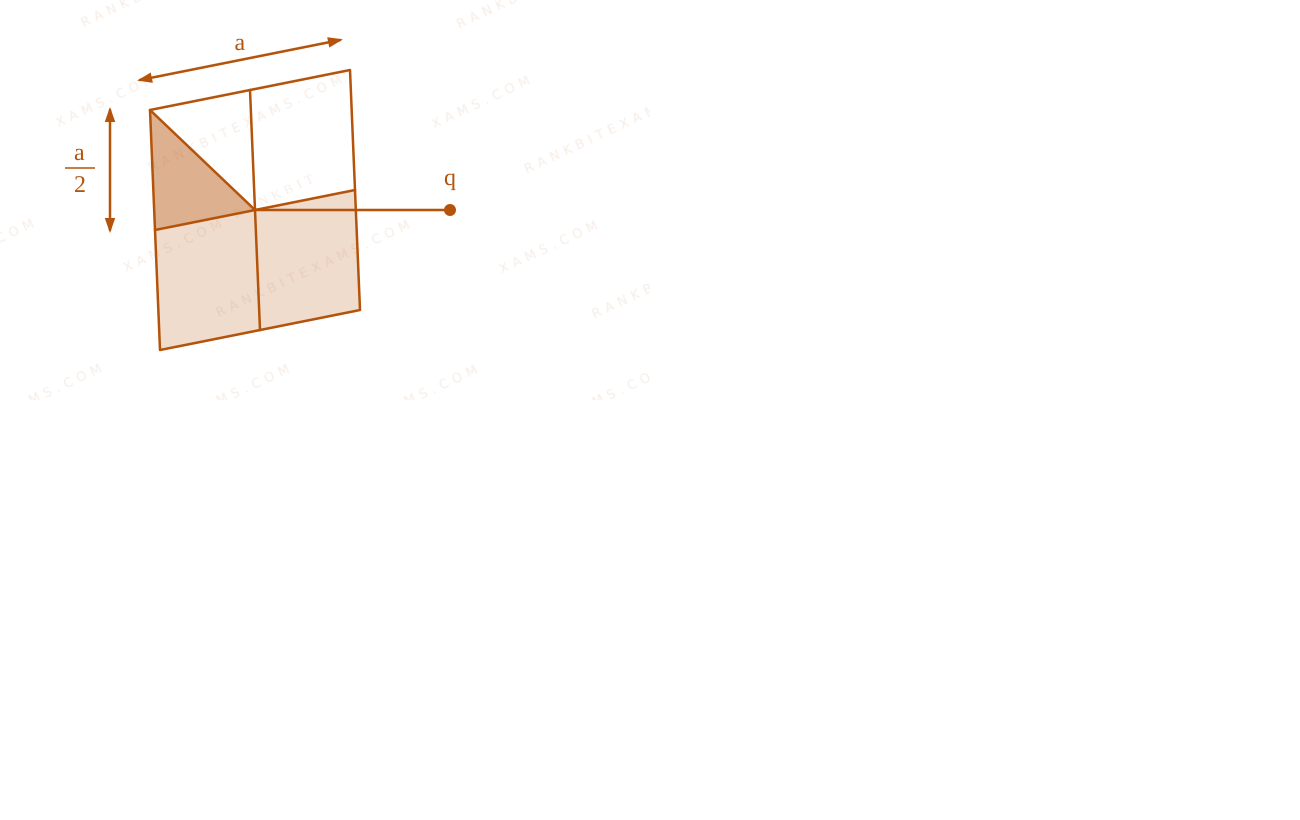
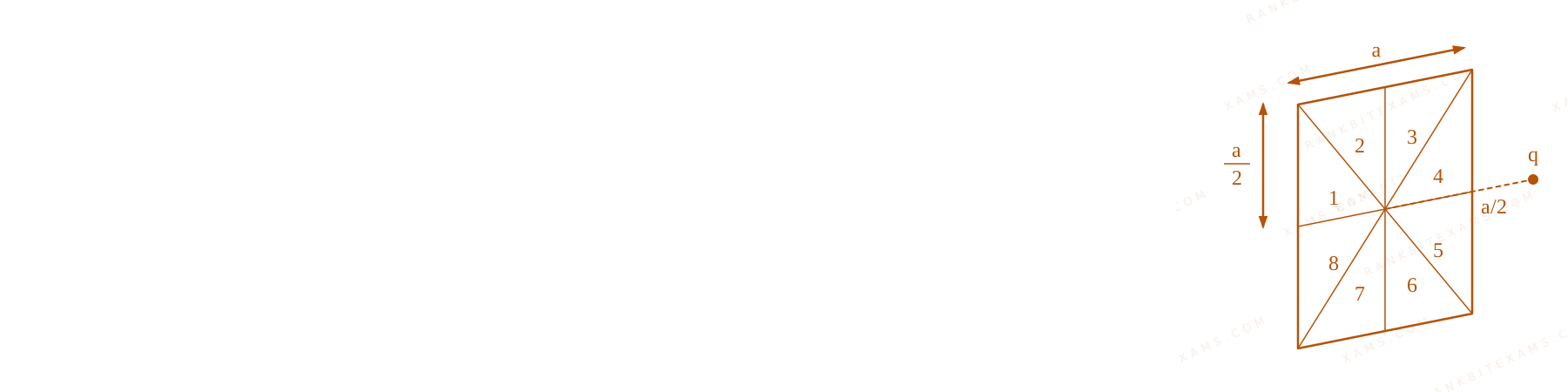
A square loop of sides a = 1$a = 1$ m is held normally in front of a point charge q = 1C$q = 1C$ The flux of the electric field through the shaded region is (5)/(p) × (1)/(ε₀) (Nm²)/(C)$\frac{5}{p} \times \frac{1}{\varepsilon_0} \frac{Nm^2}{C}$ , where the value of p is . The diagram illustrates a square loop divided into 8 symmetric parts with a point charge positioned in front of its center.
Numerical Answer Type:
Enter a numerical valueAnswer: 48 to 48+4 marks
Solution & Explanation
Related Formula
By Gauss's Law, the total flux emitted by a point charge q$q$ through a completely enclosing symmetric cube container surface is:
Assuming the charge resides at a symmetric center distance (a)/(2)$\frac{a}{2}$ relative to the loop face, this square loop represents one of the six identical faces of an enclosing cube system. Thus, the flux passing through the entire square loop face is:
As shown in the solution schematic The diagram illustrates a square loop divided into 8 symmetric parts with a point charge positioned in front of its center., the square face can be divided into 8 identical symmetric right-angled triangle sections by drawing its diagonals and medians. Each individual part intercepts an equal portion of the flux field :
Comparing this result with the given expression (5)/(p) × 1ε₀$\frac{5}{p} \times \frac{1}{\epsilon_{0}}$ , we find:
p = 48$p = 48$
Pattern Recognition
Exploit geometric symmetry to break solid angles down into equal fractions, avoiding complex surface integration.
Chapter Mix
Class 12 Physics: Electrostatics
Keywords:#Electric flux#Square loop#Point charge#Shaded region
More Electrostatics Previous-Year Questions — Page 2
Q42jee_main_2026_22_january_morningElectric Potential and Field
Electric field in a region is given by E = Ax i + By j$\vec{E} = Ax\hat{i} + By\hat{j}$, where A = 10~V / m²$A = 10~\mathrm{V / m^2}$ and B = 5~V / m²$B = 5~\mathrm{V / m^2}$. If the electric potential at a point (10, 20) is 500~V$500~\mathrm{V}$, then the electric potential at origin is \_\_\_\_ V.
A. 1000
B. 500
C. 2000
D. 0
Solution
Related Formula
V₂ - V₁ = -∫ E · d r$$V_2 - V_1 = -\int \vec{E} \cdot d\vec{r}$$
Sees: Electric field vector function given, find potential at origin.
Shortcut: Integrate line integral of electric field from origin to given point.
Check: Matches option (3). ✓
Chapter Mix
Class 12 Physics: Electrostatics
Q43jee_main_2026_22_january_morningCharged Pendulum in Electric Field
A simple pendulum has a bob with mass m and charge q. The pendulum string has negligible mass. When a uniform and horizontal electric field E$\vec{E}$ is applied, the tension in the string changes. The final tension in the string, when pendulum attains an equilibrium position is \_\_\_\_.
(g : acceleration due to gravity)
A.mg - qE$mg - qE$
B.mg + qE$mg + qE$
C.√(m²g² + q²E²)$\sqrt{m^2g^2 + q^2E^2}$
D.√(m²g² - q²E²)$\sqrt{m^2g^2 - q^2E^2}$
Solution
Related Formula
T = √((qE)² + (mg)²)$$T = \sqrt{(qE)^2 + (mg)^2}$$
Core Logic
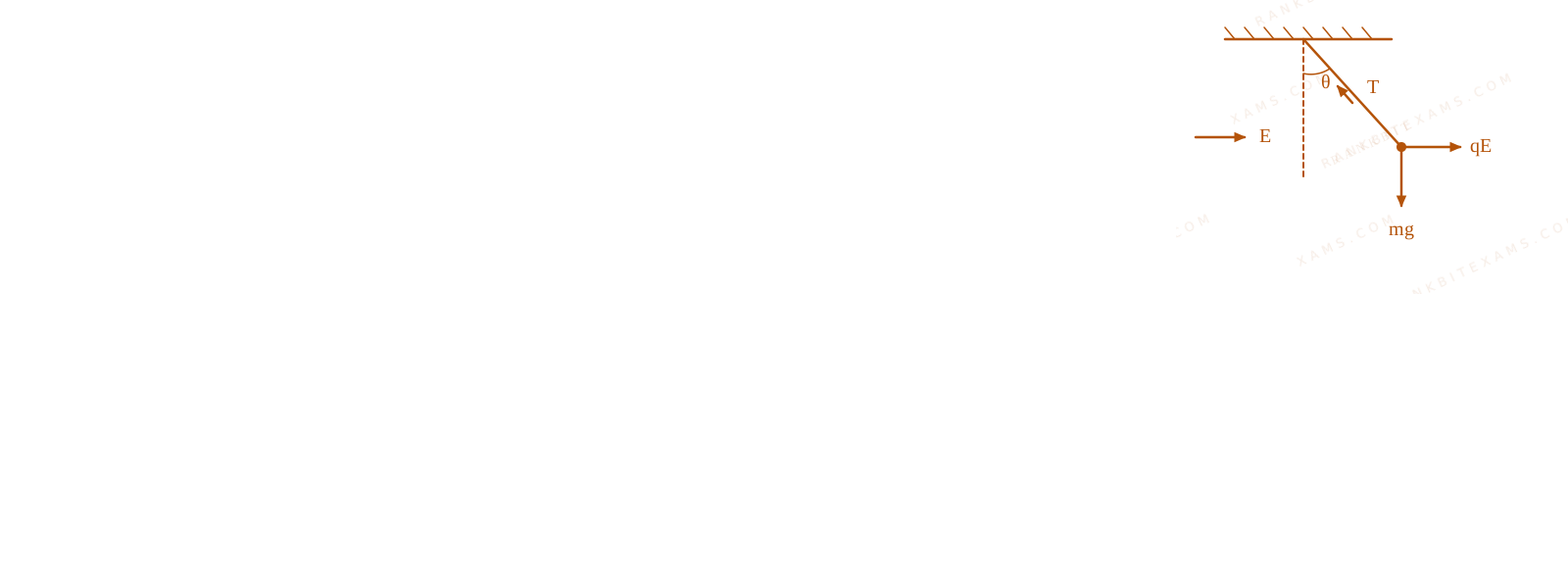
Solution pendulum diagram for Q43 - JEE Main 2026 Morning
At equilibrium, the effective forces acting on the bob are vertical gravitational force mg$mg$ and horizontal electric force qE$qE$. The string tension balances the resultant of these orthogonal forces:
T = √((qE)² + (mg)²)$$T = \sqrt{(qE)^2 + (mg)^2}$$
Pattern Recognition
Sees: Charged pendulum in horizontal electric field.
Shortcut: Combine orthogonal forces (mg$mg$ downwards and qE$qE$ horizontally) via Pythagorean vector addition.
Check: Matches option (3). ✓
Chapter Mix
Class 12 Physics: Electrostatics
Q30jee_main_2026_22_january_eveningElectric Potential of Coalescing Bubbles
Three small identical bubbles of water having same charge on each coalesce to form a bigger bubble. Then the ratio of the potentials on one initial bubble and that on the resultant bigger bubble is :
A.1:31/3$1:3^{1/3}$
B.1:22/3$1:2^{2/3}$
C.32/3:1$3^{2/3}:1$
D.1:32/3$1:3^{2/3}$
Solution
Related Formula
V = (kq)/(r)$$V = \frac{kq}{r}$$Volume Conservation: N · ((4)/(3)π r³) = (4)/(3)π R³$$\text{Volume Conservation: } N \cdot \left(\frac{4}{3}\pi r^3\right) = \frac{4}{3}\pi R^3$$
Core Logic
From volume conservation of 3 coalescing droplets:
3 ((4)/(3)π r³) = (4)/(3)π R³ R = 31/3r$$3 \left(\frac{4}{3}\pi r^3\right) = \frac{4}{3}\pi R^3 \implies R = 3^{1/3}r$$
Total charge on resultant bigger bubble Q = 3q$Q = 3q$.
Calculating initial potential Vᵢ$V_i$ and final potential Vf$V_f$:
Coalescing charged bubbles diagram for Q30 - JEE Main 2026 Evening
Step 1: Final Conclusion
The ratio of potentials is 1 : 32/3$1 : 3^{2/3}$.
Pattern Recognition
Coalescing droplets rule: For N$N$ identical drops, R = N1/3r$R = N^{1/3}r$ and Q = Nq$Q = Nq$.
Potential ratio Vᵢ / Vf = 1 / N2/3$V_i / V_f = 1 / N^{2/3}$. For N=3$N=3$, ratio is 1 / 32/3$1 / 3^{2/3}$.
Chapter Mix
Class 12 Physics: Electrostatic Potential and Capacitance
Q42jee_main_2026_22_january_eveningElectric Field and Potential of Polygon of Charges
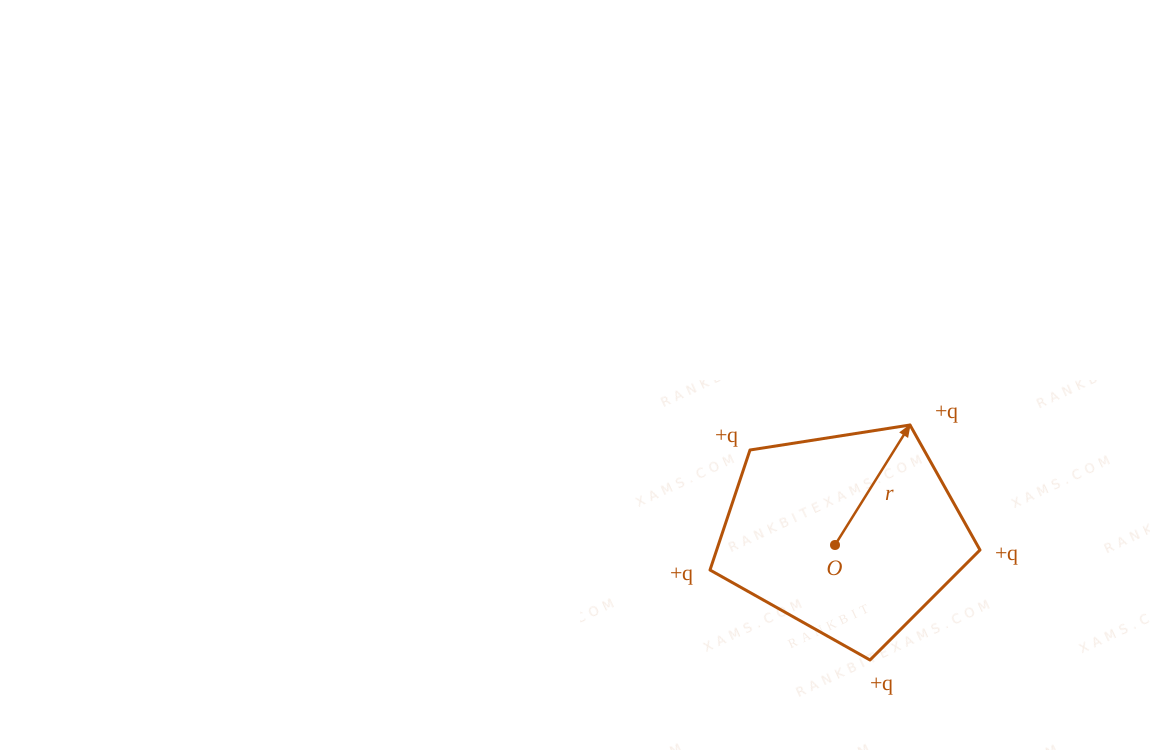
Five positive charges each having charge q are placed at the vertices of a pentagon as shown in the figure. The electric potential (V) and the electric field (E$\vec{E}$) at the center O of the pentagon due to these five positive charges are :
The figure illustrates a regular pentagon with five equal positive charges q placed at each vertex at distance r from center O.
A.V = (5q)/(4πε₀r)$V = \frac{5q}{4\pi\varepsilon_0r}$ and E = 0$\vec{E} = 0$
B.V = 5q4πε₀r$V = \frac{5q}{4\pi\varepsilon_{0}r}$ and E = 5√(3)q8πε₀r² r$\vec{E} = \frac{5\sqrt{3}q}{8\pi\varepsilon_{0}r^{2}} \hat{r}$
C.V = (5q)/(4πε₀r)$V = \frac{5q}{4\pi\varepsilon_0r}$ and E = (5q)/(4πε₀r²) r$\vec{E} = \frac{5q}{4\pi\varepsilon_0r^2}\hat{r}$
Option (1) gives the correct values V = (5q)/(4πε₀r)$V = \frac{5q}{4\pi\varepsilon_0r}$ and E = 0$\vec{E} = 0$.
Pattern Recognition
Symmetry rule: Identical charges at vertices of any regular polygon Ecenter = 0$\implies \vec{E}_{center} = 0$. Potential is scalar addition V = N (kq)/(r)$V = N \frac{kq}{r}$.
Chapter Mix
Class 12 Physics: Electrostatics
Q48jee_main_2026_22_january_eveningSharing of Charges between Capacitors
A capacitor P with capacitance 10 × 10⁻⁶$10 \times 10^{-6}$ F is fully charged with a potential difference of 6.0 V and disconnected from the battery. The charged capacitor P is connected across another capacitor Q with capacitance 20 × 10⁻⁶$20 \times 10^{-6}$ F. The charge on capacitor Q when equilibrium is established will be α × 10⁻⁵$\alpha \times 10^{-5}$ C (assume capacitor Q does not have any charge initially), the value of α$\alpha$ is ____.
Practice past-year questions one chapter at a time. Pick an exam → subject → chapter and get every PYQ for that topic — pulled together from all past papers — with the chapter's key formulas alongside.