Symmetric rational polynomials in roots α, β$\alpha, \beta$ that can be split into identical numeric multipliers for αⁿ$\alpha^n$ and βⁿ$\beta^n$ allow direct cancellation of the polynomial bases without evaluating the individual roots explicitly.
Convert standard coordinate complex numbers into Euler form immediately when large powers are present.
Chapter Mix
Class 11 Maths: Complex Numbers
Q9jee_main_2026_24_january_morningLocus in Complex Plane
Let S = z in C : | (z - 6i)/(z - 2i) | = 1 and | (z - 8 + 2i)/(z + 2i) | = (3)/(5)$S = \left\{ z \in \mathbb{C} : \left| \frac{z - 6i}{z - 2i} \right| = 1 \text{ and } \left| \frac{z - 8 + 2i}{z + 2i} \right| = \frac{3}{5} \right\}$. Then Σz in S |z|²$\sum_{z \in S} |z|^2$ is equal to
A.398$398$
B.413$413$
C.423$423$
D.385$385$
Solution
Related Formula
|z - z₁| = |z - z₂| represents the perpendicular bisector of the segment joining z₁ and z₂$$|z - z_1| = |z - z_2| \text{ represents the perpendicular bisector of the segment joining } z_1 \text{ and } z_2$$|x+iy|² = x² + y²$$|x+iy|^2 = x^2 + y^2$$
Core Logic
First condition: |z - 6i| = |z - 2i|$|z - 6i| = |z - 2i|$.
This means z$z$ lies on the perpendicular bisector of (0,6)$(0,6)$ and (0,2)$(0,2)$.
Let z = x + iy$z = x + iy$. Thus, y = 4$y = 4$.
Step 1: Circle Equation
Second condition: 5|z - 8 + 2i| = 3|z + 2i|$5|z - 8 + 2i| = 3|z + 2i|$.
Substitute y = 4$y = 4$ into z$z$: z = x + 4i$z = x + 4i$.
Whenever an absolute value ratio equals 1, immediately map it to a line (perpendicular bisector) and substitute its constraint directly into the second curve equation to reduce dimensionality.
Chapter Mix
Class 11 Maths: Complex Numbers and Quadratic Equations
Q23jee_main_2026_24_january_eveningProperties of Moduli
Let z = (1 + i)(1 + 2i)(1 + 3i) (1 + ni)$z = (1 + \mathrm{i})(1 + 2\mathrm{i})(1 + 3\mathrm{i}) \dots (1 + \mathrm{ni})$, where i = √(-1)$\mathrm{i} = \sqrt{-1}$. If |z|² = 44200$|z|^2 = 44200$, then n$n$ is equal to
The calculated product for n=5$n=5$ exactly matches the prime factorization of 44200$44200$.
Therefore, n = 5$n = 5$.
Pattern Recognition
Modulus is multiplicative. In problems featuring chains of complex multiplications set equal to a huge real magnitude, instantly switch to magnitudes and map to integer factorization.
Chapter Mix
Class 11 Maths: Complex Numbers
Q5jee_main_2026_28_january_morningGeometry of Complex Numbers
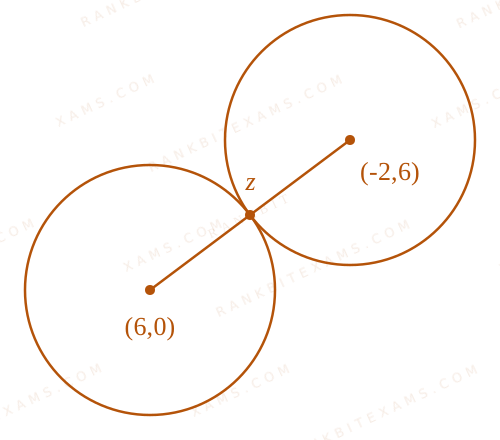
Let z$z$ be a complex number such that |z - 6| = 5$|z - 6| = 5$ and |z + 2 - 6i| = 5$|z + 2 - 6i| = 5$. Then the value of z³ + 3z² - 15z + 141$z^{3} + 3z^{2} - 15z + 141$ is equal to
A.42$42$
B.37$37$
C.50$50$
D.61$61$
Solution
Core Logic
Geometry of Complex Numbers
The given equations represent two circles in the complex plane:
Circle 1: Center C₁(6, 0)$C_1(6, 0)$, radius r₁ = 5$r_1 = 5$
Circle 2: Center C₂(-2, 6)$C_2(-2, 6)$, radius r₂ = 5$r_2 = 5$
When given two complex distance modulus equations |z-z₁|=r₁$|z-z_1|=r_1$ and |z-z₂|=r₂$|z-z_2|=r_2$, always check the distance between centers |z₁ - z₂|$|z_1 - z_2|$. If it exactly equals r₁ + r₂$r_1 + r_2$, the single unique solution is the section formula midpoint.
Chapter Mix
Class 11 Mathematics: Complex Numbers and Quadratic Equations
Q10jee_main_2026_28_january_morningNature of Roots
If α, β$\alpha, \beta$, where α < β$\alpha < \beta$, are the roots of the equation λ x² - (λ + 3)x + 3 = 0$\lambda x^2 - (\lambda + 3)x + 3 = 0$ such that (1)/(α) - (1)/(β) = (1)/(3)$\frac{1}{\alpha} - \frac{1}{\beta} = \frac{1}{3}$, then the sum of all possible values of λ$\lambda$ is:
A.6$6$
B.2$2$
C.4$4$
D.8$8$
Solution
Related Formula
For a quadratic equation ax² + bx + c = 0$ax^2 + bx + c = 0$:
Sum of roots: α + β = -(b)/(a)$\alpha + \beta = -\frac{b}{a}$
Product of roots: αβ = (c)/(a)$\alpha\beta = \frac{c}{a}$
Core Logic
From the given equation λ x² - (λ + 3)x + 3 = 0$\lambda x^2 - (\lambda + 3)x + 3 = 0$:
Practice past-year questions one chapter at a time. Pick an exam → subject → chapter and get every PYQ for that topic — pulled together from all past papers — with the chapter's key formulas alongside.