### Core Logic
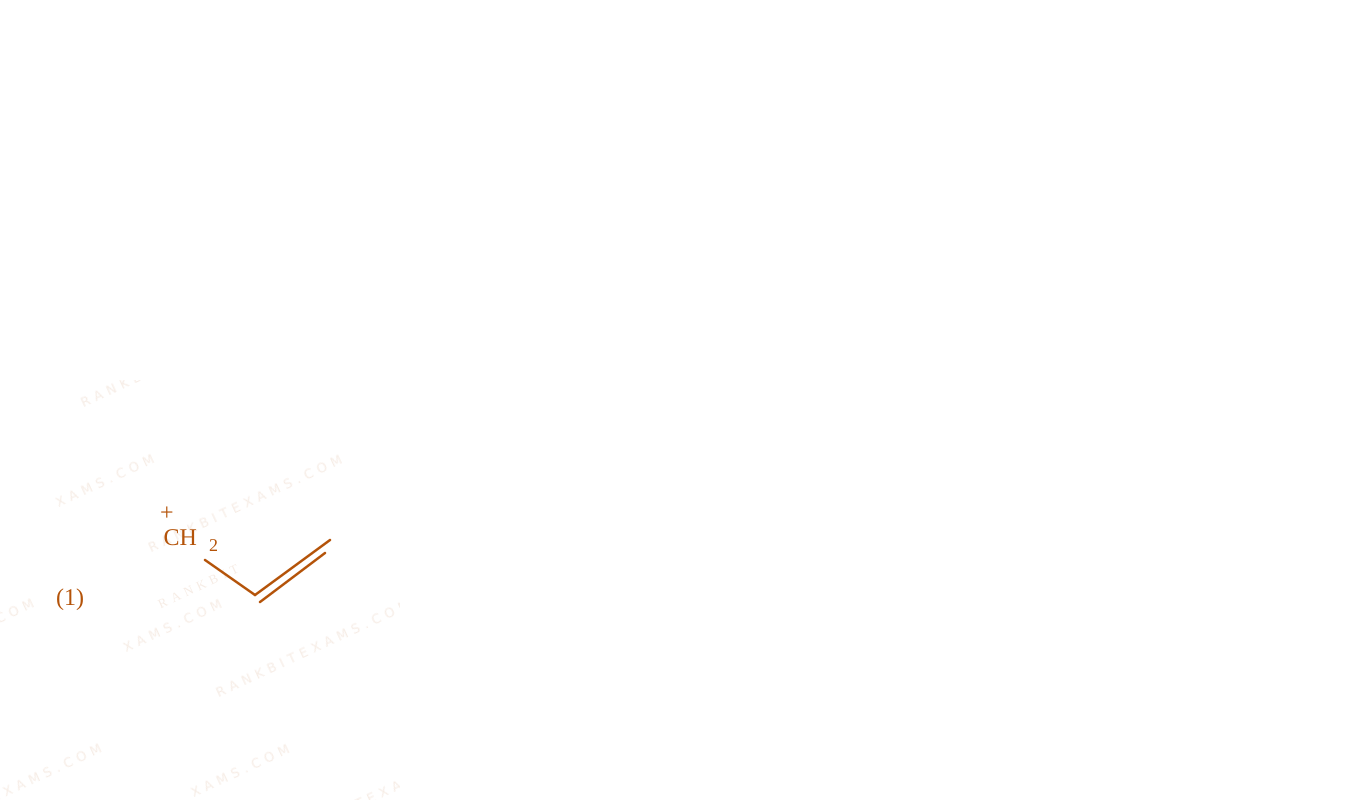
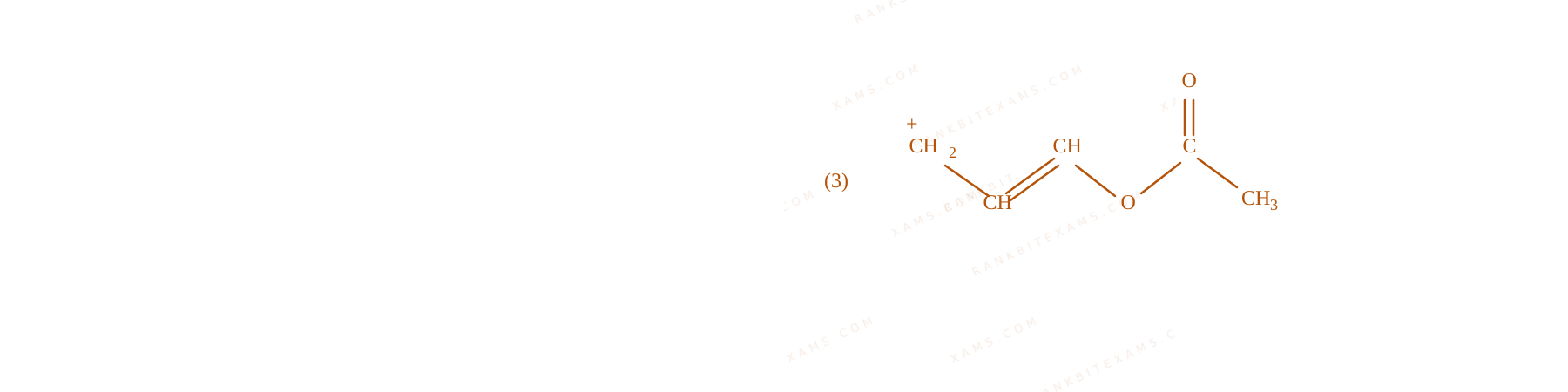
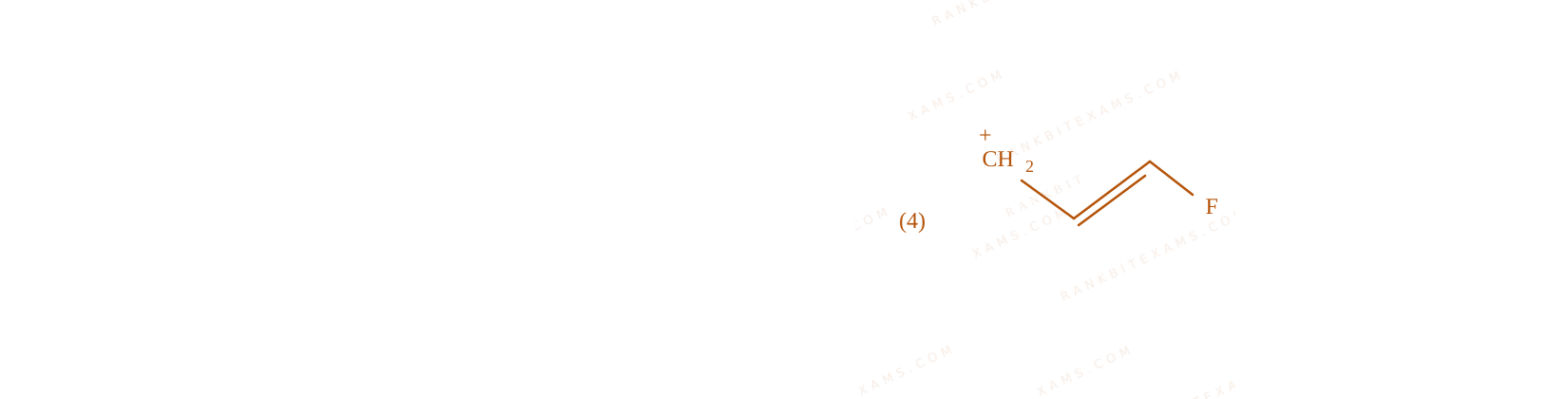
Carbocations are stabilized by structural factors such as the inductive effect (+I$+I$), mesomeric effect (+M$+M$), and hyperconjugation.
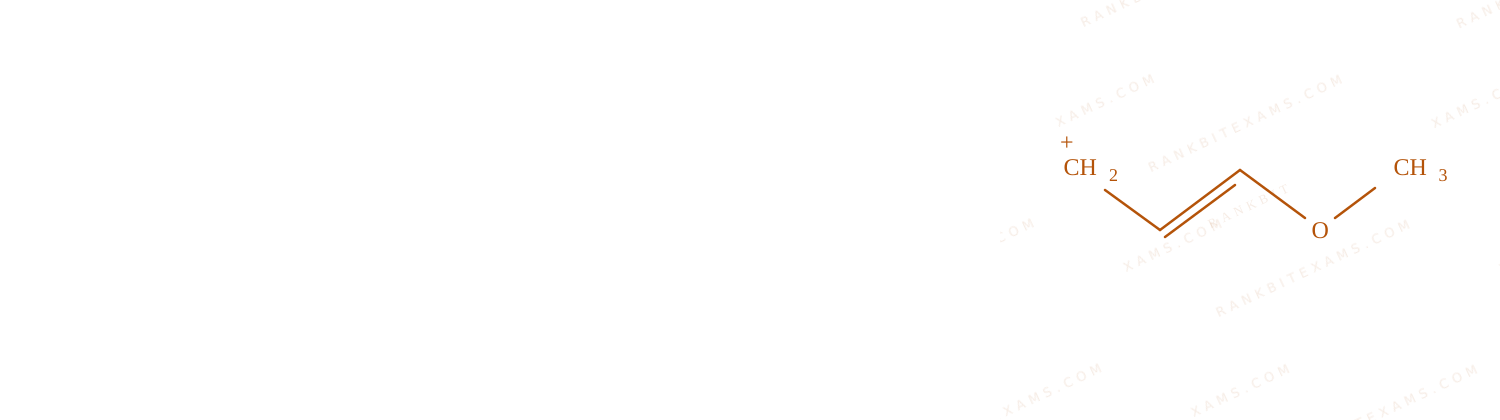
In Structure (2), the carbocation center is situated directly adjacent to a strong electronic donor methoxy group (-OCH_3$-OCH_3$). This configuration allows highly effective lone pair donation into the vacant p-orbital of the carbocation via the structural +M$+M$ mesomeric path, rendering it exceptionally stable.
### Pattern Recognition
An adjacent heteroatom with a lone pair (O, N$O, N$) triggers dynamic back-bonding stability (+M$+M$), which fundamentally outweighs basic hyperconjugation trends.
### Evaluation Rubric / Model Answer
null
### Chapter Mix
Class 11 Chemistry: Organic Chemistry - Some Basic Principles and Techniques
Keywords:#carbocations from the following is most stable#JEE Main 2025 Morning Q29#Organic Chemistry JEE Main 2025#Stability of Carbocations
More Organic Chemistry - Some Basic Principles and Techniques Previous-Year Questions — Page 6
Q462025Quantitative Analysis - Dumas Method
During estimation of nitrogen by Dumas' method of compound X (0.42 g):
The image shows the molecular skeletal architecture of compound X with structural parameters revealing a formula corresponding to a molecular mass of 86 g/mol.
mL of N2$N{2}$ gas will be liberated at STP. (nearest integer)
(Given molar mass in g mol: C: 12, H: 1, N: 14)
Numerical Answer.Answer: 111 to 111
Solution
### Related Formula
Using the Principle of Atom Conservation (POAC) for Nitrogen:
n_textcompound times textatoms of N per molecule = 2 times n_N_2$n_{\text{compound}} \times \text{atoms of N per molecule} = 2 \times n_{N_2}$
### Core Logic
The molecular weight of the given heterocyclic amine organic structure X is calculated as 86text g/mol$86\text{ g/mol}$. The image shows the molecular skeletal architecture of compound X with structural parameters revealing a formula corresponding to a molecular mass of 86 g/mol.
Given mass of compound = 0.42text g$= 0.42\text{ g}$:
textMoles of compound X = frac0.4286
$\text{Moles of compound } X = \frac{0.42}{86}
$
### Step 1: Calculating STP Volume
Using POAC on Nitrogen atoms:
n_N_2 = frac0.4286
$
n_{N_2} = \frac{0.42}{86}
$
textVolume of N_2text at STP = n_N_2 times 22400text mL = frac0.4286 times 22400 approx 110.88text mL
$
\text{Volume of } N_2\text{ at STP} = n_{N_2} \times 22400\text{ mL} = \frac{0.42}{86} \times 22400 \approx 110.88\text{ mL}
$
Rounding to the nearest integer gives 111text mL$111\text{ mL}$.
### Pattern Recognition
Shortcut: Always identify the molecular formula from the skeletal grid first. Once M = 86$M = 86$ and total textN = 2$\text{N} = 2$ atoms are established, use the stoichiometric ratio directly.
### Evaluation Rubric / Model Answer
null
### Chapter Mix
Class 11 Chemistry: Organic Chemistry - Some Basic Principles and Techniques
Q472025Quantitative Analysis - Estimation of Carbon
0.5 g of an organic compound on combustion gave 1.46 g of CO_2$CO_{2}$ and 0.9 g of H_2O$H_{2}O$. The percentage of carbon in the compound is _____. (Nearest integer)
[Given: Molar mass (in textg mol^-1$\text{g mol}^{-1}$) C: 12, H: 1, O: 16]
Numerical Answer.Answer: 80 to 80
Solution
### Related Formula
The percentage of carbon via combustion details is found using:
% text C = frac1244 times fractextMass of CO_2textMass of organic compound times 100$
% \text{ C} = \frac{12}{44} \times \frac{\text{Mass of } CO_2}{\text{Mass of organic compound}} \times 100$
### Core Logic
Let us substitute the parameters:
* Mass of organic compound = 0.5text g$= 0.5\text{ g}$
* Mass of CO_2$CO_2$ collected = 1.46text g$= 1.46\text{ g}$
### Step 1: Numerical Calculation
\% text C = frac1244 times frac1.460.5 times 100$\% \text{ C} = \frac{12}{44} \times \frac{1.46}{0.5} \times 100$% text C = frac12 times 1.4622 times 100 approx 79.63%$% \text{ C} = \frac{12 \times 1.46}{22} \times 100 \approx 79.63%$
Rounding to the nearest integer gives 80$80$.
### Pattern Recognition
Shortcut: frac1244 approx 0.2727$\frac{12}{44} \approx 0.2727$. Multiply 0.2727 times 1.46$0.2727 \times 1.46$ to find the carbon mass (0.398text g$0.398\text{ g}$). Since 0.398text g$0.398\text{ g}$ out of 0.5text g$0.5\text{ g}$ is practically frac45$\frac{4}{5}$, the value is \right around 80\%$80\%$.
### Evaluation Rubric / Model Answer
null
### Chapter Mix
Class 11 Chemistry: Organic Chemistry - Some Basic Principles and Techniques
Q432025Resonance Effect and Dipole Moment
Given below are two statements.
Statement I: The dipole moment of overset4CH_3-overset3CH=overset2CH-overset1CH=O$\overset{4}{C}H_3-\overset{3}{C}H=\overset{2}{C}H-\overset{1}{C}H=O$ is greater than CH_3-CH_2-CH_2-CH=O$CH_3-CH_2-CH_2-CH=O$.
Statement II: C_1-C_2$C_1-C_2$ bond length of CH_3-CH=CH-CH=O$CH_3-CH=CH-CH=O$ is greater than C_1-C_2$C_1-C_2$ bond length of CH_3-CH_2-CH_2-CH=O$CH_3-CH_2-CH_2-CH=O$.
In the light of the above statements, choose the correct answer from the options given below:
A.textStatement I is false but Statement II is true$\text{Statement I is false but Statement II is true}$
B.textBoth Statement I and Statement II are false$\text{Both Statement I and Statement II are false}$
C.textStatement I is true but Statement II is false$\text{Statement I is true but Statement II is false}$
D.textBoth Statement I and Statement II are true$\text{Both Statement I and Statement II are true}$
Solution
### Core Logic
* **Statement I is true:** In the conjugated system (CH_3-CH=CH-CH=O$CH_3-CH=CH-CH=O$), extended resonance delocalization occurs, shifting electron density toward the carbonyl oxygen:
CH_3-oversetoplusCH-CH=CH-oversetominusO$CH_3-\overset{\oplus}{C}H-CH=CH-\overset{\ominus}{O}$
This configuration increases both the partial charge separation q$q$ and the dipole distance d, resulting in a significantly larger net dipole moment mu = q times d$\mu = q \times d$ compared to the non-conjugated saturated aldehyde.
* **Statement II is false:** Due to resonance conjugation, the single bond between C_1$C_1$ and C_2$C_2$ acquires partial double-bond character. This double-bond character shortens the bond length, making it smaller than the standard single bond found in CH_3-CH_2-CH_2-CH=O$CH_3-CH_2-CH_2-CH=O$.
### Pattern Recognition
Conjugation spreads partial charges across a longer carbon chain, expanding the charge separation distance to drive up the overall dipole moment mu$\mu$.
### Evaluation Rubric / Model Answer
null
### Chapter Mix
Class 11 Chemistry: Organic Chemistry - Some Basic Principles and Techniques
Q462025Quantitative Analysis
In Dumas' method for estimation of nitrogen, 1mathrm~g$1\mathrm{~g}$ of an organic compound gave 150mathrm~mL$150\mathrm{~mL}$ of nitrogen collected at 300mathrm~K$300\mathrm{~K}$ temperature and 900mathrm~mmHg$900\mathrm{~mmHg}$ pressure. The percentage composition of nitrogen in the compound is _______ %$%$ (nearest integer).
(Aqueous tension at 300mathrm~K = 15mathrm~mmHg$300\mathrm{~K} = 15\mathrm{~mmHg}$)
Numerical Answer.Answer: 20 to 20
Solution
### Related Formula
P_textdry N_2 = P_texttotal - P_textaqueous tension$P_{\text{dry } N_2} = P_{\text{total}} - P_{\text{aqueous tension}}$PV = nRT implies n = fracPVRT$PV = nRT \implies n = \frac{PV}{RT}$\% N = fractextMass of NitrogentextMass of Organic Compound times 100$\% N = \frac{\text{Mass of Nitrogen}}{\text{Mass of Organic Compound}} \times 100$
### Core Logic
First, calculate the actual pressure exerted by the dry nitrogen gas:
P_N_2 = 900 - 15 = 885mathrm~mmHg = frac885760mathrm~atm$P_{N_2} = 900 - 15 = 885\mathrm{~mmHg} = \frac{885}{760}\mathrm{~atm}$
Convert volume data to liters: V = 150mathrm~mL = 0.15mathrm~L$V = 150\mathrm{~mL} = 0.15\mathrm{~L}$.
Using the ideal gas law to determine the moles of N_2$N_2$ collected:
n = fracleft(frac885760right) times 0.150.0821 times 300 = frac1.1645 times 0.1524.63 approx 0.0071mathrm~moles$n = \frac{\left(\frac{885}{760}\right) \times 0.15}{0.0821 \times 300} = \frac{1.1645 \times 0.15}{24.63} \approx 0.0071\mathrm{~moles}$
Calculate the total mass of the liberated nitrogen gas:
textMass = n times M_textmolar = 0.0071 times 28 = 0.1988mathrm~g$\text{Mass} = n \times M_{\text{molar}} = 0.0071 \times 28 = 0.1988\mathrm{~g}$
Determine the percentage composition relative to the initial 1mathrm~g$1\mathrm{~g}$ sample size:
\% N = frac0.19881 times 100 = 19.88\% approx 20\%$\% N = \frac{0.1988}{1} \times 100 = 19.88\% \approx 20\%$
### Pattern Recognition
Always remember to subtract the aqueous tension value first. Failing to correct for water vapor pressure is the most common pitfall in Dumas' method calculations.
### Evaluation Rubric / Model Answer
null
### Chapter Mix
Class 11 Chemistry: Organic Chemistry - Some Basic Principles and Techniques
Q272025Separation Techniques
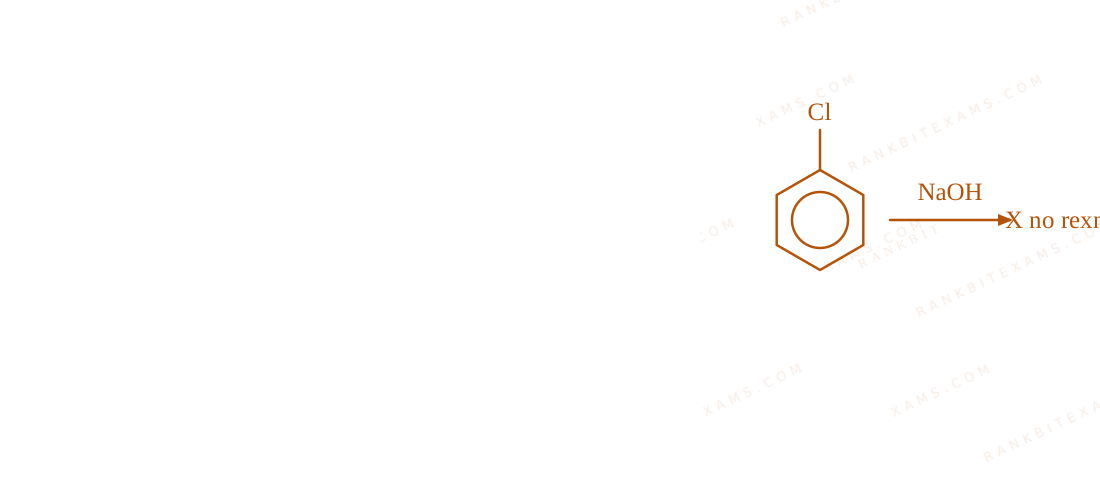
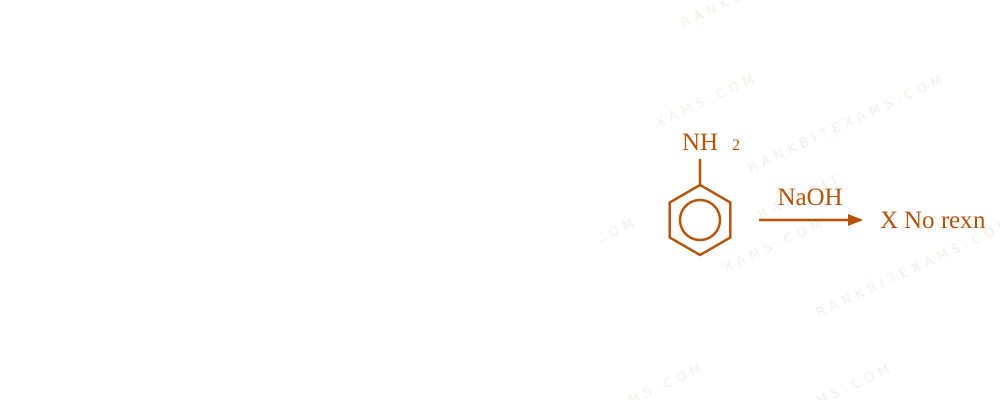
Mixture of 1text g$1\text{ g}$ each of chlorobenzene, aniline and benzoic acid is dissolved in 50text mL$50\text{ mL}$ ethyl acetate and placed in a separating funnel, 5text M NaOH$5\text{ M NaOH}$ (30text mL$30\text{ mL}$) was added in the same funnel. The funnel was shaken vigorously and then kept aside. The ethyl acetate layer in the funnel contains:
A.textbenzoic acid$\text{benzoic acid}$
B.textbenzoic acid and aniline$\text{benzoic acid and aniline}$
C.textbenzoic acid and chlorobenzene$\text{benzoic acid and chlorobenzene}$
D.textchlorobenzene and aniline$\text{chlorobenzene and aniline}$
Solution
### Related Formula
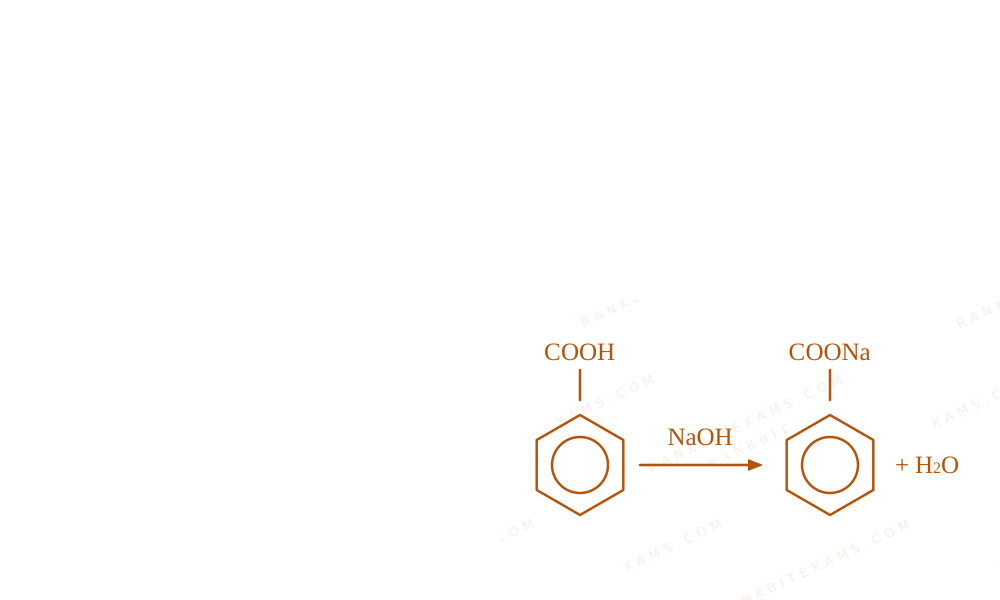
textPh-COOH + textNaOH
ightarrow textPh-COO^-textNa^+ text (Water soluble salt) [cite: 884, 885]$\text{Ph-COOH} + \text{NaOH}
ightarrow \text{Ph-COO}^-\text{Na}^+ \text{ (Water soluble salt)} [cite: 884, 885]$
### Core Logic
When aqueous textNaOH$\text{NaOH}$ is added to the mixture:
1. Benzoic acid (textPh-COOH$\text{Ph-COOH}$) reacts to form sodium benzoate (textPh-COONa$\text{Ph-COONa}$), which is highly water-soluble and moves completely into the aqueous layer.
2. Chlorobenzene (textPh-Cl$\text{Ph-Cl}$) and aniline (textPh-NH_2$\text{Ph-NH}_2$) are organic compounds that do not react with aqueous textNaOH$\text{NaOH}$ under normal conditions.
Therefore, they remain unreacted in the organic layer (ethyl acetate).
### Step 1: Visual Reaction Progress
The separation steps can be visualized tracking the structural components:
Separation Techniques diagram for Q27 - JEE Main 2025 EveningSeparation Techniques diagram for Q27 - JEE Main 2025 EveningSeparation Techniques diagram for Q27 - JEE Main 2025 Evening
Thus, the ethyl acetate layer strictly contains chlorobenzene and aniline.
### Pattern Recognition
Acid-base separation shortcut: Strong bases (textNaOH$\text{NaOH}$) pull organic acids into the aqueous phase as salts. Neutral compounds and basic amines stay behind in the organic layer unless a strong acid is added.
### Evaluation Rubric / Model Answer
null
### Chapter Mix
Class 11 Chemistry: Organic Chemistry - Some Basic Principles and Techniques
Class 12 Chemistry: Aldehydes, Ketones and Carboxylic Acids
More Organic Chemistry - Some Basic Principles and Techniques Questions — jee_main_2025_24_jan_morning
We Map Every Repeating Question in Competitive Exams.
Say goodbye to generic mock test fatigue. RankBit uses smart analysis to group past exam questions into their foundational Repeating Question Types. Find chapter weightage, track repeating questions, and score higher with targeted practice.
Select Your Target Exam
Choose an exam track below to find formulas per chapter and patterns.
Syncing Exam Intelligence
Mapping formulas and patterns across all tracks…
PATH A — FULL LENGTH PRACTICE
Full Mock Test Hub
Simulate real NTA exam conditions with fully tracked mocks. Time yourself against past papers.
Under Development
PATH B — TARGETED PRACTICE
Topic-wise Practice Hub
Practice past-year questions one chapter at a time. Pick an exam → subject → chapter and get every PYQ for that topic — pulled together from all past papers — with the chapter's key formulas alongside.

 "Dumas method quantitative, Molar weight tracking, Nitrogen gas evolution")
 "Dumas method quantitative, Molar weight tracking, Nitrogen gas evolution")