Let us consider an endothermic reaction which is non-spontaneous at the freezing point of water. However, the reaction is spontaneous at boiling point of water. Choose the correct option.

Solution & Explanation

Related Formula
Δ G = Δ H - TΔ S
Core Logic

An endothermic profile specifies that Δ H > 0. For the system to become spontaneous (Δ G < 0) specifically when shifting to higher temperatures (T), the temperature-dependent entropic subtraction term (-TΔ S) must outweigh the enthalpic barrier. This transition demands a positive structural entropy step, i.e., Δ S > 0.

Hence, both Δ H and Δ S are positive.

Pattern Recognition

Spontaneity driven purely by elevated thermal thresholds mandates matching positive signs for enthalpy and entropy.

Chapter Mix

Class 11 Chemistry: Chemical Thermodynamics

Reference Study Guides

More Chemical Thermodynamics Previous-Year Questions — Page 7

Q47 jee_main_2025_24_jan_morning Gibbs Free Energy and Equilibrium Temperature
Standard entropies of X₂, Y₂ and XY₅ are 70, 50 and 110 ~J ~K⁻¹ ~mol⁻¹ respectively. The temperature in Kelvin at which the reaction (1)/(2) X _ 2 + (5)/(2) Y _ 2 arrow X Y _ 5 Δ H ^ ° = - 3 5 k J m o l ^ - 1 will be at equilibrium is (Nearest integer)
Numerical Answer. Answer: 700 to 700

Solution

Related Formula
Δ Sᵣₓₙ⁰ = Σ Sproducts⁰ - Σ Sreactants⁰ and T = (Δ H⁰)/(Δ S⁰) at equilibrium (Δ G⁰ = 0)
Core Logic

First, calculate the standard entropy change for the reaction system (Δ Sᵣₓₙ⁰):

Δ Sᵣₓₙ⁰ = S⁰(XY₅) - [ (1)/(2)S⁰(X₂) + (5)/(2)S⁰(Y₂) ] Δ Sᵣₓₙ⁰ = 110 - [ ((1)/(2) × 70) + ((5)/(2) × 50) ] = 110 - [35 + 125] Δ Sᵣₓₙ⁰ = 110 - 160 = -50 J K⁻¹ mol⁻¹

At thermodynamic equilibrium, the change in Gibbs free energy drops to zero (Δ G⁰ = 0):

0 = Δ H⁰ - TΔ S⁰ T = (Δ H⁰)/(Δ S⁰)

Convert the enthalpy value into Joules (Δ H⁰ = -35 × 10³ J/mol) and substitute the parameters:

T = -35000 J mol⁻¹-50 J K⁻¹ mol⁻¹ = 700 Kelvin
Pattern Recognition

Ensure all variables use matching energy units (Joules vs. Kilojoules) before setting up your final division step.

Chapter Mix

Class 11 Chemistry: Chemical Thermodynamics
Q jee_main_2025_28_jan_evening First Law of Thermodynamics and State Functions
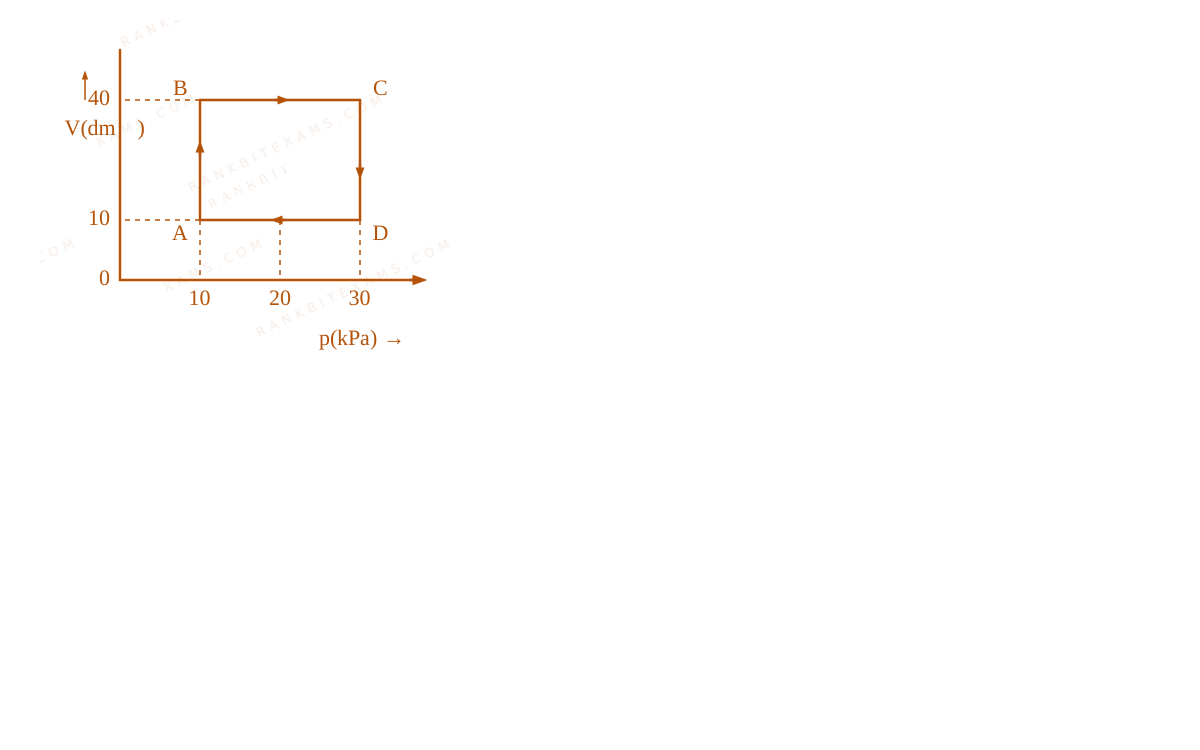
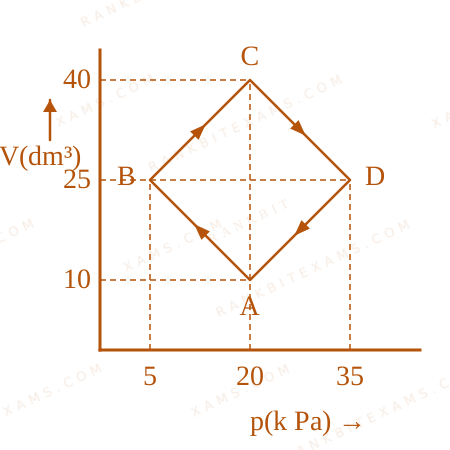
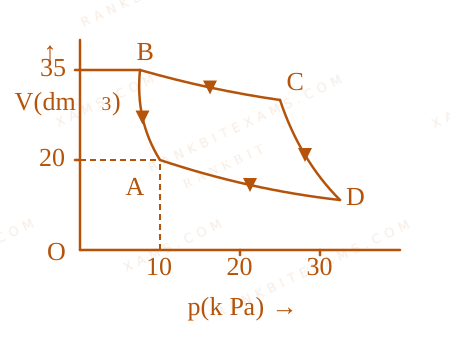
An ideal gas undergoes a cyclic transformation starting from the point A and coming back to the same point by tracing the path A→ B→ C arrow Darrow A as shown in the three cases below. Choose the correct option regarding Δ U:
Thermodynamic cyclic path diagrams for Q33 - JEE Main 2025
The diagram displays three distinct cyclic paths (Case I, Case II, Case III) on volume vs pressure graphs.
Thermodynamic cyclic path diagrams for Q33 - JEE Main 2025
The diagram displays three distinct cyclic paths (Case I, Case II, Case III) on volume vs pressure graphs.
Thermodynamic cyclic path diagrams for Q33 - JEE Main 2025
The diagram displays three distinct cyclic paths (Case I, Case II, Case III) on volume vs pressure graphs.
  • A. Δ U (Case-III) > Δ U (Case-II) > Δ U (Case-I)
  • B. Δ U (Case-I) > Δ U (Case-II) > Δ U (Case-III)
  • C. Δ U (Case-I) > Δ U (Case-III) > Δ U (Case-II)
  • D. Δ U (Case-I) = Δ U (Case-II) = Δ U (Case-III)

Solution

Related Formula

For any state function like Internal Energy (U), the cyclic integral over a complete closed loop is identically zero:

∮ dU = 0 Δ Ucyclic = 0
Core Logic

Internal energy (U) depends only on the initial and final states of the thermodynamic system, not on the path followed.

In all three listed cases, the ideal gas undergoes a complete cyclic path that returns to its original configuration state A.

Step 1: Final Evaluation

Since every transformation begins and ends at point A:

Δ UCase-I = 0 Δ UCase-II = 0 Δ UCase-III = 0

Therefore, Δ U (Case-I) = Δ U (Case-II) = Δ U (Case-III).

Pattern Recognition

Do not waste time calculating path areas or values if the question asks for a state function change (Δ U, Δ H, Δ S, Δ G) over a cyclic loop. The answer is instantly zero for all cases!

Chapter Mix

Class 11 Chemistry: Thermodynamics

Q47 jee_main_2025_28_jan_evening Hess's Law / Enthalpy of Formation
Consider the following data: Heat of formation of CO₂(g) = -393.5 ~kJ~mol⁻¹ Heat of formation of H₂O(l) = -286.0 ~kJ~mol⁻¹ Heat of combustion of benzene = -3267.0 ~kJ~mol⁻¹ The heat of formation of benzene is ______ kJ~mol⁻¹ (Nearest integer).
Numerical Answer. Answer: 48 to 48

Solution

Related Formula

Enthalpy of reaction from enthalpy of formation data:

Δ Hreaction = Σ Δ Hf(Products) - Σ Δ Hf(Reactants)
Core Logic

Write out the balanced thermochemical equation for the combustion of benzene (C₆H₆):

C₆H₆(l) + (15)/(2)O₂(g) arrow 6CO₂(g) + 3H₂O(l)

Given parameters:

  • Δ Hc = -3267.0 kJ/mol
  • Δ Hf[CO₂] = -393.5 kJ/mol
  • Δ Hf[H₂O] = -286.0 kJ/mol
  • Δ Hf[O₂] = 0 kJ/mol
Step 1: Applying Hess's Law

Substitute these values into the reaction expression:

-3267 = [6(-393.5) + 3(-286.0)] - Δ Hf[C₆H₆] -3267 = [-2361.0 - 858.0] - Δ Hf[C₆H₆] -3267 = -3219.0 - Δ Hf[C₆H₆] Δ Hf[C₆H₆] = -3219.0 + 3267.0 = 48 kJ/mol
Pattern Recognition

Always set up products minus reactants when using heat of formation data. Pay close attention to stoichiometric coefficients (multiply CO₂ by 6 and H₂O by 3) to ensure accurate bookkeeping.

Chapter Mix

Class 11 Chemistry: Thermodynamics

Q jee_main_2025_29_jan_morning First Law of Thermodynamics and Heat Capacity
500 ~J of energy is transferred as heat to 0.5 ~mol of Argon gas at 298 ~K and 1.00 atm . The final temperature and the change in internal energy respectively are : Given: R = 8.3 JK⁻¹ mol⁻¹
  • A. 348K and 300J
  • B. 378K and 300J
  • C. 368K and 500J
  • D. 378K and 500J

Solution

Formulas Used

For an ideal gas undergoing a constant pressure process (1.00 atm):

qₚ = n · Cₚ · Δ T

Change in internal energy (Δ U):

Δ U = n · Cv · Δ T

For a monoatomic gas like Argon:

  • Cv = (3)/(2) R
  • Cₚ = (5)/(2) R
Core Logic

Step 1: Calculate the final temperature (Tf) Heat transferred at constant pressure (qₚ) = 500 J

500 = 0.5 × ((5)/(2) × 8.3) × (Tf - 298) 500 = 0.5 × 20.75 × (Tf - 298) 500 = 10.375 × (Tf - 298) Tf - 298 = (500)/(10.375) ≈ 48.2 K Tf = 298 + 48.2 = 346.2 K ≈ 348 K

---

Step 2: Calculate the change in internal energy (Δ U)

Δ U = n · Cv · Δ T

Alternatively, using the ratio of heat capacities:

Δ U = ((Cv)/(Cₚ)) × qₚ = (3)/(5) × 500 J = 300 J

Thus, the final temperature is 348 K and the change in internal energy is 300 J.

Pattern Recognition

For a monoatomic ideal gas under constant pressure, exactly 60% of the heat added ((Cv)/(Cₚ) = (3)/(5)) goes into increasing the internal energy (Δ U), while 40% is lost to expansion work (W).

Correct Option: (A)

Q79 jee_main_2024_01_february_morning First Law of Thermodynamics
Choose the correct option for free expansion of an ideal gas under adiabatic condition from the following:
  • A. q = 0, Δ T ≠ 0, w = 0
  • B. q = 0, Δ T < 0, w ≠ 0
  • C. q ≠ 0, Δ T = 0, w = 0
  • D. q = 0, Δ T = 0, w = 0

Solution

Core Logic

Free expansion means expansion against a vacuum (Pₑₓₜ = 0). Work done: w = -Pₑₓₜ Δ V. Since Pₑₓₜ = 0, w = 0.

Adiabatic condition means there is no heat exchange with the surroundings. Heat transfer: q = 0.

According to the First Law of Thermodynamics, Δ U = q + w. Since q = 0 and w = 0, the change in internal energy Δ U = 0.

For an ideal gas, internal energy is a function of temperature only (Δ U = nCvΔ T). If Δ U = 0, then Δ T = 0.

Step 1: Final Parameter Check

Evaluating all parameters simultaneously: q = 0 w = 0 Δ T = 0

Pattern Recognition

Adiabatic + Free Expansion of IDEAL gas arrow Nothing changes thermodynamically except volume and pressure. q = 0, w = 0, Δ U = 0, Δ T = 0, Δ H = 0.

Chapter Mix

Class 11 Chemistry: Thermodynamics

More Chemical Thermodynamics Questions — jee_main_2025_24_jan_morning

Practice all Chemical Thermodynamics previous-year questions →

Rankbit System
JEE Physics: Waves (+15.5%) | Electrostatics: Concentric Shells (-29.7%) | Modern Physics: Photoelectric Clones (+34.2%) | Mathematics: Definite Integrals (+18.1%) | Chemistry: Coordination Splitting (-11.4%) | JEE Physics: Waves (+15.5%) | Electrostatics: Concentric Shells (-29.7%) | Modern Physics: Photoelectric Clones (+34.2%) | Mathematics: Definite Integrals (+18.1%) | Chemistry: Coordination Splitting (-11.4%)