JEE Main · Chemistry ↓ Falling

Biomolecules appeared 36 times across 3 years — 4.2% of Chemistry. This question is from Carbohydrates - Nucleic Acids component.

Year 2026 2025 2024 Total
Questions 9 19 8 36

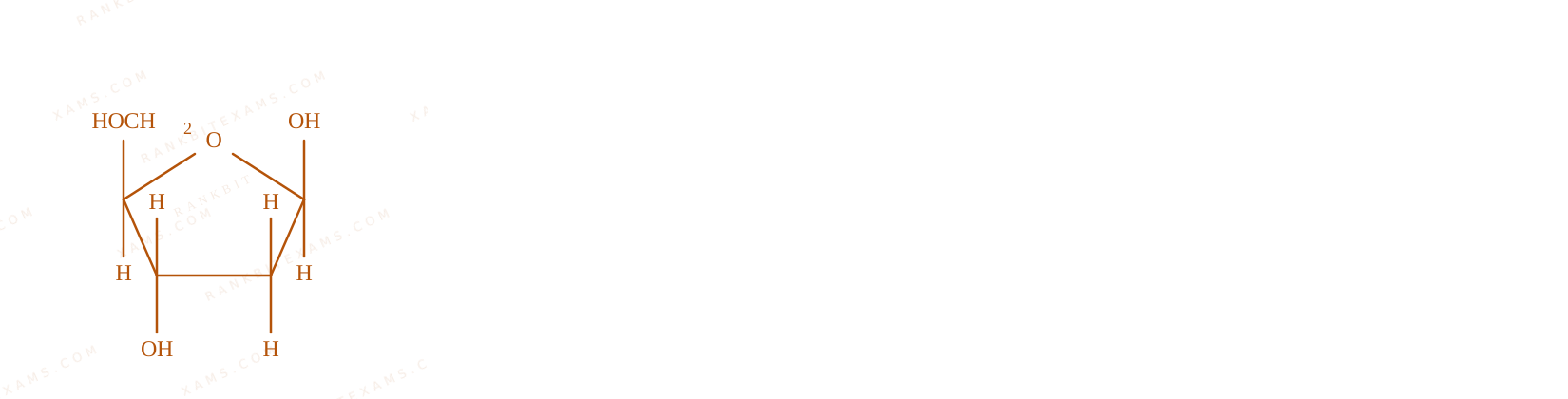
The carbohydrates "Ribose" present in DNA, is A. A pentose sugar B. present in pyranose from C. in "D" configuration D. a reducing sugar, when free E. in α -anomeric form Choose the correct answer from the options given below:

Solution & Explanation

Core Logic

The specific carbohydrate residue present across backbone units in DNA molecules is β-2-deoxy-D-ribose. Its spatial parameters satisfy the following conditions:

  • It is a 5-carbon pentose sugars skeleton structure (A).
  • It maintains a canonical D configuration pathway sequence (C).
  • When localized in free, open unlinked molecular solutions, it standardly functions as a reducing carbohydrate assembly agent (D).
  • It exists predominantly in a furanose cycle form inside DNA, rather than a pyranose ring.
    Carbohydrates - Nucleic Acids component diagram for Q36 - JEE Main 2025 Morning
    Carbohydrates - Nucleic Acids component diagram for Q36 - JEE Main 2025 Morning
Pattern Recognition

Ribose in nucleic acids occurs primarily as a five-membered furanose ring configuration system.

Chapter Mix

Class 12 Chemistry: Biomolecules

Reference Study Guides

More Biomolecules Previous-Year Questions — Page 8

Q78 jee_main_2024_31_jan_morning Reactions of Glucose
Match List I with List II
LIST-ILIST-II
A. Glucose/NaHCO₃/ΔI. Gluconic acid
B. Glucose/HNO₃II. No reaction
C. Glucose/HI/ΔIII. n-hexane
D. Glucose/Bromine waterIV. Saccharic acid
Choose the correct answer from the options given below:
  • A. A-IV, B-I, C-III, D-II
  • B. A-II, B-IV, C-III, D-I
  • C. A-III, B-II, C-I, D-IV
  • D. A-I, B-IV, C-III, D-II

Solution

Core Logic

Matching the reactions of glucose: (A) Glucose does not react with NaHCO₃, so there is no reaction. (A arrow II) (B) Oxidation of glucose with strong oxidizing agents like HNO₃ yields a dicarboxylic acid called saccharic acid. (B arrow IV) (C) Prolonged heating of glucose with HI forms n-hexane, indicating a straight chain of six carbon atoms. (C arrow III) (D) Oxidation with mild agents like bromine water converts glucose to gluconic acid. (D arrow I)

Chapter Mix

Class 12 Chemistry: Biomolecules

More Biomolecules Questions — jee_main_2025_24_jan_morning

Practice all Biomolecules previous-year questions →

Rankbit System
JEE Physics: Waves (+15.5%) | Electrostatics: Concentric Shells (-29.7%) | Modern Physics: Photoelectric Clones (+34.2%) | Mathematics: Definite Integrals (+18.1%) | Chemistry: Coordination Splitting (-11.4%) | JEE Physics: Waves (+15.5%) | Electrostatics: Concentric Shells (-29.7%) | Modern Physics: Photoelectric Clones (+34.2%) | Mathematics: Definite Integrals (+18.1%) | Chemistry: Coordination Splitting (-11.4%)