Let the position vectors of three vertices of a \triangle be 4vecp+vecq-3vecr, -5vecp+vecq+2vecr and 2vecp-vecq+2vecr If the position vectors of the orthocenter and the circumcenter of the \triangle are fracvecp+vecq+vecr4 and alphavecp+betavecq+gammavecr respectively, then alpha+2beta+5gamma is equal to: [cite: 3266, 3267, 3268, 3269, 3270, 3271, 3272]

Solution & Explanation

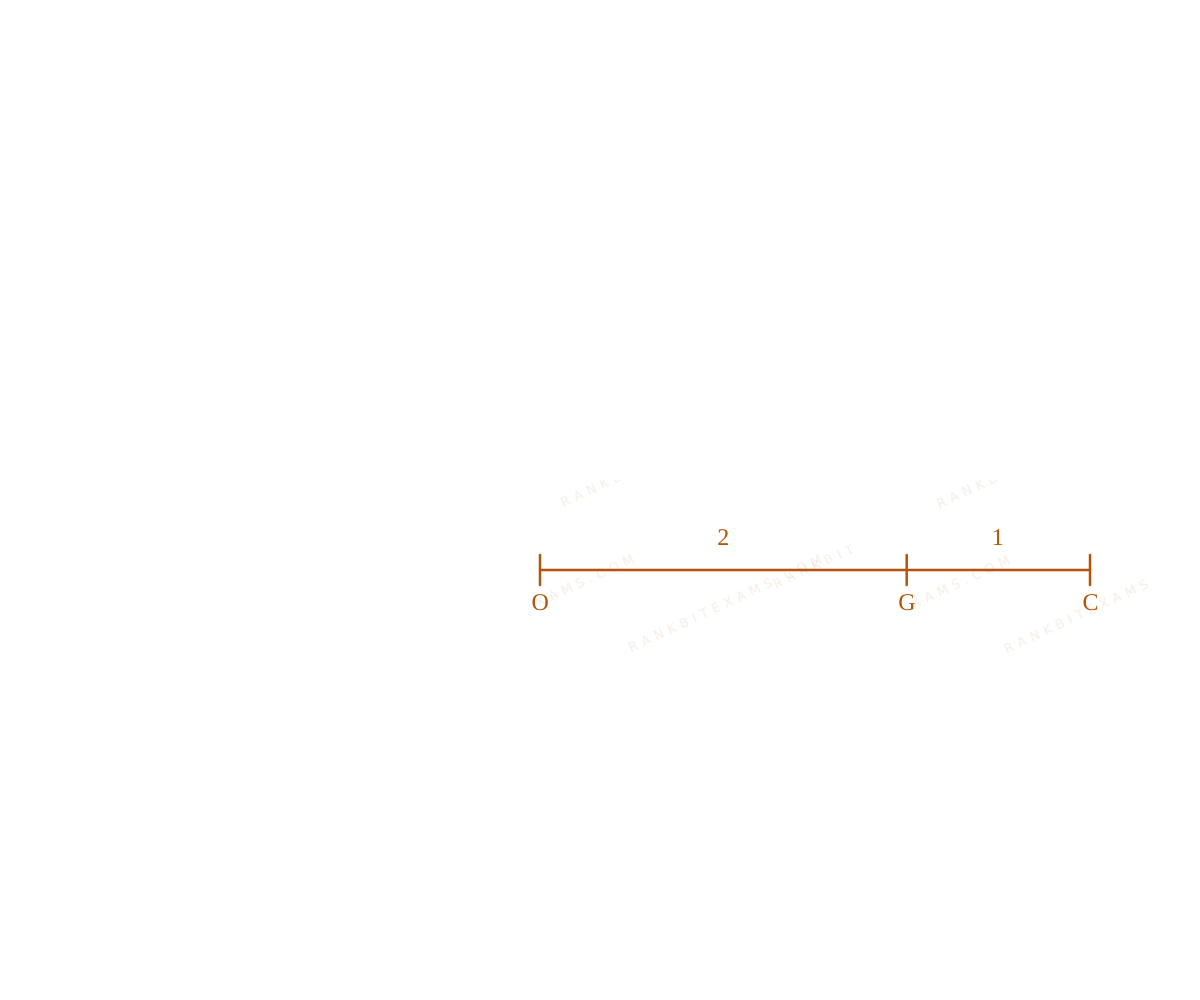
### Related Formula 1. Centroid (G) of a \triangle with vertices A, B, C is given by: vecG = fracvecA + vecB + vecC3 2. Euler\'s line property: The orthocenter (O), centroid (G), and circumcenter (C) are collinear, and G divides the segment OC internally in the ratio 2:1. ### Step 1: Compute the Centroid Vector Sum the vectors of the three given vertices [cite: 3266, 3268]: vecA = 4vecp+vecq-3vecr vecB = -5vecp+vecq+2vecr vecC = 2vecp-vecq+2vecr vecG = frac(4 - 5 + 2)vecp + (1 + 1 - 1)vecq + (-3 + 2 + 2)vecr3 = fracvecp + vecq + vecr3 ### Step 2: Apply Euler Line Section Ratio Using the section formula ratio O-G-C as 2:1 [cite: 3931, 3932]:
Euler Line section diagram for Q56 - JEE Main 2025 Evening
vecG = frac2vecC + vecO3 Rightarrow 3vecG = 2vecC + vecO 2vecC = 3vecG - vecO = 3left(fracvecp + vecq + vecr3right) - fracvecp + vecq + vecr4 2vecC = (vecp + vecq + vecr) - frac14(vecp + vecq + vecr) = frac34(vecp + vecq + vecr) vecC = frac38vecp + frac38vecq + frac38vecr ### Step 3: Coefficient Matching Compare with the given circumcenter format alphavecp + betavecq + gammavecr [cite: 3270, 3939]: alpha = frac38, quad beta = frac38, quad gamma = frac38 Calculate alpha + 2beta + 5gamma [cite: 3272, 3949]: frac38 + 2left(frac38right) + 5left(frac38right) = frac3 + 6 + 158 = frac248 = 3 ### Pattern Recognition Euler line configuration is universally O-G-C in 2:1. Remember the mnemonic 'Oil-Gas-Company' or simply 3G = 2C + O to prevent swapping structural coefficients under exam stress. ### Evaluation Rubric / Model Answer null ### Chapter Mix Class 12 Mathematics: Vector Algebra Class 11 Mathematics: Properties of Triangles

Reference Study Guides

More Vector Algebra Previous-Year Questions — Page 7

Q26 jee_main_2024_31_jan_evening Vector Triple Product
Let veca = 3hati + 2hatj + hatk, vecb = 2hati - hatj + 3hatk and vecc be a vector such that (veca + vecb) times vecc = 2(veca times vecb) + 24hatj - 6hatk and (veca - vecb + hati) cdot vecc = -3. Then |vecc|^2 is equal to
Numerical Answer. Answer: 38 to 38

Solution

### Core Logic Evaluate base vectors: veca + vecb = (5, 1, 4) veca times vecb = beginvmatrix hati & hatj & hatk \\ 3 & 2 & 1 \\ 2 & -1 & 3 endvmatrix = (7, -7, -7) Substitute into given cross product equation, letting vecc = (x, y, z): (5hati + hatj + 4hatk) times (xhati + yhatj + zhatk) = 2(7hati - 7hatj - 7hatk) + 24hatj - 6hatk beginvmatrix hati & hatj & hatk \\ 5 & 1 & 4 \\ x & y & z endvmatrix = (14, -14, -14) + (0, 24, -6) (z-4y)hati - (5z-4x)hatj + (5y-x)hatk = (14, 10, -20) Equating components: z - 4y = 14 implies z = 4y + 14 4x - 5z = 10 5y - x = -20 implies x = 5y + 20 Now use the dot product constraint: veca - vecb + hati = (3-2+1)hati + (2+1)hatj + (1-3)hatk = (2, 3, -2). (veca - vecb + hati) cdot vecc = -3 2x + 3y - 2z = -3 Substitute x = 5y + 20 and z = 4y + 14: 2(5y + 20) + 3y - 2(4y + 14) = -3 10y + 40 + 3y - 8y - 28 = -3 5y + 12 = -3 implies 5y = -15 implies y = -3 Calculate x and z: x = 5(-3) + 20 = 5 z = 4(-3) + 14 = 2 So, vecc = (5, -3, 2). |vecc|^2 = 5^2 + (-3)^2 + 2^2 = 25 + 9 + 4 = 38 ### Evaluation Rubric / Model Answer null ### Chapter Mix Class 12 Maths: Vector Algebra

Q12 jee_main_2024_31_jan_morning Cross and Dot Product Operations
Let veca = 3hati + hatj - 2hatk, vecb = 4hati + hatj + 7hatk and vecc = hati - 3hatj + 4hatk be three vectors. If a vector vecp satisfies vecp times vecb = vecc times vecb and vecp cdot veca = 0, then vecp cdot (hati - hatj - hatk) is equal to
  • A. 24
  • B. 36
  • C. 28
  • D. 32

Solution

### Core Logic Given vecp times vecb = vecc times vecb. (vecp - vecc) times vecb = vec0 Thus, vecp - vecc = lambda vecb implies vecp = vecc + lambda vecb. ### Step 1: Utilize Dot Product Condition Given vecp cdot veca = 0. (vecc + lambda vecb) cdot veca = 0 vecc cdot veca + lambda (vecb cdot veca) = 0 Calculate vecc cdot veca: (1)(3) + (-3)(1) + (4)(-2) = 3 - 3 - 8 = -8. Calculate vecb cdot veca: (4)(3) + (1)(1) + (7)(-2) = 12 + 1 - 14 = -1. -8 + lambda(-1) = 0 implies lambda = -8 ### Step 2: Substitute and Solve Substitute lambda back to find vecp: vecp = vecc - 8vecb = (hati - 3hatj + 4hatk) - 8(4hati + hatj + 7hatk) vecp = -31hati - 11hatj - 52hatk Now compute vecp cdot (hati - hatj - hatk): = (-31)(1) + (-11)(-1) + (-52)(-1) = -31 + 11 + 52 = 32 ### Evaluation Rubric / Model Answer null ### Chapter Mix Class 12 Maths: Vector Algebra
Q28 jee_main_2024_31_jan_morning Vector Triple Product
Let veca and vecb be two vectors such that |veca| = 1, |vecb| = 4 and veca cdot vecb = 2. If vecc = (2veca times vecb) - 3vecb and the angle between vecb and vecc is alpha, then 192sin^2alpha is equal to
Numerical Answer. Answer: 48 to 48

Solution

### Core Logic vecb cdot vecc = vecb cdot ((2veca times vecb) - 3vecb) |b||c|cosalpha = 2(vecb cdot (veca times vecb)) - 3|b|^2 Since vecb cdot (veca times vecb) = 0, we have |b||c|cosalpha = -3|b|^2. |c|cosalpha = -3|b| = -12 implies |c|^2 cos^2 alpha = 144 ### Step 1: Compute Modulus of c |c|^2 = |2veca times vecb - 3vecb|^2 = 4|veca times vecb|^2 + 9|vecb|^2 - 12((veca times vecb) cdot vecb) = 4|veca times vecb|^2 + 9|vecb|^2 Given veca cdot vecb = 2 implies |a||b|costheta = 2 implies 1 cdot 4 costheta = 2 implies theta = fracpi3. |veca times vecb|^2 = |a|^2|b|^2sin^2theta = 1 cdot 16 cdot frac34 = 12 |c|^2 = 4(12) + 9(16) = 48 + 144 = 192 ### Step 2: Final Calculation We know |c|^2 cos^2 alpha = 144. 192 cos^2 alpha = 144 192(1 - sin^2 alpha) = 144 192sin^2 alpha = 192 - 144 = 48 ### Evaluation Rubric / Model Answer null ### Chapter Mix Class 12 Maths: Vector Algebra

More Vector Algebra Questions — jee_main_2025_24_jan_evening

Practice all Vector Algebra previous-year questions →

Rankbit System
JEE Physics: Waves (+15.5%) | Electrostatics: Concentric Shells (-29.7%) | Modern Physics: Photoelectric Clones (+34.2%) | Mathematics: Definite Integrals (+18.1%) | Chemistry: Coordination Splitting (-11.4%) | JEE Physics: Waves (+15.5%) | Electrostatics: Concentric Shells (-29.7%) | Modern Physics: Photoelectric Clones (+34.2%) | Mathematics: Definite Integrals (+18.1%) | Chemistry: Coordination Splitting (-11.4%)