JEE Main · Mathematics → Steady

Trigonometric Functions appeared 43 times across 3 years — 5% of Mathematics. This question is from Trigonometric Equations and Solutions.

Year 2026 2025 2024 Total
Questions 15 18 10 43

Let A=xin(0,π)-(π)/(2): (2/π)| x|+ (2/π)| x|=2 and B=x≥0:√(x)(√(x)-4)-3|√(x)-2|+6=0. Then n(A B) is equal to:

Solution & Explanation

Related Formula

Logarithmic addition property: (a) + (b) = (ab). Double angle sine formula: 2 x x = 2x.

Step 1: Simplify Set A

Combine the logarithmic elements:

(2/π) (| x| · | x|) = 2 | x x| = ((2)/(π))² = (4)/(π²) |2 x x| = (8)/(π²) ⇒ | 2x| = (8)/(π²)

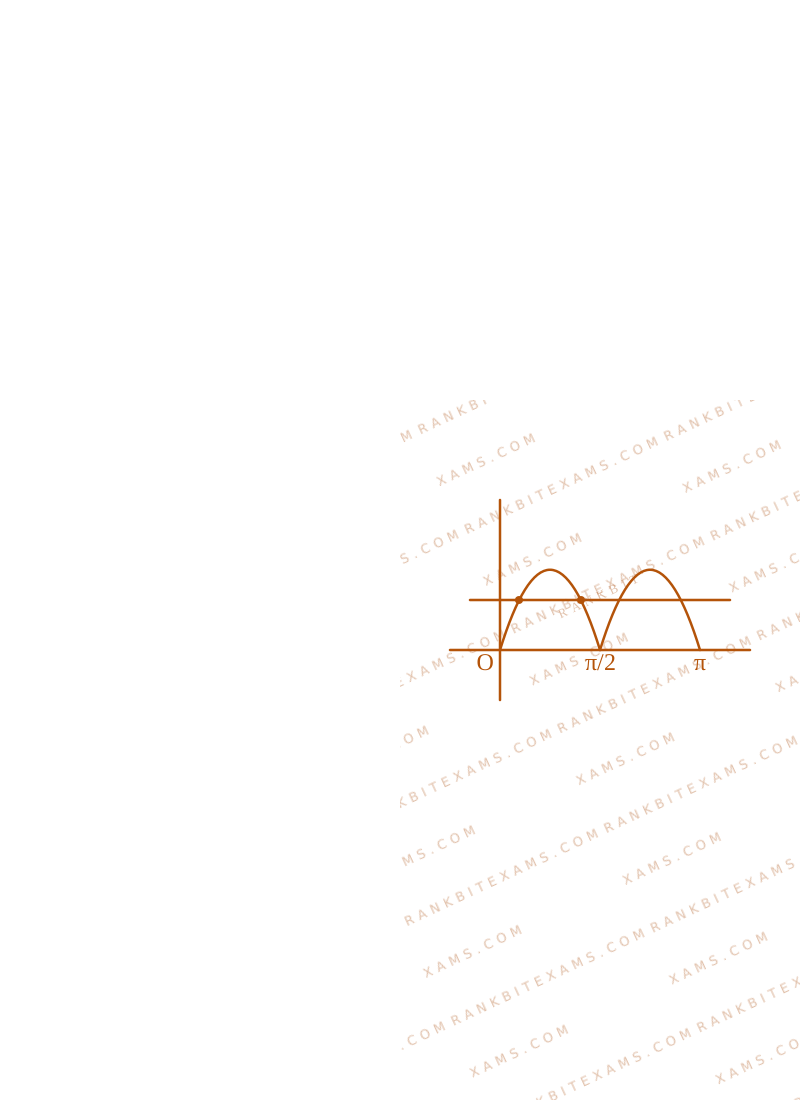
Since π² ≈ 9.87, (8)/(π²) ≈ 0.81, which is less than 1. Plotting | 2x| = (8)/(π²) over the specified range x in (0, π) yields exactly 4 real intersection points.

Trigonometric Equations graph for Q55 - JEE Main 2025 Evening

Hence, n(A) = 4.

Step 2: Simplify Set B

Let √(x) = t where t ≥ 0. The equation becomes:

t(t-4) - 3|t-2| + 6 = 0

Case I: If t < 2 :

t² - 4t - 3(-(t-2)) + 6 = 0 ⇒ t² - 4t + 3t - 6 + 6 = 0 ⇒ t² - t = 0 t = 0, 1 ⇒ x = 0, 1

Case II: If t > 2 :

t² - 4t - 3(t-2) + 6 = 0 ⇒ t² - 4t - 3t + 6 + 6 = 0 ⇒ t² - 7t + 12 = 0 (t-3)(t-4) = 0 ⇒ t = 3, 4 ⇒ x = 9, 16

Hence, set B = 0, 1, 9, 16, giving n(B) = 4.

Step 3: Calculate Union

Since all elements of set A are non-integral angles in (0, π) and elements of set B are pure integers, the sets are completely disjoint (A B =).

n(A B) = n(A) + n(B) = 4 + 4 = 8
Pattern Recognition

Always separate functions into disjoint numeric domains (e.g., angles vs. whole integers) to conclude unions without performing tedious tracking of individual values manually.

Chapter Mix

Class 11 Physics: Trigonometric Functions Class 11 Mathematics: Sets

Reference Study Guides

More Trigonometric Functions Previous-Year Questions — Page 8

Q15 jee_main_2024_29_january_evening Inverse Trigonometric Equations
Let x = (m)/(n) (m, n are co-prime natural numbers) be a solution of the equation (2 ⁻¹x) = (1)/(9) and let α, β (α > β) be the roots of the equation mx² - nx - m + n = 0. Then the point (α, β) lies on the line
  • A. 3x + 2y = 2
  • B. 5x - 8y = -9
  • C. 3x - 2y = -2
  • D. 5x + 8y = 9

Solution

Related Formula

(2θ) = 1 - 2 ²θ

Core Logic

Let ⁻¹x = θ θ = x. The equation matches (2θ) = (1)/(9):

1 - 2 ²θ = (1)/(9) 1 - 2x² = (1)/(9) 2x² = 1 - (1)/(9) = (8)/(9) x² = (4)/(9) x = ± (2)/(3)

Since m and n are natural numbers, we pick x = (2)/(3) = (m)/(n). Because 2 and 3 are co-prime, we choose m = 2 and n = 3.

Step 1: Formulating Quadratic Equations

Substituting values into mx² - nx - m + n = 0:

2x² - 3x - 2 + 3 = 0 2x² - 3x + 1 = 0

Factoring the equations:

(2x - 1)(x - 1) = 0 x = 1 or x = (1)/(2)

Given α > β, we have α = 1 and β = (1)/(2).

Step 2: Checking Options

Let us check the coordinates (1, (1)/(2)) against option line configurations:

5(1) + 8((1)/(2)) = 5 + 4 = 9

This exactly matches option (4).

Pattern Recognition

Co-prime conditions uniquely lock fractional values down to absolute integers. This bridges variables directly into standard algebraic calculations.

Chapter Mix

Class 12 Mathematics: Inverse Trigonometric Functions Class 10 Mathematics: Quadratic Equations

Q27 jee_main_2024_27_jan_morning Multiple Angles and Equations
Let the set of all ain R such that the equation 2x+a x=2a-7 has a solution be [p, q] and r= 9°- 27°- 1 63°+ 81°, then pqr is equal to:
Numerical Answer. Answer: 48 to 48

Solution

Related Formula
2x = 1 - 2 ² x θ + θ = (2)/( 2θ)
Core Logic

Transform the trigonometric equation into a quadratic in terms of x:

(1 - 2 ² x) + a x = 2a - 7 2 ² x - a x + 2a - 8 = 0

Factorizing the quadratic:

2 ² x - 4 x - (a-4) x + 2(a-4) = 0 2 x( x - 2) - (a-4)( x - 2) = 0 ( x - 2)(2 x - (a-4)) = 0
Step 1: Finding bounds for a

Since x = 2 has no real solution, we must have:

x = (a-4)/(2)

For this to have a solution, the root must lie in the standard domain of sine:

-1 ≤ (a-4)/(2) ≤ 1 -2 ≤ a-4 ≤ 2

2 ≤ a ≤ 6 Thus, the solution set is [p, q] = [2, 6], meaning p = 2 and q = 6.

Step 2: Evaluating r

Evaluate r = 9° - 27° - 1 63° + 81°. Using complementary angles ((90 - θ) = θ): 81° = 9° 1 63° = 63° = 27° Substitute these in:

r = ( 9° + 9°) - ( 27° + 27°)

Apply the formula θ + θ = (2)/( 2θ):

r = 2 18° - 2 54°

We know 18° = √(5)-14 and 54° = 36° = √(5)+14.

r = 8√(5)-1 - 8√(5)+1 = 8 [ √(5)+1 - (√(5)-1)(√(5)-1)(√(5)+1) ] r = 8 [ (2)/(4) ] = 4
Step 3: Final Output Calculation

We need the value of pqr:

pqr = 2 × 6 × 4 = 48
Pattern Recognition

Converting mixed trig degrees like 9, 27, 63, 81 entirely into cot/tan pairs ALWAYS drops them into the (2)/( 2θ) double-angle trap, bringing them natively to 18 and 54 degrees.

Chapter Mix

Class 11 Maths: Trigonometric Functions

Q11 jee_main_2024_29_jan_morning Trigonometric Equations
If α, -(π)/(2) lt α lt (π)/(2) is the solution of 4 θ+5 θ=1, then the value of α is
  • A. 10-√(10)6
  • B. 10-√(10)12
  • C. √(10)-1012
  • D. √(10)-106

Solution

Related Formula
²θ - ²θ = 1

If a θ + b θ = c, dividing by θ transforms the equation into a quadratic in terms of θ and θ.

Core Logic

Given the equation:

4 θ + 5 θ = 1

Divide the entire equation by θ:

4 + 5 θ = θ

Square both sides to convert the θ into a θ expression:

(4 + 5 θ)² = ²θ 16 + 25 ²θ + 40 θ = 1 + ²θ

Rearranging into a standard quadratic equation in terms of θ:

24 ²θ + 40 θ + 15 = 0
Step 1: Apply Quadratic Formula

Solve for θ using the quadratic formula:

θ = -40 ± √(1600 - 4(24)(15))2(24) θ = -40 ± √(1600 - 1440)48 θ = -40 ± √(160)48 θ = -40 ± 4√(10)48 θ = -10 ± √(10)12

This gives two possible values:

θ = -10 + √(10)12 and θ = -( 10 + √(10)12)
Step 2: Check Extraneous Roots

When we squared the equation 4 + 5 θ = θ, we introduced the possibility of extraneous roots where θ might be strictly negative while 4 + 5 θ is negative, but α in (-π/2, π/2) restricts α gt 0, hence α gt 0. For α to be positive, 4 + 5 α gt 0. If α = - 10 + √(10)12 (approx -1.09):

4 + 5(-1.09) = 4 - 5.45 = -1.45 lt 0

This contradicts α gt 0. Hence, this root is rejected.

Therefore, the only valid solution is:

α = √(10) - 1012
Pattern Recognition

Whenever you square a trigonometric equation (like converting to ), always map the proposed roots back to the domain limits to prune out extraneous negative parity roots.

Chapter Mix

Class 11 Mathematics: Trigonometric Functions

Q2 jee_main_2024_30_january_evening Compound Angles
For α, β in (0, (π)/(2)) , let 3 (α + β) = 2 (α - β) and a real number k be such that α = k β . Then the value of k is equal to:
  • A. -(2)/(3)
  • B. -5
  • C. (2)/(3)
  • D. 5

Solution

Related Formula
(A ± B) = A B ± A B
Core Logic

Given equation:

3 (α + β) = 2 (α - β)

Expanding both sides:

3( α β + α β) = 2( α β - α β) 3 α β + 3 α β = 2 α β - 2 α β
Step 1: Rearranging Terms

Grouping like terms together:

3 α β - 2 α β = -2 α β - 3 α β α β = -5 α β

Dividing both sides by α β:

( α)/( α) = -5( β)/( β) α = -5 β
Step 2: Conclusion

Comparing with the given equation α = k β, we get k = -5.

Note by our answer (Bonus): Since α, β in (0, (π)/(2)), both α and β must be positive. Hence, α = -5 β is not possible. The data is inconsistent, but the NTA key marks option (2) as correct.

Pattern Recognition

Standard expansion of (A± B) and grouping identical products to isolate (A) and (B).

Chapter Mix

Class 11 Maths: Trigonometric Functions

Q19 jee_main_2024_30_jan_morning Trigonometric Equations
If 2 ³ x + 2x x + 4 x - 4 = 0 has exactly 3 solutions in the interval [0,(nπ)/(2)], nin N, then the roots of the equation x² + nx + (n - 3) = 0 belong to :
  • A. (0,∞)
  • B. (-∞,0)
  • C. (- √(17)2, √(17)2)
  • D. Z

Solution

Related Formula
2x = 2 x x
Core Logic

Given equation: 2 ³ x + 2x x + 4 x - 4 = 0 Expand 2x:

2 ³ x + 2 x ² x + 4 x - 4 = 0

Factor out 2 x from the first two terms:

2 x ( ² x + ² x) + 4 x - 4 = 0

Since ² x + ² x = 1:

2 x (1) + 4 x - 4 = 0 6 x - 4 = 0 ⇒ x = (4)/(6) = (2)/(3)
Step 1: Finding appropriate interval for exactly 3 roots

We need exactly 3 solutions in [0, (nπ)/(2)]. The line y = 2/3 intersects the sine wave y = x twice in every 2π interval. In [0, π], there are 2 solutions. In [π, 2π], there are 0 solutions. In [2π, 3π], there are 2 solutions (total 4 solutions). To get exactly 3 solutions, the interval must stretch past the first root in [2π, 3π], but not reach the second root in that interval. However, the interval is defined as (nπ)/(2). Let's check endpoints (nπ)/(2): For n=4: [0, 2π] has 2 solutions. For n=5: [0, (5π)/(2)] includes [2π, 2π + (π)/(2)]. Since x = 2/3 happens in (0, π/2), there is exactly 1 solution in [2π, 5π/2]. Thus, total solutions = 3 for n=5.

Step 2: Solving quadratic equation

Given n = 5, the quadratic equation is:

x² + 5x + 2 = 0

Using quadratic formula:

x = -5 ± √(25 - 8)2 = -5 ± √(17)2

The roots are approximately (-5 ± 4.12)/(2), which evaluates to roughly -0.44 and -4.56. Both roots are strictly negative.

Step 3: Determining interval membership

Since both roots are negative, they belong to the interval (-∞, 0).

Pattern Recognition

Collapsing complex trigonometric expressions often yields c₁ x = c₂. Overlaying horizontal line intersections on the sine graph bounds n rapidly by counting nodes.

Chapter Mix

Class 11 Maths: Trigonometric Functions Class 11 Maths: Complex Numbers and Quadratic Equations

More Trigonometric Functions Questions — jee_main_2025_24_jan_evening

Practice all Trigonometric Functions previous-year questions →

Rankbit System
JEE Physics: Waves (+15.5%) | Electrostatics: Concentric Shells (-29.7%) | Modern Physics: Photoelectric Clones (+34.2%) | Mathematics: Definite Integrals (+18.1%) | Chemistry: Coordination Splitting (-11.4%) | JEE Physics: Waves (+15.5%) | Electrostatics: Concentric Shells (-29.7%) | Modern Physics: Photoelectric Clones (+34.2%) | Mathematics: Definite Integrals (+18.1%) | Chemistry: Coordination Splitting (-11.4%)