Let
A=xin(0,π)-(π)/(2): (2/π)| x|+ (2/π)| x|=2$A=\left\{x\in(0,\pi)-\left\{\frac{\pi}{2}\right\}:\log_{(2/\pi)}|\sin x|+\log_{(2/\pi)}|\cos x|=2\right\}$
and
B=x≥0:√(x)(√(x)-4)-3|√(x)-2|+6=0.$B=\left\{x\ge0:\sqrt{x}(\sqrt{x}-4)-3|\sqrt{x}-2|+6=0\right\}.$
Then n(A B)$n(A\cup B)$ is equal to:
A.4$4$
B.2$2$
C.8$8$
D.6$6$
Solution & Explanation
Related Formula
Logarithmic addition property: (a) + (b) = (ab)$\log(a) + \log(b) = \log(ab)$.
Double angle sine formula: 2 x x = 2x$2\sin x \cos x = \sin 2x$.
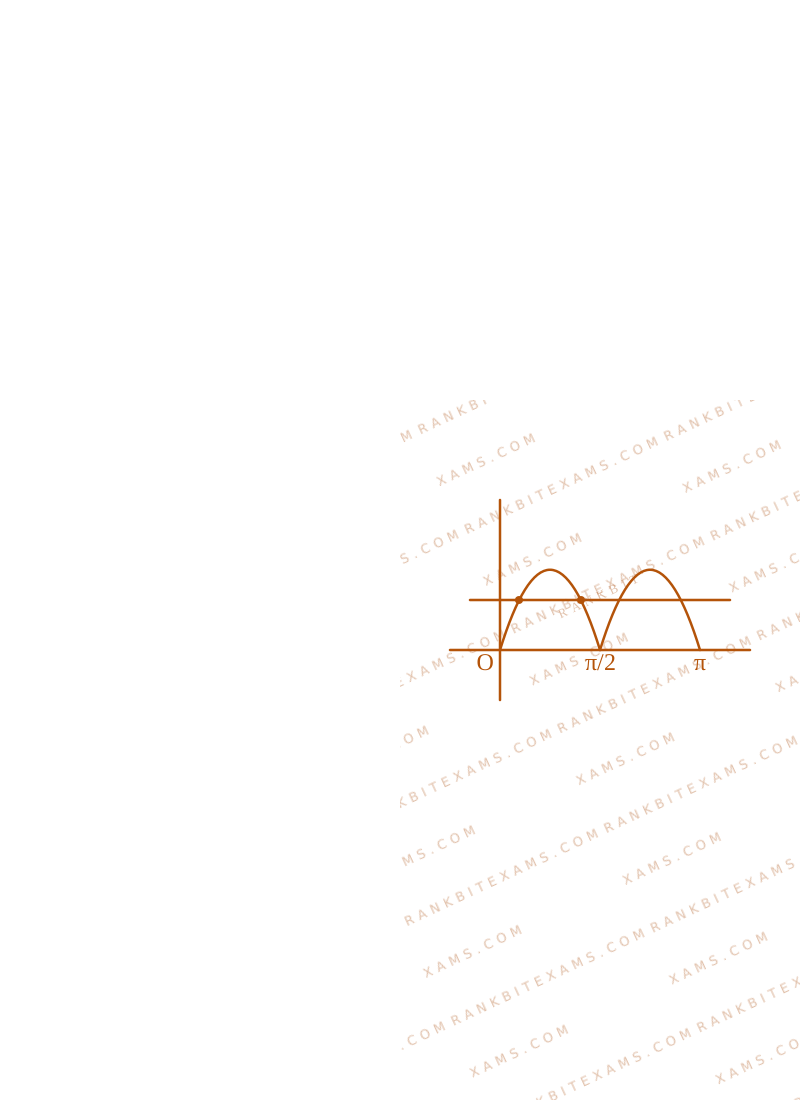
Since π² ≈ 9.87$\pi^2 \approx 9.87$, (8)/(π²) ≈ 0.81$\frac{8}{\pi^2} \approx 0.81$, which is less than 1. Plotting | 2x| = (8)/(π²)$|\sin 2x| = \frac{8}{\pi^2}$ over the specified range x in (0, π)$x \in (0, \pi)$ yields exactly 4 real intersection points.
Trigonometric Equations graph for Q55 - JEE Main 2025 Evening
Hence, n(A) = 4$n(A) = 4$.
Step 2: Simplify Set B
Let √(x) = t$\sqrt{x} = t$ where t ≥ 0$t \ge 0$. The equation becomes:
Hence, set B = 0, 1, 9, 16$B = \{0, 1, 9, 16\}$, giving n(B) = 4$n(B) = 4$.
Step 3: Calculate Union
Since all elements of set A are non-integral angles in (0, π)$(0, \pi)$ and elements of set B are pure integers, the sets are completely disjoint (A B =$A \cap B = \emptyset$).
Always separate functions into disjoint numeric domains (e.g., angles vs. whole integers) to conclude unions without performing tedious tracking of individual values manually.
Chapter Mix
Class 11 Physics: Trigonometric Functions
Class 11 Mathematics: Sets
Keywords:#logarithm trigonometric equation solutions#JEE Main 2025 Evening Q55#modulus radical equations solutions#set union counting disjoint
More Trigonometric Functions Previous-Year Questions — Page 6
Q63jee_main_2025_04_april_morningSimplification of Inverse Trigonometric Expressions
Considering the principal values of the inverse trigonometric functions, ⁻¹( √(3)2 x + (1)/(2)√(1 - x²))$\sin^{-1}\left(\frac{\sqrt{3}}{2} x + \frac{1}{2}\sqrt{1 - x^2}\right)$, where -(1)/(2) < x < 1√(2)$-\frac{1}{2} < x < \frac{1}{\sqrt{2}}$, is equal to
A.(π)/(4) + ⁻¹x$\frac{\pi}{4} + \sin^{-1}x$
B.(π)/(6) + ⁻¹x$\frac{\pi}{6} + \sin^{-1}x$
C.(-5π)/(6) - ⁻¹ x$\frac{-5\pi}{6} - \sin^{-1} x$
D.(5π)/(6) - ⁻¹ x$\frac{5\pi}{6} - \sin^{-1} x$
Solution
Related Formula
Trigonometric Sine Identity:
(A + B) = A B + A B$$\sin(A + B) = \sin A \cos B + \cos A \sin B$$
Core Logic
Let ⁻¹x = θ x = θ$\sin^{-1}x = \theta \implies x = \sin\theta$ and √(1-x²) = θ$\sqrt{1-x^2} = \cos\theta$.
Given constraint -(1)/(2) < x < 1√(2) -(π)/(6) < θ < (π)/(4)$-\frac{1}{2} < x < \frac{1}{\sqrt{2}} \implies -\frac{\pi}{6} < \theta < \frac{\pi}{4}$.
Substitute parameter representations into expression:
This lies completely within the principal value branch of ⁻¹x$\sin^{-1}x$, which is [-(π)/(2), (π)/(2)]$\left[-\frac{\pi}{2}, \frac{\pi}{2}\right]$.
Therefore, ⁻¹( (θ + (π)/(6))) = θ + (π)/(6)$\sin^{-1}\left(\sin\left(\theta + \frac{\pi}{6}\right)\right) = \theta + \frac{\pi}{6}$.
Step 2: Final Form
Substituting back θ = ⁻¹x$\theta = \sin^{-1}x$:
(π)/(6) + ⁻¹x$$\frac{\pi}{6} + \sin^{-1}x$$
Pattern Recognition
Always check primary interval bounds when stripping inverse operators. If the arguments exceed bounds, quadrant mapping transformations must be performed.
Chapter Mix
Class 12 Mathematics: Inverse Trigonometric Functions

If 10 ⁴θ + 15 ⁴θ = 6$10\sin^4\theta + 15\cos^4\theta = 6$, then the value of (27 ⁶θ + 8 ⁶θ)/(16 ⁸θ)$\frac{27\csc^6\theta + 8\sec^6\theta}{16\sec^8\theta}$ is:
A.(2)/(5)$\frac{2}{5}$
B.(3)/(4)$\frac{3}{4}$
C.(3)/(5)$\frac{3}{5}$
D.(1)/(5)$\frac{1}{5}$
Solution
Related Formula
Trigonometric identity conversion:
²θ = 1 - ²θ$$\cos^2\theta = 1 - \sin^2\theta$$
Core Logic
Let ²θ = t$\sin^2\theta = t$. Substitute this into the given equation:
Value = (250)/(625) = (2)/(5)$$\text{Value} = \frac{250}{625} = \frac{2}{5}$$
Pattern Recognition
Equations structured as A ⁴θ + B ⁴θ = C$A\sin^4\theta + B\cos^4\theta = C$ often yield perfect square trinomial combinations. Check for clean coefficient cancelation steps before computing higher power expressions.
Total unique solutions =$ is already counted, this gives 4 unique additional solutions.
Total unique solutions = $3 + 4 = 7.
Pattern Recognition
Transforming powers like$.
Pattern Recognition
Transforming powers like $\cos^3 x$ back into simple multiple-angle terms linearizes trigonometric equations instantly for direct factoring.
Chapter Mix
Class 11 Mathematics: Trigonometry
Q53jee_main_2025_24_jan_eveningProperties of Inverse Trigonometric Functions
If α>β>γ>0$\alpha>\beta>\gamma>0$ then the expression ⁻¹β+ (1+β²)(α-β)+ ⁻¹γ+ (1+γ²)(β-γ)+ ⁻¹α+ (1+α²)(γ-α)$\cot^{-1}\left\{\beta+\frac{(1+\beta^{2})}{(\alpha-\beta)}\right\}+\cot^{-1}\left\{\gamma+\frac{(1+\gamma^{2})}{(\beta-\gamma)}\right\}+\cot^{-1}\left\{\alpha+\frac{(1+\alpha^{2})}{(\gamma-\alpha)}\right\}$ is equal to:
The sign trap is the most vital component of this question. The ordering α > β > γ > 0$\alpha > \beta > \gamma > 0$ means the last term contains a denominator with a negative difference (γ - α)$(\gamma - \alpha)$, introducing the +π$+\pi$ offset according to the principal range of ⁻¹(x)$\cot^{-1}(x)$.
Chapter Mix
Class 12 Mathematics: Inverse Trigonometric Functions
More Trigonometric Functions Questions — jee_main_2025_24_jan_evening
Practice past-year questions one chapter at a time. Pick an exam → subject → chapter and get every PYQ for that topic — pulled together from all past papers — with the chapter's key formulas alongside.