JEE Main · Chemistry ↓ Falling

Thermodynamics appeared 44 times across 3 years — 5.1% of Chemistry. This question is from Hess's Law of Constant Heat Summation.

Year 2026 2025 2024 Total
Questions 12 24 8 44

S(g) + (3)/(2) O₂(g) arrow SO₃(g) + 2x kcal SO2(g) + (1)/(2)O2(g) arrow SO3(g) + y kcal The heat of formation of SO₂(g) is given by:

Solution & Explanation

Related Formula

Using Hess's Law, the enthalpy change of a net reaction can be determined by linearly combining the steps:

Δ Hnet = Σ Δ Hproducts - Σ Δ Hreactants
Core Logic

The heat of formation of SO₂(g) corresponds to the target thermochemical equation:

Target: S(g) + O2(g) arrow SO2(g) Δ Hf = ?

Let's write out the given equations along with their enthalpy changes (remembering that exothermic reactions release heat, so Δ H = -Q): 1. S(g) + (3)/(2)O₂(g) arrow SO₃(g) Δ H₁ = -2x kcal 2. SO₂(g) + (1)/(2)O₂(g) arrow SO₃(g) Δ H₂ = -y kcal

To isolate SO₂(g) on the product side, subtract Equation (2) from Equation (1):

[S(g) + (3)/(2)O2(g)] - [SO2(g) + (1)/(2)O2(g)] arrow SO3(g) - SO3(g) S(g) + O2(g) arrow SO2(g)

Now apply the same operation to the enthalpy values:

Δ Hf = Δ H1 - Δ H₂ = -2x - (-y) = y - 2x kcal

This matches Option (2).

Pattern Recognition

To isolate your target species on the desired side of the equation, use Hess's Law to add or subtract the given elemental equations. Make sure to invert the sign of the enthalpy change if you reverse a reaction.

Chapter Mix

Class 11 Chemistry: Thermodynamics
Reference Study Guides

More Thermodynamics Previous-Year Questions — Page 9

Q83 jee_main_2024_30_january_evening Hess's Law of Constant Heat Summation
Two reactions are given below: 2Fe(s) + (3)/(2)O2(g) arrow Fe₂O3(s), Δ H° = -822 kJ/mol C(s) + (1)/(2)O2(g) arrow CO(g), Δ H° = -110 kJ/mol Then enthalpy change for following reaction 3C(s) + Fe₂O3(s) arrow 2Fe(s) + 3CO(g)
Numerical Answer. Answer: 492 to 492

Solution

Related Formula

According to Hess's Law, the net enthalpy change of a reaction is the sum of the enthalpy changes of the individual steps into which it can be divided.

Core Logic

Let the given reactions be: (1) 2Fe(s) + (3)/(2)O2(g) arrow Fe₂O3(s), Δ H₁ = -822 kJ/mol (2) C(s) + (1)/(2)O2(g) arrow CO(g), Δ H₂ = -110 kJ/mol

Target Reaction (3):

3C(s) + Fe₂O3(s) arrow 2Fe(s) + 3CO(g), Δ H₃ = ?

To construct the target reaction:

  • We need 3 CO(g) on the product side, so we multiply reaction (2) by 3.
  • We need Fe₂O3(s) on the reactant side and 2 Fe(s) on the product side, so we reverse reaction (1).
Step 1: Calculate Net Enthalpy

Target Reaction (3) = 3 × (2) - (1)

Δ H₃ = 3 × Δ H₂ - Δ H₁ Δ H₃ = 3(-110) - (-822) Δ H₃ = -330 + 822 = 492 kJ/mol
Chapter Mix

Class 11 Chemistry: Thermodynamics

Q jee_main_2024_30_jan_morning Work Done in Cyclic Process
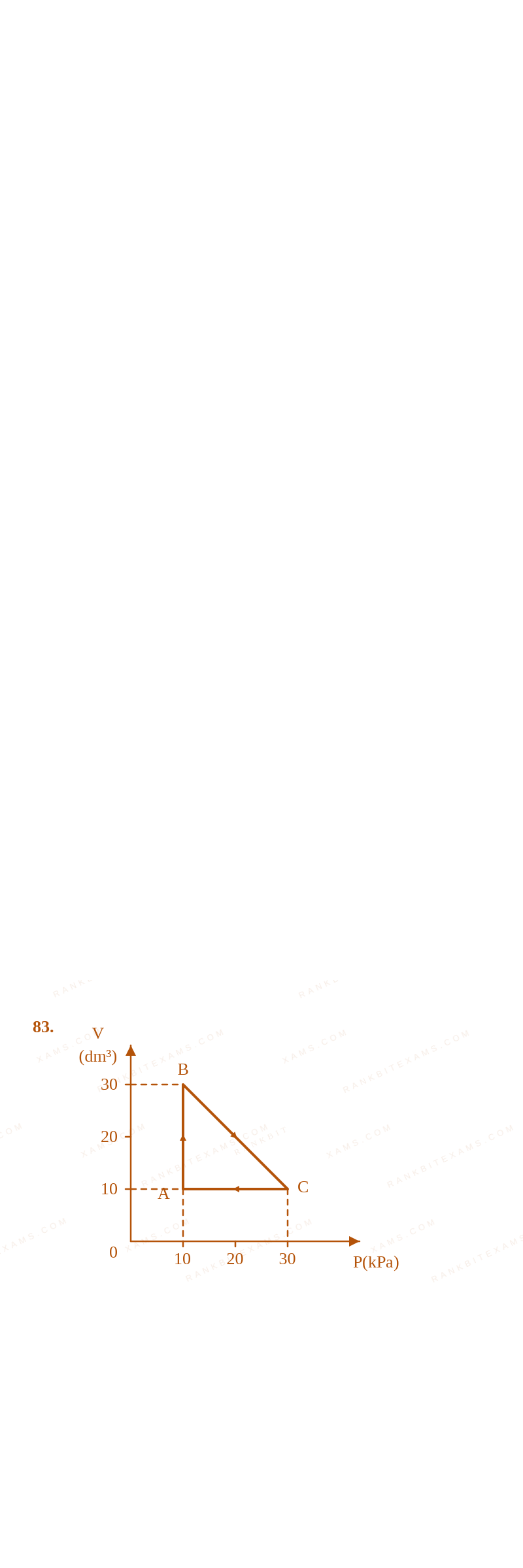
An ideal gas undergoes a cyclic transformation starting from the point A and coming back to the same point by tracing the path Aarrow Barrow Carrow A as shown in the diagram. The total work done in the process is ________ J.
Work Done in Cyclic Process diagram for Q83 - JEE Main 2024 Morning
The image is a graph of Volume (dm3) vs Pressure (kPa) showing a triangular cyclic process starting from A(10,10) to B(10,30) to C(30,10) and back to A.
Numerical Answer. Answer: 200 to 200

Solution

Related Formula
Wcyclic = Area enclosed in P-V graph
Core Logic

The work done in a cyclic process is equal to the magnitude of the area enclosed by the cycle on a Pressure-Volume graph. Note that the provided graph is Volume (V) on the y-axis versus Pressure (P) on the x-axis. The path A arrow B arrow C arrow A is traced in a clockwise direction on the V-P graph. Clockwise on a V-P graph corresponds to anti-clockwise on a standard P-V graph, meaning net expansion work is done by the gas, making it positive conventionally (or negative depending on chemistry sign convention, but magnitude is asked for).

Step 1: Calculating Area

The enclosed region is a right-angled triangle. Base of triangle on P-axis = 30 - 10 = 20 kPa Height of triangle on V-axis = 30 - 10 = 20 dm³

Area = (1)/(2) × base × height Area = (1)/(2) × 20 × 20 = 200 kPa ³
Step 2: Unit conversion

1 kPa = 10³ Pa 1 dm³ = 1 Litre = 10⁻³ m³

W = 200 × 10³ Pa × 10⁻³ m³ W = 200 J
Pattern Recognition

1 kPa · 1 L = 1 Joule. This direct conversion saves time without converting explicitly to standard SI units (Pa and m³).

Chapter Mix

Class 11 Chemistry: Thermodynamics

Q90 jee_main_2024_31_jan_evening Work Done in Isothermal Reversible Expansion
If 5 moles of an ideal gas expands from 10 L to a volume of 100 L at 300 K under isothermal and reversible condition then work w, is -x J. The value of x is ________ (Given R = 8.314 J K⁻¹mol⁻¹)
Numerical Answer. Answer: 28720 to 28721

Solution

Related Formula
W = -2.303 nRT ( (V₂)/(V₁) )
Core Logic

For an isothermal and reversible expansion of an ideal gas, work is done by the system on the surroundings, hence it is negative by IUPAC convention. Given: n = 5 moles R = 8.314 J K⁻¹mol⁻¹ T = 300 K V₁ = 10 L V₂ = 100 L

Step 1: Calculating Work Done
W = -2.303 × 5 × 8.314 × 300 × ( (100)/(10) ) W = -2.303 × 5 × 8.314 × 300 × (10) W = -2.303 × 12471 × 1 W = -28720.713 J
Step 2: Final Formatting

The question asks for work w = -x J. So x = 28720.713, which rounds to 28721.

Chapter Mix

Class 11 Chemistry: Thermodynamics

Q88 jee_main_2024_31_jan_morning Gibbs Free Energy and Equilibrium
Consider the following reaction at 298 K. (3)/(2)O2(g) leftharpoons O3(g). Kₚ = 2.47 × 10⁻²⁹ ΔᵣG for the reaction is ________ kJ. (Given R = 8.314 J K⁻¹ mol⁻¹)
Numerical Answer. Answer: 163 to 164

Solution

Related Formula
ΔᵣG = -RT ln Kₚ
Step 1: Calculation
ΔᵣG = -8.314 × 10⁻³ kJ K⁻¹ mol⁻¹ × 298 K × ln(2.47 × 10⁻²⁹) = -8.314 × 10⁻³ × 298 × (-65.87) = 163.19 kJ
Step 2: Nearest Integer

Rounding 163.19 to the nearest integer gives 163.

Chapter Mix

Class 11 Chemistry: Thermodynamics

More Thermodynamics Questions — jee_main_2025_24_jan_evening

Practice all Thermodynamics previous-year questions →

Rankbit System
JEE Physics: Waves (+15.5%) | Electrostatics: Concentric Shells (-29.7%) | Modern Physics: Photoelectric Clones (+34.2%) | Mathematics: Definite Integrals (+18.1%) | Chemistry: Coordination Splitting (-11.4%) | JEE Physics: Waves (+15.5%) | Electrostatics: Concentric Shells (-29.7%) | Modern Physics: Photoelectric Clones (+34.2%) | Mathematics: Definite Integrals (+18.1%) | Chemistry: Coordination Splitting (-11.4%)