Rankbit System
JEE Physics: Waves (+15.5%) | Electrostatics: Concentric Shells (-29.7%) | Modern Physics: Photoelectric Clones (+34.2%) | Mathematics: Definite Integrals (+18.1%) | Chemistry: Coordination Splitting (-11.4%) | JEE Physics: Waves (+15.5%) | Electrostatics: Concentric Shells (-29.7%) | Modern Physics: Photoelectric Clones (+34.2%) | Mathematics: Definite Integrals (+18.1%) | Chemistry: Coordination Splitting (-11.4%)

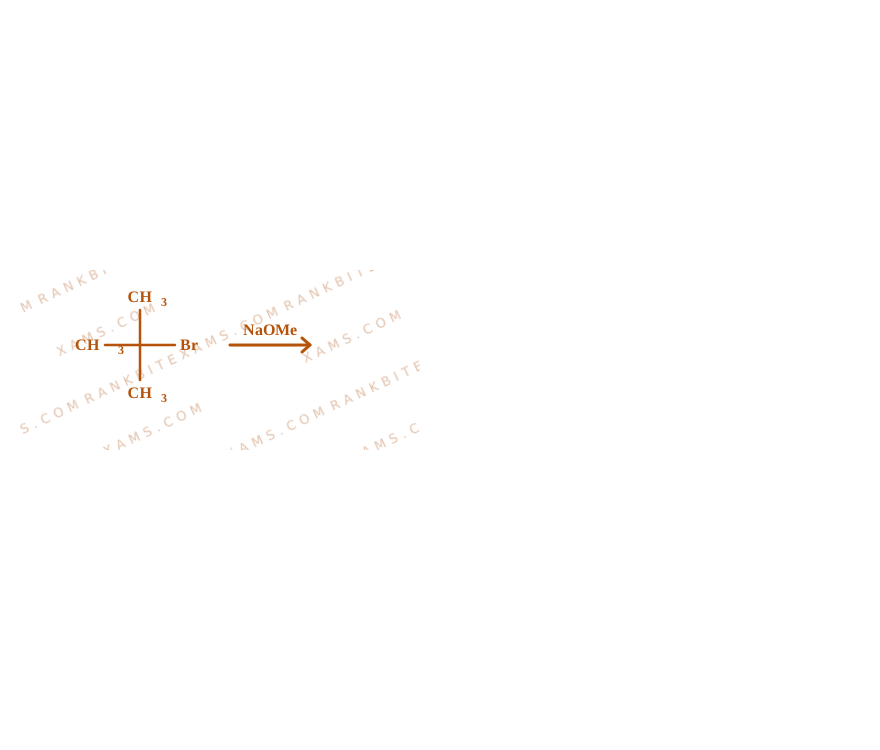
The structure of the major product formed in the following reaction is :
Nucleophilic Substitution Reactions diagram for Q43 - JEE Main 2025 Evening
The reaction shows a dihalogenated aromatic derivative reacting with silver cyanide to generate a major product.

Solution & Explanation

### Core Logic The substrate contains two distinct carbon-halogen bonds: an aryl-bromide bond (mathrmAr-Br) on the ring and an aliphatic alkyl-chloride bond (mathrmCH_2-Cl) on the side chain. 1. **Aryl Halide Site (mathrmC_sp^2mathrm-Br):** The bromine atom attached directly to the aromatic ring does not undergo standard nucleophilic substitution (S_N2 or S_N1) under normal conditions due to resonance stabilization, which gives the bond partial double-bond character. 2. **Alkyl Halide Site (mathrmC_sp^3mathrm-Cl):** The side-chain aliphatic carbon bond undergoes smooth, unhindered nucleophilic substitution. When reacting with silver cyanide (mathrmAgCN): mathrmAgCN is predominantly covalent. The lone pair on the nitrogen atom acts as the primary nucleophilic center rather than the carbon atom. Consequently, substitution at the aliphatic site yields an **isonitrile (-mathrmNC)** derivative as the major product, leaving the aryl bromide group completely untouched. ### Step 1: Structural Resolution The reaction progresses cleanly at the side-chain carbon:
Nucleophilic Substitution Reactions solution diagram for Q43 - JEE Main 2025 Evening
The reaction shows a dihalogenated aromatic derivative reacting with silver cyanide to generate a major product.
### Pattern Recognition Remember the key selectivity rule for cyanide nucleophiles: * mathrmKCN / mathrmNaCN ightarrow ionic reagents ightarrow attacks via carbon to form a **Nitrile (-mathrmCN)**. * mathrmAgCN ightarrow covalent reagent ightarrow attacks via nitrogen to form an **Isonitrile (-mathrmNC)**. ### Evaluation Rubric / Model Answer null ### Chapter Mix Class 12 Chemistry: Haloalkanes and Haloarenes
Reference Study Guides

More Haloalkanes and Haloarenes Previous-Year Questions — Page 3

Q44 2025 Nucleophilic Substitution Reactions
Given below are two statements : Statement-I: The conversion proceeds well in the less polar medium. mathrmCH_3-mathrmCH_2-mathrmCH_2-mathrmCH_2-mathrmCl xrightarrowmathrmHO^- mathrmCH_3-mathrmCH_2-mathrmCH_2-mathrmCH_2-mathrmOH + mathrmCl^- Statement-II: The conversion proceeds well in the more polar medium. mathrmCH_3-mathrmCH_2-mathrmCH_2-mathrmCH_2-mathrmCl xrightarrowmathrmR_3mathrmN [mathrmCH_3-mathrmCH_2-mathrmCH_2-mathrmCH_2-mathrmNR_3]^+mathrmCl^-
  • A. Both statement I and statement II are true
  • B. Both statement I and statement II are false.
  • C. Statement I is false but statement II is true
  • D. Statement I is true but statement II is false

Solution

### Core Logic Analyzing the solvent effects on reaction kinetics: - In Statement-I, the reaction involves an anionic nucleophile (OH^-), creating a highly localized charge density on the reactant side. The resulting transition state disperses this negative charge over a larger volume, lowering its charge density. Highly polar solvents strongly solvate the reactant ion, increasing the activation energy barrier. Consequently, less polar solvents accelerate this process.
SN2 pathway charge density solvent dynamics part 1
- In Statement-II, the reaction begins with neutral precursors (R_3N and alkyl chloride). The resulting transition state develops partial charges (delta+ and delta-) as the new bond forms, increasing its charge density relative to the reactants. Polar solvents stabilize this charged transition state, lowering the activation energy barrier. Thus, highly polar media accelerate this substitution pathway.
SN2 pathway charge density solvent dynamics part 1
### Pattern Recognition If the transition state concentrates charge relative to the reactants, polar solvents accelerate the reaction. If the transition state disperses charge, less polar solvents are favored. ### Evaluation Rubric / Model Answer null ### Chapter Mix Class 12 Chemistry: Haloalkanes and Haloarenes
Q 2025 Elimination Reactions (E2)
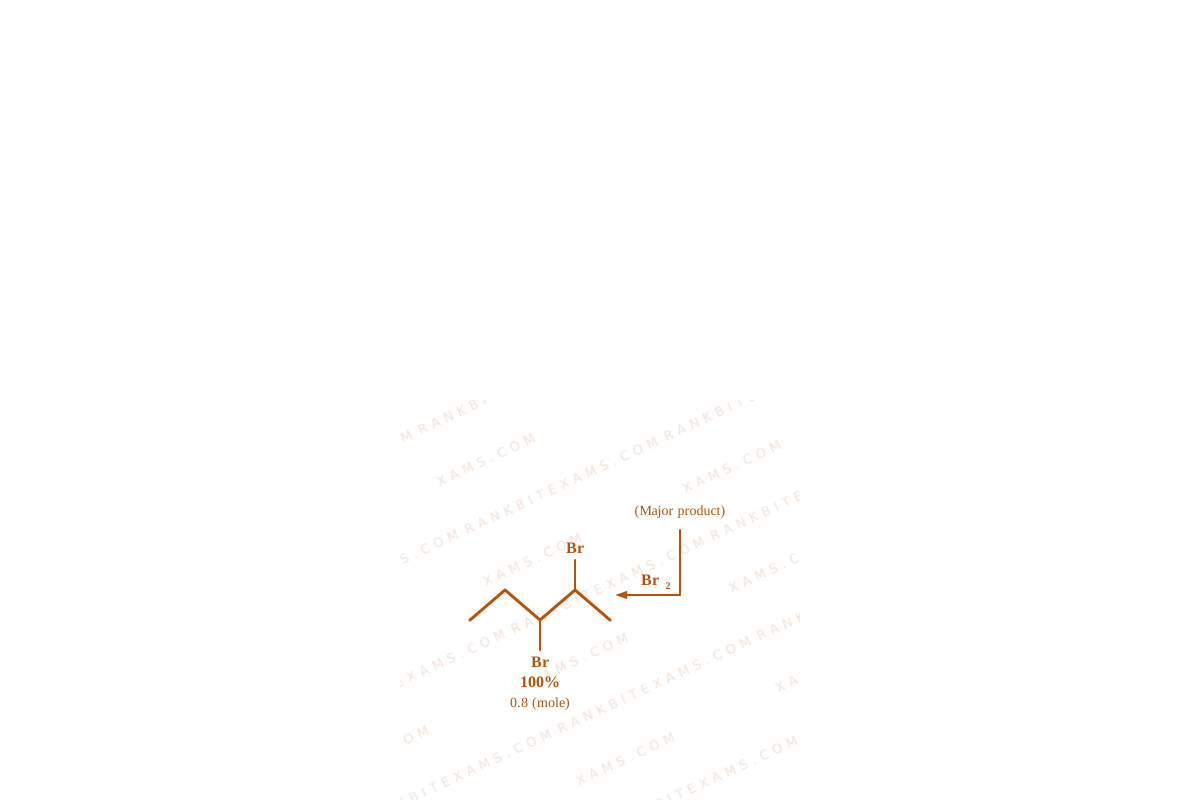
The major product of the following reaction is:
Dihaloalkane starting reactant structure for Q38
The image details a multi-halogenated hydrocarbon chain reacting with excess ethanolic potassium hydroxide under heating conditions.
  • A. 6-Phenylhepta-2,4-diene
  • B. 2-Phenylhepta-2,5-diene
  • C. 6-Phenylhepta-3,5-diene
  • D. 2-Phenylhepta-2,4-diene

Solution

### Related Formula Base-induced dehydrohalogenation follows the Zaitsev rule to maximize thermodynamic stability via conjugated double bond networks: R-CHX-CH_2-CHX-R' xrightarrowtextexcess KOH/EtOH, Delta textConjugated Diene ### Core Logic The reactant is a dihalide containing a phenyl substitution. Treating with excess alcoholic KOH and heat induces double dehydrohalogenation via successive E2 elimination pathways. The eliminations occur to yield the most stable, highly conjugated product where the double bonds are conjugated with each other and, if possible, with the aromatic phenyl ring system. ### Step 1: Eliminating and Tracking Conjugation Eliminating the first and second equivalents of HBr sets up a conjugated diene system along the heptadiene chain. Tracing carbon numbers correctly from the end closest to the phenyl ring reveals that the conjugated diene centers sit across carbons 2 and 4, producing **2-Phenylhepta-2,4-diene**.
Elimination mechanism steps for conjugated diene synthesis
The image details a multi-halogenated hydrocarbon chain reacting with excess ethanolic potassium hydroxide under heating conditions.
### Pattern Recognition When dealing with excess elimination agents on dihalides, look for options that form a *continuous conjugated diene* structure (alternating double-single-double bonds). This conjugation offers significant thermodynamic stability, especially when directly extended from a phenyl group. ### Evaluation Rubric / Model Answer null ### Chapter Mix Class 12 Chemistry: Haloalkanes and Haloarenes
Q34 2025 Nucleophilic Substitution Reactions
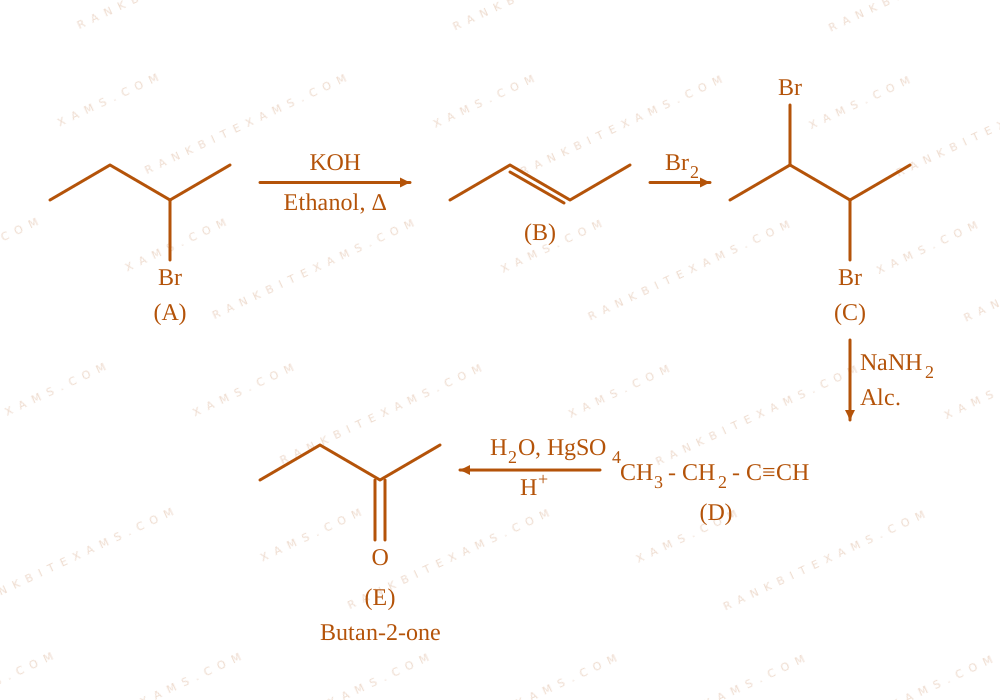
The product B formed in the following reaction sequence is :
Reaction sequence diagram for Q34 - JEE Main 2025
The image outlines an addition reaction followed by substitution using silver cyanide.
  • A. (1)
  • B. (2)
  • C. (3)
  • D. (4)

Solution

### Related Formula Markovnikov addition of HCl across an alkene: R-CH=CH_2 + HCl rightarrow R-CHCl-CH_3 Nucleophilic substitution with AgCN favors coordinate carbon bonding over nitrogen, yielding covalent isocyanides (R-NC). ### Core Logic Step 1: The starting material contains a double bond. Treating it with HCl leads to addition. According to Markovnikov's rule, the chloride ion attaches to the secondary position, creating chloride intermediate [A]. Step 2: Compound [A] reacts with AgCN. Since AgCN is covalent, the lone pair on nitrogen acts as the attacking nucleophile, leading to substitution with an isocyanide group (-NC) rather than a cyanide group (-CN). ### Step 1: Structural Synthesis The intermediate [A] possesses a chlorine atom at the secondary carbon position. Substituting this chlorine with -NC provides the product corresponding to option (4).
Detailed mechanism step for reaction sequence of Q34
The image outlines an addition reaction followed by substitution using silver cyanide.
### Pattern Recognition Distinguish between ionic vs covalent cyanide sources: - KCN / NaCN implies forms alkyl nitriles (R-CN) - AgCN implies forms alkyl isocyanides (R-NC) ### Evaluation Rubric / Model Answer null ### Chapter Mix Class 12 Chemistry: Haloalkanes and Haloarenes
Q34 2025 Nucleophilic Aromatic Substitution
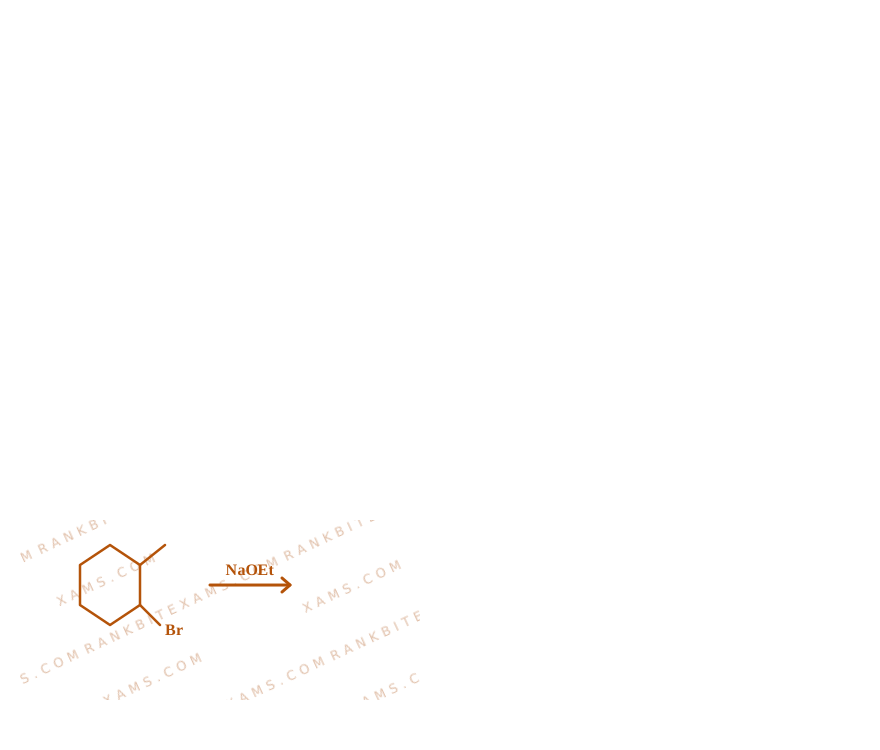
In the following substitution reaction:
Nucleophilic Aromatic Substitution diagram for Q34 - JEE Main 2025 Morning
The structural layout depicts a 1,2-dibromo-4-nitrobenzene reacting with sodium ethoxide.
Product mathrmP formed is:
  • A. {{IMG_OPT1}}
  • B. {{IMG_OPT2}}
  • C. {{IMG_OPT3}}
  • D. {{IMG_OPT4}}

Solution

### Related Formula Nucleophilic Aromatic Substitution (S_NAr) occurs via a Meisenheimer complex intermediate, where strong electron-withdrawing groups (-mathrmNO_2) activate positions strictly ortho and para to themselves. ### Core Logic The reactant is 1,2-dibromo-4-nitrobenzene. Let us evaluate the two bromine positions relative to the nitro group: * The bromine at C-1 is para to the strong activating -mathrmNO_2 group. * The bromine at C-2 is meta to the -mathrmNO_2 group. Since the para position facilitates effective negative charge delocalization onto the oxygen atoms of the nitro group during intermediate formation, the para-bromine undergoes substitution exclusively by the ethoxide ion (^-mathrmOC_2mathrmH_5). This yields the final product shown below:
Nucleophilic Aromatic Substitution diagram for Q34 - JEE Main 2025 Morning
The structural layout depicts a 1,2-dibromo-4-nitrobenzene reacting with sodium ethoxide.
### Pattern Recognition In aromatic pathways activated by -mathrmNO_2, substitution happens exclusively at positions ortho or para relative to the nitro flag; meta positions remain unactivated. ### Evaluation Rubric / Model Answer null ### Chapter Mix Class 12 Chemistry: Haloalkanes and Haloarenes
More Haloalkanes and Haloarenes Questions — jee_main_2025_24_jan_evening

Practice all Haloalkanes and Haloarenes previous-year questions →

YOUR FIRST PREP STEP STARTS HERE

We Map Every Repeating Question in Competitive Exams.

Say goodbye to generic mock test fatigue. RankBit uses smart analysis to group past exam questions into their foundational Repeating Question Types. Find chapter weightage, track repeating questions, and score higher with targeted practice.

Select Your Target Exam

Choose an exam track below to find formulas per chapter and patterns.

Syncing Exam Intelligence

Mapping formulas and patterns across all tracks…

PATH A — FULL LENGTH PRACTICE

Full Mock Test Hub

Simulate real NTA exam conditions with fully tracked mocks. Time yourself against past papers.

Under Development
PATH B — TARGETED PRACTICE

Topic-wise Practice Hub

Practice past-year questions one chapter at a time. Pick an exam → subject → chapter and get every PYQ for that topic — pulled together from all past papers — with the chapter's key formulas alongside.

Loading Questions... Browse Topics
Latest from the Blog
View all →

Loading articles...