JEE Main · Chemistry ↓ Falling

Haloalkanes and Haloarenes appeared 38 times across 3 years — 4.4% of Chemistry. This question is from Preparation and Reactions of Styrene derivatives.

Year 2026 2025 2024 Total
Questions 11 15 12 38

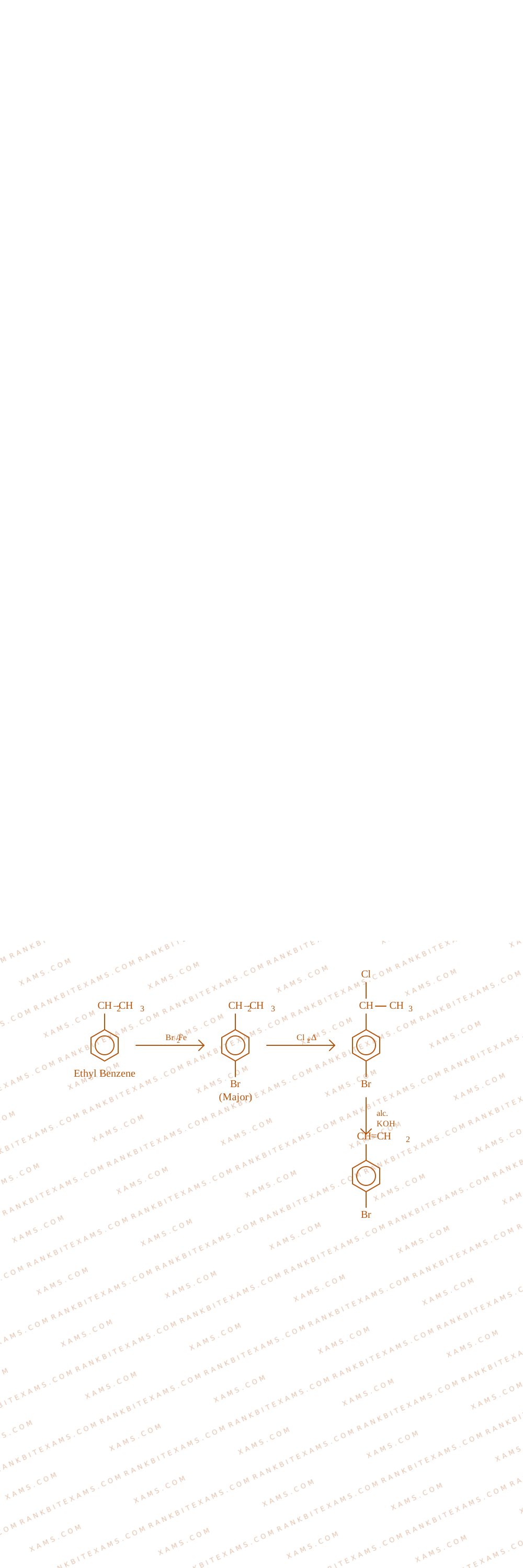
Choose the correct set of reagents for the following conversion: Ethyl benzene 4-bromostyrene {{Q_IMG1}}

Conversion scheme of ethylbenzene to 4-bromostyrene for Q29
The figure illustrates the multi-step conversion starting from ethylbenzene to yield a brominated styrene derivative.
Conversion scheme of ethylbenzene to 4-bromostyrene for Q29
The figure illustrates the multi-step conversion starting from ethylbenzene to yield a brominated styrene derivative.

Solution & Explanation

Core Logic

To synthesize 4-bromostyrene starting from ethyl benzene, we must carry out ring functionalization prior to developing the side-chain double bond:

  • Ring Bromination: Treatment of ethylbenzene with Br₂ in the presence of Fe (or FeBr₃) acts via electrophilic aromatic substitution. The ethyl group is an ortho/para director, yielding 1-bromo-4-ethylbenzene as the major product owing to steric mitigation.
  • Side-Chain Halogenation: Free radical substitution with Cl₂ under thermal conditions (Δ) or UV light specifically chlorinates the benzylic position because the benzylic radical is exceptionally stable via resonance.
  • Elimination: Heating with alcoholic KOH drives an E2 elimination of the benzylic chloride, cleanly synthesizing the terminal alkene linkage of the styrene system.
    Detailed mechanism of 4-bromostyrene synthesis from ethylbenzene
    The figure illustrates the multi-step conversion starting from ethylbenzene to yield a brominated styrene derivative.
Pattern Recognition

If you perform side-chain halogenation/alkene generation first, the ring substitution later would lack para-selectivity control and risk reacting across the alkene path. Hence, ring substitution MUST precede double bond creation.

Chapter Mix

Class 12 Chemistry: Haloalkanes and Haloarenes Class 11 Chemistry: Hydrocarbons

More Haloalkanes and Haloarenes Previous-Year Questions

Q54 jee_main_2026_21_jan_morning Reactions of Haloalkanes
A hydrocarbon ‘P’ (C₄H₈) on reaction with HCl gives an optically active compound ‘Q’ (C₄H₉Cl) which on reaction with one mole of ammonia gives compound ‘R’ (C₄H₁₁N). ‘R’ on diazotization followed by hydrolysis gives ‘S’. Identify P, Q, R and S.
  • A. P = CH₃ - CH₂ - CH = CH₂, Q = CH₃ - CH₂ - CH₂ - CH₂Cl, R = CH₃ - CH₂ - CH₂ - NH₂, S = CH₃ - CH₂ - CH(OH) - CH₃
  • B. P = Cyclobutane, Q = 1-Chlorobutane, R = Butan-1-amine, S = Cyclobutanol
  • C. P = CH₃ - CH = CH - CH₃, Q = CH₃ - CH₂ - CH(Cl) - CH₃, R = CH₃ - CH₂ - CH(NH₂) - CH₃, S = CH₃ - CH₂ - CH(OH) - CH₃
  • D. P = CH₃ - CH = CH - CH₃, Q = CH₃ - CH₂ - CH₂ - CH₂ - Cl, R = CH₃ - CH₂ - CH₂ - CH₂ - NH₂, S = CH₃ - CH₂ - CH₂ - CH₂ - OH

Solution

Core Logic

Since P (C₄H₈) reacts with HCl to give an optically active compound Q (C₄H₉Cl), P must be But-2-ene. Addition of HCl yields 2-chlorobutane, which possesses a chiral center.

CH₃-CH=CH-CH₃ HCl CH₃-CH₂-C^*H(Cl)-CH₃ (P is But-2-ene, Q is 2-chlorobutane)
Reactions of Haloalkanes diagram for Q54 - JEE Main 2026 Morning

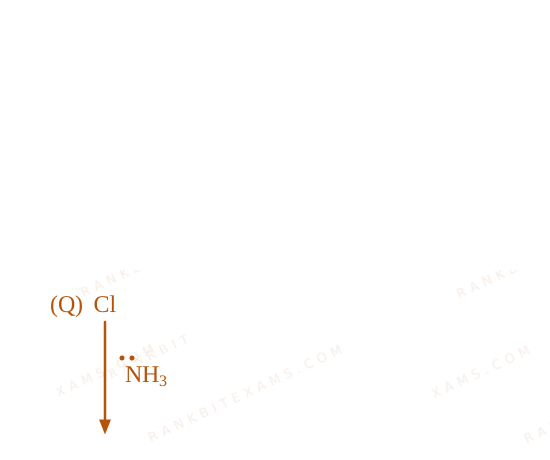
Compound Q reacts with NH₃ to undergo nucleophilic substitution forming a primary amine R:

CH₃-CH₂-CH(Cl)-CH₃ NH₃ CH₃-CH₂-CH(NH₂)-CH₃ (R is Butan-2-amine)
Reactions of Haloalkanes diagram for Q54 - JEE Main 2026 Morning

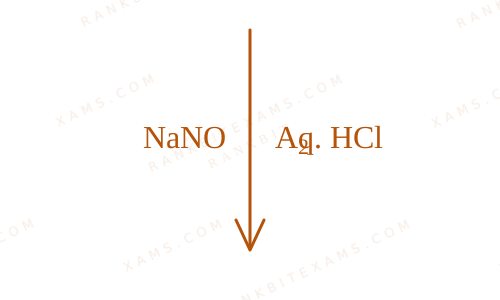
Diazotization of primary aliphatic amines followed by hydrolysis yields an alcohol via a carbocation intermediate (S):

CH₃-CH₂-CH(NH₂)-CH₃ NaNO₂ / HCl / H₂O CH₃-CH₂-CH(OH)-CH₃ (S is Butan-2-ol)
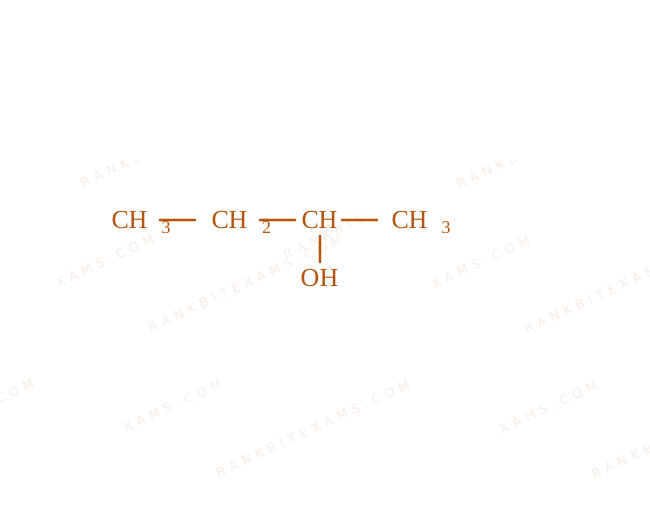
Reactions of Haloalkanes diagram for Q54 - JEE Main 2026 Morning

Pattern Recognition

An optically active alkyl halide formed from a C₄H₈ alkene with HX is a classic pointer to 2-halobutane originating from But-2-ene or But-1-ene. Diazotization of primary aliphatic amines (R-NH₂) with NaNO₂/HCl yields alcohols (R-OH) with possible rearrangements, though here a secondary carbocation is already stable.

Chapter Mix

Class 12 Chemistry: Haloalkanes and Haloarenes Class 12 Chemistry: Amines

Q59 jee_main_2026_21_jan_evening Nucleophilic Substitution ($S_N1$) and Carbocation Stability
The correct order of reactivity of the following benzyl halides towards reaction with KCN is:
Benzyl halide structures for Q59 - JEE Main 2026 Evening
Four substituted benzyl halide structures labelled a, b, c, d.
  • A. (1) a > b > c > d
  • B. (2) b > a > d > c
  • C. (3) b > a > c > d
  • D. (4) a > b > d > d

Solution

Core Logic

The reaction proceeds via an SN1 mechanism for activated benzyl halides or nucleophilic substitution rate depends on carbocation stability / electronic effects of substituents (-OH, -NH₂, -NO₂, etc.).

  • Amino and hydroxy substituents strongly activate through +M effect.
  • Nitro groups strongly deactivate through -M effect.
Step 1: Final Conclusion

The correct order of reactivity is b > a > d > c, corresponding to option (2).

Pattern Recognition

Sees: benzyl halide reactivity with cyanide. Trap: Confusing polar/inductive effects with resonance effects of substituents.

Chapter Mix

Class 12 Chemistry: Haloalkanes and Haloarenes

Q65 jee_main_2026_21_jan_evening Optical Isomerism and Composition Percentage
Given below are four compounds: (a) n-propyl chloride (b) iso-propyl chloride (c) sec-butyl chloride (d) neo-pentyl chloride Percentage of carbon in the one which exhibits optical isomerism is:
  • A. (1) 52
  • B. (2) 56
  • C. (3) 46
  • D. (4) 40

Solution

Core Logic

Among the given compounds, sec-butyl chloride (2-chlorobutane) is optically active and contains a chiral center. Molecular formula of 2-chlorobutane arrow C₄H₉Cl. Molar mass = 4(12) + 9(1) + 35.5 = 48 + 9 + 35.5 = 92.5 g/mol.

Step 1: Calculating Percentage of Carbon
% of C = (48)/(92.5) × 100 = 51.89% ≈ 52%
Pattern Recognition

Sees: optical isomerism identification combined with elemental percentage composition calculation. Trap: Selecting the wrong halogen derivative for optical activity.

Chapter Mix

Class 12 Chemistry: Haloalkanes and Haloarenes

Q59 jee_main_2026_22_january_morning Nucleophilicity Trends
The correct order of reactivity of CH₃Br in methanol with the following nucleophiles is F⁻, I⁻, C₂H₅O⁻ and C₆H₅O⁻
  • A. I⁻ > C₆H₅O⁻ > F⁻ > C₂H₅O⁻
  • B. I⁻ > C₂H₅O⁻ > C₆H₅O⁻ > F⁻
  • C. I⁻ > C₂H₅O⁻ > F⁻ > C₆H₅O⁻
  • D. I⁻ > F⁻ > C₆H₅O⁻ > C₂H₅O⁻

Solution

Related Formula
Rate ∝ Nucleophilicity
Core Logic

The reaction of CH₃Br (a primary halide) occurs via the SN2 mechanism. The rate depends directly on the nucleophilicity of the attacking species. Methanol is a polar protic solvent. In polar protic solvents, larger halide ions are better nucleophiles because they are less solvated. Therefore, I^- is a stronger nucleophile than F^-. For the alkoxide and phenoxide, C₂H₅O^- is a stronger nucleophile than C₆H₅O^- because the negative charge on phenoxide is delocalized over the benzene ring, reducing its electron-donating ability.

Step 1: Final Order

Combining these factors, the overall order of nucleophilicity in methanol is:

I⁻ > C₂H₅O⁻ > C₆H₅O⁻ > F⁻
Pattern Recognition

In polar protic solvents: Size dominates (down a group, nucleophilicity increases). For species of similar size, less resonance stabilization means stronger nucleophile.

Chapter Mix

Class 12 Chemistry: Haloalkanes and Haloarenes

Q67 jee_main_2026_22_january_morning SN1 Mechanism
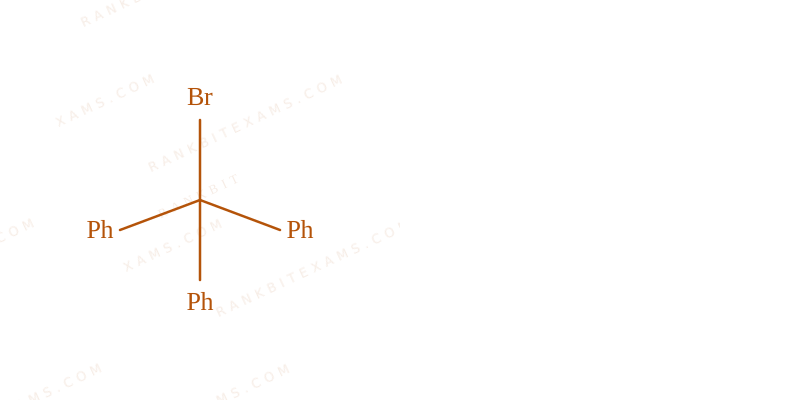
The correct order of the rate of reaction of the following reactants with nucleophile by SN1 mechanism is: (Given: Structure I and II are rigid)
Four rigid structures reacting via SN1 diagram for Q67 - JEE Main 2026 Morning
Image depicts four bicyclic and aromatic structures labeled I through IV.
  • A. IV < III < II < I
  • B. III < I < II < IV
  • C. II < I < III < IV
  • D. I < II < III < IV

Solution

Related Formula
Rate of SN1 ∝ Stability of intermediate carbocation
Core Logic

Evaluate the stability of the carbocations formed upon dissociation of the bromide ion:

Structure (I) and (II) form carbocations at bridgehead positions of rigid bicyclic systems. According to Bredt's rule, these are highly unstable because they cannot adopt the necessary planar sp² geometry. Among them, (I) has an additional methyl group which provides slight +I stabilization compared to (II). So, (II) is even less stable than (I).

Structure (III) forms a tertiary carbocation, but it's not a rigid bridgehead preventing planarity, so it's significantly more stable than I and II.

Structure (IV) is a highly stable trityl-like carbocation where the positive charge is stabilized by extensive resonance with the adjacent phenyl ring(s).

Step 1: Final Ordering

Stability order: (II) < (I) < (III) < (IV). Thus, the SN1 rate follows the same order.

Pattern Recognition

Bridgehead halides effectively do not undergo SN1 (or SN2) reactions due to Bredt's rule. Resonance stabilized carbocations always dominate.

Chapter Mix

Class 12 Chemistry: Haloalkanes and Haloarenes

Rankbit System
JEE Physics: Waves (+15.5%) | Electrostatics: Concentric Shells (-29.7%) | Modern Physics: Photoelectric Clones (+34.2%) | Mathematics: Definite Integrals (+18.1%) | Chemistry: Coordination Splitting (-11.4%) | JEE Physics: Waves (+15.5%) | Electrostatics: Concentric Shells (-29.7%) | Modern Physics: Photoelectric Clones (+34.2%) | Mathematics: Definite Integrals (+18.1%) | Chemistry: Coordination Splitting (-11.4%)