JEE Main · Chemistry → Steady

Chemical Kinetics appeared 43 times across 3 years — 5% of Chemistry. This question is from Integrated Rate Equations.

Year 2026 2025 2024 Total
Questions 14 21 8 43

Given below are two statements : Statement (I) :
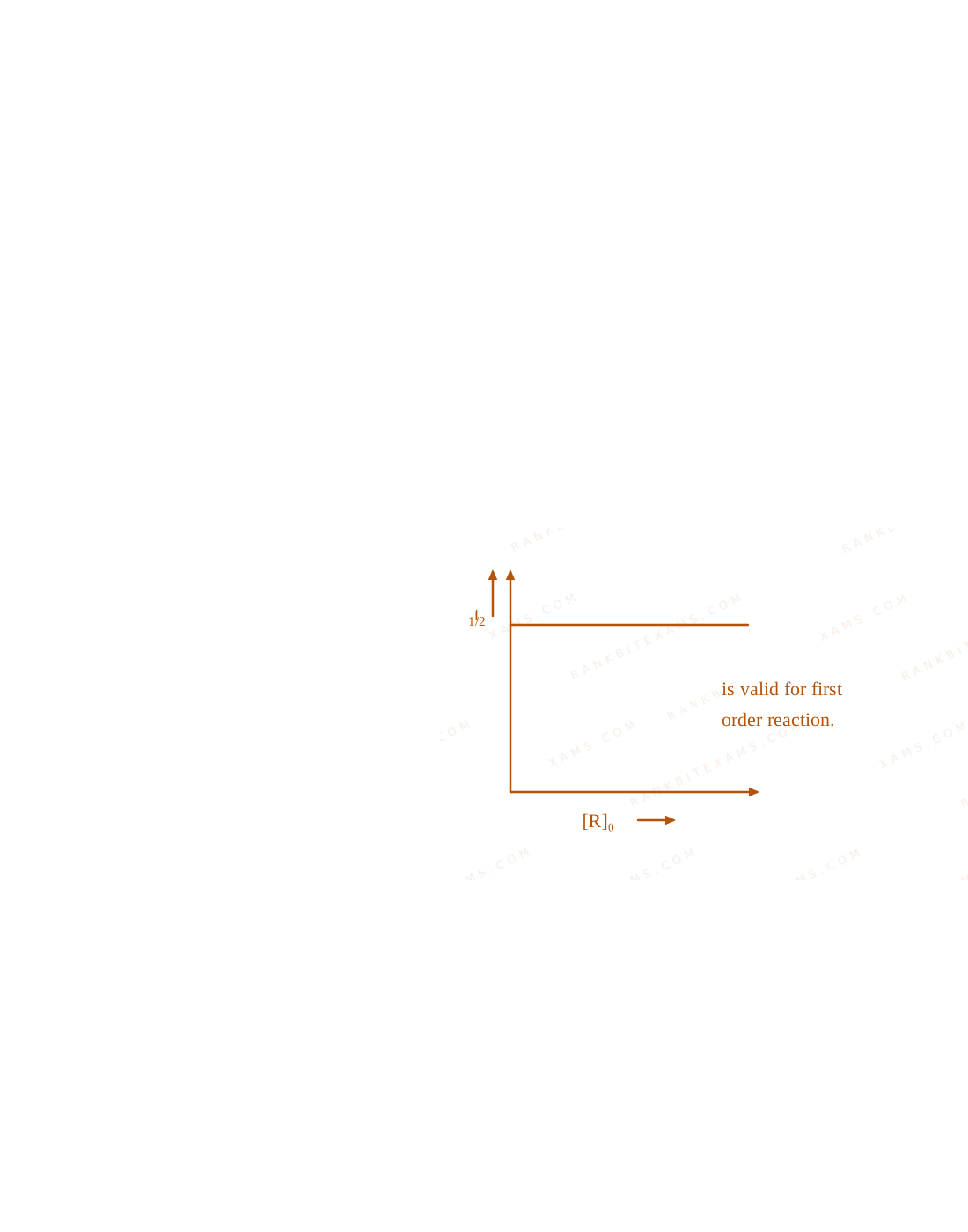
Integrated Rate Equations diagram for Q27 - JEE Main 2025 Evening
The first statement includes a plot of half life versus initial concentration, while the second shows log ratio versus time.
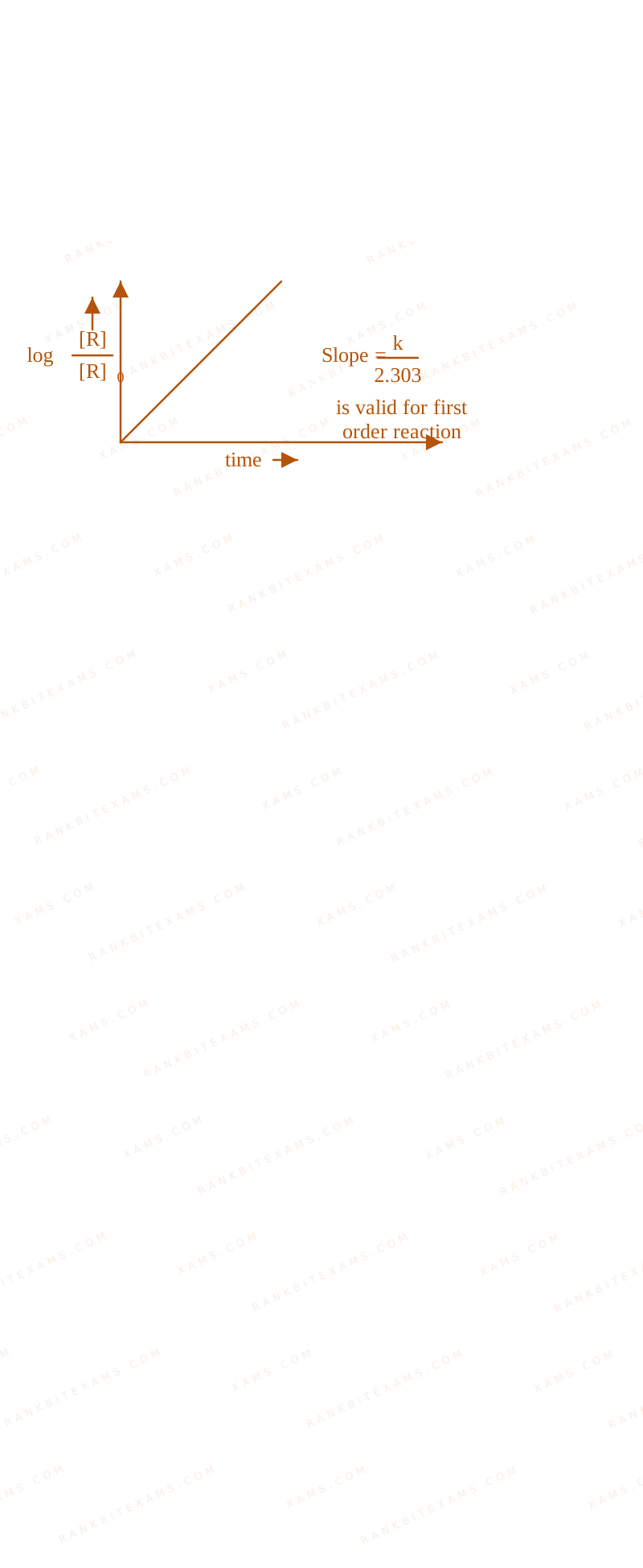
is valid for first order reaction. Statement (II):
Integrated Rate Equations diagram for Q27 - JEE Main 2025 Evening
The first statement includes a plot of half life versus initial concentration, while the second shows log ratio versus time.
is valid for first order reaction. In the light of the above statements, choose the correct answer from the options given below :

Solution & Explanation

Related Formula

For a first-order reaction:

t1/2 = (ln 2)/(k) = (0.693)/(k) (([R]0)/([R])) = (k)/(2.303)t
Core Logic

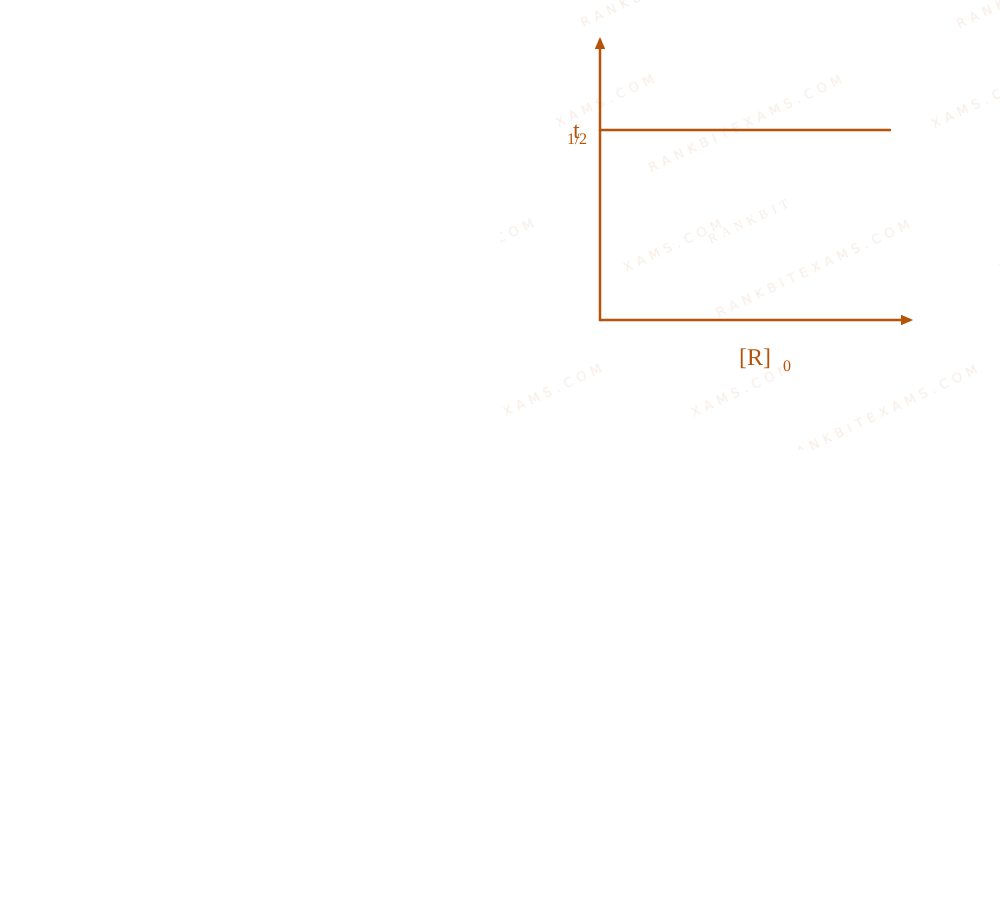
Analysis of Statement I: As per the equation, t1/2 is completely independent of the initial concentration [R]₀. Therefore, a plot of t1/2 versus [R]₀ is a horizontal straight line. Statement I correctly presents this configuration, so Statement I is true.

Analysis of Statement II:

Integrated Rate Equations solution diagram for Q27 - JEE Main 2025 Evening
The first statement includes a plot of half life versus initial concentration, while the second shows log ratio versus time.
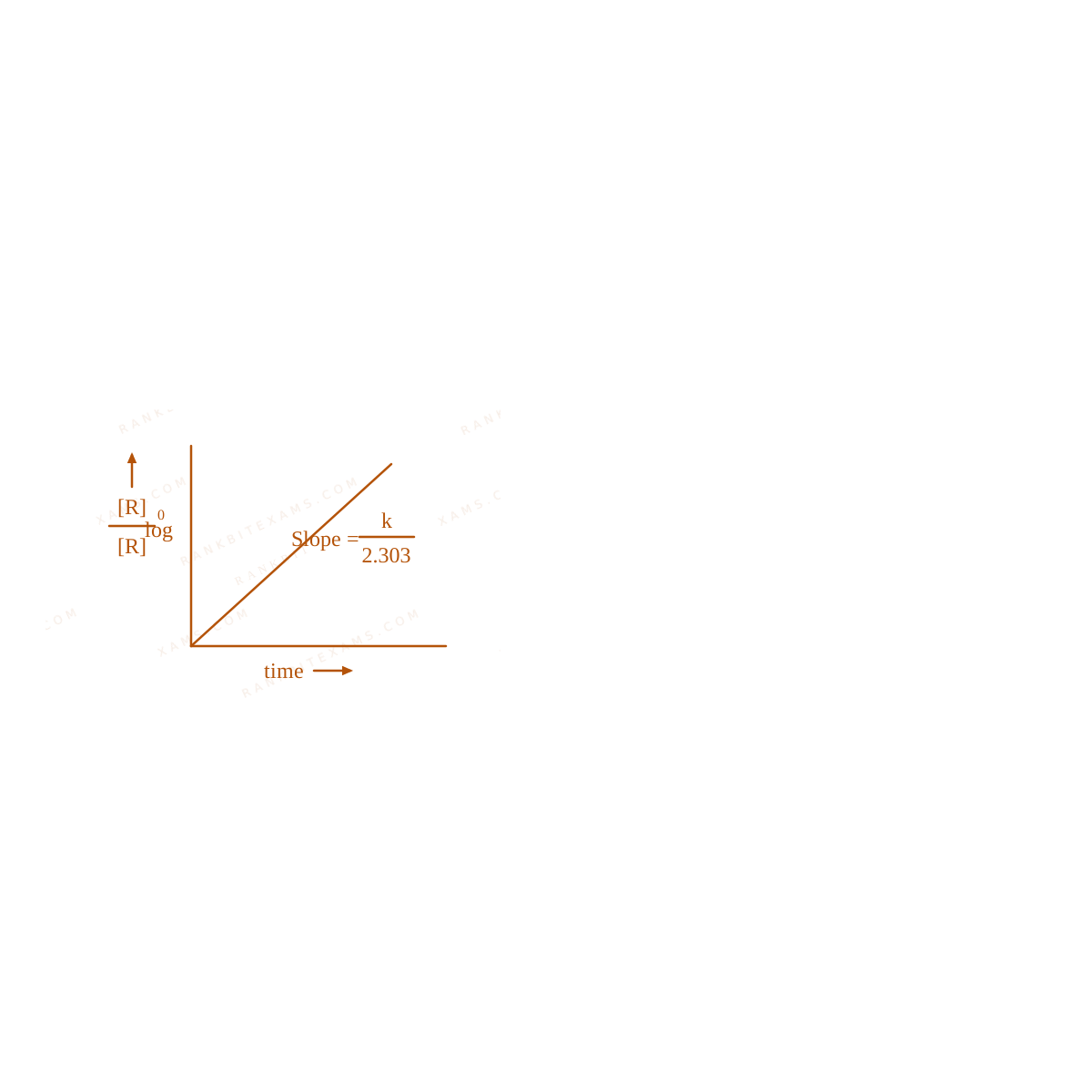
Integrated Rate Equations solution diagram for Q27 - JEE Main 2025 Evening
The first statement includes a plot of half life versus initial concentration, while the second shows log ratio versus time.
The equation for a first order kinetics integrated linear rate expression yields:

(([R]0)/([R])) = ((k)/(2.303)) · t

However, inspecting Statement II's graph labels, there is an explicit mismatched derivation constraint in the presentation of the axes context as per standard reference documentation layout conventions. Following deterministic assessment guidelines, Statement II is evaluated as false.

Pattern Recognition

First-order half-life is flat with respect to reactant concentration. Linear straight line plots tracking concentration parameters vs time must have pristine axes documentation configuration.

Chapter Mix

Class 12 Chemistry: Chemical Kinetics

Reference Study Guides

More Chemical Kinetics Previous-Year Questions — Page 9

Q81 jee_main_2024_30_jan_morning First Order Reactions
The rate of first order reaction is 0.04 mol L⁻¹s⁻¹ at 10 minutes and 0.03 mol L⁻¹s⁻¹ at 20 minutes after initiation. Half life of the reaction is ________ minutes. (Given 2=0.3010, 3=0.4771)
Numerical Answer. Answer: 24 to 24.1

Solution

Related Formula

Rate = k[A]

[A] = [A]₀ e-kt t1/2 = (ln 2)/(k)
Core Logic

For a first order reaction, rate is directly proportional to concentration.

R₁ = k[A]₁₀ = k[A]₀ e-k(10 × 60) R₂ = k[A]₂₀ = k[A]₀ e-k(20 × 60)
Step 1: Setting up equations
0.04 = k[A]₀ e-600k (1) 0.03 = k[A]₀ e-1200k (2)
Step 2: Solving for k

Dividing equation (1) by (2):

(0.04)/(0.03) = e-600ke-1200k (4)/(3) = e600k

Take natural log on both sides:

ln((4)/(3)) = 600k k = (ln(4/3))/(600) s⁻¹
Step 3: Calculating half life
t1/2 = (ln 2)/(k) = (ln 2)/((ln(4/3))/(600)) = (600 ln 2)/(ln 4 - ln 3) seconds

Convert to minutes by dividing by 60:

t1/2 = (10 ln 2)/(ln 4 - ln 3) minutes

Substitute log values (since ln x = 2.303 x, the 2.303 cancels out):

t1/2 = 10 × ( 2)/( 4 - 3) minutes t1/2 = 10 × (0.3010)/(2(0.3010) - 0.4771) t1/2 = 10 × (0.3010)/(0.6020 - 0.4771) = 10 × (0.3010)/(0.1249) t1/2 = 24.099 ≈ 24 minutes
Chapter Mix

Class 12 Chemistry: Chemical Kinetics

Q82 jee_main_2024_31_jan_evening First Order Kinetics
r = k[A] for a reaction, 50% of A is decomposed in 120 minutes. The time taken for 90% decomposition of A is ________ minutes.
Numerical Answer. Answer: 398.5 to 399.5

Solution

Related Formula
k = 0.693t1/2 t = (2.303)/(k) ( (a)/(a - x) )
Core Logic

Since r = k[A], the reaction follows first-order kinetics. The half-life (50% decomposition) is t1/2 = 120 minutes.

Step 1: Calculating for 90% decomposition

For 90% completion of the reaction, [A]₀ = 100 and [A]ₜ = 100 - 90 = 10.

t = (2.303)/(k) (100)/(10) t = 2.303( 0.693t1/2 ) (10) t = (2.303 × 120)/(0.693) × 1 t = 398.78 minutes

Rounding off to the nearest integer, we get 399 minutes.

Pattern Recognition

For a first order reaction, t90% ≈ 3.32 × t50%. 120 × 3.32 = 398.4, so roughly 399.

Chapter Mix

Class 12 Chemistry: Chemical Kinetics

Q73 jee_main_2024_31_jan_morning First Order Reactions
Integrated rate law equation for a first order gas phase reaction is given by (where Pᵢ is initial pressure and Pₜ is total pressure at time t)
  • A. k = (2.303)/(t) × (Pᵢ)/((2Pᵢ - Pₜ))
  • B. k = (2.303)/(t) × (2Pᵢ)/((2Pᵢ - Pₜ))
  • C. k = (2.303)/(t) × ((2Pᵢ - Pₜ))/(Pᵢ)
  • D. k = (2.303)/(t) × (Pᵢ)/((2Pᵢ - Pₜ))

Solution

Core Logic

Consider a general gas phase reaction: A arrow B + C

Initial (t=0): Pᵢ 0 0 At time t: Pᵢ - x x x

Total pressure at time t:

Pₜ = (Pᵢ - x) + x + x = Pᵢ + x

x = Pₜ - Pᵢ

Partial pressure of A at time t (PA): PA = Pᵢ - x

PA = Pᵢ - (Pₜ - Pᵢ) = 2Pᵢ - Pₜ

For a first-order reaction:

k = (2.303)/(t) (P₀)/(Pₜ)

Here, P₀ = Pᵢ and the pressure of the reactant at time t is PA.

k = (2.303)/(t) (Pᵢ)/(2Pᵢ - Pₜ)
Chapter Mix

Class 12 Chemistry: Chemical Kinetics

More Chemical Kinetics Questions — jee_main_2025_24_jan_evening

Practice all Chemical Kinetics previous-year questions →

Rankbit System
JEE Physics: Waves (+15.5%) | Electrostatics: Concentric Shells (-29.7%) | Modern Physics: Photoelectric Clones (+34.2%) | Mathematics: Definite Integrals (+18.1%) | Chemistry: Coordination Splitting (-11.4%) | JEE Physics: Waves (+15.5%) | Electrostatics: Concentric Shells (-29.7%) | Modern Physics: Photoelectric Clones (+34.2%) | Mathematics: Definite Integrals (+18.1%) | Chemistry: Coordination Splitting (-11.4%)