JEE Main · Chemistry → Steady

Chemical Kinetics appeared 42 times across 3 years — 4.9% of Chemistry. This question is from Integrated Rate Equations.

Year 2026 2025 2024 Total
Questions 14 20 8 42

Given below are two statements : Statement (I) :
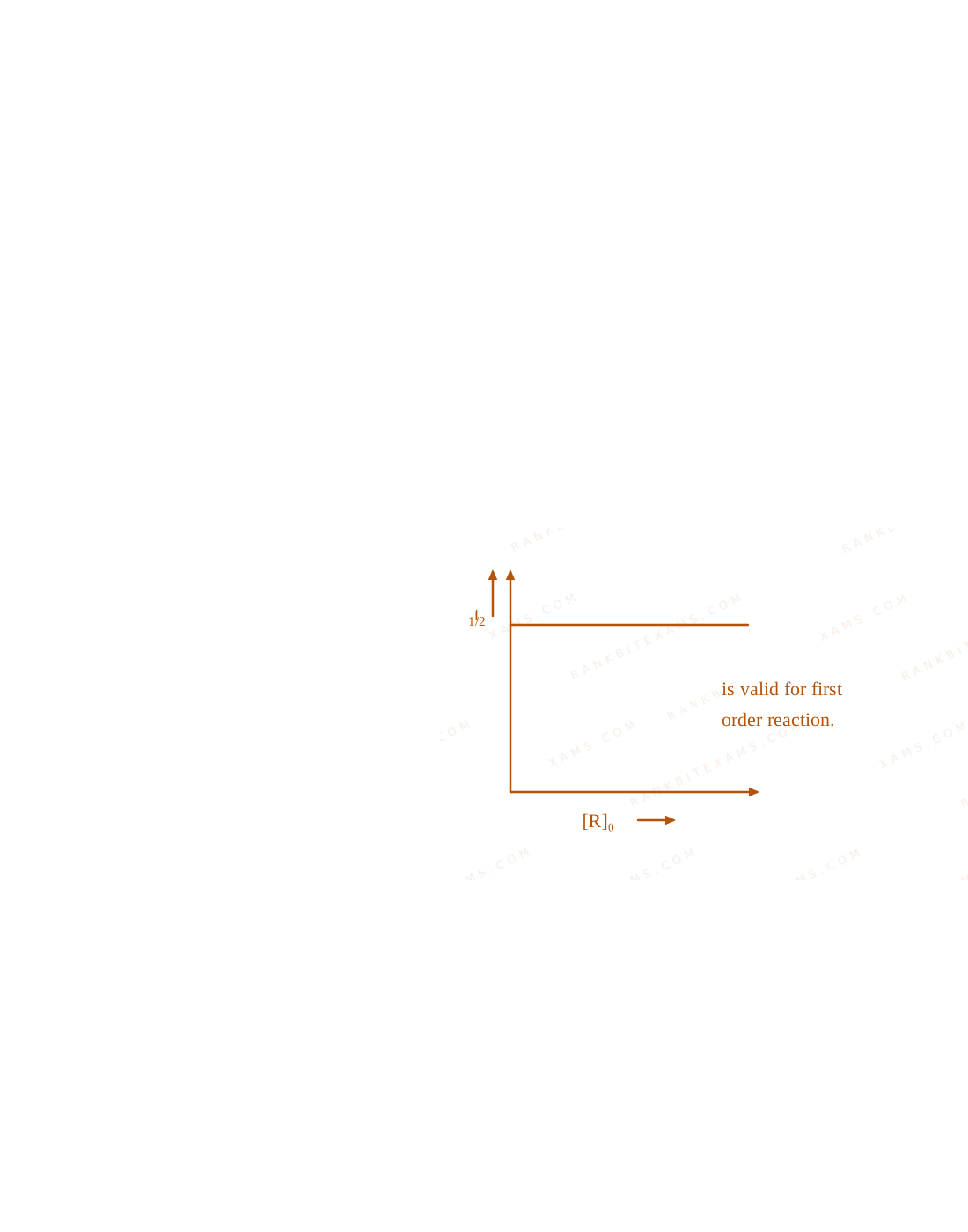
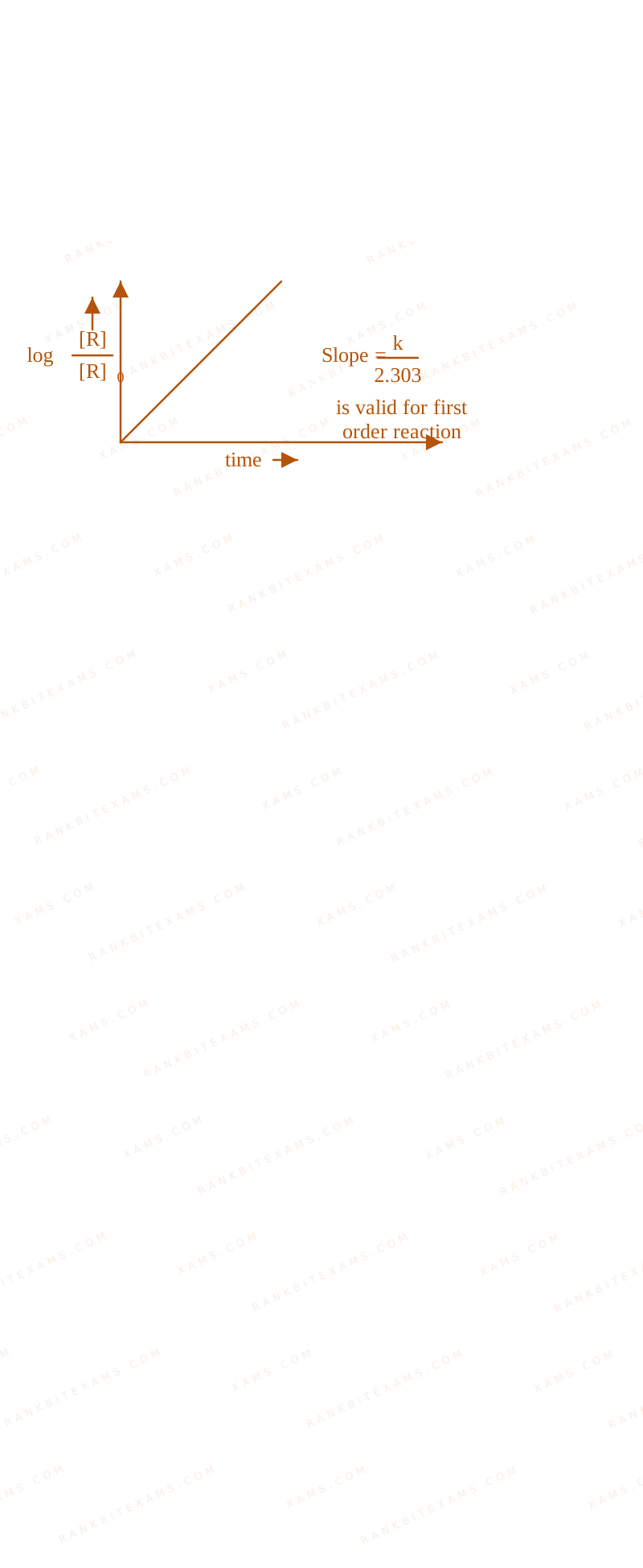
Integrated Rate Equations diagram for Q27 - JEE Main 2025 Evening
The first statement includes a plot of half life versus initial concentration, while the second shows log ratio versus time.
is valid for first order reaction. Statement (II):
Integrated Rate Equations diagram for Q27 - JEE Main 2025 Evening
The first statement includes a plot of half life versus initial concentration, while the second shows log ratio versus time.
is valid for first order reaction. In the light of the above statements, choose the correct answer from the options given below :

Solution & Explanation

Related Formula

For a first-order reaction:

t1/2 = (ln 2)/(k) = (0.693)/(k) (([R]0)/([R])) = (k)/(2.303)t
Core Logic

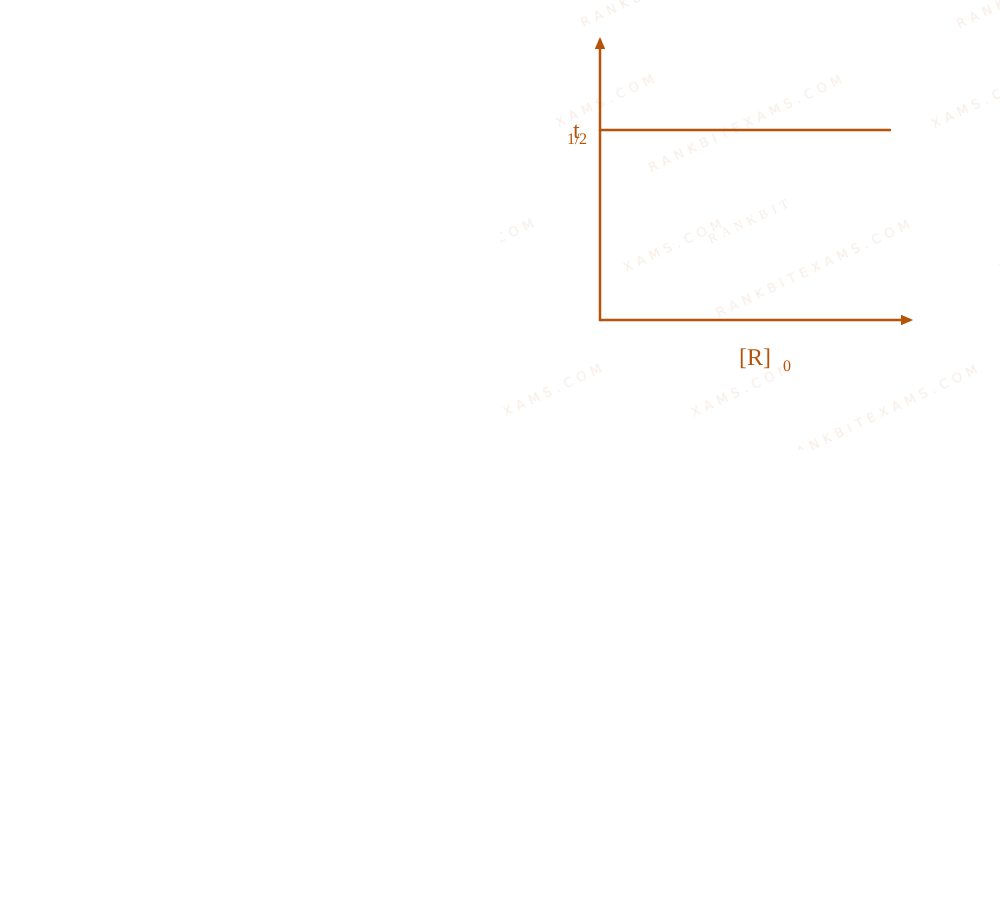
Analysis of Statement I: As per the equation, t1/2 is completely independent of the initial concentration [R]₀. Therefore, a plot of t1/2 versus [R]₀ is a horizontal straight line. Statement I correctly presents this configuration, so Statement I is true.

Analysis of Statement II:

Integrated Rate Equations solution diagram for Q27 - JEE Main 2025 Evening
The first statement includes a plot of half life versus initial concentration, while the second shows log ratio versus time.
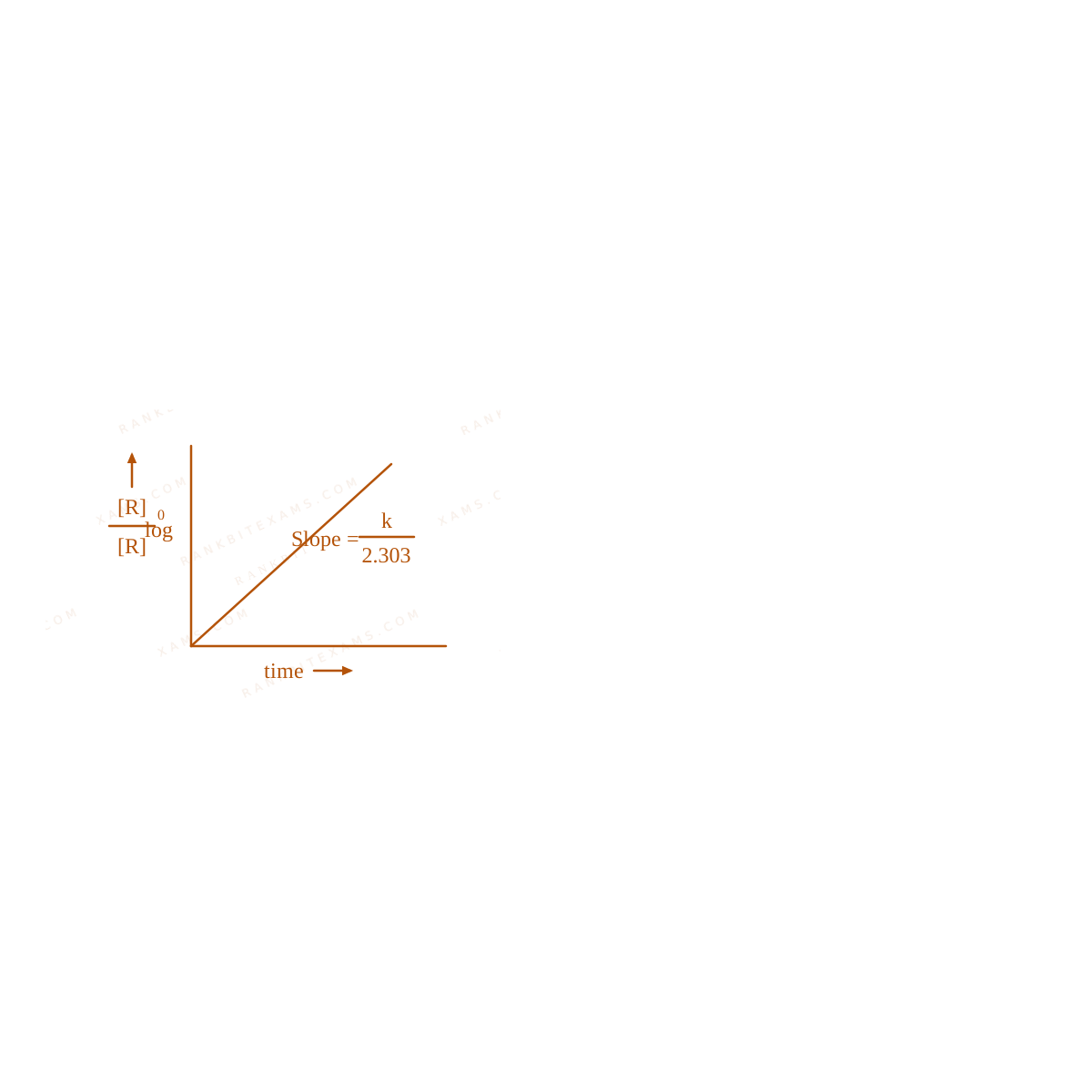
Integrated Rate Equations solution diagram for Q27 - JEE Main 2025 Evening
The first statement includes a plot of half life versus initial concentration, while the second shows log ratio versus time.
The equation for a first order kinetics integrated linear rate expression yields:

(([R]0)/([R])) = ((k)/(2.303)) · t

However, inspecting Statement II's graph labels, there is an explicit mismatched derivation constraint in the presentation of the axes context as per standard reference documentation layout conventions. Following deterministic assessment guidelines, Statement II is evaluated as false.

Pattern Recognition

First-order half-life is flat with respect to reactant concentration. Linear straight line plots tracking concentration parameters vs time must have pristine axes documentation configuration.

Chapter Mix

Class 12 Chemistry: Chemical Kinetics

Reference Study Guides

More Chemical Kinetics Previous-Year Questions — Page 5

Q26 jee_main_2025_08_april_evening First Order Reactions
In a first order decomposition reaction, the time taken for the decomposition of reactant to one fourth and one eighth of its initial concentration are t₁ and t₂ (s), respectively. The ratio t₁ / t₂ will: Choose the correct answer from the options given below:
  • A. (4)/(3)
  • B. (3)/(2)
  • C. (3)/(4)
  • D. (2)/(3)

Solution

Related Formula

For a first-order reaction:

t = (2.303)/(k) ((C₀)/(Cₜ))

Alternatively, using half-life t50%:

Cₜ = (C₀)/(2ⁿ)

where n is the number of half-lives (n = tt50%).

Core Logic

Step 1: Calculate t₁ for decomposition to (1)/(4) of initial concentration:

Cₜ = (C₀)/(4) = (C₀)/(2²) n = 2 t₁ = 2 · t50%

Step 2: Calculate t₂ for decomposition to (1)/(8) of initial concentration:

Cₜ = (C₀)/(8) = (C₀)/(2³) n = 3 t₂ = 3 · t50%

Step 3: Find the ratio (t₁)/(t₂):

(t₁)/(t₂) = 2 · t50%3 · t50% = (2)/(3)
Pattern Recognition

For first-order kinetics, every step of concentration halving takes exactly one half-life (t50%). Initial t50% (1)/(2) t50% (1)/(4) (Total 2 half-lives) (1)/(4) t50% (1)/(8) (Total 3 half-lives) Therefore, the ratio is simply the ratio of the number of half-lives: 2 : 3.

Chapter Mix

Class 12 Chemistry: Chemical Kinetics

Q42 jee_main_2025_29_jan_evening First Order Reaction Kinetics
Drug X becomes ineffective after 50% decomposition. The original concentration of drug in a bottle was 16 mg/mL which becomes 4 mg/mL in 12 months. The expiry time of the drug in months is (Assume that the decomposition of the drug follows first order kinetics). (1) 12 (2) 2 (3) 3 (4) 6
  • A. 12
  • B. 2
  • C. 3
  • D. 4

Solution

Related Formula
Nₜ = N₀ left((1)/(2))ⁿ
Core Logic

Let's track concentration reductions:

16 mg/mL xrightarrowt1/2 8 mg/mL xrightarrowt1/2 4 mg/mL

This total progression constitutes exactly 2 half-lives (n = 2).

2 cdot t1/2 = 12 months implies t1/2 = 6 months

Since the drug becomes ineffective right after 50% decomposition, its functional expiry limit is exactly 1 half-life period.

Expiry time = t1/2 = 6 months
Pattern Recognition

For multi-step concentration halving, bypass complex integrated logarithmic rate expressions by directly applying integer half-life steps (16 arrow 8 arrow 4).

Chapter Mix

Class 12 Chemistry: Chemical Kinetics

Q32 jee_main_2025_28_jan_morning Order of Reaction and Half-life
For a given reaction Rarrow P,t1 / 2 is related to [A]₀ as given in table :
[A]₀ / mol L⁻¹t1/2 / min
0.100200
0.025100
Given: 2 = 0.30 Which of the following is true? A. The order of the reaction is (1)/(2) . B. If [A]₀ is 1M , then t1/2 is 200√(10) min C. The order of the reaction changes to 1 if the concentration of reactant changes from 0.100 M to 0.500 M . D. t1 / 2 is 800 ~min for [A]₀ = 1.6 M Choose the correct answer from the options given below:
  • A. A and C only
  • B. A and B only
  • C. A, B and D only
  • D. C and D only

Solution

Related Formula

The dependence of half-life on initial concentration is given by:

t1/2 ∝ 1[A]₀ⁿ⁻¹
Step 1: Finding the reaction order (n)

Using the values provided:

(t1/2)₁(t1/2)₂ = ( [A]0,2[A]0,1 )ⁿ⁻¹ (200)/(100) = ( (0.025)/(0.100) )ⁿ⁻¹ ⇒ 2 = ( (1)/(4) )ⁿ⁻¹ 2 = 2-2(n-1) ⇒ 1 = -2n + 2 ⇒ n = (1)/(2)

Hence, statement A is correct.

Step 2: Checking half-life at other concentrations

Since n = (1)/(2), t1/2 ∝ √([A]₀).

  • For [A]₀ = 1 M:
200t1/2 = √((0.1)/(1)) ⇒ t1/2 = 200√(10) min

Hence, statement B is correct.

  • For [A]₀ = 1.6 M:
200t1/2 = √((0.1)/(1.6)) = √((1)/(16)) = (1)/(4) ⇒ t1/2 = 800 min

Hence, statement D is correct.

Pattern Recognition

Sees: Half-life reducing as initial concentration decreases. Trap: Assuming all reactions are first or zero order without calculations. Shortcut: Reduction of [A]₀ by 4 causes reduction of t1/2 by 2 arrow indicates a square root dependence (t1/2 ∝ √(A₀)), which implies n = 0.5.

Chapter Mix

Class 12 Chemistry: Chemical Kinetics

Q jee_main_2025_04_april_evening Arrhenius Equation and Activation Energy
Consider the following plots of log of rate constant k (log k) vs 1T for three different reactions. The correct order of activation energies of these reactions is
Arrhenius plots of log k vs 1 over T for Q40 - JEE Main 2025 Evening
The graph depicts three linear curves with distinct negative slopes showing the temperature dependence of rate constants.
Arrhenius plots of log k vs 1 over T for Q40 - JEE Main 2025 Evening
The graph depicts three linear curves with distinct negative slopes showing the temperature dependence of rate constants.
  • A. Ea₂ > Ea₁ > Ea₃
  • B. Ea₁ > Ea₃ > Ea₂
  • C. Ea₁ > Ea₂ > Ea₃
  • D. Ea₃ > Ea₂ > Ea₁

Solution

Related Formula
k = A - (Eₐ)/(2.303 R T) Slope of the line = -(Eₐ)/(2.303 R) |Slope| ∝ Eₐ
Core Logic

From the given graph, we look at the steepness (magnitude of the negative slope) of lines 1, 2, and 3:

  • Line 2 is the steepest, meaning it has the largest slope magnitude.
  • Line 1 has an intermediate slope.
  • Line 3 is the flattest, indicating the smallest slope magnitude.
  • Since the activation energy Eₐ is directly proportional to the magnitude of this slope:

|Slope₂| > |Slope₁| > |Slope₃| Eₐ₂ > Eₐ₁ > Eₐ₃
Pattern Recognition

In Arrhenius coordinates, steepness equals barriers. A steeper line means the reaction rate is highly sensitive to temperature because it has a higher activation energy (Eₐ).

Chapter Mix

Class 12 Chemistry: Chemical Kinetics

Q45 jee_main_2025_04_april_evening Integrated Rate Equations
Half-life of zero order reaction A arrow product is 1 hour, when initial concentration of reaction is 2.0 ~mol L⁻¹ . The time required to decrease concentration of A from 0.50 to 0.25 ~mol L⁻¹ is:
  • A. 0.5 hour
  • B. 4 hour
  • C. 15 min
  • D. 60 min

Solution

Related Formula
t1/2 = ([A]₀)/(2k) (for Zero-Order रिएक्शन) t = ([A]₀ - [A]ₜ)/(k)
Core Logic
  • Find the rate constant k using the given half-life parameters:
1 hour = 60 min = (2.0)/(2k) k = (2.0)/(2 × 60) = (1)/(60) ~M · min⁻¹
  • Calculate the time t to drop from 0.50 ~mol· L⁻¹ to 0.25 ~mol· L⁻¹:
t = (0.50 - 0.25)/(k) = (0.25)/(((1)/(60))) = 0.25 × 60 = 15 minutes
Pattern Recognition

For zero-order systems, the rate of reaction is entirely independent of concentration. This means the time required to consume a specific quantity of reactant scales linearly with the concentration change (t = (Δ C)/(k)).

Chapter Mix

Class 12 Chemistry: Chemical Kinetics

More Chemical Kinetics Questions — jee_main_2025_24_jan_evening

Practice all Chemical Kinetics previous-year questions →

Rankbit System
JEE Physics: Waves (+15.5%) | Electrostatics: Concentric Shells (-29.7%) | Modern Physics: Photoelectric Clones (+34.2%) | Mathematics: Definite Integrals (+18.1%) | Chemistry: Coordination Splitting (-11.4%) | JEE Physics: Waves (+15.5%) | Electrostatics: Concentric Shells (-29.7%) | Modern Physics: Photoelectric Clones (+34.2%) | Mathematics: Definite Integrals (+18.1%) | Chemistry: Coordination Splitting (-11.4%)
