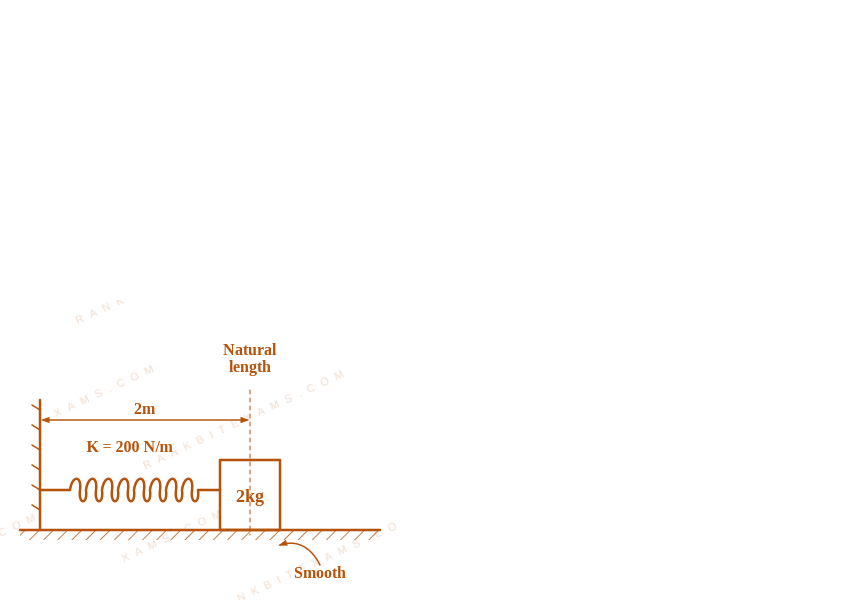
A block of mass 2~kg$2\mathrm{~kg}$ is attached to one end of a massless spring whose other end is fixed at a wall. The spring-mass system moves on a frictionless horizontal table. The spring's natural length is 2~m$2\mathrm{~m}$ and spring constant is 200~N/m$200\mathrm{~N/m}$. The block is pushed such that the length of the spring becomes 1~m$1\mathrm{~m}$ and then released. At distance x~m$x\mathrm{~m}$ (x < 2$x < 2$) from the wall, the speed of the block will be:
Sees: Horizontal spring-mass energy conservation.
Trap: The deformation is not x$x$; it is the difference from natural length, i.e., (L₀ - x) = (2 - x)$(L_0 - x) = (2 - x)$.
Shortcut: Writing out energy conservation directly allows mass to cancel beautifully, simplifying the algebra immediately. ✓
Chapter Mix
Class 11 Physics: Work, Energy and Power
Class 11 Physics: Oscillations
More Work, Energy and Power Previous-Year Questions — Page 7
Q49jee_main_2024_31_jan_morningConservation Of Momentum
An artillery piece of mass M₁$M_1$ fires a shell of mass M₂$M_2$ horizontally. Instantaneously after the firing, the ratio of kinetic energy of the artillery and that of the shell is :
A.M₁ / (M₁ + M₂)$M_1 / (M_1 + M_2)$
B.(M₂)/(M₁)$\frac{M_2}{M_1}$
C.M₂ / (M₁ + M₂)$M_2 / (M_1 + M_2)$
D.(M₁)/(M₂)$\frac{M_1}{M_2}$
Solution
Related Formula
KE = (p²)/(2m)$$\text{KE} = \frac{p^2}{2m}$$
Core Logic
By conservation of linear momentum (since no external horizontal force acts on the system):
Practice past-year questions one chapter at a time. Pick an exam → subject → chapter and get every PYQ for that topic — pulled together from all past papers — with the chapter's key formulas alongside.