JEE Main · Physics → Steady

Waves appeared 22 times across 3 years — 2.5% of Physics. This question is from Wave Speed.

Year 2026 2025 2024 Total
Questions 7 10 5 22

Two strings with circular cross section and made of same material, are stretched to have same amount of tension. A transverse wave is then made to pass through both the strings. The velocity of the wave in the first string having the radius of cross section R is v₁, and that in the other string having radius of cross section R/2 is v₂. Then v₂v₁ =

Solution & Explanation

Related Formula
v = √((T)/(μ)) μ = ρ A = ρ (π R²)

where, v = velocity of transverse wave on a string T = tension on string μ = linear mass density ρ = density of material A = cross-sectional area

Core Logic

Since both strings are made of the same material, their density ρ is the same. Also, they are stretched to have the same amount of tension T.

Substitute the formula for μ into the velocity equation:

v = √((T)/(ρ π R²)) = (1)/(R) √((T)/(ρ π))

Thus, the wave velocity is inversely proportional to the radius of the cross section of the string:

v ∝ (1)/(R) (v₂)/(v₁) = (R₁)/(R₂)
Step 1: Ratio Computation

Given:

  • R₁ = R
  • R₂ = R/2
  • Substitute these values:

(v₂)/(v₁) = (R)/(R/2) = 2
Pattern Recognition

Sees: Circular cross-section strings + transverse wave speed relation. Shortcut: Wave velocity v ∝ 1√(μ) ∝ (1)/(R). If the radius is halved, the mass per unit length decreases by 4 times, which makes the speed increase by √(4) = 2 times. ✓

Chapter Mix

Class 11 Physics: Waves

Reference Study Guides

More Waves Previous-Year Questions — Page 5

Q37 jee_main_2024_31_jan_evening Speed of Sound in Gases
The speed of sound in oxygen at S.T.P. will be approximately: (Given, R = 8.3 J K⁻¹ , γ = 1.4)
  • A. 310 m/s
  • B. 333 m/s
  • C. 341 m/s
  • D. 325 m/s

Solution

Related Formula
v = √((γ RT)/(M))
Core Logic

For Oxygen (O₂) at standard temperature and pressure (S.T.P.): T = 273 K M = 32 g/mol = 32 × 10⁻³ kg/mol γ = 1.4 R = 8.3 J K⁻¹ mol⁻¹

Step 1: Calculate Velocity
v = 1.4 × 8.3 × 27332 × 10⁻³ v = 3172.2632 × 10⁻³ v = √(99.133 × 10³) v = √(99133) ≈ 314.85 m/s

Approximating to the closest given option yields 310 m/s.

Pattern Recognition

For diatomic gases around room temp or STP, velocities range roughly from 250 to 350 m/s depending on molar mass (N₂ ≈ 334, O₂ ≈ 315). Recognize 315 is closest to option (1) due to standard approximations taken in exams.

Chapter Mix

Class 11 Physics: Waves Class 11 Physics: Kinetic Theory of Gases
Q jee_main_2024_31_jan_morning Organ Pipes
The fundamental frequency of a closed organ pipe is equal to the first overtone frequency of an open organ pipe. If length of the open pipe is 60~cm, the length of the closed pipe will be:
  • A. 60~cm
  • B. 45~cm
  • C. 30~cm
  • D. 15~cm

Solution

Related Formula
fclosed, fundamental = (v)/(4Lc) fopen, 1st overtone = (2v)/(2Lₒ)
Core Logic

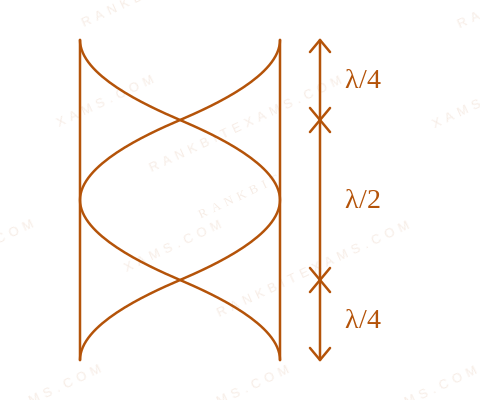
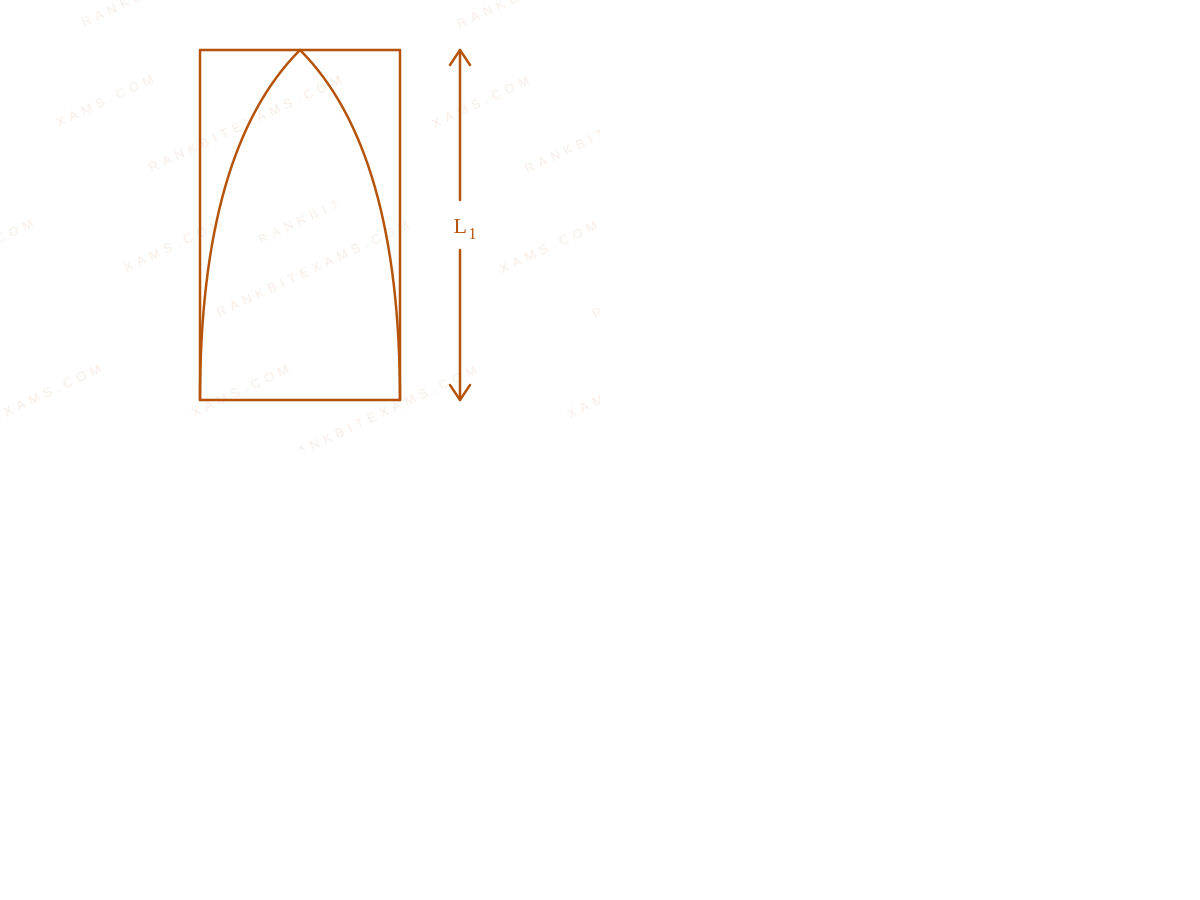
Organ Pipes diagram for Q45 - JEE Main 2024 Morning

Organ Pipes diagram for Q45 - JEE Main 2024 Morning

For a closed organ pipe, the fundamental frequency (1st harmonic) is:

f₁ = (v)/(λ) = (v)/(4L₁)

where L₁ is the length of the closed pipe.

For an open organ pipe, the first overtone (2nd harmonic) is:

f₂ = (2v)/(2L₂) = (v)/(L₂)

where L₂ is the length of the open pipe (L₂ = 60 cm).

Step 2: Equating Frequencies

Given f₁ = f₂:

(v)/(4L₁) = (v)/(L₂)

L₂ = 4L₁

60 = 4 × L₁ L₁ = 15 cm
Chapter Mix

Class 11 Physics: Waves

More Waves Questions — jee_main_2025_08_april_evening

Practice all Waves previous-year questions →

Rankbit System
JEE Physics: Waves (+15.5%) | Electrostatics: Concentric Shells (-29.7%) | Modern Physics: Photoelectric Clones (+34.2%) | Mathematics: Definite Integrals (+18.1%) | Chemistry: Coordination Splitting (-11.4%) | JEE Physics: Waves (+15.5%) | Electrostatics: Concentric Shells (-29.7%) | Modern Physics: Photoelectric Clones (+34.2%) | Mathematics: Definite Integrals (+18.1%) | Chemistry: Coordination Splitting (-11.4%)