JEE Main · Physics → Steady

Electrostatics appeared 79 times across 3 years — 9.1% of Physics. This question is from Conductors and Corona Discharge.

Year 2026 2025 2024 Total
Questions 24 39 16 79

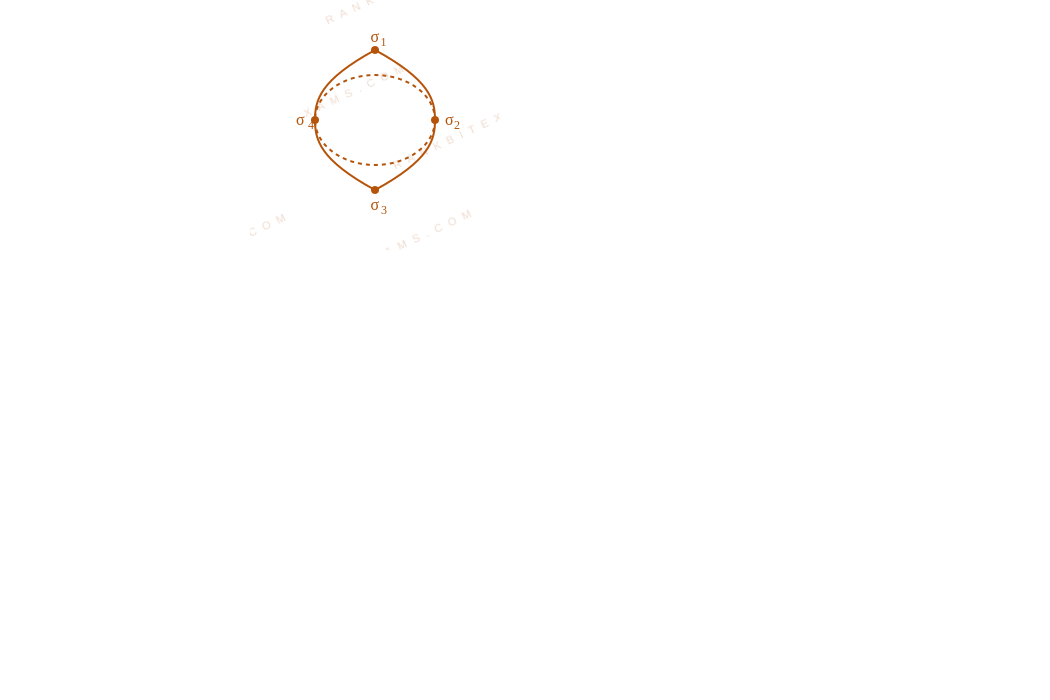
Electric charge is transferred to an irregular metallic disk as shown in figure. If σ₁, σ₂, σ₃ and σ₄ are charge densities at given points then, choose the correct answer from the options given below:
Conductors and Corona Discharge diagram for Q4 - JEE Main 2025 Evening
This diagram shows an irregular metallic conductor with numbered points 1, 2, 3, and 4 marking areas of different curvature along its perimeter.
(A) σ₁ > σ₃; σ₂ = σ₄ (B) σ₁ > σ₂; σ₃ > σ₄ (C) σ₁ > σ₃ > σ₂ = σ₄ (D) σ₁ < σ₃ < σ₂ = σ₄ (E) σ₁ = σ₂ = σ₃ = σ₄

Solution & Explanation

Related Formula
σ ∝ 1Rcurv

where, σ = surface charge density Rcurv = local radius of curvature at that point on the conductor's surface

Core Logic

On an irregular-shaped charged metallic conductor in electrostatic equilibrium:

  • The electric potential is identical at all points on the surface.
  • However, the surface charge density σ is not uniform. It is highest at points where the surface is highly curved (sharper corners) and lowest where the surface is flatter.
  • Analyzing the radii of curvature (Rcurv) from the figure:

  • Point 1 is the sharpest corner (smallest radius of curvature): (Rcurv)₁
  • Point 3 is less sharp: (Rcurv)₃
  • Points 2 and 4 are symmetric flat regions of equal curvature: (Rcurv)₂ = (Rcurv)₄
  • Therefore, we have:

(Rcurv)₁ < (Rcurv)₃ < (Rcurv)₂ = (Rcurv)₄

Using the inverse relationship σ ∝ 1Rcurv:

σ₁ > σ₃ > σ₂ = σ₄
Step 1: Verification of Statements
  • Statement (A) σ₁ > σ₃; σ₂ = σ₄ is Correct.
  • Statement (B) σ₁ > σ₂; σ₃ > σ₄ is Correct (since σ₁ > σ₂ and σ₃ > σ₄).
  • Statement (C) σ₁ > σ₃ > σ₂ = σ₄ is Correct (most comprehensive description).
  • Therefore, statements A, B, and C are all true. Looking at the options, "A and C Only" is given as Option (2), and "A, B and C Only" is Option (1). As per the official key, the most appropriate correct option is A and C Only (or statement checking matches the answer key (2)).
Pattern Recognition

Sees: "Irregular charged metallic conductor" → Sharpest point has maximum charge density σ. Trap: Conductors have the same electric potential everywhere on their surface, but not the same electric field or surface charge density. Keep potential vs. charge density concepts separated! ✓

Chapter Mix

Class 12 Physics: Electrostatics

Reference Study Guides

More Electrostatics Previous-Year Questions — Page 6

Q9 jee_main_2025_02_april_evening Electric Potential Difference
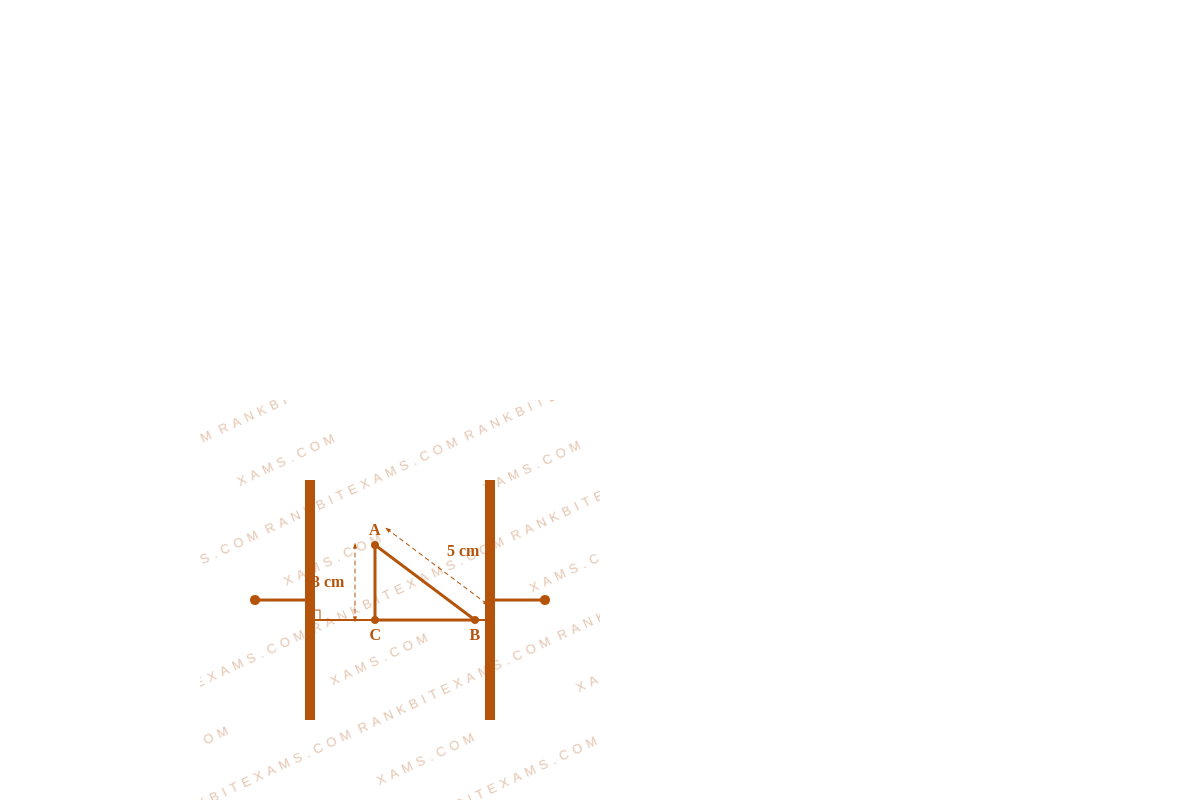
Two large plane parallel conducting plates are kept 10cm apart as shown in figure. The potential difference between them is V. The potential difference between the points A and B (shown in the figure) is :
Parallel conducting plates with potential difference V showing points A and B
The diagram shows two parallel plates separated by 10 cm, with points A and B defining a right triangle of legs 3 cm and 4 cm.
  • A. (1)/(4) ~V
  • B. (2)/(5) ~V
  • C. (3)/(4) ~V
  • D. 1 ~V

Solution

Related Formula
  • Uniform Electric Field between parallel plates:
E = (V)/(d)
  • Potential difference between two points along the direction of the field:
Δ V = E · Δ x
Core Logic

The separation between the plates is d = 10 cm. The electric field E between them is uniform and runs perpendicularly between the plates (along the horizontal direction, +x):

E = (V)/(10) V/cm

From the geometry shown in the figure:

  • AC = 3 cm is perpendicular to E (vertical direction).
  • CB = 4 cm is parallel to E (horizontal direction).
Step 1: Calculate potential difference between A and B

Since line AC is perpendicular to E:

VA - VC = 0 VA = VC

Thus, the potential difference between A and B is completely due to the horizontal displacement CB:

VAB = VA - VB = E · (CB)

Substitute the values:

VAB = ((V)/(10)) × 4 = (2)/(5) V

Thus, the potential difference between A and B is (2)/(5)V.

Pattern Recognition

Sees: Uniform electric field, potential difference over diagonal paths. Trap: Projecting along the hypotenuse length (5 cm) directly without considering the electric field's physical direction. Shortcut: Electric field is purely horizontal. Hence, only horizontal displacement matters. The horizontal displacement is 4 cm out of 10 cm total plate gap, so the potential difference is (4)/(10)V = (2)/(5)V.

Chapter Mix

Class 12 Physics: Electrostatic Potential and Capacitance
Q20 jee_main_2025_02_april_evening Electric Field of a Ring
Consider a circular loop that is uniformly charged and has a radius a√(2) . Find the position along the positive z -axis of the cartesian coordinate system where the electric field is maximum if the ring was assumed to be placed in xy-plane at the origin:
  • A. a√(2)
  • B. (a)/(2)
  • C. a
  • D. 0

Solution

Related Formula
  • Electric field intensity on the axis of a ring of radius R at axial distance z:
E = k Q z(z² + R²)3/2
  • Condition for maximum electric field on the axis of a ring:
z = R√(2)
Core Logic

To find where the axial field is maximized, take the first derivative of E with respect to z and set it to zero:

(dE)/(dz) = 0 z² + R² - 3z² = 0 z = R√(2)

We are given:

  • Radius of the loop R = a√(2)
Step 1: Calculate the peak coordinate

Substitute the radius R = a√(2) into the maximized coordinate condition:

z = a√(2)√(2) = a

Thus, the electric field reaches its peak intensity at z = a.

Pattern Recognition

Sees: Maximum axial field location of circular charged ring. Trap: Simply picking radius R directly as the distance value, or omitting the 1/√(2) scaling factor. Shortcut: The peak of the axial field distribution of any ring always lies at z = R√(2). With R = a√(2), z resolves simply to a√(2)√(2) = a.

Chapter Mix

Class 12 Physics: Electric Charges and Fields

Q jee_main_2025_02_april_morning Electric Field and Gauss's Law
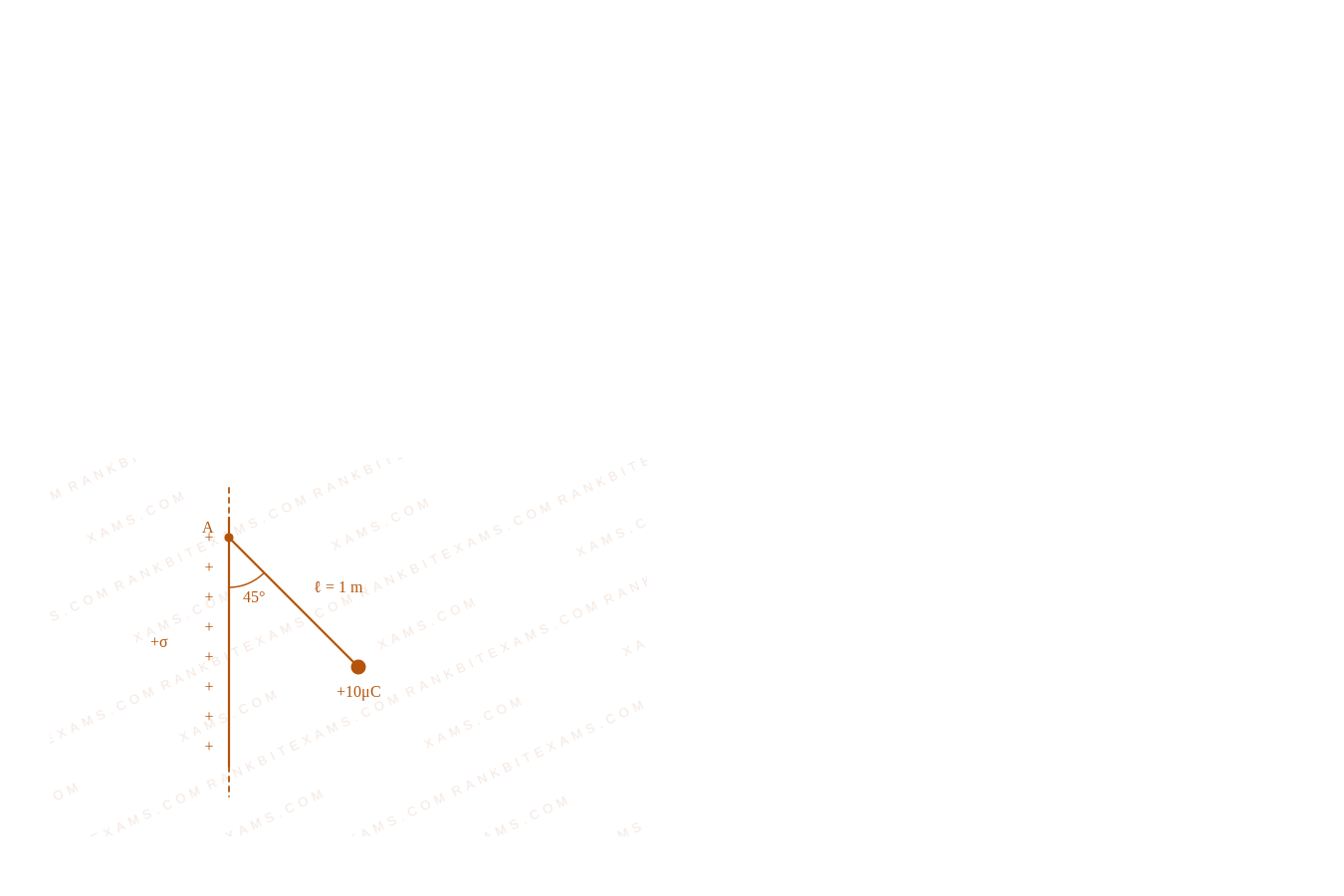
A small bob of mass 100~mg and charge +10~μ C is connected to an insulating string of length 1~m. It is brought near to an infinitely long non-conducting sheet of charge density 'σ' as shown in figure. If string subtends an angle of 45circ with the sheet at equilibrium the charge density of sheet will be: (Given, ε₀ = 8.85× 10⁻¹² Fm and acceleration due to gravity, g = 10~m/s²)
Charged bob suspended near sheet for Q19
A small charged bob hanging by a string of length 1 m subtending an angle of 45 degrees near a charged sheet.
  • A. 0.885 nC / m²
  • B. 17.7 nC / m²
  • C. 885 nC / m²
  • D. 1.77 nC / m²

Solution

Related Formula
E = (σ)/(2ε₀) (field of infinite non-conducting charged sheet) θ = (Fₑ)/(mg)
Core Logic

In equilibrium, three forces act on the suspended charged bob:

  • Tension T directed along the string at θ = 45° with the vertical sheet.
  • Weight mg directed vertically downwards.
  • Electrostatic repulsion force Fₑ = qE acting horizontally away from the sheet.
  • From the balance of forces in vertical and horizontal directions:

T (45°) = mg T (45°) = q E

Dividing the two equations:

(45°) = (q E)/(mg) = 1 q E = mg

Substitute the expression for E:

q ((σ)/(2ε₀)) = mg σ = (2 ε₀ m g)/(q)

Now plug in the given numerical values:

  • m = 100~mg = 100 × 10⁻⁶~kg = 10⁻⁴~kg
  • q = +10~μ C = 10 × 10⁻⁶~C = 10⁻⁵~C
  • g = 10~m/s²
  • ε₀ = 8.85 × 10⁻¹²~F/m
σ = 2 × (8.85 × 10⁻¹²) × 10⁻⁴ × 1010⁻⁵ σ = 17.7 × 10⁻¹⁰~C/m² = 1.77 × 10⁻⁹~C/m² = 1.77~nC/m²
Step 1: Final Conclusion

The charge density of the sheet is 1.77~nC/m².

Pattern Recognition

For a charge hanging near a vertical charged sheet, the equilibrium angle is governed by θ = (Fₑ)/(mg). For θ = 45°, the horizontal force equals the vertical force (Fₑ = mg). Be careful to use the field of a non-conducting sheet: E = (σ)/(2ε₀).

Chapter Mix

Class 12 Physics: Electrostatics

Q5 jee_main_2025_02_april_morning Electric Field and Gauss's Law
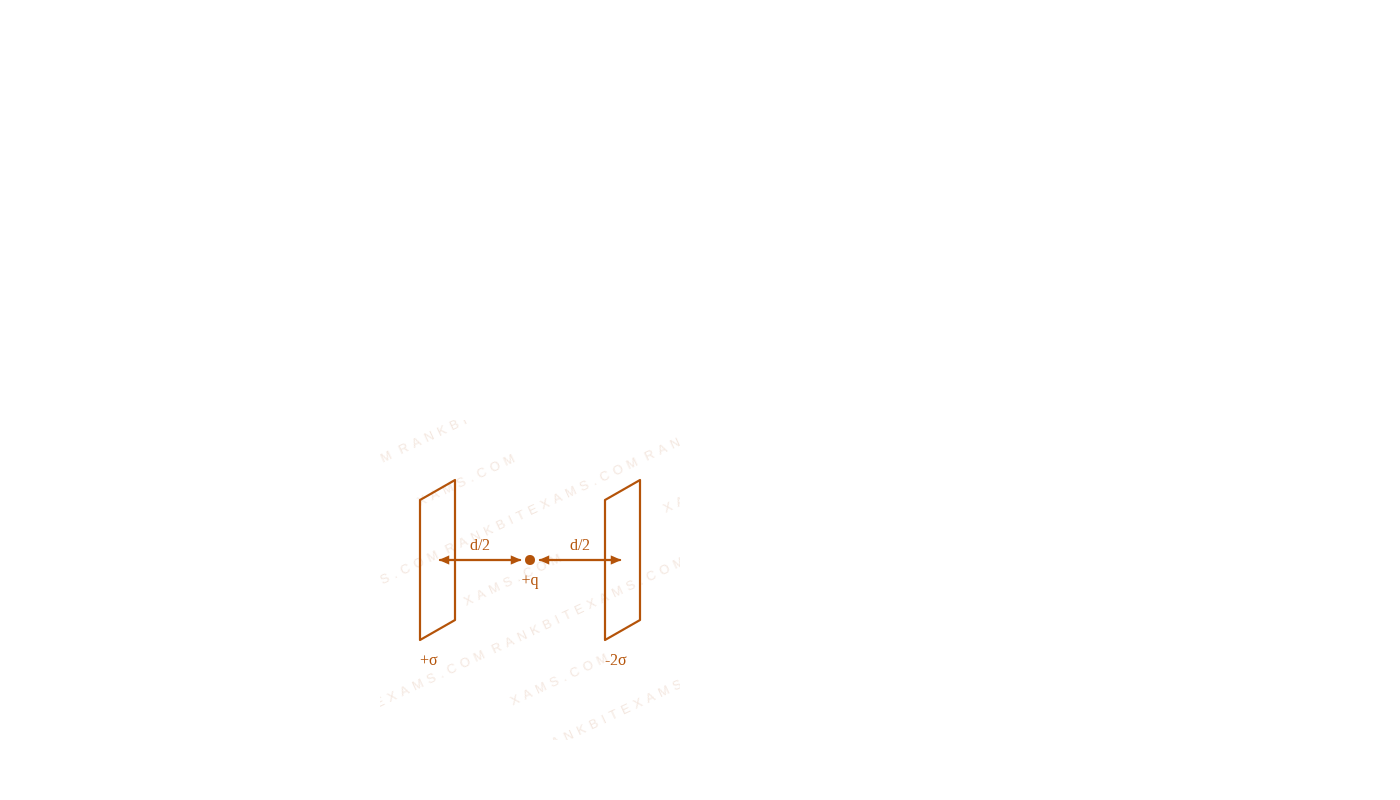
Consider two infinitely large plane parallel conducting plates as shown below. The plates are uniformly charged with a surface charge density +σ and -2σ. The force experienced by a point charge +q placed at the mid point between two plates will be:
Parallel conducting plates for Q5
Two parallel plates with charges +sigma and -2sigma and a point charge +q at the midpoint.
  • A. (σ q)/(4 ε₀)
  • B. (3σ q)/(2 ε₀)
  • C. (3σ q)/(4 ε₀)
  • D. (σ q)/(2 ε₀)

Solution

Related Formula
E = σᵢₙₙₑᵣε₀
Core Logic

For parallel conducting plates of large area, charges redistribute on the outer and inner faces to maintain electrostatic equilibrium. Total charge per unit area on Plate 1: q₁ = σ Total charge per unit area on Plate 2: q₂ = -2σ

The outer surface charge density on the far sides of both plates must be equal:

σouter = (q₁ + q₂)/(2) = (σ - 2σ)/(2) = -(σ)/(2)

Now, compute the charges on the inner facing surfaces:

  • Inner face of Plate 1:
σᵢₙₙₑᵣ₁ = q₁ - σouter = σ - (-(σ)/(2)) = (3σ)/(2)
  • Inner face of Plate 2:
σᵢₙₙₑᵣ₂ = q₂ - σouter = -2σ - (-(σ)/(2)) = -(3σ)/(2)

In the region between the plates, both inner surfaces create an electric field in the same direction (away from the positive plate 1 and towards negative plate 2):

E = σᵢₙₙₑᵣ₁2ε₀ + |σᵢₙₙₑᵣ₂|2ε₀ = (3σ/2)/(2ε₀) + (3σ/2)/(2ε₀) = (3σ)/(2ε₀)

Thus, the electrostatic force on +q is:

F = q E = (3σ q)/(2ε₀)
Step 1: Final Conclusion

The force experienced by the point charge +q is (3σ q)/(2ε₀).

Pattern Recognition

For conducting plates with total charges Q₁ and Q₂, always calculate the outer charge first: Qouter = (Q₁+Q₂)/(2). The field inside the gap is exclusively due to the inner surfaces: E = σᵢₙₙₑᵣε₀.

Chapter Mix

Class 12 Physics: Electrostatics

Q7 jee_main_2025_02_april_morning Electric Field and Gauss's Law
A point charge +q is placed at the origin. A second point charge +9q is placed at (d, 0, 0) in Cartesian coordinate system. The point in between them where the electric field vanishes is:
  • A. (4d / 3, 0, 0)
  • B. (d / 4, 0, 0)
  • C. (3d / 4, 0, 0)
  • D. (d / 3, 0, 0)

Solution

Related Formula
E = (k Q)/(r²) x = d1 + √((q₂)/(q₁))
Core Logic

Let the null point where the electric field is zero be at (x, 0, 0) where 0 < x < d.

At this point, the fields due to both charges are equal in magnitude and opposite in direction:

(k q)/(x²) = (k (9q))/((d - x)²)

Taking the square root on both sides:

(1)/(x) = (3)/(d - x) d - x = 3x 4x = d x = (d)/(4)

Thus, the coordinates of the null point are ((d)/(4), 0, 0).

Step 1: Final Conclusion

The point where the electric field vanishes is ((d)/(4), 0, 0).

Pattern Recognition

For two like charges, the zero-field null point always lies along the line joining them and is closer to the smaller charge. Use the standard shortcut: x = d1 + √(q₂/q₁) measured from charge q₁.

Chapter Mix

Class 12 Physics: Electrostatics

More Electrostatics Questions — jee_main_2025_08_april_evening

Practice all Electrostatics previous-year questions →

Rankbit System
JEE Physics: Waves (+15.5%) | Electrostatics: Concentric Shells (-29.7%) | Modern Physics: Photoelectric Clones (+34.2%) | Mathematics: Definite Integrals (+18.1%) | Chemistry: Coordination Splitting (-11.4%) | JEE Physics: Waves (+15.5%) | Electrostatics: Concentric Shells (-29.7%) | Modern Physics: Photoelectric Clones (+34.2%) | Mathematics: Definite Integrals (+18.1%) | Chemistry: Coordination Splitting (-11.4%)