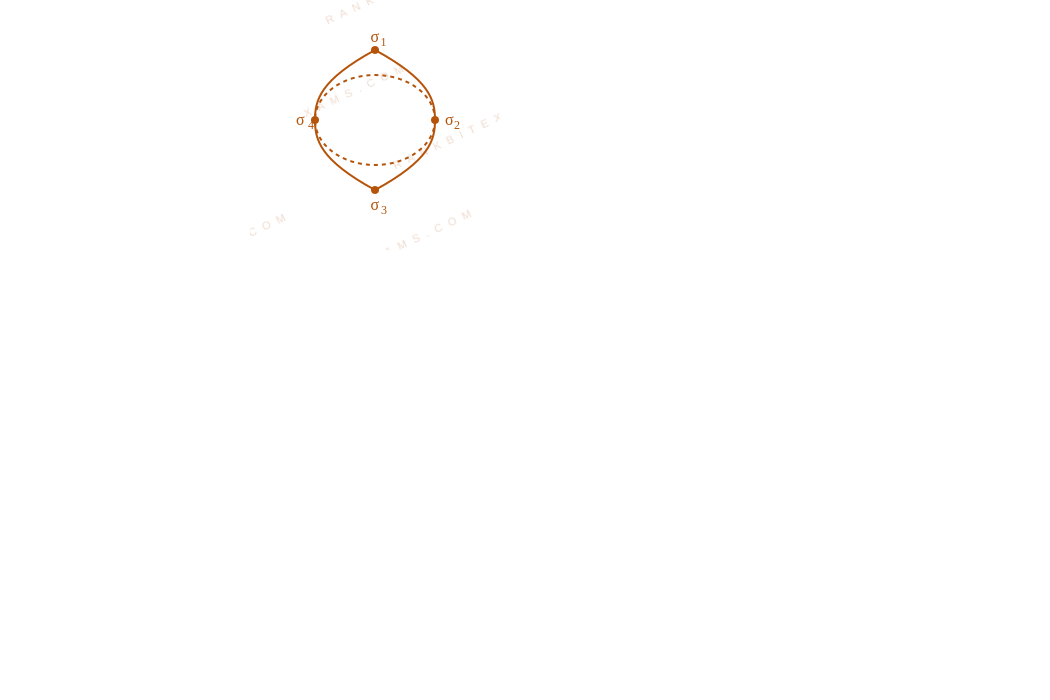
Electric charge is transferred to an irregular metallic disk as shown in figure. If σ₁, σ₂, σ₃$\sigma_{1}, \sigma_{2}, \sigma_{3}$ and σ₄$\sigma_{4}$ are charge densities at given points then, choose the correct answer from the options given below:
This diagram shows an irregular metallic conductor with numbered points 1, 2, 3, and 4 marking areas of different curvature along its perimeter.
(A) σ₁ > σ₃$\sigma_{1} > \sigma_{3}$; σ₂ = σ₄$\sigma_{2} = \sigma_{4}$
(B) σ₁ > σ₂$\sigma_{1} > \sigma_{2}$; σ₃ > σ₄$\sigma_{3} > \sigma_{4}$
(C) σ₁ > σ₃ > σ₂ = σ₄$\sigma_{1} > \sigma_{3} > \sigma_{2} = \sigma_{4}$
(D) σ₁ < σ₃ < σ₂ = σ₄$\sigma_{1} < \sigma_{3} < \sigma_{2} = \sigma_{4}$
(E) σ₁ = σ₂ = σ₃ = σ₄$\sigma_{1} = \sigma_{2} = \sigma_{3} = \sigma_{4}$
where,
σ$\sigma$ = surface charge density
Rcurv$R_{\text{curv}}$ = local radius of curvature at that point on the conductor's surface
Core Logic
On an irregular-shaped charged metallic conductor in electrostatic equilibrium:
The electric potential is identical at all points on the surface.
However, the surface charge density σ$\sigma$ is not uniform. It is highest at points where the surface is highly curved (sharper corners) and lowest where the surface is flatter.
Analyzing the radii of curvature (Rcurv)$(R_{\text{curv}})$ from the figure:
Point 1 is the sharpest corner (smallest radius of curvature): (Rcurv)₁$(R_{\text{curv}})_1$
Point 3 is less sharp: (Rcurv)₃$(R_{\text{curv}})_3$
Points 2 and 4 are symmetric flat regions of equal curvature: (Rcurv)₂ = (Rcurv)₄$(R_{\text{curv}})_2 = (R_{\text{curv}})_4$
Therefore, statements A, B, and C are all true. Looking at the options, "A and C Only" is given as Option (2), and "A, B and C Only" is Option (1). As per the official key, the most appropriate correct option is A and C Only (or statement checking matches the answer key (2)).
Pattern Recognition
Sees: "Irregular charged metallic conductor" → Sharpest point has maximum charge density σ$\sigma$.
Trap: Conductors have the same electric potential everywhere on their surface, but not the same electric field or surface charge density. Keep potential vs. charge density concepts separated! ✓
Keywords:#Charge density on irregular conductor#JEE Main 2025 Evening Q4#Electrostatics conductors RankBit#Radius of curvature charge density#metallic disk#charge density#irregular conductor#radius of curvature
More Electrostatics Previous-Year Questions — Page 4
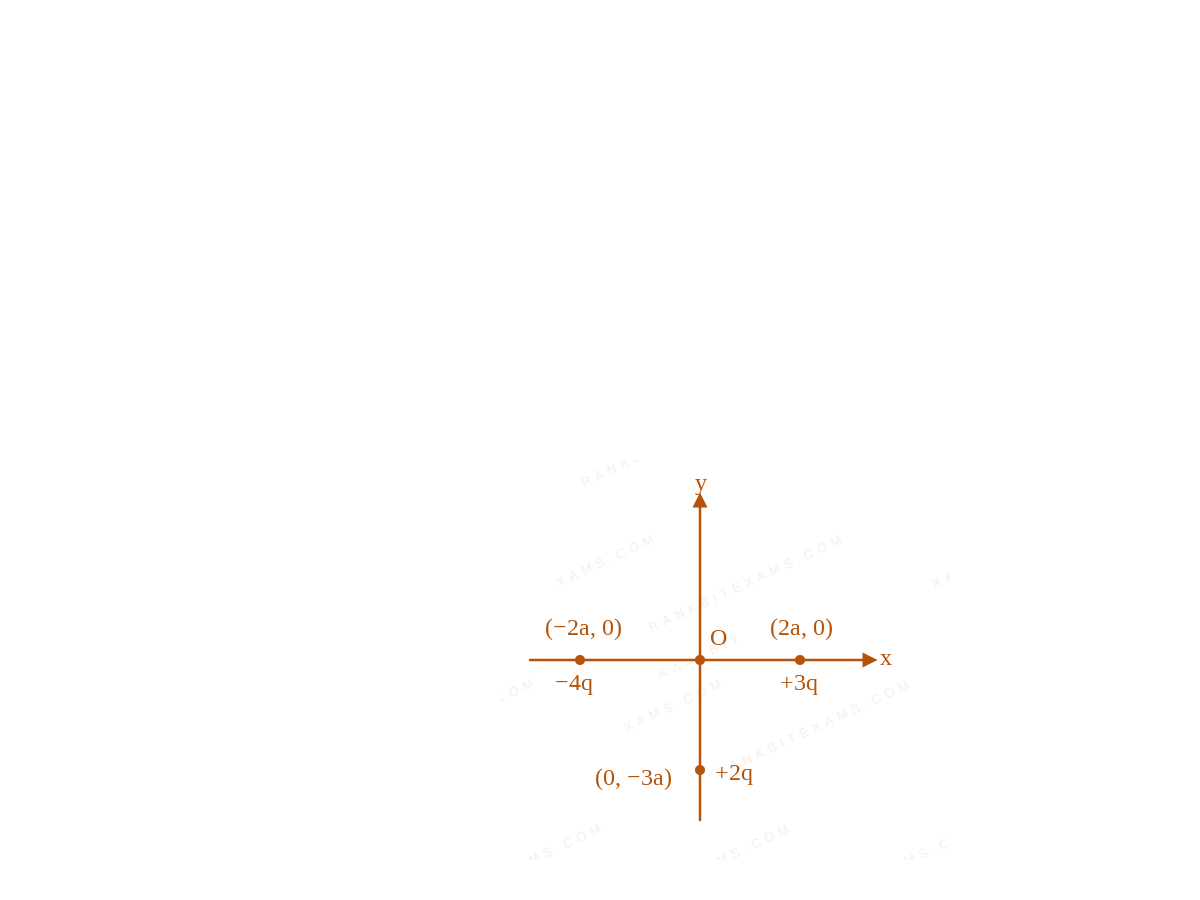
Three charges +2q$+2q$, +3q$+3q$ and -4q$-4q$ are situated at (0,-3a)$(0,-3a)$, (2a, 0)$(2a, 0)$ and (-2a,0)$(-2a,0)$ respectively in the xy plane. The resultant dipole moment about origin is
For a system of point charges where the net charge is non-zero, the dipole moment depends on the origin. However, taking the standard formula Σ qᵢ rᵢ$\sum q_i r_i$ yields the required mathematical expression directly.
Chapter Mix
Class 12 Physics: Electric Charges and Fields
Q40jee_main_2026_24_january_morningGauss's Law
The electrostatic potential in a charged spherical region of radius r varies as V = ar³ + b$V = ar^{3} + b$, where a and b are constants. The total charge in the sphere of unit radius is α × π a in₀$\alpha \times \pi a \in_{0}$. The value of α$\alpha$ is ____. (permittivity of vacuum is in₀$\in_{0}$)
A.-12$-12$
B.-6$-6$
C.-9$-9$
D.-8$-8$
Solution
Related Formula
E = -(dV)/(dr)$$E = -\frac{dV}{dr}$$∮ E · d A = qencε₀$$\oint \vec{E} \cdot d\vec{A} = \frac{q_{\text{enc}}}{\epsilon_0}$$
Core Logic
Gauss law for a spherical region
Given potential V = ar³ + b$V = ar^3 + b$.
The electric field E$E$ is given by the negative gradient of potential:
E = -(dV)/(dr) = -(d)/(dr)(ar³ + b) = -3ar²$$E = -\frac{dV}{dr} = -\frac{d}{dr}(ar^3 + b) = -3ar^2$$
Using Gauss's Law to find the enclosed charge for a spherical region:
Φclosed = E · A = qencε₀$$\Phi_{\text{closed}} = E \cdot A = \frac{q_{\text{enc}}}{\epsilon_0}$$
Step 1: Enclosed Charge Calculation
The surface area of a sphere of radius r=1$r=1$ is A = 4π(1)² = 4π$A = 4\pi(1)^2 = 4\pi$.
The electric field at r=1$r=1$ is:
E = -3a(1)² = -3a$$E = -3a(1)^2 = -3a$$
So,
qenc = ε₀ · E · A = ε₀ (-3a) (4π) = -12π a ε₀$$q_{\text{enc}} = \epsilon_0 \cdot E \cdot A = \epsilon_0 (-3a) (4\pi) = -12\pi a \epsilon_0$$
Comparing with the given expression α × π a ε₀$\alpha \times \pi a \epsilon_0$, we get:
α = -12$\alpha = -12$
Pattern Recognition
For spherical symmetry, extracting total charge enclosed is fastest using Gauss's Law at the boundary surface rather than integrating local charge density ρ(r)$\rho(r)$ using Poisson's equation.
Chapter Mix
Class 12 Physics: Electrostatics
Q44jee_main_2026_24_january_morningElectric Potential of Spherical Shells
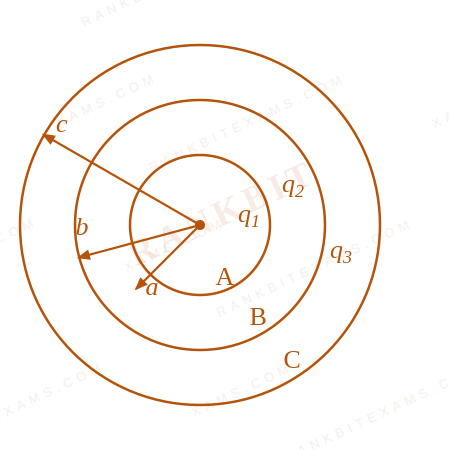
There are three co-centric conducting spherical shells A, B and C of radii a, b and c respectively. The potential of the spheres A, B and C respectively, are :
Potential at surface of middle sphere B (radius b$b$):
For charge q₁$q_1$, this is an outside point. For q₂$q_2$, it's on the surface. For q₃$q_3$, it's inside.
Matching these results shows option (3) represents the potentials perfectly.
Pattern Recognition
Potential on a sphere from inner charges uses its own radius, whereas potential from outer shells uses the outer shell's radius. Inner charges "collapse" computationally to the sphere's center.
Chapter Mix
Class 12 Physics: Electrostatics
Q35jee_main_2026_24_january_eveningCapacitors with Dielectrics
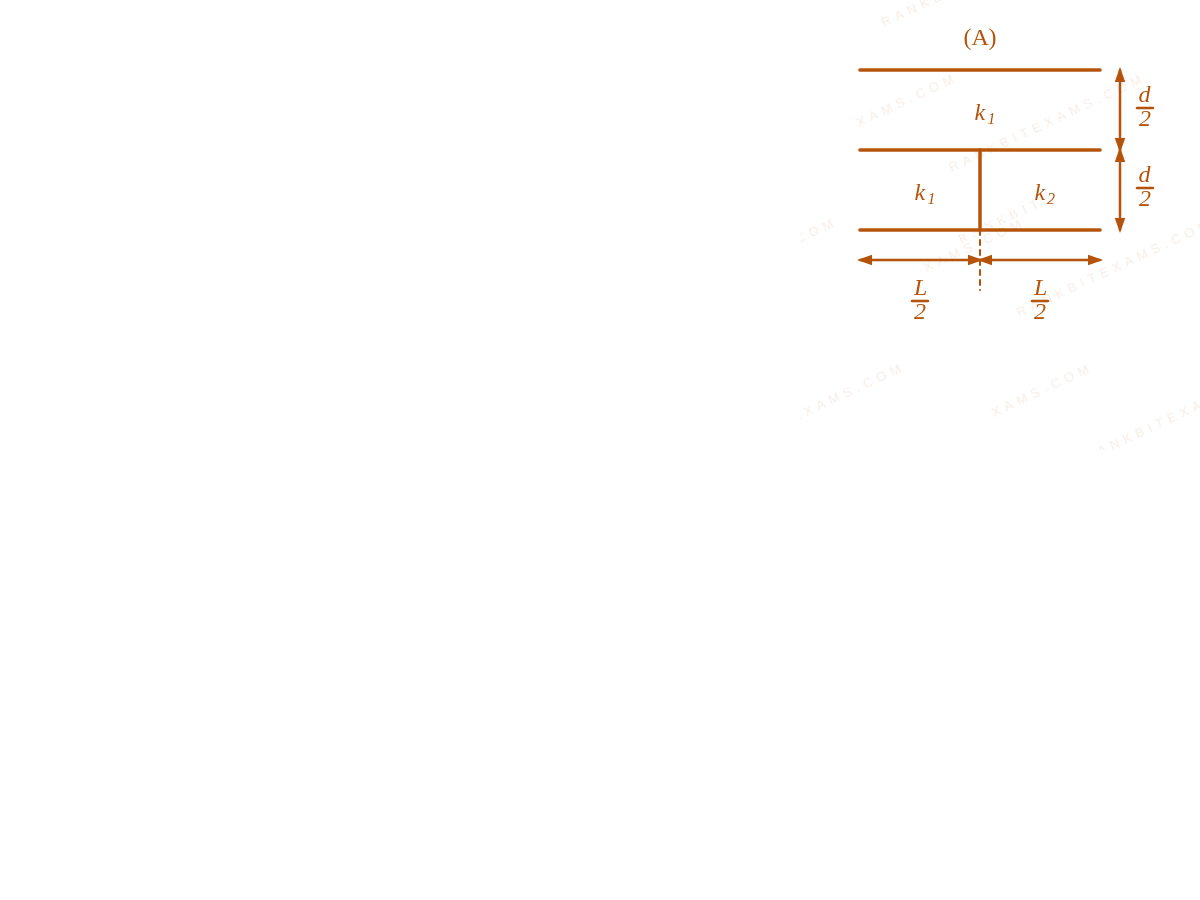
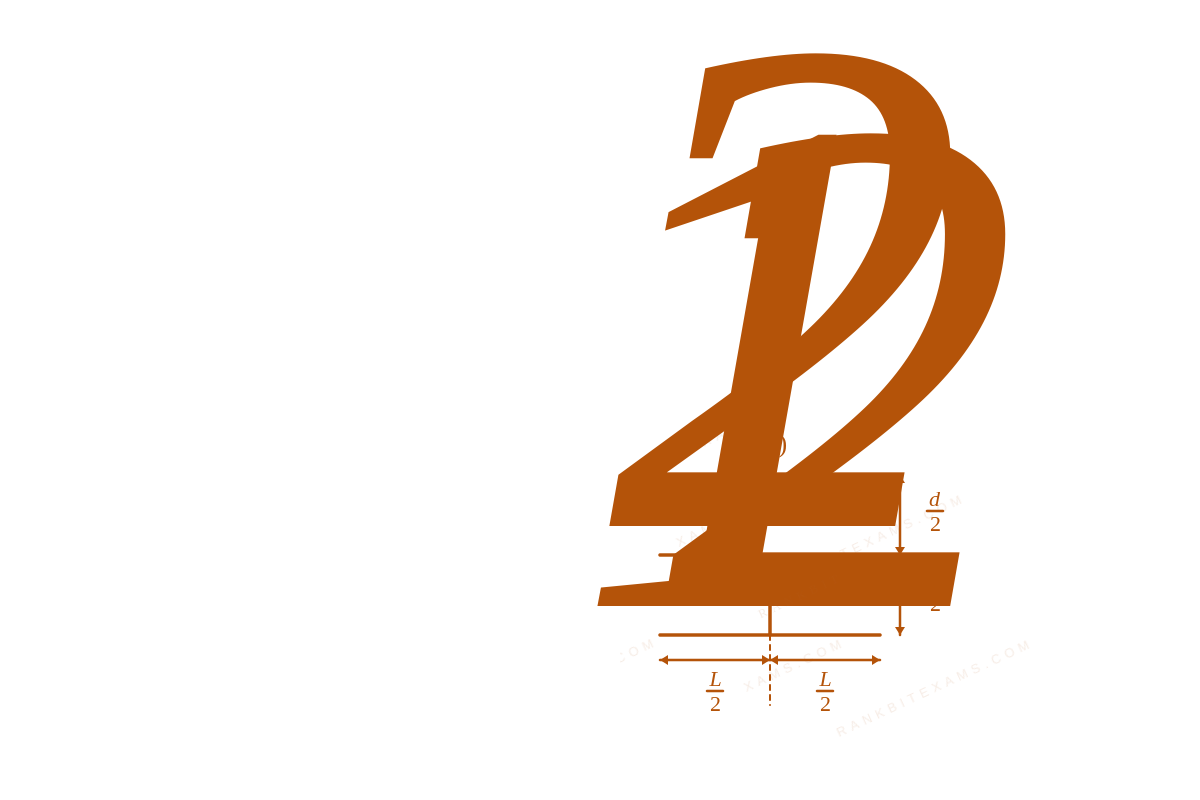
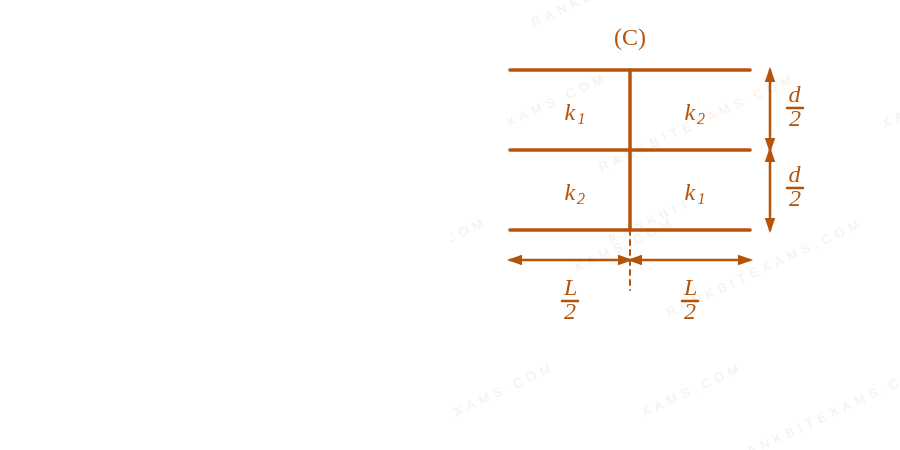
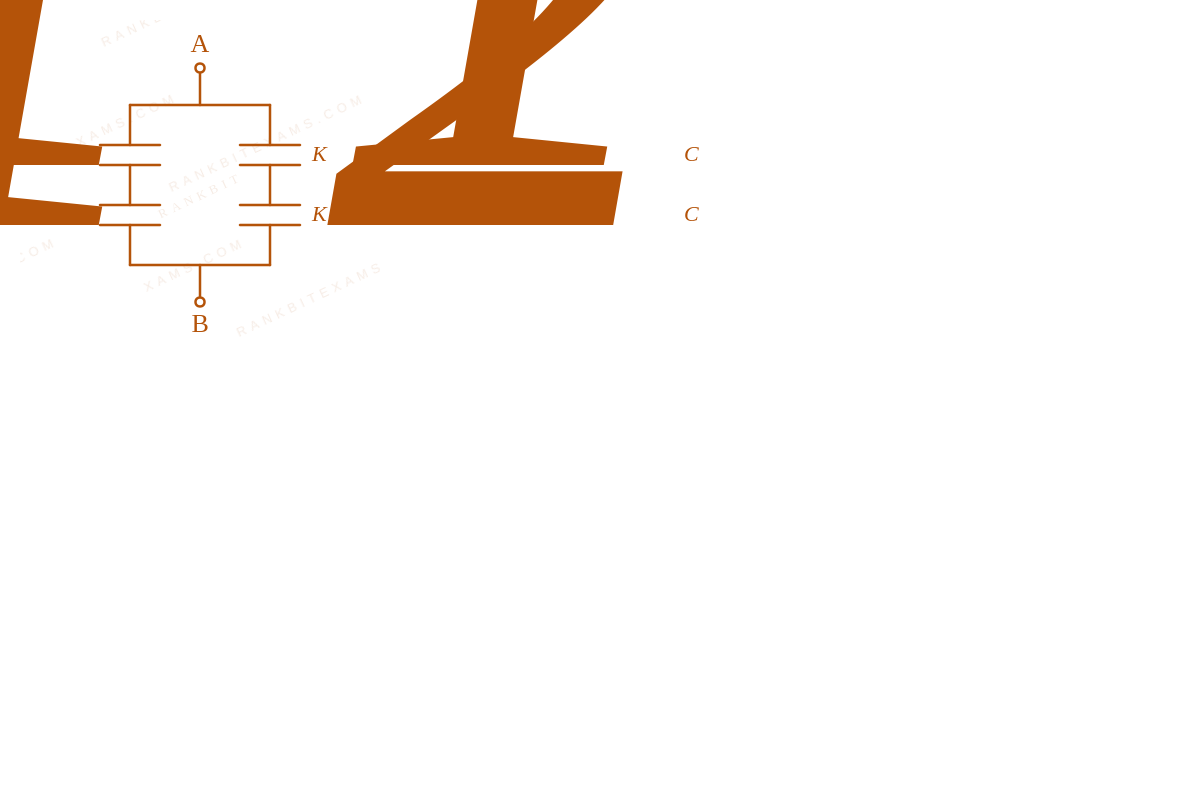
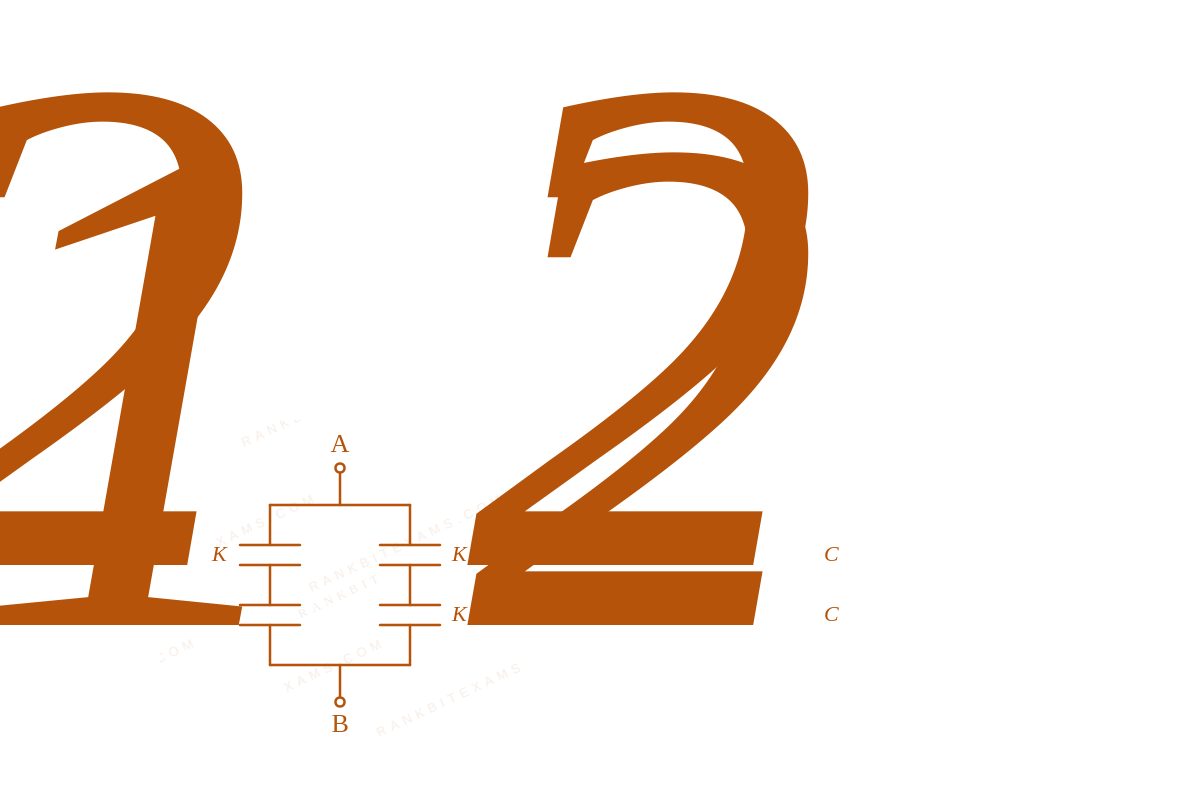
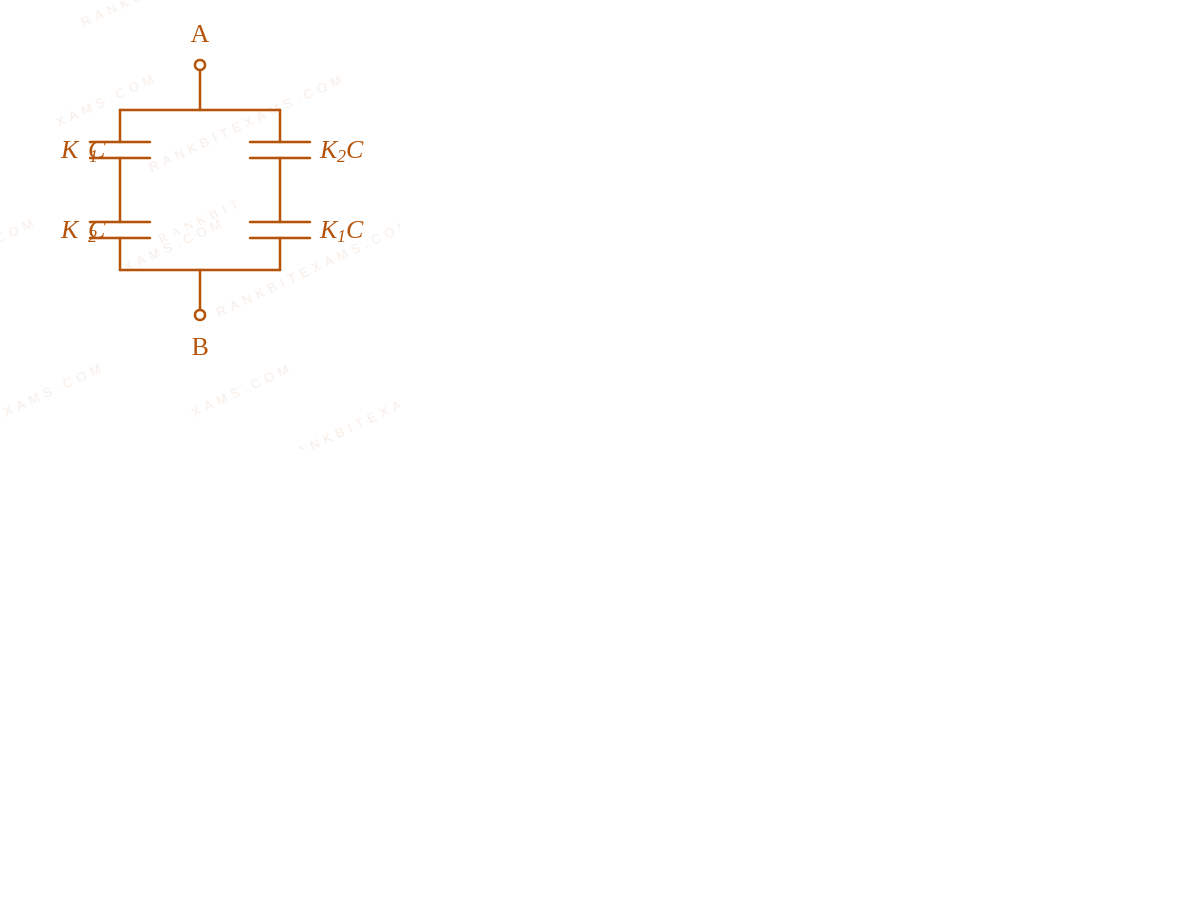
Three parallel plate capacitors each with area A and separation d are filled with two dielectric ( k₁$k_{1}$ and k₂$k_{2}$ ) in the following fashion. Which of the following is true? ( k₁ > k₂$k_{1} > k_{2}$ )
Three different capacitor configurations showing dielectrics k1 and k2 split vertically or horizontally.Three different capacitor configurations showing dielectrics k1 and k2 split vertically or horizontally.Three different capacitor configurations showing dielectrics k1 and k2 split vertically or horizontally.
A.CB > CC > CA$\mathrm{C_B > C_C > C_A}$
B.CC > CB > CA$\mathrm{C_C > C_B > C_A}$
C.CC > CA > CB$\mathrm{C_C > C_A > C_B}$
D.CA > CC > CB$\mathrm{C_A > C_C > C_B}$
Solution
Related Formula
C = (ε₀ A)/(d)$$C = \frac{\epsilon_0 A}{d}$$
Core Logic
Let C = (ε₀ A)/(d)$C = \frac{\epsilon_0 A}{d}$. We decompose the configurations into equivalent circuits.
For CA$C_A$:
Three different capacitor configurations showing dielectrics k1 and k2 split vertically or horizontally.
Since K₁ > K₂$K_1 > K_2$:
Comparing CA$C_A$ and CC$C_C$, and CC$C_C$ and CB$C_B$, algebraic manipulation proves:
CA > CC > CB$C_A > C_C > C_B$
Pattern Recognition
Symmetry dictates the capacity. Adding more of the higher dielectric constant material (K₁$K_1$) in parallel paths effectively boosts total capacitance significantly, while stacking lower K₂$K_2$ diminishes it.
Chapter Mix
Class 12 Physics: Electrostatics
Q47jee_main_2026_24_january_eveningCoulomb's Law and Continuous Charge Distribution
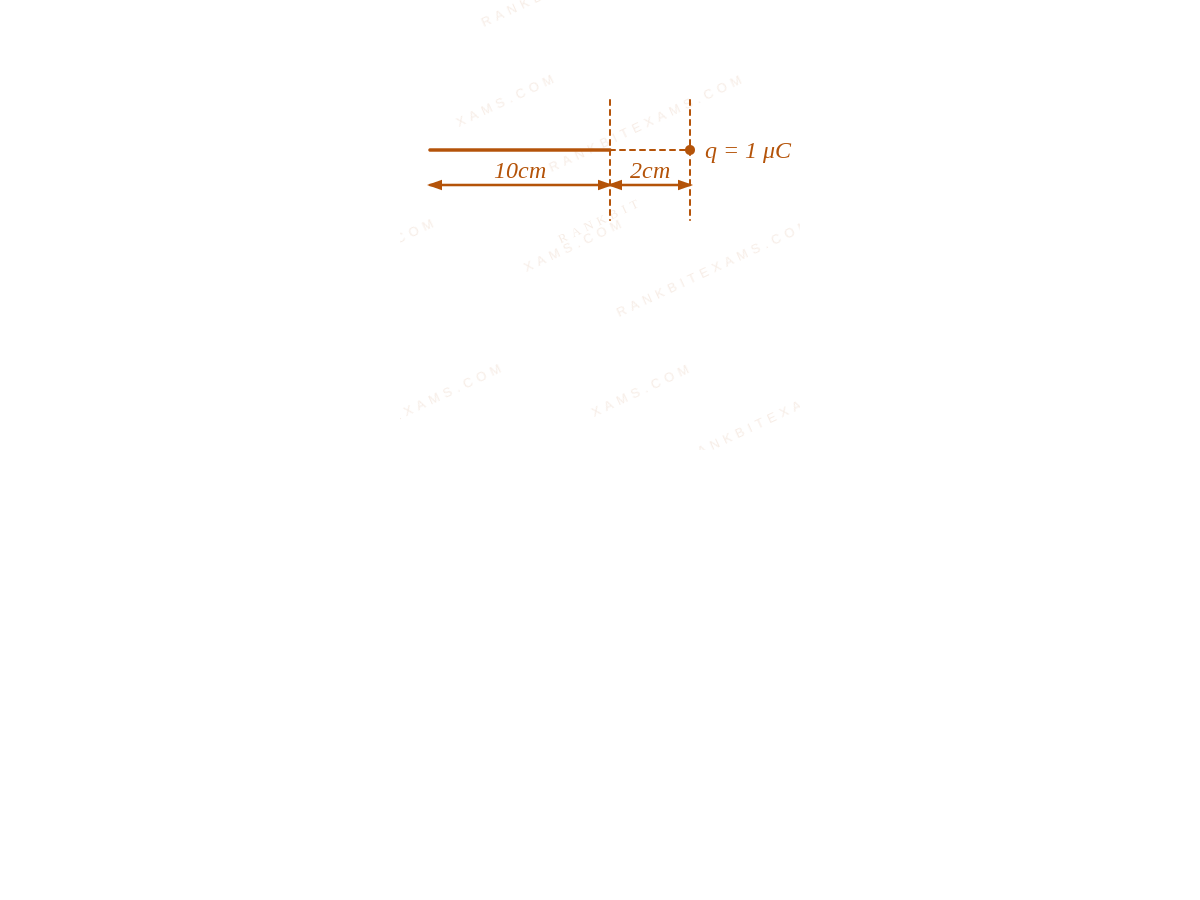
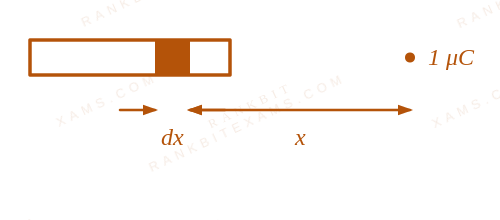
A point charge q = 1 μ C$q = 1 \mu C$ is located at a distance 2 cm from one end of a thin insulating wire of length 10 cm having a charge Q = 24 μ C$Q = 24 \mu C$ , distributed uniformly along its length, as shown in figure. Force between q and wire is ____ N.
( Use 14 π ε_ 0 = 9 × 1 0 ^ 9 N.m ^ 2 / C ^ 2)$\left(\text { Use } \frac {1}{4 \pi \epsilon_ {0}} = 9 \times 1 0 ^ {9} \mathrm{N.m} ^ {2} / \mathrm{C} ^ {2}\right)$A point charge placed 2 cm coaxially from a uniformly charged wire of length 10 cm.
For a point charge q$q$ acting on a line charge of length L$L$ separated by distance a$a$, F = (k q Q)/(a(a+L))$F = \frac{k q Q}{a(a+L)}$. Directly applying this bypasses the integration completely.
Chapter Mix
Class 12 Physics: Electrostatics
More Electrostatics Questions — jee_main_2025_08_april_evening
Practice past-year questions one chapter at a time. Pick an exam → subject → chapter and get every PYQ for that topic — pulled together from all past papers — with the chapter's key formulas alongside.