JEE Main · Physics → Steady

Electrostatics appeared 79 times across 3 years — 9.1% of Physics. This question is from Conductors and Corona Discharge.

Year 2026 2025 2024 Total
Questions 24 39 16 79

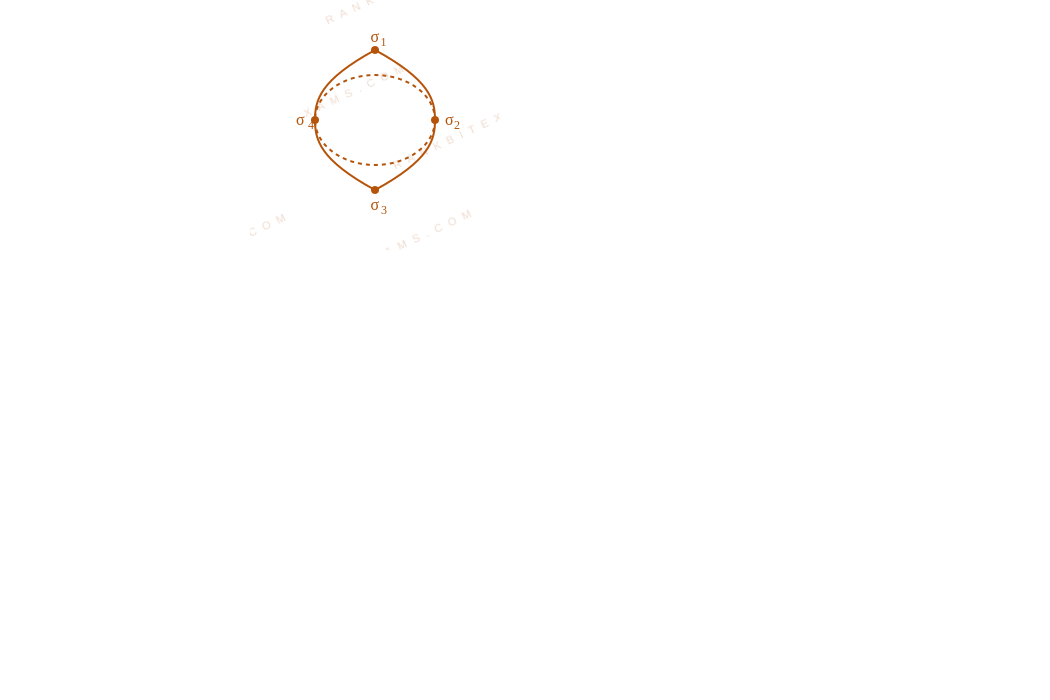
Electric charge is transferred to an irregular metallic disk as shown in figure. If σ₁, σ₂, σ₃ and σ₄ are charge densities at given points then, choose the correct answer from the options given below:
Conductors and Corona Discharge diagram for Q4 - JEE Main 2025 Evening
This diagram shows an irregular metallic conductor with numbered points 1, 2, 3, and 4 marking areas of different curvature along its perimeter.
(A) σ₁ > σ₃; σ₂ = σ₄ (B) σ₁ > σ₂; σ₃ > σ₄ (C) σ₁ > σ₃ > σ₂ = σ₄ (D) σ₁ < σ₃ < σ₂ = σ₄ (E) σ₁ = σ₂ = σ₃ = σ₄

Solution & Explanation

Related Formula
σ ∝ 1Rcurv

where, σ = surface charge density Rcurv = local radius of curvature at that point on the conductor's surface

Core Logic

On an irregular-shaped charged metallic conductor in electrostatic equilibrium:

  • The electric potential is identical at all points on the surface.
  • However, the surface charge density σ is not uniform. It is highest at points where the surface is highly curved (sharper corners) and lowest where the surface is flatter.
  • Analyzing the radii of curvature (Rcurv) from the figure:

  • Point 1 is the sharpest corner (smallest radius of curvature): (Rcurv)₁
  • Point 3 is less sharp: (Rcurv)₃
  • Points 2 and 4 are symmetric flat regions of equal curvature: (Rcurv)₂ = (Rcurv)₄
  • Therefore, we have:

(Rcurv)₁ < (Rcurv)₃ < (Rcurv)₂ = (Rcurv)₄

Using the inverse relationship σ ∝ 1Rcurv:

σ₁ > σ₃ > σ₂ = σ₄
Step 1: Verification of Statements
  • Statement (A) σ₁ > σ₃; σ₂ = σ₄ is Correct.
  • Statement (B) σ₁ > σ₂; σ₃ > σ₄ is Correct (since σ₁ > σ₂ and σ₃ > σ₄).
  • Statement (C) σ₁ > σ₃ > σ₂ = σ₄ is Correct (most comprehensive description).
  • Therefore, statements A, B, and C are all true. Looking at the options, "A and C Only" is given as Option (2), and "A, B and C Only" is Option (1). As per the official key, the most appropriate correct option is A and C Only (or statement checking matches the answer key (2)).
Pattern Recognition

Sees: "Irregular charged metallic conductor" → Sharpest point has maximum charge density σ. Trap: Conductors have the same electric potential everywhere on their surface, but not the same electric field or surface charge density. Keep potential vs. charge density concepts separated! ✓

Chapter Mix

Class 12 Physics: Electrostatics

Reference Study Guides

More Electrostatics Previous-Year Questions — Page 2

Q42 jee_main_2026_22_january_morning Electric Potential and Field
Electric field in a region is given by E = Ax i + By j, where A = 10~V / m² and B = 5~V / m². If the electric potential at a point (10, 20) is 500~V, then the electric potential at origin is \_\_\_\_ V.
  • A. 1000
  • B. 500
  • C. 2000
  • D. 0

Solution

Related Formula
V₂ - V₁ = -∫ E · d r
Core Logic

Using potential difference relation:

500 - V₀ = -∫(0,0)(10,20) (10x i + 5y j) · (dx i + dy j) 500 - V₀ = -[5x² + (5y²)/(2)](0,0)(10,20) V₀ - 500 = 500 + 1000 V₀ = 2000 V
Pattern Recognition

Sees: Electric field vector function given, find potential at origin. Shortcut: Integrate line integral of electric field from origin to given point. Check: Matches option (3). ✓

Chapter Mix

Class 12 Physics: Electrostatics
Q43 jee_main_2026_22_january_morning Charged Pendulum in Electric Field
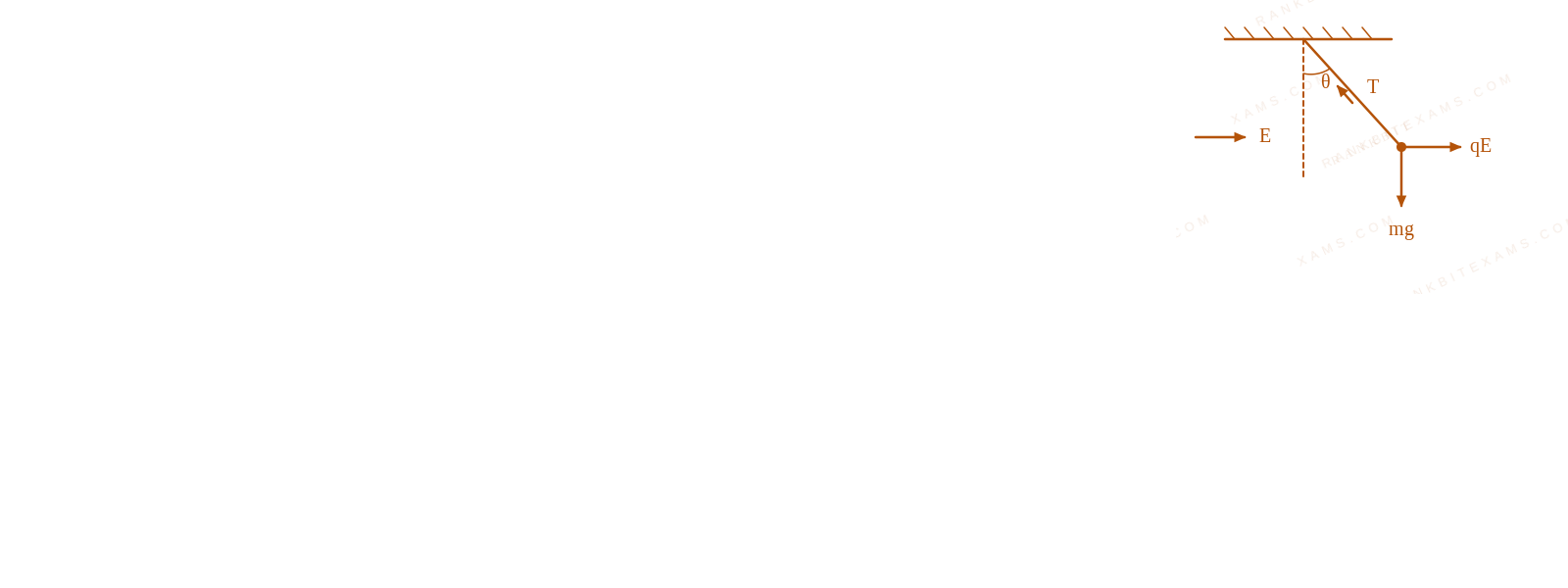
A simple pendulum has a bob with mass m and charge q. The pendulum string has negligible mass. When a uniform and horizontal electric field E is applied, the tension in the string changes. The final tension in the string, when pendulum attains an equilibrium position is \_\_\_\_. (g : acceleration due to gravity)
  • A. mg - qE
  • B. mg + qE
  • C. √(m²g² + q²E²)
  • D. √(m²g² - q²E²)

Solution

Related Formula
T = √((qE)² + (mg)²)
Core Logic

Solution pendulum diagram for Q43 - JEE Main 2026 Morning

At equilibrium, the effective forces acting on the bob are vertical gravitational force mg and horizontal electric force qE. The string tension balances the resultant of these orthogonal forces:

T = √((qE)² + (mg)²)
Pattern Recognition

Sees: Charged pendulum in horizontal electric field. Shortcut: Combine orthogonal forces (mg downwards and qE horizontally) via Pythagorean vector addition. Check: Matches option (3). ✓

Chapter Mix

Class 12 Physics: Electrostatics

Q30 jee_main_2026_22_january_evening Electric Potential of Coalescing Bubbles
Three small identical bubbles of water having same charge on each coalesce to form a bigger bubble. Then the ratio of the potentials on one initial bubble and that on the resultant bigger bubble is :
  • A. 1:31/3
  • B. 1:22/3
  • C. 32/3:1
  • D. 1:32/3

Solution

Related Formula
V = (kq)/(r) Volume Conservation: N · ((4)/(3)π r³) = (4)/(3)π R³
Core Logic

From volume conservation of 3 coalescing droplets:

3 ((4)/(3)π r³) = (4)/(3)π R³ R = 31/3r

Total charge on resultant bigger bubble Q = 3q.

Calculating initial potential Vᵢ and final potential Vf:

Vᵢ = (kq)/(r) Vf = (k(3q))/(R) = 3kq31/3r = 32/3 (kq)/(r)

Ratio of initial to final potential:

(Vᵢ)/(Vf) = 132/3 = 1 : 32/3

Coalescing charged bubbles diagram for Q30 - JEE Main 2026 Evening

Step 1: Final Conclusion

The ratio of potentials is 1 : 32/3.

Pattern Recognition

Coalescing droplets rule: For N identical drops, R = N1/3r and Q = Nq. Potential ratio Vᵢ / Vf = 1 / N2/3. For N=3, ratio is 1 / 32/3.

Chapter Mix

Class 12 Physics: Electrostatic Potential and Capacitance

Q42 jee_main_2026_22_january_evening Electric Field and Potential of Polygon of Charges
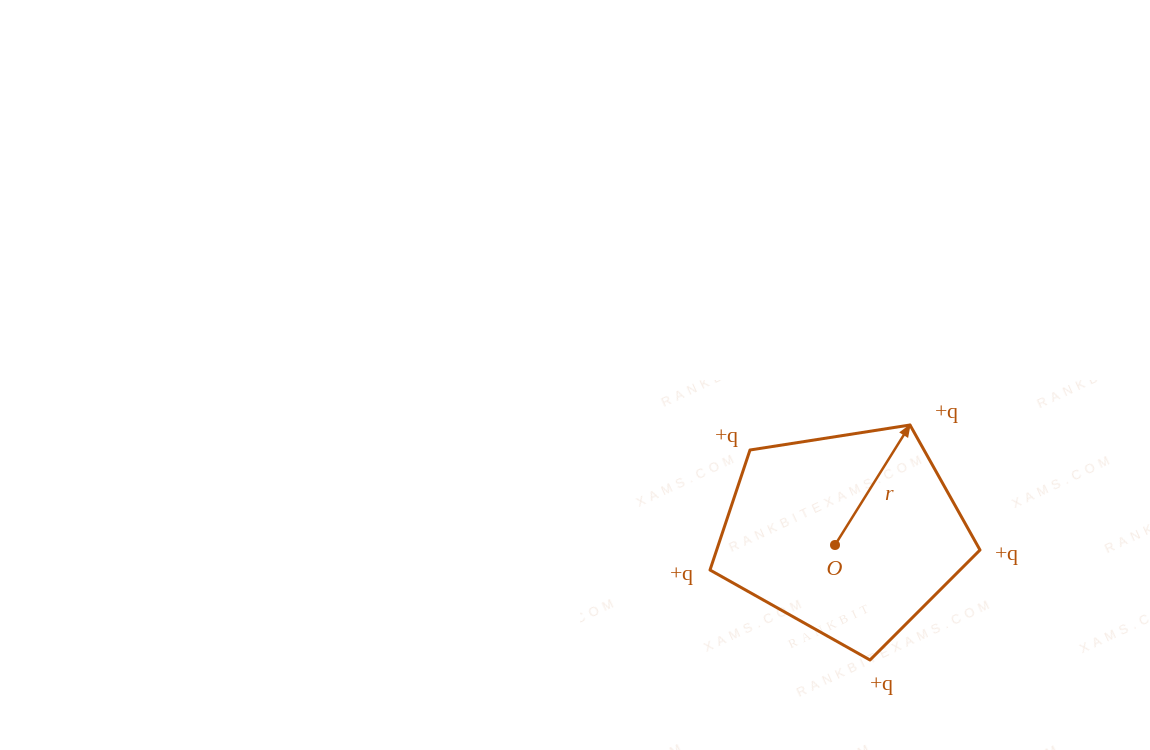
Five positive charges each having charge q are placed at the vertices of a pentagon as shown in the figure. The electric potential (V) and the electric field (E) at the center O of the pentagon due to these five positive charges are :
Regular pentagon charged vertices diagram for Q42 - JEE Main 2026 Evening
The figure illustrates a regular pentagon with five equal positive charges q placed at each vertex at distance r from center O.
  • A. V = (5q)/(4πε₀r) and E = 0
  • B. V = 5q4πε₀r and E = 5√(3)q8πε₀r² r
  • C. V = (5q)/(4πε₀r) and E = (5q)/(4πε₀r²) r
  • D. V = 0 and E = 0

Solution

Related Formula
V = Σ (k qᵢ)/(r) Ecenter = Σ Eᵢ = 0 (Symmetric Polygon)
Core Logic

Due to spatial symmetry of identical charges at the 5 vertices of a regular pentagon, vector sum of electric fields at center O cancels out:

E = 0

Electric potential is a scalar sum:

V = 5 × ((q)/(4πε₀ r)) = (5q)/(4πε₀ r)
Step 1: Final Conclusion

Option (1) gives the correct values V = (5q)/(4πε₀r) and E = 0.

Pattern Recognition

Symmetry rule: Identical charges at vertices of any regular polygon Ecenter = 0. Potential is scalar addition V = N (kq)/(r).

Chapter Mix

Class 12 Physics: Electrostatics
Q48 jee_main_2026_22_january_evening Sharing of Charges between Capacitors
A capacitor P with capacitance 10 × 10⁻⁶ F is fully charged with a potential difference of 6.0 V and disconnected from the battery. The charged capacitor P is connected across another capacitor Q with capacitance 20 × 10⁻⁶ F. The charge on capacitor Q when equilibrium is established will be α × 10⁻⁵ C (assume capacitor Q does not have any charge initially), the value of α is ____.
Numerical Answer. Answer: 4 to 4

Solution

Related Formula
Vcommon = (C₁ V₁ + C₂ V₂)/(C₁ + C₂) Q₂ = C₂ Vcommon
Core Logic

Given C₁ = 10 × 10⁻⁶ ~F, V₁ = 6.0 ~V and C₂ = 20 × 10⁻⁶ ~F, V₂ = 0 ~V:

Vcommon = 10⁻⁵ × 6 + 010⁻⁵ + 2 × 10⁻⁵ = 6 × 10⁻⁵3 × 10⁻⁵ = 2 ~V

Calculating final charge on capacitor Q (C₂):

Q₂ = C₂ Vcommon = (20 × 10⁻⁶ ~F) × 2 ~V = 40 × 10⁻⁶ ~C = 4 × 10⁻⁵ ~C

Comparing with α × 10⁻⁵ ~C α = 4.

Step 1: Final Conclusion

The value of α is 4.

Pattern Recognition

Charge distribution rule: Total initial charge Qtotal = C₁ V₁ = 60. Final charge splits in proportion to capacitance ratio C₂ / (C₁+C₂) = 2/3. Q₂ = (2/3) × 60 = 40 = 4 × 10⁻⁵~C.

Chapter Mix

Class 12 Physics: Electrostatic Potential and Capacitance

More Electrostatics Questions — jee_main_2025_08_april_evening

Practice all Electrostatics previous-year questions →

Rankbit System
JEE Physics: Waves (+15.5%) | Electrostatics: Concentric Shells (-29.7%) | Modern Physics: Photoelectric Clones (+34.2%) | Mathematics: Definite Integrals (+18.1%) | Chemistry: Coordination Splitting (-11.4%) | JEE Physics: Waves (+15.5%) | Electrostatics: Concentric Shells (-29.7%) | Modern Physics: Photoelectric Clones (+34.2%) | Mathematics: Definite Integrals (+18.1%) | Chemistry: Coordination Splitting (-11.4%)
