JEE Main · Chemistry → Steady

Electrochemistry appeared 40 times across 3 years — 4.7% of Chemistry. This question is from Nernst Equation.

Year 2026 2025 2024 Total
Questions 13 19 8 40

Consider the following half-cell reduction reaction: Cr₂O₇²⁻(aq) + 6e^- + 14H^+(aq) 2Cr³⁺(aq) + 7H₂O(l) The process is conducted with a concentration ratio of [Cr³⁺]²[Cr₂O₇²⁻] = 10⁻⁶. The specific pH value at which the EMF (E) of this reduction half-cell becomes exactly zero is _________ (as the nearest integer value). Given parameters: E^°Cr₂O₇²⁻/Cr³⁺ = 1.33 V and (2.303RT)/(F) = 0.059 V.

Numerical Answer Type:
Enter a numerical value Answer: 10 to 10 +4 marks

Solution & Explanation

Related Formula

The Nernst equation for a reduction half-cell is:

E = E^° - (2.303RT)/(nF) Q

For this reaction, the reaction quotient Q is:

Q = [Cr³⁺]²[Cr₂O₇²⁻] · [H^+]¹⁴
Execution

Step 1: Identify the number of transferred electrons (n = 6) and substitute the condition E = 0:

0 = 1.33 - (0.059)/(6) ( 10⁻⁶[H^+]¹⁴ )

Step 2: Isolate the logarithmic term:

1.33 = (0.059)/(6) [ (10⁻⁶) - ([H^+]¹⁴) ] (1.33 × 6)/(0.059) = -6 - 14 [H^+]

Step 3: Perform the arithmetic division:

135.254 = -6 - 14 [H^+]

Step 4: Rearrange the terms using the definition of pH (- [H^+] = pH):

135.254 + 6 = 14 · pH 141.254 = 14 · pH pH = (141.254)/(14) = 10.089

Rounding to the nearest integer value gives 10.

Pattern Recognition

The exponent of the hydrogen ion concentration ([H^+]¹⁴) heavily influences the cell potential. A small shift in pH causes a large change in EMF due to this factor of 14, which explains why the potential drops to zero even in a highly basic environment (pH ≈ 10).

Chapter Mix

Class 12 Chemistry: Electrochemistry Class 11 Chemistry: Ionic Equilibrium

Reference Study Guides

More Electrochemistry Previous-Year Questions — Page 2

Q71 jee_main_2026_22_january_evening Nernst Equation and Anodic Oxygen Evolution
Consider the following electrochemical cell: Pt O₂(g) (1 bar) HCl(aq) M²⁺(aq, 1.0 M) M(s) The pH above which, oxygen gas would start to evolve at anode is ____ (nearest integer). Given: E⁰M²⁺/M = 0.994 V, E⁰O₂/H₂O = 1.23 V standard reduction potential and (RT)/(F)(2.303) = 0.059 V at the given condition
Numerical Answer. Answer: 4 to 4

Solution

Related Formula
Ecell = ERed(cathode) + EOxi(anode) > 0 EOxi(anode) = -E⁰O₂/H₂O - (0.059)/(2) ([H^+]² PO₂1/2)
Core Logic

Step 1: Set spontaneous cell reaction threshold (Ecell = 0):

EOxi(anode) = -ERed(cathode) = -0.994 V

Step 2: Anodic reaction:

H₂O arrow 2H^+ + (1)/(2)O₂ + 2e^- EOxi = -1.23 - (0.059)/(2) ([H^+]² × 11/2) = -1.23 + 0.059 × pH

Step 3: Equate oxidation potential:

-0.994 = -1.23 + 0.059 × pH 0.059 × pH = 0.236 pH = (0.236)/(0.059) = 4
Pattern Recognition

Sees: Minimum pH for gas evolution at anode. Shortcut: Apply Ecell = 0 threshold equation -0.994 = -1.23 + 0.059 pH pH = 4.

Chapter Mix

Class 12 Chemistry: Electrochemistry
Q55 jee_main_2026_23_january_morning Nernst Equation and Cell Potential
In the given electrochemical cell, Ag(s)|AgCl(s)|Cl⁻(aq) || FeCl₂(aq), FeCl₃(aq)|Pt(s) at 298 K, the cell potential (Ecell) will increase when : (A) Concentration of Fe²⁺ is increased. (B) Concentration of Fe³⁺ is decreased. (C) Concentration of Fe²⁺ is decreased. (D) Concentration of Fe³⁺ is increased. (E) Concentration of Cl⁻ is increased. Choose the correct answer from the options given below :
  • A. A and B only
  • B. A and E only
  • C. B only
  • D. C, D and E only

Solution

Related Formula
Ecell = E°cell - (0.059)/(n) Q
Core Logic

First, write the complete balanced cell reaction. At Anode (Oxidation): Ag(s) + Cl^-(aq) arrow AgCl(s) + e^- At Cathode (Reduction): Fe³⁺(aq) + e^- arrow Fe²⁺(aq)

Overall cell reaction:

Ag(s) + Cl^-(aq) + Fe³⁺(aq) arrow AgCl(s) + Fe²⁺(aq)
Step 1: Applying the Nernst Equation

Applying the Nernst equation at 298 K with n = 1:

Ecell = E°cell - (0.059)/(1) [Fe²⁺][Cl^-][Fe³⁺]
Step 2: Analysis of Variables

To increase Ecell, the value of the logarithmic term [Fe²⁺][Cl^-][Fe³⁺] must decrease. This happens if the numerator decreases or the denominator increases.

  • Decreasing [Fe²⁺] (Statement C)
  • Increasing [Fe³⁺] (Statement D)
  • Increasing [Cl^-] (Statement E)
  • Thus, statements C, D, and E will increase the cell potential.

Pattern Recognition

Nernst equation trick: Ecell increases when product concentrations decrease or reactant concentrations increase (Le Chatelier's perspective of pushing the forward reaction).

Chapter Mix

Class 12 Chemistry: Electrochemistry

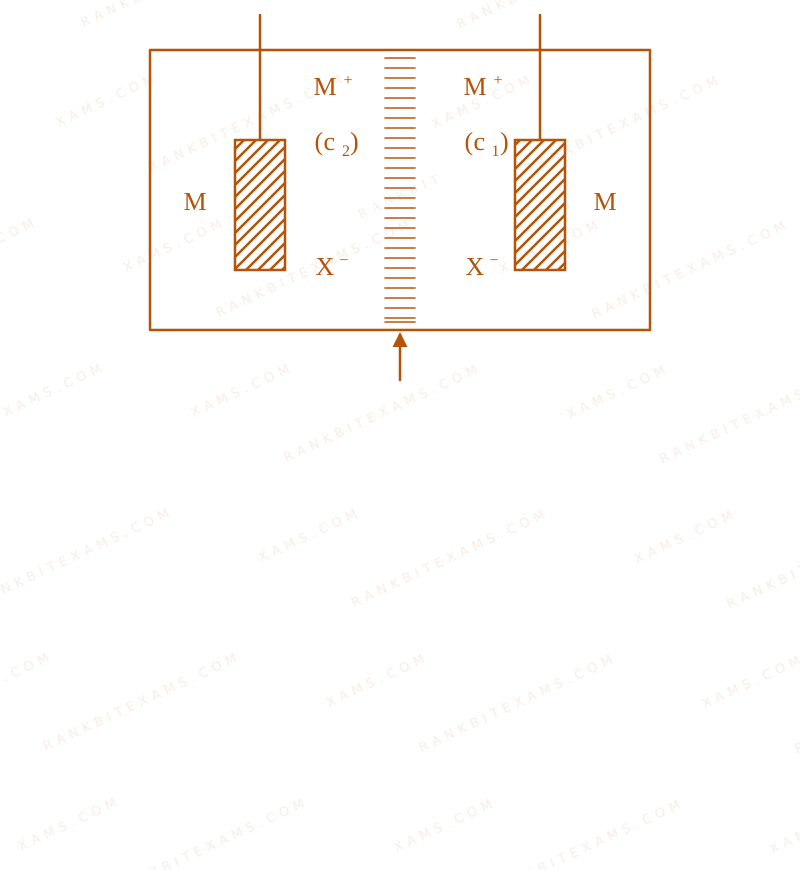
Q53 jee_main_2026_23_january_evening Concentration Cells
Concentration Cells diagram for Q53 - JEE Main 2026 Evening
Diagram of a concentration cell with two M electrodes dipping into M+ solutions of concentrations c1 and c2.
Consider the above electrochemical cell where a metal electrode (M) is undergoing redox reaction by forming M⁺ (M arrow M⁺ + e⁻). The cation M⁺ is present in two different concentrations c₁ and c₂ as shown above. Which of the following statement is correct for generating a positive cell potential?
  • A. If c₁ is present at anode, then c₁ = c₂
  • B. If c₁ is present at cathode, then c₁ < c₂
  • C. If c₁ is present at cathode, then c₁ > c₂
  • D. If c₁ is present at anode, then c₁ > c₂

Solution

Related Formula
Ecell = E°cell - (0.0591)/(n) Q

For a concentration cell, E°cell = 0, so:

Ecell = - (0.0591)/(n) ( [Anode][Cathode] )
Core Logic

For a concentration cell to have a positive cell potential (Ecell > 0), the ratio [Anode][Cathode] must be less than 1. This implies that [Anode] < [Cathode].

Let's evaluate the given conditions:

Case 1: If c₁ is at the anode. Then c₂ is at the cathode. Cell reaction: M(s) + M⁺(c₂) arrow M(s) + M⁺(c₁)

Ecell = -0.059 (c₁)/(c₂)

For Ecell > 0, we need c₁ < c₂. Option 1 says c₁ = c₂ (Incorrect). Option 4 says c₁ > c₂ (Incorrect).

Step 1: Check Cathode Conditions

Case 2: If c₁ is at the cathode. Then c₂ is at the anode. Cell reaction: M(s) + M⁺(c₁) arrow M(s) + M⁺(c₂)

Ecell = -0.059 (c₂)/(c₁)

For Ecell > 0, we need (c₂)/(c₁) < 1 c₂ < c₁ c₁ > c₂. Option 2 says c₁ < c₂ (Incorrect). Option 3 says c₁ > c₂ (Correct).

Pattern Recognition

In any spontaneous concentration cell, ions flow from the higher concentration compartment to the lower concentration compartment. Thus, for a positive voltage, the cathode must always have the higher concentration.

Chapter Mix

Class 12 Chemistry: Electrochemistry

Q71 jee_main_2026_24_january_morning Faraday's Laws of Electrolysis
Electricity is passed through an acidic solution of Cu²⁺ till all the Cu²⁺ was exhausted, leading to the deposition of 300 mg of Cu metal. However, a current of 600 mA was continued to pass through the same solution for another 28 minutes by keeping the total volume of the solution fixed at 200 mL. The total volume of oxygen evolved at STP during the entire process is ____ mL. (Nearest integer) [Given : Cu²⁺(aq)+2e⁻ arrow Cu(s) Ered⁰ = +0.34 V O₂(g)+4H^++4e⁻ arrow 2H₂O Ered⁰ = +1.23 V Molar mass of Cu = 63.54 g mol⁻¹ Molar mass of O₂ = 32 g mol⁻¹ Faraday Constant = 96500 C mol⁻¹ Molar volume at STP = 22.4 L ]
Numerical Answer. Answer: 111 to 111

Solution

Related Formula
Equivalents of metal deposited = Equivalents of gas evolved (in Phase 1) ne^- = (Q)/(F) = (I × t)/(96500)
Core Logic

Phase 1: Deposition of 300 mg Cu. By Faraday's Laws, the equivalents of copper deposited at the cathode must equal the equivalents of oxygen evolved at the anode during this period. Equivalents of Cu = (W)/(E) = 300 × 10⁻³(63.54)/(2) Equivalents of O₂ = nO₂ × 4 300 × 10⁻³ × 263.54 = nO₂ × 4 2.36 × 10⁻³ = nO₂ (moles of O₂ in Phase 1)

Phase 2: Current continued. I = 600 mA = 0.6 A, t = 28 mins = 28 × 60 seconds. Moles of electrons passed = (0.6 × 28 × 60)/(96500) = 0.010445 moles of e⁻ Equivalents of O₂ evolved in Phase 2 = Moles of e⁻ passed = 0.010445 nO₂ (Phase 2) = (0.010445)/(4) = 2.611 × 10⁻³ mol

Step 1: Calculate Total Volume of Oxygen

Total moles of O₂ evolved = (2.36 × 10⁻³) + (2.611 × 10⁻³) = 4.971 × 10⁻³ mol

Total volume at STP: VO₂ = ntotal × 22400 mL VO₂ = 4.971 × 10⁻³ × 22400 mL = 111.35 mL Rounding to nearest integer 111 mL.

Pattern Recognition

Equivalents of products at cathode and anode are always equal in any given time span. Valency factor for O₂ evolution from water is 4.

Chapter Mix

Class 12 Chemistry: Electrochemistry

Q74 jee_main_2026_24_january_evening Kohlrausch's Law and its Applications
Molar conductivity of a weak acid HQ of concentration 0.18 M was found to be 1/30 of the molar conductivity of another weak acid HZ with concentration of 0.02 of M. If λQ⁻⁰ happened to be equal with λZ⁻⁰ , then the difference of the pKₐ values of the two weak acids ( pKₐ(HQ) - pKₐ(HZ) ) is ____ (Nearest integer). [Given : degree of dissociation ( α ) << 1 for both weak acids, λ° : limiting molar conductivity of ions]
Numerical Answer. Answer: 2 to 2

Solution

Related Formula
α = λmλm∞ Kₐ C α² (for α ll 1)
Core Logic

For weak acid HQ: α₁ = λm(HQ)λm∞(HQ) Kₐ(HQ) = C₁ α₁² = 0.18 ( λm(HQ)λm∞(HQ))²

For weak acid HZ: α₂ = λm(HZ)λm∞(HZ) Kₐ(HZ) = C₂ α₂² = 0.02 ( λm(HZ)λm∞(HZ))²

Step 1: Evaluate Ratios

Since limiting molar conductivities of anions λQ^-⁰ and λZ^-⁰ are equal, and both have H^+ as the cation: λm∞(HQ) = λm∞(HZ)

Take the ratio of their ionization constants:

Kₐ(HQ)Kₐ(HZ) = (C₁)/(C₂) · [ λm(HQ)λm(HZ) ]²

We are given λm(HQ) = (1)/(30) λm(HZ), so the ratio inside the bracket is (1)/(30).

Kₐ(HQ)Kₐ(HZ) = (0.18)/(0.02) × ((1)/(30))² Kₐ(HQ)Kₐ(HZ) = 9 × (1)/(900) = (1)/(100)
Step 2: Logarithmic Difference

Taking the negative logarithm on both sides:

- ( Kₐ(HQ)Kₐ(HZ)) = - (10⁻²) pKₐ(HQ) - pKₐ(HZ) = 2
Pattern Recognition

When λₐₙᵢₒₙ⁰ is identical for both acids, λm^∞ cancels out entirely in comparative ratios. Use Kₐ = C · (λm / λm^∞)² directly.

Chapter Mix

Class 12 Chemistry: Electrochemistry Class 11 Chemistry: Equilibrium

More Electrochemistry Questions — jee_main_2025_08_april_evening

Practice all Electrochemistry previous-year questions →

Rankbit System
JEE Physics: Waves (+15.5%) | Electrostatics: Concentric Shells (-29.7%) | Modern Physics: Photoelectric Clones (+34.2%) | Mathematics: Definite Integrals (+18.1%) | Chemistry: Coordination Splitting (-11.4%) | JEE Physics: Waves (+15.5%) | Electrostatics: Concentric Shells (-29.7%) | Modern Physics: Photoelectric Clones (+34.2%) | Mathematics: Definite Integrals (+18.1%) | Chemistry: Coordination Splitting (-11.4%)