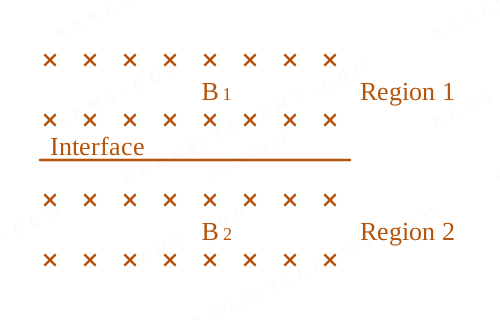
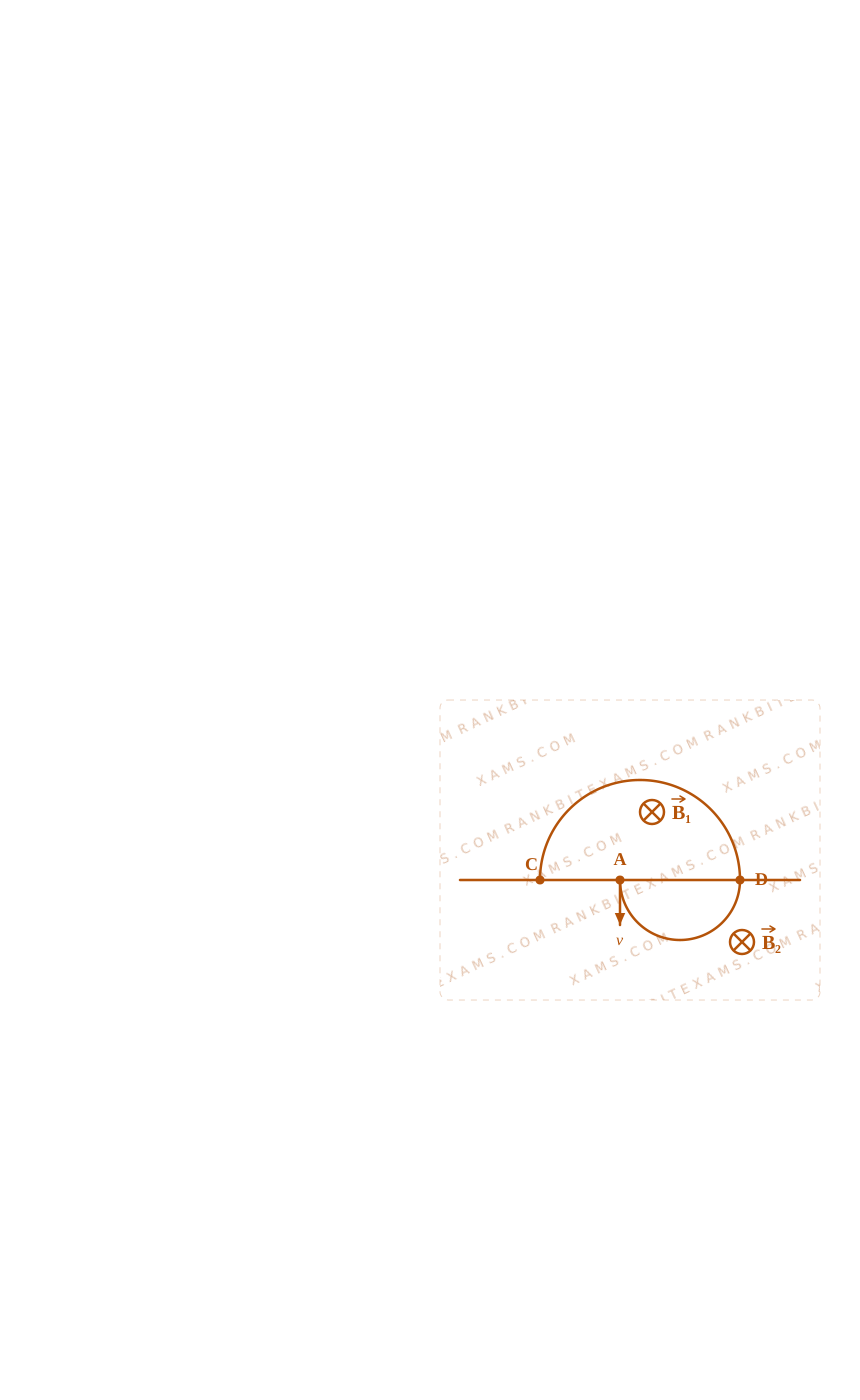
Uniform magnetic fields of different strengths (mathrmB_1 and mathrmB_2) , both normal to the plane of the paper exist as shown in the figure. A charged particle of mass m and charge q , at the interface at an instant, moves into the region 2 with velocity v and returns to the interface. It continues to move into region 1 and finally reaches the interface. What is the displacement of the particle during this movement along the interface?
Motion of Charged Particle in Magnetic Field
(Consider the velocity of the particle to be normal to the magnetic field and mathrmB_2 > mathrmB_1 )

Solution & Explanation

### Related Formula The radius of a circular trajectory of a charged particle in a uniform magnetic field perpendicular to its velocity is: R = fracmvqB ### Core Logic textStarting point rightarrow textA textEnding point rightarrow textC therefore textNet displacement = textAC textAC = textCD - textAD textAC = frac2mvqB_1 - frac2mvqB_2 textAC = frac2mvqB_1 left[ 1 - fracB_1B_2 right] ### Pattern Recognition Sees: Particle traversing two different perpendicular fields across an interface. Shortcut: The displacement on completing a loop across a boundary between two fields always equals 2(R_textlarge - R_textsmall). Factoring out the term with B_1 in the denominator leaves the factor left(1 - B_1/B_2right). ### Evaluation Rubric / Model Answer null ### Chapter Mix Class 12 Physics: Moving Charges and Magnetism
Interface path and circular orbits layout

More Moving Charges and Magnetism Previous-Year Questions — Page 2

Q21 jee_main_2025_29_jan_evening Ampere's Circuital Law and Solenoid
The magnetic field inside a 200 turns solenoid of radius 10mathrm~cm is 2.9 times 10^-4 Tesla. If the solenoid carries a current of 0.29mathrm~A , then the length of the solenoid is ______ pi mathrm~cm.
Numerical Answer. Answer: 8 to 8

Solution

### Related Formula B = mu_0 n I = mu_0 left(fracNellright) I where, B = magnetic field inside the solenoid N = total number of turns ell = length of the solenoid I = current inside the wire ### Core Logic Assuming a long standard solenoid, express the formula to solve for length ell: ell = fracmu_0 N IB Substitute the given numeric parameters: ell = frac(4pi times 10^-7) times 200 times 0.292.9 times 10^-4 ell = frac4pi times 10^-7 times 200 times 0.2929 times 10^-5 = 8pi times 10^-2 mathrm~m = 8pi mathrm~cm Since the target unit suffix is specified as pi mathrm~cm, the missing integer coefficient is exactly 8. ### Pattern Recognition Radius (10mathrm~cm) serves as dummy unneeded information for the idealized long solenoid expression. Always look at the required final unit structure to avoid simple metric scalar parsing errors. ### Evaluation Rubric / Model Answer null ### Chapter Mix Class 12 Physics: Moving Charges and Magnetism
Q6 jee_main_2025_28_jan_morning Magnetic Force on a Charged Particle
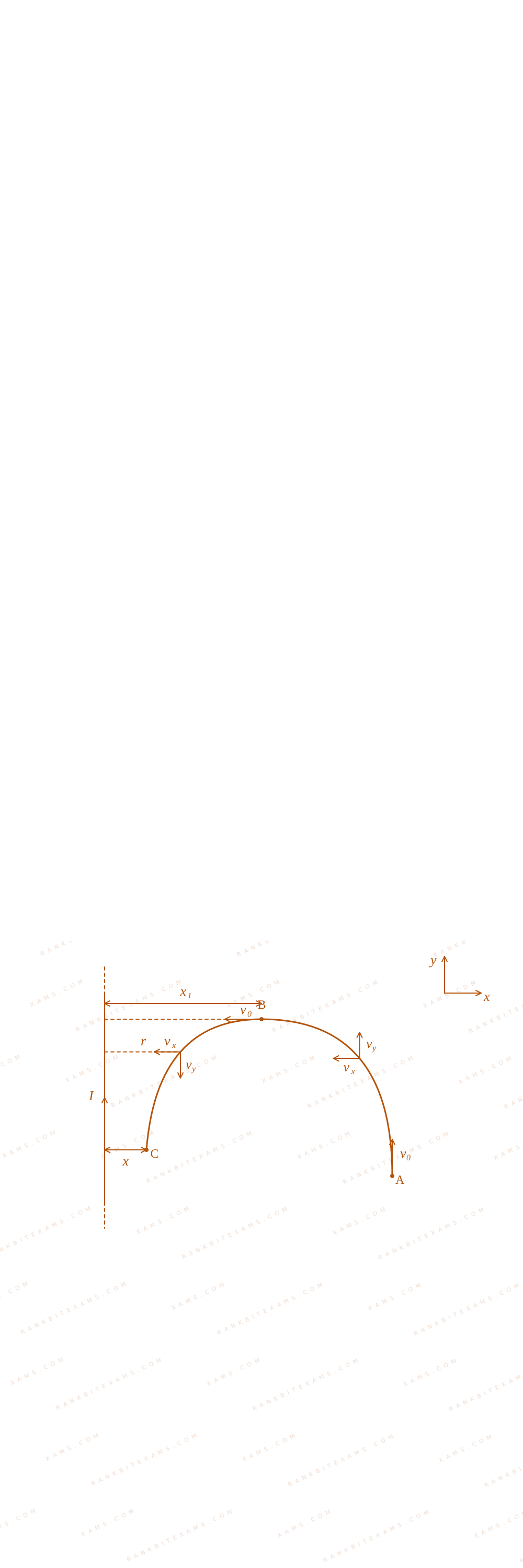
Consider a long thin conducting wire carrying a uniform current I. A particle having mass "M" and charge "q" is released at a distance "a" from the wire with a speed mathbfv_0 along the direction of current in the wire. The particle gets attracted to the wire due to magnetic force. The particle turns round when it is at distance mathbfx from the wire. The value of mathbfx is [mu_0 is vacuum permeability]
  • A. aleft[1 - fracmv_o2qmu_oIright]
  • B. fraca2
  • C. mathrmaleftlbrack 1 - fracmathrmmv_mathrmomathrmqmu _mathrmomathrmIrightrbrack
  • D. mathrmae^frac-4pi mnu_oqmu_oI

Solution

### Core Logic Analyzing motion from path phases mathrmA rightarrow mathrmB and mathrmB rightarrow mathrmC inside the coordinate field:
Coordinate trajectory analysis path diagram for Q6
vecmathrmB = fracmu_0 mathrmI2pi mathrmr(-hatmathrmk) The lorentz magnetic field acceleration rules dictate differential trajectory steps: int_v_0^0 fracv_x dv_xsqrtv_0^2 - v_x^2 = -fracmu_0 mathrmI q2pi mathrmm int_a^x_1 fracdrr Solving this integration step gives the position node parameter: x_1 = a e^-frac2pi m v_0mu_0 I q Compounding this loop interaction for the turning path phase mathrmB rightarrow mathrmC gives: ### Step 1: Final Solution Integration x = x_1 e^-frac2pi m v_0mu_0 I q = a e^-frac4pi m v_0mu_0 I q Matches criteria for option (4). ### Pattern Recognition Variable magnetic field cross-products result in dual exponential scaling metrics. Remember the total velocity magnitude stays fixed under zero work magnetic operations. ### Evaluation Rubric / Model Answer null ### Chapter Mix Class 12 Physics: Moving Charges and Magnetism
Q21 jee_main_2025_04_april_evening Motion in a Magnetic Field
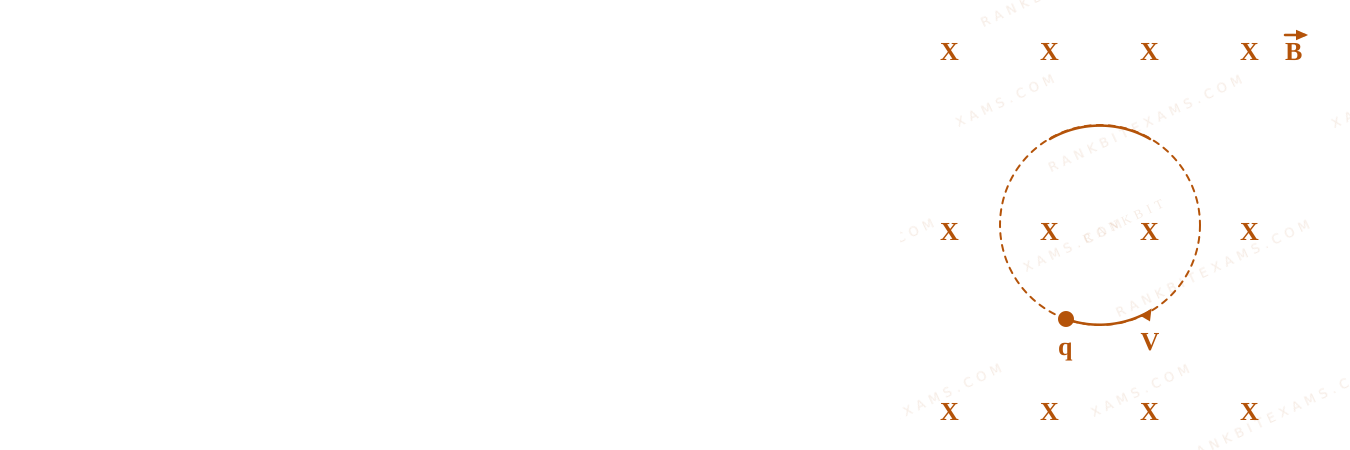
A particle of charge 1.6 µC and mass 16 µg is present in a strong magnetic field of 6.28 T. The particle is then fired perpendicular to magnetic field. The time required for the particle to return to original location for the first time is ________ s. (Take pi=3.14)
Numerical Answer. Answer: 0 to 0

Solution

### Related Formula Time Period of circular motion in a magnetic field: T = frac2pi mqB ### Core Logic Convert given parameter values into SI baseline metrics: q = 1.6\ mutextC = 1.6 times 10^-6text C m = 16\ mutextg = 16 times 10^-9text kg B = 6.28text T = 2pitext T ### Step 1: Solve for Time Period T = frac2pi times 16 times 10^-91.6 times 10^-6 times 6.28 = frac6.28 times 16 times 10^-91.6 times 10^-6 times 6.28 T = frac16 times 10^-91.6 times 10^-6 = 10 times 10^-3 = 0.01text seconds Rounding to the nearest integer as required for standard integer formatting gives **0**.
Circular trajectory of a charged particle in a magnetic field
### Pattern Recognition Check your prefixes. Micrograms (mutextg) conversion introduces a factor of 10^-9text kg, not 10^-6. If nearest integer is requested, 0.01text s rounds down cleanly to 0. ### Evaluation Rubric / Model Answer null ### Chapter Mix Class 12 Physics: Moving Charges and Magnetism
Q3 jee_main_2025_24_jan_evening Magnetic Force on a Charge
Given below are two statements. One is labelled as Assertion (A) and the other is labelled as Reason (R). Assertion (A): An electron in a certain region of uniform magnetic field is moving with constant velocity in a straight line path. Reason (R): The magnetic field in that region is along the direction of velocity of the electron. In the light of the above statements, choose the correct answer from the options given below:
  • A. (A) is false but (R) is true
  • B. Both (A) and (R) are true and (R) is the correct explanation of (A)
  • C. Both (A) and (R) are true but (R) is NOT the correct explanation of (A)
  • D. (A) is true but (R) is false

Solution

### Related Formula vecF = q(vecv times vecB) ### Core Logic For a particle to move with a constant velocity in a straight line inside a magnetic field alone, the net magnetic force must be zero: vecF = 0 implies vecv parallel vecB This means the angle theta between the velocity vector and the magnetic field vector is either 0^circ or 180^circ. Thus, if the magnetic field is along the direction of velocity, the force is zero, allowing unaccelerated straight-line motion. Both Assertion and Reason are true, and the Reason correctly explains the Assertion. ### Pattern Recognition Magnetic field cannot change the speed of a charged particle, but it changes direction unless vecv is parallel or anti-parallel to vecB, in which case the magnetic force vanishes entirely. ### Evaluation Rubric / Model Answer null ### Chapter Mix Class 12 Physics: Moving Charges and Magnetism
Q5 jee_main_2025_24_jan_evening Ampere's Circuital Law
A long straight wire of a circular cross-section with radius 'a' carries a steady current I. The current I is uniformly distributed across this cross-section. The plot of magnitude of magnetic field B with distance r from the centre of the wire is given by:
  • A. Graph (1)
  • B. Graph (2)
  • C. Graph (3)
  • D. Graph (4)

Solution

### Related Formula B_textin = fracmu_0 I r2pi a^2 implies B_textin propto r B_textout = fracmu_0 I2pi r implies B_textout propto frac1r ### Core Logic Inside the wire (r < a), the magnetic field grows linearly with distance r from the axis. At the surface (r = a), it reaches its maximum value B_textmax = fracmu_0 I2pi a. Outside the wire (r > a), it decays inversely with r. This combination matches the curve shown in Graph (1).
Ampere law plot variation for thick wire Q5
magnetic field variation, ampere law plot, current carrying wire
### Pattern Recognition Solid cylinder current profile: linear inside (B propto r), hyperbolic outside (B propto 1/r). ### Evaluation Rubric / Model Answer null ### Chapter Mix Class 12 Physics: Moving Charges and Magnetism

More Moving Charges and Magnetism Questions — jee_main_2025_07_april_morning

Practice all Moving Charges and Magnetism previous-year questions →

Rankbit System
JEE Physics: Waves (+15.5%) | Electrostatics: Concentric Shells (-29.7%) | Modern Physics: Photoelectric Clones (+34.2%) | Mathematics: Definite Integrals (+18.1%) | Chemistry: Coordination Splitting (-11.4%) | JEE Physics: Waves (+15.5%) | Electrostatics: Concentric Shells (-29.7%) | Modern Physics: Photoelectric Clones (+34.2%) | Mathematics: Definite Integrals (+18.1%) | Chemistry: Coordination Splitting (-11.4%)
