I. fracC_PC_V=frac53$\frac{C_{P}}{C_{V}}=\frac{5}{3}$
B. Diatomic non-rigid gas
II. fracC_PC_V=frac75$\frac{C_{P}}{C_{V}}=\frac{7}{5}$
C. Monoatomic gas
III. fracC_PC_V=frac43$\frac{C_{P}}{C_{V}}=\frac{4}{3}$
D. Diatomic rigid gas
IV. fracC_PC_V=frac97$\frac{C_{P}}{C_{V}}=\frac{9}{7}$
Choose the correct answer from the options given below:
A.A-III, B-IV, C-I, D-II
B.A-III, B-II, C-IV, D-I
C.A-II, B-IV, C-I, D-III
D.A-IV, B-II, C-III, D-I
Solution & Explanation
### Related Formula
The ratio of specific heats gamma$\gamma$ is related to degrees of freedom f$f$ by:
gamma = fracC_PC_V = 1 + frac2f$$\gamma = \frac{C_P}{C_V} = 1 + \frac{2}{f}$$
### Core Logic
Determine the degrees of freedom $
### Core Logic
Determine the degrees of freedom $f for each type of gas:
- **Monoatomic gas**: Translational only $ for each type of gas:
- **Monoatomic gas**: Translational only $\implies f = 3$
$gamma = 1 + frac23 = frac53 quad text(Matches C-I)$\gamma = 1 + \frac{2}{3} = \frac{5}{3} \quad \text{(Matches C-I)}$
- **Diatomic rigid gas**: Translational (3) + Rotational (2) $
- **Diatomic rigid gas**: Translational (3) + Rotational (2) $\implies f = 5$
$gamma = 1 + frac25 = frac75 quad text(Matches D-II)$\gamma = 1 + \frac{2}{5} = \frac{7}{5} \quad \text{(Matches D-II)}$
### Step 1: Check Remaining Categories
- **Diatomic non-rigid gas**: Translational (3) + Rotational (2) + Vibrational (2) $
### Step 1: Check Remaining Categories
- **Diatomic non-rigid gas**: Translational (3) + Rotational (2) + Vibrational (2) $\implies f = 7$
$gamma = 1 + frac27 = frac97 quad text(Matches B-IV)$\gamma = 1 + \frac{2}{7} = \frac{9}{7} \quad \text{(Matches B-IV)}$
- **Triatomic rigid gas**: Translational (3) + Rotational (3) $
- **Triatomic rigid gas**: Translational (3) + Rotational (3) $\implies f = 6$
$gamma = 1 + frac26 = 1 + frac13 = frac43 quad text(Matches A-III)$\gamma = 1 + \frac{2}{6} = 1 + \frac{1}{3} = \frac{4}{3} \quad \text{(Matches A-III)}$
This yields the matching order: A-III, B-IV, C-I, D-II.
### Pattern Recognition
Sees: Degrees of freedom and $
This yields the matching order: A-III, B-IV, C-I, D-II.
### Pattern Recognition
Sees: Degrees of freedom and $\gamma values.
Shortcut: Lower degrees of freedom result in higher $ values.
Shortcut: Lower degrees of freedom result in higher $\gamma values. Order of degrees of freedom: Monoatomic (3) < Diatomic rigid (5) < Triatomic rigid (6) < Diatomic non-rigid (7). Corresponding $ values. Order of degrees of freedom: Monoatomic (3) < Diatomic rigid (5) < Triatomic rigid (6) < Diatomic non-rigid (7). Corresponding $\gamma: $: $\frac{5}{3} > \frac{7}{5} > \frac{4}{3} > \frac{9}{7}$.
### Evaluation Rubric / Model Answer
null
### Chapter Mix
Class 11 Physics: Kinetic Theory
More Kinetic Theory Previous-Year Questions — Page 2
Q8jee_main_2025_04_april_eveningIdeal Gas Equation
There are two vessels filled with an ideal gas where volume of one is double the volume of other. The large vessel contains the gas at 8 kPa at 1000 K while the smaller vessel contains the gas at 7 kPa at 500 K. If the vessels are connected to each other by a thin tube allowing the gas to flow and the temperature of both vessels is maintained at 600 K, at steady state the pressure in the vessels will be (in kPa).
A. 4.4
B. 6
C. 24
D. 18
Solution
### Related Formula
Ideal Gas Law:
n = fracPVRT$$n = \frac{PV}{RT}$$
Conservation of moles:
n_1 + n_2 = n_f$n_1 + n_2 = n_f$
### Core Logic
Let the volume of the smaller vessel be V_1 = V$V_1 = V$, then the volume of the larger vessel is V_2 = 2V$V_2 = 2V$.
Initial moles in large vessel:
n_2 = frac8 times 2VR times 1000 = frac16V1000R$$n_2 = \frac{8 \times 2V}{R \times 1000} = \frac{16V}{1000R}$$
Initial moles in small vessel:
n_1 = frac7 times VR times 500 = frac14V1000R$$n_1 = \frac{7 \times V}{R \times 500} = \frac{14V}{1000R}$$
Total total initial moles:
n_texttotal = n_1 + n_2 = frac30V1000R$$n_{\text{total}} = n_1 + n_2 = \frac{30V}{1000R}$$
### Step 1: Connect Vessels to Dynamic Equilibrium
When connected, the total final volume is V_f = V + 2V = 3V$V_f = V + 2V = 3V$.
The final temperature is T_f = 600text K$T_f = 600\text{ K}$.
Using mole conservation:
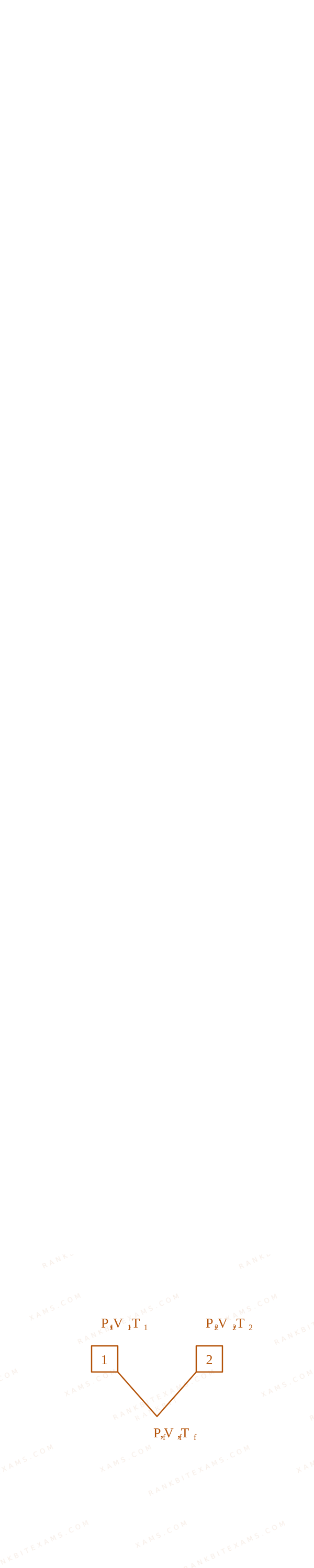
frac30V1000R = fracP_f (3V)R times 600$$\frac{30V}{1000R} = \frac{P_f (3V)}{R \times 600}$$frac301000 = frac3P_f600 implies frac301000 = fracP_f200$$\frac{30}{1000} = \frac{3P_f}{600} \implies \frac{30}{1000} = \frac{P_f}{200}$$P_f = frac30 times 2001000 = 6text kPa$$P_f = \frac{30 \times 200}{1000} = 6\text{ kPa}$$Dual vessel gas flow schema
### Pattern Recognition
Connecting chambers preserves the net mass/moles (sum n_i = textconstant$\sum n_i = \text{constant}$). Keep everything relative to a common volume multiplier V$V$ to easily cancel terms.
### Evaluation Rubric / Model Answer
null
### Chapter Mix
Class 11 Physics: Kinetic Theory
Q1jee_main_2025_04_april_morningMean Free Path and Collision Frequency
The mean free path and the average speed of oxygen molecules at 300mathrm~K$300\mathrm{~K}$ and 1mathrm~atm$1\mathrm{~atm}$ are 3 times 10^-7mathrm~m$3 \times 10^{-7}\mathrm{~m}$ and 600mathrm~m/s$600\mathrm{~m/s}$, respectively. Find the frequency of its collisions.
A.2 times 10^10/mathrms$2 \times 10^{10}/\mathrm{s}$
B.9 times 10^5/mathrms$9 \times 10^{5}/\mathrm{s}$
C.2 times 10^9/mathrms$2 \times 10^{9}/\mathrm{s}$
D.5 times 10^8/mathrms$5 \times 10^{8}/\mathrm{s}$
Solution
### Related Formula
f = frac1T = fracv_textavglambda$$f = \frac{1}{T} = \frac{v_{\text{avg}}}{\lambda}$$
where:
* f$f$ = frequency of collisions
* v_textavg$v_{\text{avg}}$ = average speed of the molecules
* lambda$\lambda$ = mean free path
### Core Logic
Given parameters:
* Average speed, v_textavg = 600mathrm~m/s$v_{\text{avg}} = 600\mathrm{~m/s}$
* Mean free path, lambda = 3 times 10^-7mathrm~m$\lambda = 3 \times 10^{-7}\mathrm{~m}$
### Step 1: Calculate Frequency
Substitute the values into the formula:
f = frac6003 times 10^-7 = 2 times 10^9mathrm~s^-1$$f = \frac{600}{3 \times 10^{-7}} = 2 \times 10^{9}\mathrm{~s}^{-1}$$
Hence, the collision frequency is 2 times 10^9/mathrms$2 \times 10^{9}/\mathrm{s}$.
### Pattern Recognition
Collision frequency is simply distance covered per unit time (average velocity) divided by the average distance between consecutive collisions (mean free path).
### Evaluation Rubric / Model Answer
null
### Chapter Mix
Class 11 Physics: Kinetic Theory
Q7jee_main_2025_07_april_eveningKinetic Energy of Gas Molecules
The helium and argon are put in the flask at the same room temperature (300 K).
The ratio of average kinetic energies (per molecule) of helium and argon is :
(Give: Molar mass of helium = 4 g/mol, Molar mass of argon =40~g/mol)$=40~g/mol)$ [cite: 74, 75, 76, 77]
A. 1:10 [cite: 79]
B. 10:1 [cite: 81]
C. 1: sqrt10$\sqrt{10}$ [cite: 80]
D. 1:1 [cite: 82]
Solution
### Related Formula
textK.E. = fracf2 k_B T$$\text{K.E.} = \frac{f}{2} k_B T$$ [cite: 688]
### Core Logic
The average kinetic energy per molecule depends only on the temperature T$T$ and the degrees of freedom f$f$ of the gas[cite: 75, 688]. Both Helium (mathrmHe$\mathrm{He}$) and Argon (mathrmAr$\mathrm{Ar}$) are monoatomic noble gases, meaning both share the same degrees of freedom (f = 3$f = 3$)[cite: 689]. Since they sit in the same flask at identical room temperature (T = 300\ textK$T = 300\ \text{K}$), their translational kinetic energies per molecule are exactly equal [cite: 74, 688]:
fractextK.E._mathrmHetextK.E._mathrmAr = frac11$$\frac{\text{K.E.}_{\mathrm{He}}}{\text{K.E.}_{\mathrm{Ar}}} = \frac{1}{1}$$ [cite: 688]
### Pattern Recognition
Do not get distracted by the molar masses given in the question stem[cite: 76, 77]. Kinetic energy per molecule is purely temperature-dependent for an ideal gas, unlike the root-mean-square velocity (v_textrms$v_{\text{rms}}$) which explicitly includes molecular weight.
### Evaluation Rubric / Model Answer
null
### Chapter Mix
Class 11 Physics: Kinetic Theory of Gases
Q4jee_main_2025_28_jan_eveningRMS Velocity
The ratio of vapour densities of two gases at the same temperature is frac425$\frac{4}{25}$ , then the ratio of r.m.s. velocities will be: [cite: 59-61]
A.frac254$\frac{25}{4}$
B.frac25$\frac{2}{5}$
C.frac52$\frac{5}{2}$
D.frac425$\frac{4}{25}$
Solution
### Related Formula
The root-mean-square (r.m.s.) velocity of gas molecules is given by:
v_textrms = sqrtfrac3RTM$$v_{\text{rms}} = \sqrt{\frac{3RT}{M}}$$
Since molecular weight M$M$ is directly proportional to the vapour density (rho$\rho$), the r.m.s. velocity is inversely proportional to the square root of its vapour density:
fracv_textrms1v_textrms2 = sqrtfracrho_2rho_1$$\frac{v_{\text{rms1}}}{v_{\text{rms2}}} = \sqrt{\frac{\rho_2}{\rho_1}}$$
### Core Logic
Given the ratio of vapour densities :
fracrho_1rho_2 = frac425$$\frac{\rho_1}{\rho_2} = \frac{4}{25}$$
Therefore, the ratio of their r.m.s. velocities is:
fracv_textrms1v_textrms2 = sqrtfrac254 = frac52$$\frac{v_{\text{rms1}}}{v_{\text{rms2}}} = \sqrt{\frac{25}{4}} = \frac{5}{2}$$
### Pattern Recognition
R.M.S. velocity changes inversely with the square root of mass or density. Whenever a density ratio is given, simply invert the fraction and take the square root to immediately find the velocity ratio.
### Evaluation Rubric / Model Answer
null
### Chapter Mix
Class 11 Physics: Kinetic Theory of Gases
Q5jee_main_2025_28_jan_eveningTranslational Kinetic Energy
The kinetic energy of translation of the molecules in 50 mathrm~g$50 \mathrm{~g}$ of mathrmCO_2$\mathrm{CO}_{2}$ gas at 17^circ mathrmC$17^{\circ} \mathrm{C}$ is :
A.3986.3 mathrmJ$3986.3 \mathrm{J}$
B.4102.8 mathrmJ$4102.8 \mathrm{J}$
C.4205.5 mathrm~J$4205.5 \mathrm{~J}$
D.3582.7 mathrmJ$3582.7 \mathrm{J}$
Solution
### Related Formula
The total translational kinetic energy of a gas sample depends only on the number of moles and absolute temperature, regardless of whether the molecule is monoatomic or polyatomic:
K.E._texttranslational = frac32 n R T$$K.E._{\text{translational}} = \frac{3}{2} n R T$$
### Core Logic
Given data:
* Mass of mathrmCO_2$\mathrm{CO}_2$ gas, m = 50 text g$m = 50 \text{ g}$
* Molar mass of mathrmCO_2$\mathrm{CO}_2$, M = 44 text g/mol$M = 44 \text{ g/mol}$
* Absolute Temperature, T = 17 + 273.15 = 290.15 text K$T = 17 + 273.15 = 290.15 \text{ K}$
* Universal gas constant, R approx 8.314 text J/(molcdottextK)$R \approx 8.314 \text{ J/(mol}\cdot\text{K)}$
Calculate total moles n$n$:
n = frac5044 approx 1.1364 text moles$$n = \frac{50}{44} \approx 1.1364 \text{ moles}$$
Substitute values into the expression :
K.E._texttranslational = frac32 times frac5044 times 8.314 times 290.15$$K.E._{\text{translational}} = \frac{3}{2} \times \frac{50}{44} \times 8.314 \times 290.15$$K.E._texttranslational = 1.5 times 1.1364 times 8.314 times 290.15 approx 4108.6 text J$$K.E._{\text{translational}} = 1.5 \times 1.1364 \times 8.314 \times 290.15 \approx 4108.6 \text{ J}$$
The closest matching value specified in the test alternatives is 4102.8 mathrmJ$4102.8 \mathrm{J}$.
### Pattern Recognition
A common mistake is using frac52nRT$\frac{5}{2}nRT$ or frac72nRT$\frac{7}{2}nRT$ because mathrmCO_2$\mathrm{CO}_2$ is a triatomic linear molecule. Remember that **translational** kinetic energy is always frac32nRT$\frac{3}{2}nRT$ for any gas sample, as translation has exactly 3 degrees of freedom regardless of the molecular layout.
### Evaluation Rubric / Model Answer
null
### Chapter Mix
Class 11 Physics: Kinetic Theory of Gases
More Kinetic Theory Questions — jee_main_2025_07_april_morning
We Map Every Repeating Question in Competitive Exams.
Say goodbye to generic mock test fatigue. RankBit uses smart analysis to group past exam questions into their foundational Repeating Question Types. Find chapter weightage, track repeating questions, and score higher with targeted practice.
Select Your Target Exam
Choose an exam track below to find formulas per chapter and patterns.
Syncing Exam Intelligence
Mapping formulas and patterns across all tracks…
PATH A — FULL LENGTH PRACTICE
Full Mock Test Hub
Simulate real NTA exam conditions with fully tracked mocks. Time yourself against past papers.
Practice past-year questions one chapter at a time. Pick an exam → subject → chapter and get every PYQ for that topic — pulled together from all past papers — with the chapter's key formulas alongside.