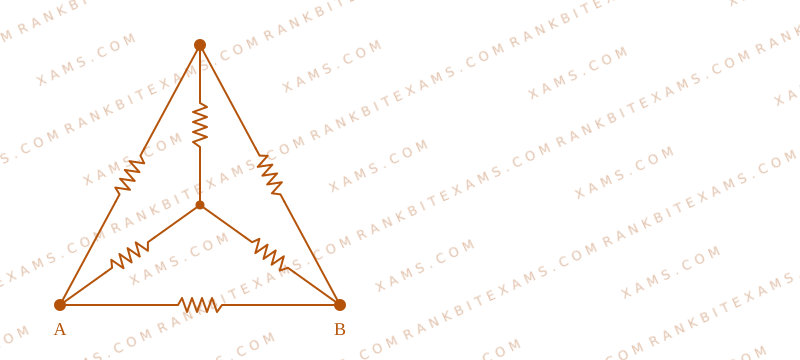
A wire of resistance R is bent into a triangular pyramid as shown in figure with each segment having same length. The resistance between points A and B is R/n. The value of n is :
Triangular pyramid resistor network for Q3 - JEE Main 2025 Morning
A triangular pyramid resistor network with terminals A and B marked, showing symmetry in the layout.

Solution & Explanation

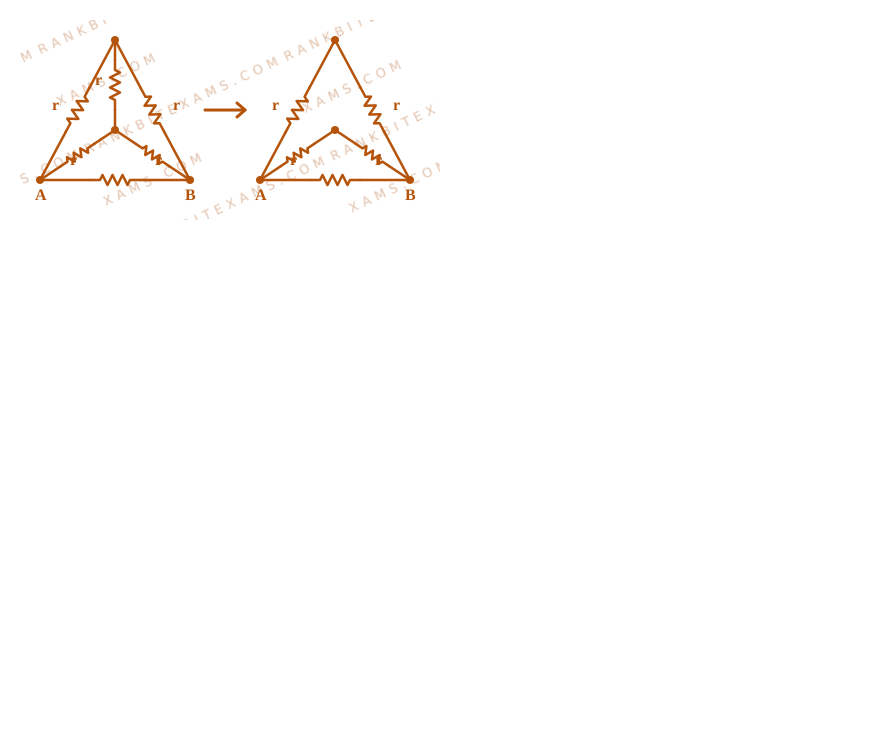
### Related Formula For a wire of total resistance R divided into N equal segments, the resistance of each segment r is: r = fracRN For a balanced Wheatstone bridge with resistors of resistance r, the central arm can be neglected because no current flows through it. ### Core Logic The triangular pyramid has 6 segments of equal length. Since the total resistance of the wire is R: r = fracR6 Let the four vertices of the pyramid be A, B, C, and D. Terminals are at A and B. The segments are: - AB (direct path between terminals, resistance r) - AC, BC, AD, BD (forming a closed quadrilateral network between A and B with bridge arm CD) - CD (bridge arm connecting the midpoints, resistance r) ### Step 1: Simplify the Network By symmetry, the potentials at C and D are equal when a voltage is applied across A and B. Thus, the bridge is balanced, and no current flows through the segment CD. We can remove segment CD from the calculations: - The path A to C to B consists of two resistors in series: r + r = 2r. - The path A to D to B also consists of two resistors in series: r + r = 2r. - The direct path A to B has a single resistor r. These three parallel branches are connected between A and B. ### Step 2: Calculate Equivalent Resistance The equivalent resistance R_AB is: frac1R_AB = frac12r + frac12r + frac1r = frac1r + frac1r = frac2r R_AB = fracr2 Substitute r = fracR6: R_AB = fracR/62 = fracR12 Comparing with R_AB = fracRn, we find n = 12. ### Pattern Recognition Sees: Resistor network formed by a 3D pyramid (6 identical edges, 4 nodes). Shortcut: A 6-resistor regular tetrahedron has an equivalent resistance of r/2 across any two vertices. Since the total wire resistance is R and it's cut into 6 pieces, r = R/6 implies R_texteq = R/12. ### Evaluation Rubric / Model Answer null ### Chapter Mix Class 12 Physics: Current Electricity
Simplified bridge schematic for equivalent resistance of pyramid
A triangular pyramid resistor network with terminals A and B marked, showing symmetry in the layout.

Reference Study Guides

More Current Electricity Previous-Year Questions — Page 4

Q59 jee_main_2024_01_february_morning Electric Charge and Current
The current in a conductor is expressed as I = 3t^2 + 4t^3, where I is in Ampere and t is in second. The amount of electric charge that flows through a section of the conductor during t = 1mathrm~s to t = 2mathrm~s is _______ mathrmC.
Numerical Answer. Answer: 22 to 22

Solution

### Related Formula Relationship between charge and time-varying current: I = fracdqdt implies q = int_t_1^t_2 I \, dt ### Core Logic Set up the definite integral using the given bounds t=1mathrm~s to t=2mathrm~s: q = int_1^2 (3t^2 + 4t^3) \, dt Perform integration term-by-term: q = left[ frac3t^33 + frac4t^44 right]_1^2 = left[ t^3 + t^4 right]_1^2 ### Step 1: Evaluate Definite Bounds Substitute upper and lower limits: q = (2^3 + 2^4) - (1^3 + 1^4) q = (8 + 16) - (1 + 1) = 24 - 2 = 22mathrm~C ### Pattern Recognition Simple polynomial integration. Always evaluate both boundary points explicitly to avoid dropped terms from the lower bound. ### Evaluation Rubric / Model Answer null ### Chapter Mix Class 12 Physics: Current Electricity
Q46 jee_main_2024_29_january_evening Series and Parallel Combination of Resistors
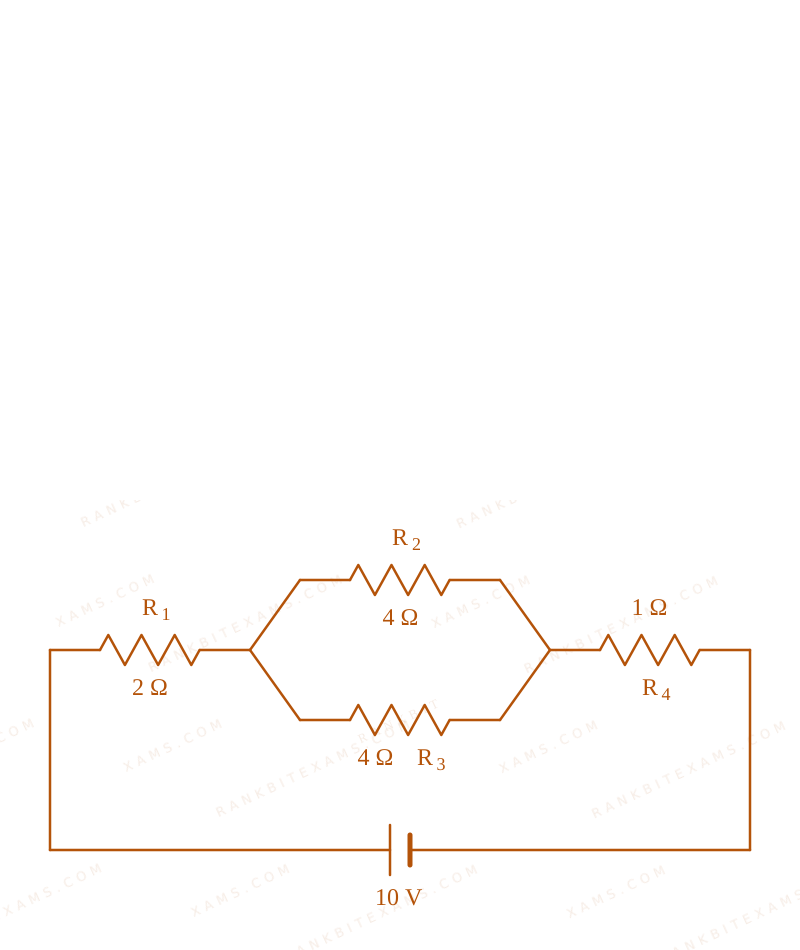
In the given circuit, the current in resistance R_3 is:
Series and parallel resistor network with 10V battery for Q46 - JEE Main 2024 29 January Shift 2
The diagram displays a circuit consisting of series-parallel combinations of R1, R2, R3, and R4 with a 10V voltage source.
  • A. 1text A
  • B. 1.5text A
  • C. 2text A
  • D. 2.5text A

Solution

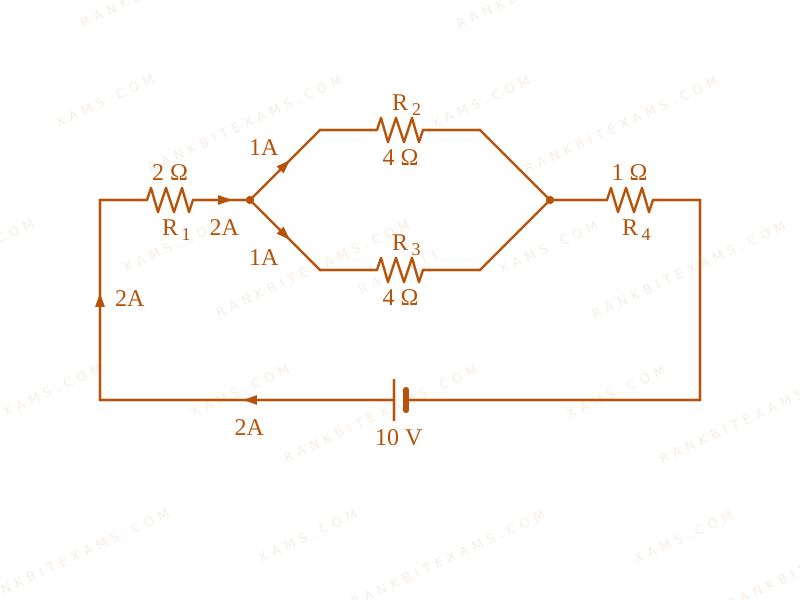
### Related Formula For parallel resistors: R_textparallel = fracR_a R_bR_a + R_b Total equivalent resistance in series: R_texteq = R_1 + R_textparallel + R_4 Total current from source: I = fracVR_texteq ### Core Logic Analyzing the circuit network: * R_1 = 2\ Omega * R_2 = 4\ Omega and R_3 = 4\ Omega are in parallel. * R_4 = 1\ Omega Calculate the equivalent resistance of the parallel combination: R_textparallel = fracR_2 times R_3R_2 + R_3 = frac4 times 44 + 4 = 2\ Omega ### Step 1: Calculate Total Equivalent Resistance and Current Total equivalent resistance is: R_texteq = R_1 + R_textparallel + R_4 = 2 + 2 + 1 = 5\ Omega Total circuit current is: I = fracVR_texteq = frac10text V5\ Omega = 2text A ### Step 2: Determine Current in R3 The total current of 2text A enters the parallel branch of R_2 and R_3. Since R_2 = R_3 = 4\ Omega, the current divides equally between them: I_R_3 = I times fracR_2R_2 + R_3 = 2 times frac48 = 1text A
Equivalent resistance and current paths in circuit for Q46
The diagram displays a circuit consisting of series-parallel combinations of R1, R2, R3, and R4 with a 10V voltage source.
### Pattern Recognition Equal parallel resistors split current exactly down the middle. Once total current is found to be 2text A, the parallel branches share it as 1text A each without further math. ### Evaluation Rubric / Model Answer null ### Chapter Mix Class 12 Physics: Current Electricity
Q58 jee_main_2024_29_january_evening Kirchhoff's Laws and Mesh Analysis
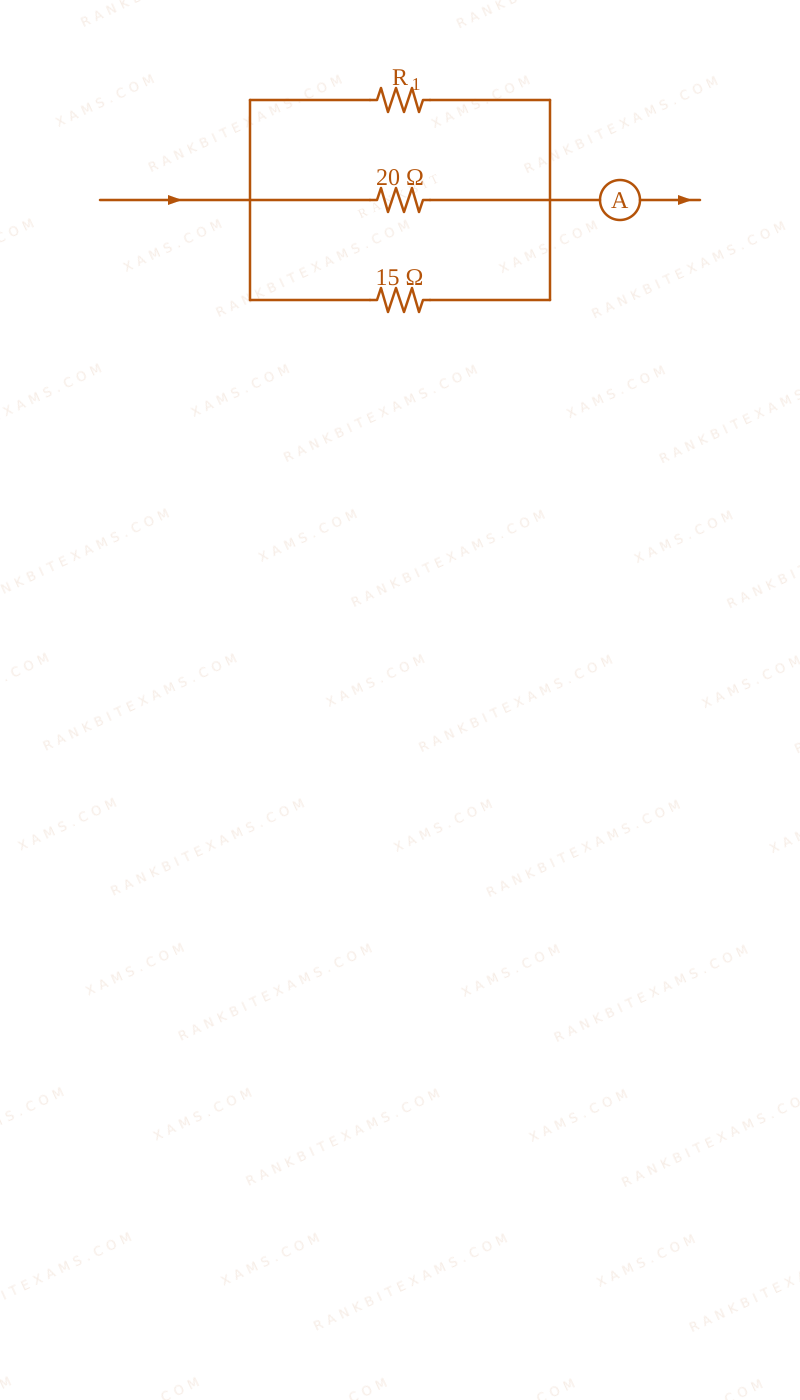
In the given circuit, the current flowing through the resistance 20\ Omega is 0.3text A, while the ammeter reads 0.9text A. The value of R_1 is ________ Omega.
Parallel branch resistor circuit with ammeter for Q58 - JEE Main 2024 29 January Shift 2
The diagram displays a circuit consisting of three parallel branches containing R1, a 20 Ohm resistor, and a 15 Ohm resistor, with an ammeter in series.
Numerical Answer. Answer: 30 to 30

Solution

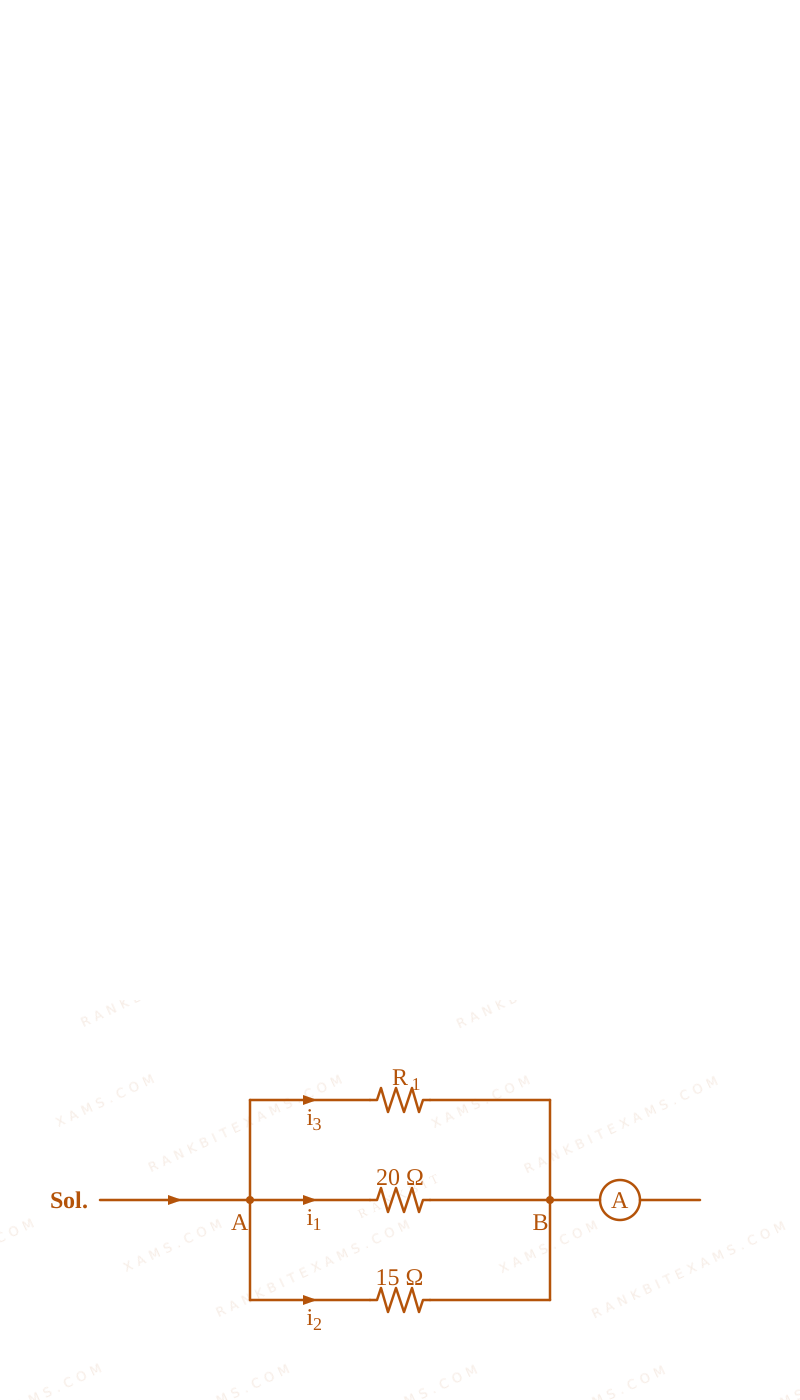
### Related Formula For parallel branches, the potential difference V across each branch is identical: V = I_i R_i According to Kirchhoff's Current Law, the total current I_texttotal is the sum of currents in all parallel branches: I_texttotal = i_1 + i_2 + i_3 ### Core Logic Analyzing the circuit diagram: * Branch 1: Current i_1 through 20\ Omega is 0.3text A. * Branch 2: Contains 15\ Omega resistor with current i_2. * Branch 3: Contains resistor R_1 with current i_3. Since the branches are in parallel, they have the same potential difference V_AB: V_AB = i_1 times 20\ Omega = 0.3text A times 20\ Omega = 6text V ### Step 1: Calculate Currents Current through the second branch (15\ Omega resistor) is: i_2 = fracV_AB15\ Omega = frac6text V15\ Omega = 0.4text A Total current read by the ammeter is 0.9text A. Thus: i_1 + i_2 + i_3 = 0.9text A 0.3text A + 0.4text A + i_3 = 0.9text A 0.7text A + i_3 = 0.9text A implies i_3 = 0.2text A ### Step 2: Calculate R1 Now use the voltage relation for the branch containing R_1: i_3 times R_1 = V_AB (0.2text A) times R_1 = 6text V R_1 = frac60.2 = 30\ Omega
Current directions and node equations in parallel circuit for Q58
The diagram displays a circuit consisting of three parallel branches containing R1, a 20 Ohm resistor, and a 15 Ohm resistor, with an ammeter in series.
### Pattern Recognition In parallel networks, finding the branch voltage is always the primary step. Once V = 6text V is established, the remaining branch currents are easily found using Ohm's Law and current conservation. ### Evaluation Rubric / Model Answer null ### Chapter Mix Class 12 Physics: Current Electricity
Q48 jee_main_2024_27_jan_morning Meter Bridge and Resistivity
A wire of length 10text cm and radius sqrt7 times 10^-4text m is connected across the right gap of a meter bridge. When a resistance of 4.5\ Omega is connected on the left gap by using a resistance box, the balance length is found to be at 60text cm from the left end. If the resistivity of the wire is R times 10^-7\ Omegatextm, then the value of R is:
  • A. 63
  • B. 70
  • C. 66
  • D. 35

Solution

### Related Formula From the balance condition of the meter bridge: fracX_textleftl = fracX_textright100 - l Resistance formula: X = rho fracl_wA = fracrho l_wpi r^2 ### Core Logic First, evaluate the unknown resistance X_textright in the right gap: frac4.560 = fracX_textright40 implies X_textright = frac4.5 times 4060 = 3\ Omega ### Step 1: Calculate Resistivity Value Now map the resistance parameters (l_w = 10text cm = 0.1text m, r = sqrt7 times 10^-4text m): 3 = rho frac0.1frac227 times (sqrt7 times 10^-4)^2 3 = rho frac0.1frac227 times 7 times 10^-8 3 = rho frac0.122 times 10^-8 rho = frac3 times 22 times 10^-80.1 = 66 times 10^-7\ Omegatextm ### Step 2: Compare to find R Given rho = R times 10^-7, comparing coefficients gives: R = 66 ### Pattern Recognition Meter bridge balance simplifies directly to simple scalar component checks. The sqrt7 term perfectly neutralizes the fractional frac227 constant in circular area profiles. ### Evaluation Rubric / Model Answer null ### Chapter Mix Class 12 Physics: Current Electricity
Q49 jee_main_2024_27_jan_morning Combination of Resistors
A wire of resistance R and length L is cut into 5 equal parts. If these parts are joined parallely, then the resultant resistance will be:
  • A. frac125R
  • B. frac15R
  • C. 25R
  • D. 5R

Solution

### Core Logic Resistance is directly proportional to length (R propto L). Cutting the wire into 5 equal pieces reduces the resistance of each segment to: R' = fracR5 ### Step 1: Compute parallel value Connecting 5 identical resistors R' in parallel gives a total equivalent resistance of: R_texteq = fracR'5 = fracR/55 = fracR25 ### Pattern Recognition Cutting an item into N components and grouping them in parallel scales the overall baseline systemic value down cleanly by a factor of N^2. ### Evaluation Rubric / Model Answer null ### Chapter Mix Class 12 Physics: Current Electricity

More Current Electricity Questions — jee_main_2025_07_april_morning

Practice all Current Electricity previous-year questions →

Rankbit System
JEE Physics: Waves (+15.5%) | Electrostatics: Concentric Shells (-29.7%) | Modern Physics: Photoelectric Clones (+34.2%) | Mathematics: Definite Integrals (+18.1%) | Chemistry: Coordination Splitting (-11.4%) | JEE Physics: Waves (+15.5%) | Electrostatics: Concentric Shells (-29.7%) | Modern Physics: Photoelectric Clones (+34.2%) | Mathematics: Definite Integrals (+18.1%) | Chemistry: Coordination Splitting (-11.4%)