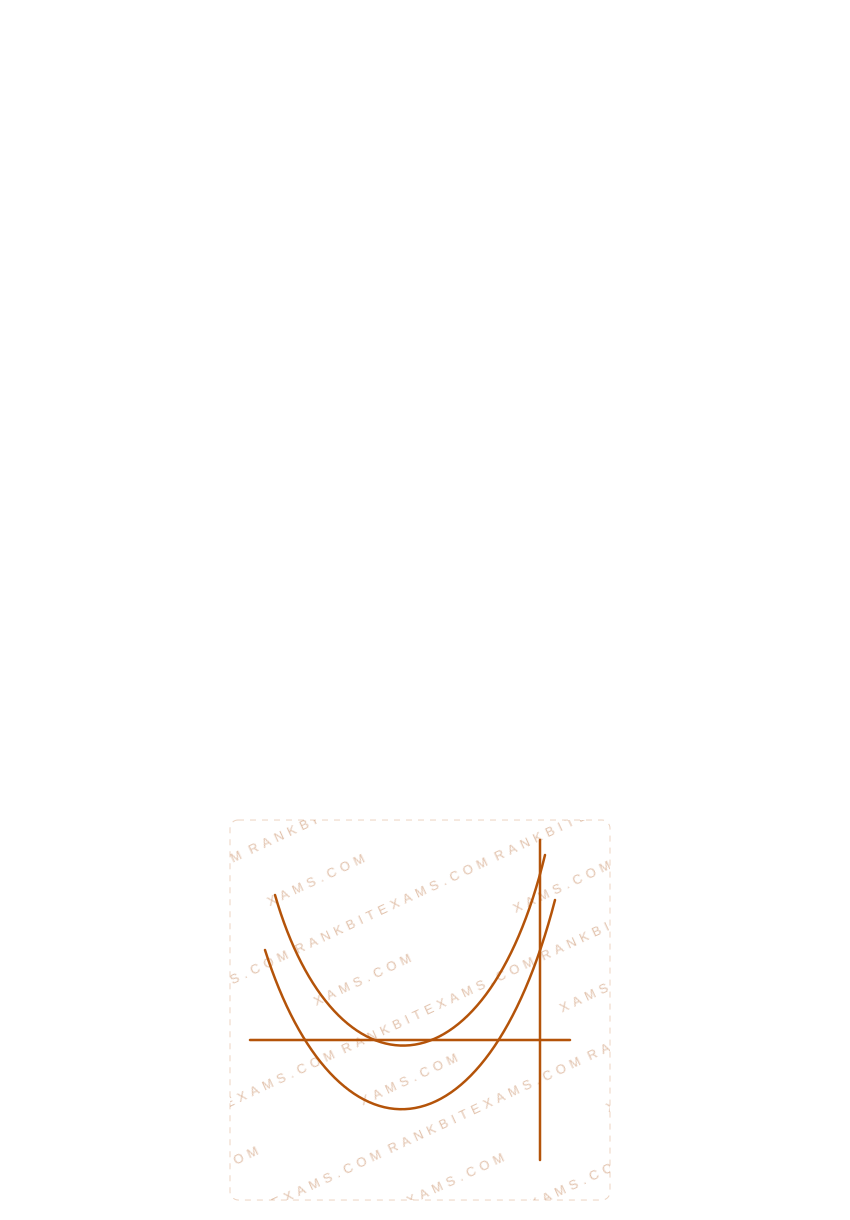
Let the set of all values of p in R$p \in \mathbb{R}$ , for which both the roots of the equation x² - (p + 2)x + (2p + 9) = 0$x^2 - (p + 2)x + (2p + 9) = 0$ are negative real numbers, be the interval (α, β]$(\alpha, \beta]$ . Then β - 2α$\beta - 2\alpha$ is equal to
A.0$0$
B.9$9$
C.5$5$
D.20$20$
Solution & Explanation
Related Formula
For both roots of a quadratic equation ax² + bx + c = 0$ax^2 + bx + c = 0$ to be negative real numbers, three mandatory rules must be met simultaneously:
D ≥ 0$D \ge 0$ (Real roots)
Sum of roots = -b/a < 0$= -b/a < 0$
Product of roots = c/a > 0$= c/a > 0$
Core Logic
From the given quadratic equation x² - (p + 2)x + (2p + 9) = 0$x^2 - (p + 2)x + (2p + 9) = 0$:
Remember that if roots are strictly real and matching signs, managing product rules before analyzing spatial configurations saves major compute overhead during intersection evaluation.
Chapter Mix
Class 11 Mathematics: Complex Numbers and Quadratic Equations
Keywords:#location of roots quadratic equation#negative real roots condition#JEE Main 2025 Morning Q64#Quadratic Equations interval valuation
More Quadratic Equations Previous-Year Questions — Page 6
Q20jee_main_2024_31_jan_morningSign of Quadratic Expressions
Let S$S$ be the set of positive integral values of a$a$ for which (ax² + 2(a + 1)x + 9a + 4)/(x² - 8x + 32) < 0, x in R$\frac{ax^2 + 2(a + 1)x + 9a + 4}{x^2 - 8x + 32} < 0, \forall x \in \mathbb{R}$. Then, the number of elements in S$S$ is:
A.1$1$
B.0$0$
C.∞$\infty$
D.3$3$
Solution
Core Logic
For the denominator x² - 8x + 32$x^2 - 8x + 32$, D = 64 - 128 < 0$D = 64 - 128 < 0$ and a = 1 > 0$a = 1 > 0$. Thus, x² - 8x + 32 > 0 x in R$x^2 - 8x + 32 > 0 \forall x \in \mathbb{R}$.
Step 1: Constraint on Numerator
Since the denominator is always positive, the numerator must be strictly negative for all x in R$x \in \mathbb{R}$.
ax² + 2(a + 1)x + 9a + 4 < 0 x in R$$ax^2 + 2(a + 1)x + 9a + 4 < 0 \quad \forall x \in \mathbb{R}$$
This requires a < 0$a < 0$ and D < 0$D < 0$.
Step 2: Conclusion
Since a$a$ must be strictly less than 0$0$, there are no positive integral values of a$a$ that satisfy the condition.
Hence, S$S$ is an empty set. Number of elements is 0.
Chapter Mix
Class 11 Maths: Quadratic Equations
More Quadratic Equations Questions — jee_main_2025_07_april_morning
Practice past-year questions one chapter at a time. Pick an exam → subject → chapter and get every PYQ for that topic — pulled together from all past papers — with the chapter's key formulas alongside.