Given below are two statements:
Statement I: Mohr's salt is composed of only three types of ions-ferrous, ammonium and sulphate.
Statement II: If the molar conductance at infinite dilution of ferrous, ammonium and sulphate ions are x₁$\mathbf{x}_1$, x₂$\mathbf{x}_2$ and x₃$\mathbf{x}_3$S cm² mol⁻¹$\mathrm{S\ cm}^2\ \mathrm{mol}^{-1}$, respectively then the molar conductance for Mohr's salt solution at infinite dilution would be given by x₁ + x₂ + 2x₃$\mathbf{x}_1 + \mathbf{x}_2 + 2\mathbf{x}_3$.
In the light of the given statements, choose the correct answer from the options given below:
A.Both Statement I and Statement II are false$\text{Both Statement I and Statement II are false}$
B.Statement I is false but Statement II is true$\text{Statement I is false but Statement II is true}$
C.Statement I is true but Statement II is false$\text{Statement I is true but Statement II is false}$
D.Both Statement I and Statement II are true$\text{Both Statement I and Statement II are true}$
Statement II claims the expression is x₁ + x₂ + 2x₃$x_1 + x_2 + 2x_3$ (missing the coefficient 2$2$ for ammonium). Thus, Statement II is false.
Pattern Recognition
Kohlrausch's law matches stoichiometric coefficients directly to the ion quantities released. Mohr's salt formula contains (NH₄)₂$(NH_4)_2$, requiring a multiplier of 2$2$ for ammonium ion conductance.
Chapter Mix
Class 12 Chemistry: Electrochemistry
Class 12 Chemistry: d- and f-Block Elements
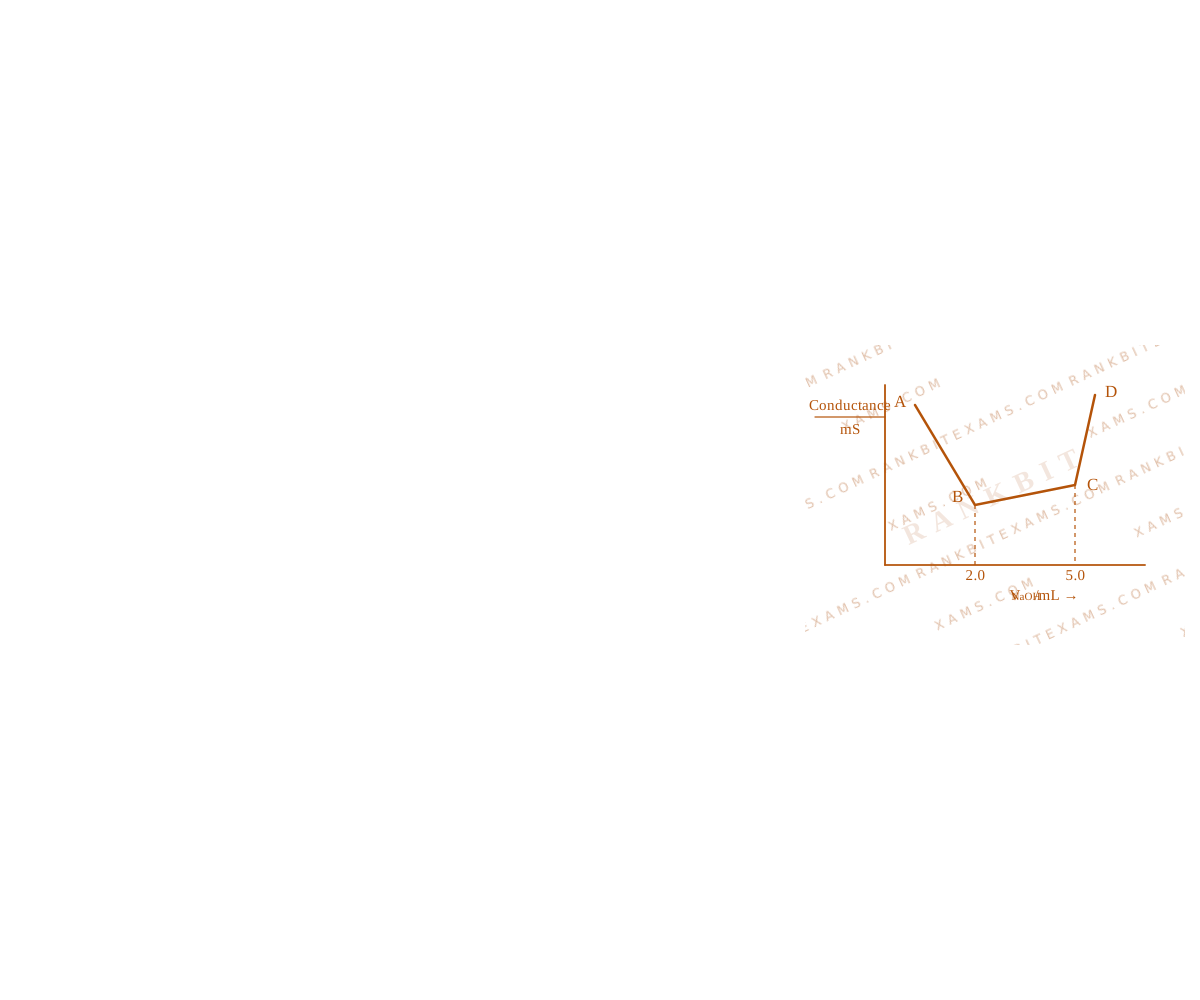
40~mL$40\mathrm{~mL}$ of a mixture of CH₃COOH$\mathrm{CH}_{3}\mathrm{COOH}$ and HCl$\mathrm{HCl}$ (aqueous solution) is titrated against 0.1~M~NaOH$0.1\mathrm{~M~NaOH}$ solution conductometrically. Which of the following statements is correct? Conductance vs Volume of NaOH added curve showing two equivalence points at 2.0 mL and 5.0 mL.
A. The concentration of CH₃COOH$\mathrm{CH}_3\mathrm{COOH}$ in the original mixture is 0.005~M$0.005\mathrm{~M}$
B. The concentration of HCl$\mathrm{HCl}$ in the original mixture is 0.005~M$0.005\mathrm{~M}$
C.CH₃COOH$\mathrm{CH}_3\mathrm{COOH}$ is neutralised first followed by neutralisation of HCl$\mathrm{HCl}$
D. Point 'C' indicates the complete neutralisation of HCl$\mathrm{HCl}$
In a mixture of a strong acid (HCl$\mathrm{HCl}$) and a weak acid (CH₃COOH$\mathrm{CH}_3\mathrm{COOH}$):
HCl$\mathrm{HCl}$ is a strong acid and is completely ionized. When NaOH$\mathrm{NaOH}$ is added, highly mobile H^+$\mathrm{H}^+$ ions are replaced by less mobile Na^+$\mathrm{Na}^+$ ions, causing a sharp drop in conductance (segment AB).
At point B (2.0~mL$2.0\mathrm{~mL}$), HCl$\mathrm{HCl}$ is completely neutralized.
Segment BC represents the neutralization of the weak acid CH₃COOH$\mathrm{CH}_3\mathrm{COOH}$ to form highly conducting sodium acetate, causing a moderate rise in conductance up to point C (5.0~mL$5.0\mathrm{~mL}$).
Beyond point C, excess OH^-$\mathrm{OH}^-$ ions cause a rapid rise in conductance (segment CD).
Step 1: Calculate concentration of HCl$\mathrm{HCl}$
Volume of NaOH$\mathrm{NaOH}$ used to neutralize HCl$\mathrm{HCl}$ is V₁ = 2.0~mL$V_1 = 2.0\mathrm{~mL}$:
Conductometric titration curves are analyzed sequentially: the strongest electrolyte is always neutralized first. A steep drop in conductance always signals the neutralization of a strong acid (H^+$\mathrm{H}^+$ depletion). A weak acid titration shows a gentle upward slope due to salt formation.
Chapter Mix
Class 12 Chemistry: Electrochemistry
Class 11 Chemistry: Equilibrium
Q34jee_main_2025_03_april_eveningFuel Cells and Standard Cell Potential
The standard cell potential (Ecell)$\left(E_{\mathrm{cell}}^{\ominus}\right)$ of a fuel cell based on the oxidation of methanol in air that has been used to power television relay station is measured as 1.21~V$1.21\mathrm{~V}$. The standard half cell reduction potential for O₂$\mathrm{O}_2$(EO₂/H₂O°)$\left(E_{\mathrm{O}_2/\mathrm{H}_2\mathrm{O}}^{\circ}\right)$ is 1.229~V$1.229\mathrm{~V}$. Choose the correct statement:
A. The standard half cell reduction potential for the reduction of CO₂$\mathrm{CO}_2$(ECO₂/CH₃OH°)$\left(E_{\mathrm{CO}_2/\mathrm{CH}_3\mathrm{OH}}^{\circ}\right)$ is 19~mV$19\mathrm{~mV}$
B. Oxygen is formed at the anode.
C. Reactants are fed at one go to each electrode.
D. Reduction of methanol takes place at the cathode.
Solution
Related Formula
Standard cell EMF is related to standard reduction potentials:
The standard half-cell reduction potential for the CO₂/CH₃OH$\mathrm{CO}_2/\mathrm{CH}_3\mathrm{OH}$ couple is 19~mV$19\mathrm{~mV}$, matching Option (1).
Pattern Recognition
Fuel cells are galvanic cells where reactants (like fuels and oxidants) are fed continuously to the electrodes, not at one go. Oxidation always occurs at the anode (methanol) and reduction at the cathode (oxygen).
Chapter Mix
Class 12 Chemistry: Electrochemistry
Q48jee_main_2025_07_april_morningNernst Equation
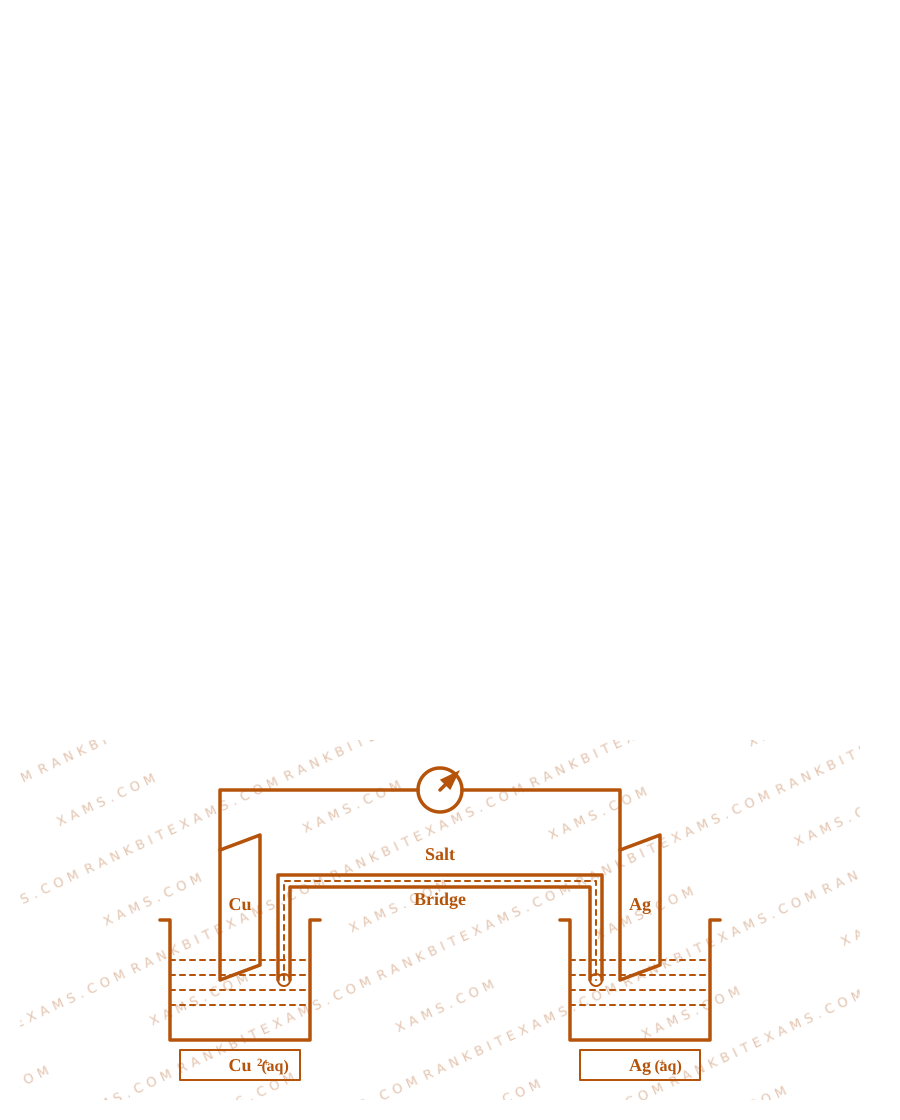
1 Faraday electricity was passed through Cu²⁺$\mathrm{Cu}^{2+}$ (1.5 M, 1 L)/Cu and 0.1 Faraday was passed through Ag⁺$\mathrm{Ag}^{+}$ (0.2 M, 1 L)/Ag electrolytic cells. After this, the two cells were connected as shown below to make an electrochemical cell. The emf of the cell thus formed at 298 K is ______ V.
The cell assembly combines Cu and Ag half cells after individual initial electrolysis modifications.
Given:
ECu²⁺/Cu° = 0.34 ~V$\mathrm{E}_{\mathrm{Cu}^{2+}/\mathrm{Cu}}^{\circ} = 0.34 \mathrm{~V}$EAg⁺/Ag° = 0.8 ~V$\mathrm{E}_{\mathrm{Ag}^{+}/\mathrm{Ag}}^{\circ} = 0.8 \mathrm{~V}$(2.303RT)/(F) = 0.06 ~V$\frac{2.303RT}{F} = 0.06 \mathrm{~V}$
(Note: The potential is 0.4 V$0.4\text{ V}$ or 400 mV$400\text{ mV}$).
Pattern Recognition
Electrolysis modifies the bulk concentrations. First, use Faraday's laws to get the new concentration values ([Cu²⁺] = 1.0 M$[Cu^{2+}] = 1.0\text{ M}$, [Ag^+] = 0.1 M$[Ag^+] = 0.1\text{ M}$). Then plug these straight into standard Nernst equations.
Evaluation Rubric / Model Answer
Requires complete calculations showing concentrations updated by electrolysis, followed by a double-transfer Nernst equation calculation.
Chapter Mix
Class 12 Chemistry: Electrochemistry
Q50jee_main_2025_08_april_eveningNernst Equation
Consider the following half-cell reduction reaction:
Cr₂O₇²⁻(aq) + 6e^- + 14H^+(aq) 2Cr³⁺(aq) + 7H₂O(l)$$\text{Cr}_2\text{O}_7^{2-}\text{(aq)} + 6e^- + 14\text{H}^+\text{(aq)} \longrightarrow 2\text{Cr}^{3+}\text{(aq)} + 7\text{H}_2\text{O(l)}$$
The process is conducted with a concentration ratio of [Cr³⁺]²[Cr₂O₇²⁻] = 10⁻⁶$\frac{[\text{Cr}^{3+}]^2}{[\text{Cr}_2\text{O}_7^{2-}]} = 10^{-6}$. The specific pH value at which the EMF (E$E$) of this reduction half-cell becomes exactly zero is _________ (as the nearest integer value).
Given parameters: E^°Cr₂O₇²⁻/Cr³⁺ = 1.33 V$E^\circ_{\text{Cr}_2\text{O}_7^{2-}/\text{Cr}^{3+}} = 1.33 \text{ V}$ and (2.303RT)/(F) = 0.059 V$\frac{2.303RT}{F} = 0.059 \text{ V}$.
The exponent of the hydrogen ion concentration ([H^+]¹⁴$[\text{H}^+]^{14}$) heavily influences the cell potential. A small shift in pH causes a large change in EMF due to this factor of 14, which explains why the potential drops to zero even in a highly basic environment (pH ≈ 10$\text{pH} \approx 10$).
Chapter Mix
Class 12 Chemistry: Electrochemistry
Class 11 Chemistry: Ionic Equilibrium
More Electrochemistry Questions — jee_main_2025_07_april_morning
Practice past-year questions one chapter at a time. Pick an exam → subject → chapter and get every PYQ for that topic — pulled together from all past papers — with the chapter's key formulas alongside.