JEE Main · Chemistry → Steady

Electrochemistry appeared 40 times across 3 years — 4.6% of Chemistry. This question is from Nernst Equation.

Year 2026 2025 2024 Total
Questions 13 19 8 40

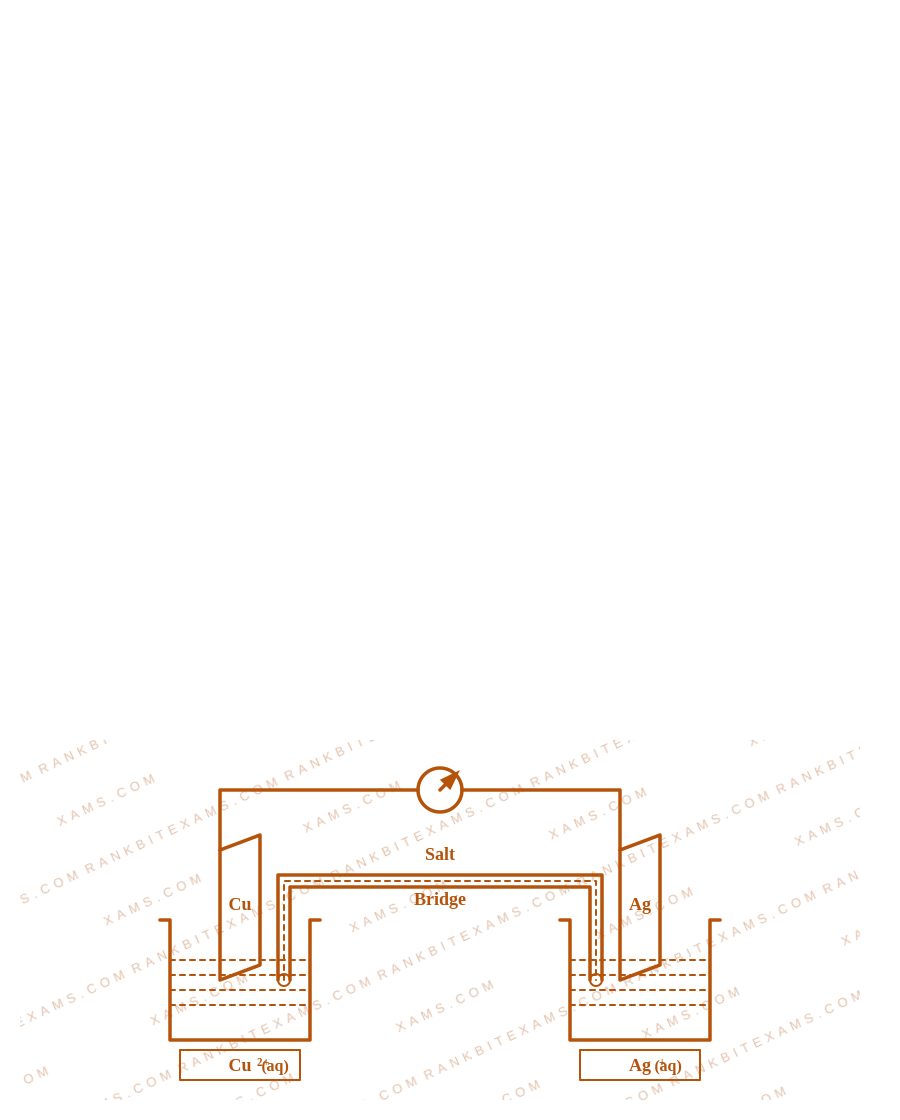
1 Faraday electricity was passed through Cu²⁺ (1.5 M, 1 L)/Cu and 0.1 Faraday was passed through Ag⁺ (0.2 M, 1 L)/Ag electrolytic cells. After this, the two cells were connected as shown below to make an electrochemical cell. The emf of the cell thus formed at 298 K is ______ V.
Galvanic cell assembly diagram with salt bridge for Q48
The cell assembly combines Cu and Ag half cells after individual initial electrolysis modifications.
Given: ECu²⁺/Cu° = 0.34 ~V EAg⁺/Ag° = 0.8 ~V (2.303RT)/(F) = 0.06 ~V

Numerical Answer Type:
Enter a numerical value Answer: 0.4 to 0.4 +4 marks

Solution & Explanation

Related Formula
Ecell = E°cell - (0.06)/(n) Q
Core Logic

First, analyze the electrolysis step to determine final ionic concentrations:

  • For Cu²⁺/Cu half-cell:
  • Initial moles of Cu²⁺ = 1.5 M × 1 L = 1.5 mol.
  • Reductive half-reaction: Cu²⁺ + 2e^- arrow Cu.
  • Passing 1 Faraday converts: (1)/(2) = 0.5 mol of Cu²⁺.
  • Remaining moles of Cu²⁺ = 1.5 - 0.5 = 1.0 mol.
  • Final concentration [Cu²⁺] = 1.0 M.
  • For Ag⁺/Ag half-cell:
  • Initial moles of Ag^+ = 0.2 M × 1 L = 0.2 mol.
  • Reductive half-reaction: Ag^+ + e^- arrow Ag.
  • Passing 0.1 Faraday converts: 0.1 mol of Ag^+.
  • Remaining moles of Ag^+ = 0.2 - 0.1 = 0.1 mol.
  • Final concentration [Ag^+] = 0.1 M.
  • Now, connect the two components into a galvanic cell:

  • Anode reaction: Cu(s) arrow Cu²⁺(aq) + 2e^-
  • Cathode reaction: 2Ag⁺(aq) + 2e^- arrow 2Ag(s)
  • Net cell reaction: Cu(s) + 2Ag⁺(aq) arrow Cu²⁺(aq) + 2Ag(s)
  • n = 2
  • Calculate standard cell potential:

E°cell = E°Ag^+/Ag - E°Cu²⁺/Cu = 0.80 - 0.34 = 0.46 V

Applying Nernst Equation:

Ecell = E°cell - (0.06)/(2) ( [Cu²⁺][Ag^+]² ) Ecell = 0.46 - 0.03 ( (1)/((0.1)²) ) = 0.46 - 0.03 (100) Ecell = 0.46 - 0.03(2) = 0.46 - 0.06 = 0.40 V

(Note: The potential is 0.4 V or 400 mV).

Pattern Recognition

Electrolysis modifies the bulk concentrations. First, use Faraday's laws to get the new concentration values ([Cu²⁺] = 1.0 M, [Ag^+] = 0.1 M). Then plug these straight into standard Nernst equations.

Evaluation Rubric / Model Answer

Requires complete calculations showing concentrations updated by electrolysis, followed by a double-transfer Nernst equation calculation.

Chapter Mix

Class 12 Chemistry: Electrochemistry

Reference Study Guides

More Electrochemistry Previous-Year Questions — Page 8

Q82 jee_main_2024_29_jan_morning Faradays Laws of Electrolysis
The mass of zinc produced by the electrolysis of zinc sulphate solution with a steady current of 0.015 A for 15 minutes is ______ × 10⁻⁴ g. (Atomic mass of zinc = 65.4 amu)
Numerical Answer. Answer: 45.75 to 46

Solution

Related Formula
W = Z · I · t = (M)/(n · F) · I · t

where, W = mass deposited Z = electrochemical equivalent I = current in amperes t = time in seconds M = molar mass n = n-factor (electrons exchanged) F = Faraday's constant (96500 C/mol)

Core Logic

The electrolysis of zinc sulphate (ZnSO₄) involves the reduction of zinc ions at the cathode:

Zn⁺² + 2e^- arrow Zn

Here, the n-factor (n) is 2.

Step 1: Calculation

Given values: I = 0.015 A t = 15 minutes = 15 × 60 seconds = 900 s M = 65.4 g/mol F ≈ 96500 C

Plugging the values into Faraday's First Law:

W = (65.4)/(2 × 96500) × 0.015 × 15 × 60 W = (65.4)/(193000) × 13.5 W = 3.3886 × 10⁻⁴ × 13.5 W = 45.746 × 10⁻⁴ g

Rounding to two decimal places (or nearest integer depending on convention), we get 45.75 × 10⁻⁴ g.

Chapter Mix

Class 12 Chemistry: Electrochemistry

Q80 jee_main_2024_30_january_evening Standard Electrode Potential
Reduction potential of ions are given below: ClO₄^- E° = 1.19V IO₄^- E° = 1.65V BrO₄^- E° = 1.74V The correct order of their oxidising power is:
  • A. ClO₄^- > IO₄^- > BrO₄^-
  • B. BrO₄^- > IO₄^- > ClO₄^-
  • C. BrO₄^- > ClO₄^- > IO₄^-
  • D. IO₄^- > BrO₄^- > ClO₄^-

Solution

Core Logic

The Standard Reduction Potential (E^°) measures a species' tendency to undergo reduction (gain electrons). A higher, more positive E^° value means the species has a stronger tendency to be reduced, which in turn makes it a stronger oxidizing agent.

Comparing the given E^° values: BrO₄^-: 1.74V IO₄^-: 1.65V ClO₄^-: 1.19V

The order of oxidizing power follows the magnitude of the reduction potential: BrO₄^- > IO₄^- > ClO₄^-

Pattern Recognition

Higher +ve Standard Reduction Potential (SRP) = Stronger Oxidising Agent.

Chapter Mix

Class 12 Chemistry: Electrochemistry Class 12 Chemistry: The p Block Elements

Q65 jee_main_2024_31_jan_morning Batteries
The metals that are employed in the battery industries are A. Fe B. Mn C. Ni D. Cr E. Cd Choose the correct answer from the options given below:
  • A. B, C and E only
  • B. A, B, C, D and E
  • C. A, B, C and D only
  • D. B, D and E only

Solution

Core Logic

Mn, Ni, and Cd metals are predominantly used in battery industries.

  • Mn is used in dry cells (Leclanche cell).
  • Ni and Cd are used in Nickel-Cadmium (Ni-Cd) rechargeable batteries.
Chapter Mix

Class 12 Chemistry: Electrochemistry

Q67 jee_main_2024_31_jan_morning Electrolytic Conductance
Identify the factor from the following that does not affect electrolytic conductance of a solution.
  • A. The nature of the electrolyte added.
  • B. The nature of the electrode used.
  • C. Concentration of the electrolyte.
  • D. The nature of solvent used.

Solution

Core Logic

Conductivity of an electrolytic cell is affected by the concentration of the electrolyte, the nature of the electrolyte, and the nature of the solvent. It does not depend on the nature of the electrode used.

Chapter Mix

Class 12 Chemistry: Electrochemistry

Q90 jee_main_2024_31_jan_morning Faraday's Laws of Electrolysis
One Faraday of electricity liberates x × 10⁻¹ gram atom of copper from copper sulphate, x is
Numerical Answer. Answer: 5 to 5

Solution

Core Logic

The reduction reaction for copper is:

Cu²⁺ + 2e^- arrow Cu

This shows that 2 moles of electrons (2 Faraday) are required to deposit 1 mole (or 1 gram atom) of Cu.

Therefore, 1 Faraday of electricity will deposit:

(1)/(2) = 0.5 moles of Cu
Step 1: Finding x
0.5 mole = 0.5 gram atom = 5 × 10⁻¹ gram atom

Hence, x = 5.

Chapter Mix

Class 12 Chemistry: Electrochemistry

More Electrochemistry Questions — jee_main_2025_07_april_morning

Practice all Electrochemistry previous-year questions →

Rankbit System
JEE Physics: Waves (+15.5%) | Electrostatics: Concentric Shells (-29.7%) | Modern Physics: Photoelectric Clones (+34.2%) | Mathematics: Definite Integrals (+18.1%) | Chemistry: Coordination Splitting (-11.4%) | JEE Physics: Waves (+15.5%) | Electrostatics: Concentric Shells (-29.7%) | Modern Physics: Photoelectric Clones (+34.2%) | Mathematics: Definite Integrals (+18.1%) | Chemistry: Coordination Splitting (-11.4%)