Related Formula
Ecell = E°cell - (0.06)/(n) Q$$E_{\text{cell}} = E^{\circ}_{\text{cell}} - \frac{0.06}{n} \log Q$$
Core Logic
First, analyze the electrolysis step to determine final ionic concentrations:
- For Cu²⁺/Cu$\mathrm{Cu}^{2+}/\mathrm{Cu}$ half-cell:
- Initial moles of Cu²⁺ = 1.5 M × 1 L = 1.5 mol$\mathrm{Cu}^{2+} = 1.5 \text{ M} \times 1 \text{ L} = 1.5 \text{ mol}$.
- Reductive half-reaction: Cu²⁺ + 2e^- arrow Cu$\mathrm{Cu}^{2+} + 2\mathrm{e}^- \rightarrow \mathrm{Cu}$.
- Passing 1 Faraday$1 \text{ Faraday}$ converts: (1)/(2) = 0.5 mol$\frac{1}{2} = 0.5 \text{ mol}$ of Cu²⁺$\mathrm{Cu}^{2+}$.
- Remaining moles of Cu²⁺ = 1.5 - 0.5 = 1.0 mol$\mathrm{Cu}^{2+} = 1.5 - 0.5 = 1.0 \text{ mol}$.
- Final concentration [Cu²⁺] = 1.0 M$[\mathrm{Cu}^{2+}] = 1.0 \text{ M}$.
- For Ag⁺/Ag$\mathrm{Ag}^{+}/\mathrm{Ag}$ half-cell:
- Initial moles of Ag^+ = 0.2 M × 1 L = 0.2 mol$\mathrm{Ag}^+ = 0.2 \text{ M} \times 1 \text{ L} = 0.2 \text{ mol}$.
- Reductive half-reaction: Ag^+ + e^- arrow Ag$\mathrm{Ag}^+ + \mathrm{e}^- \rightarrow \mathrm{Ag}$.
- Passing 0.1 Faraday$0.1 \text{ Faraday}$ converts: 0.1 mol$0.1 \text{ mol}$ of Ag^+$\mathrm{Ag}^+$.
- Remaining moles of Ag^+ = 0.2 - 0.1 = 0.1 mol$\mathrm{Ag}^+ = 0.2 - 0.1 = 0.1 \text{ mol}$.
- Final concentration [Ag^+] = 0.1 M$[\mathrm{Ag}^+] = 0.1 \text{ M}$.
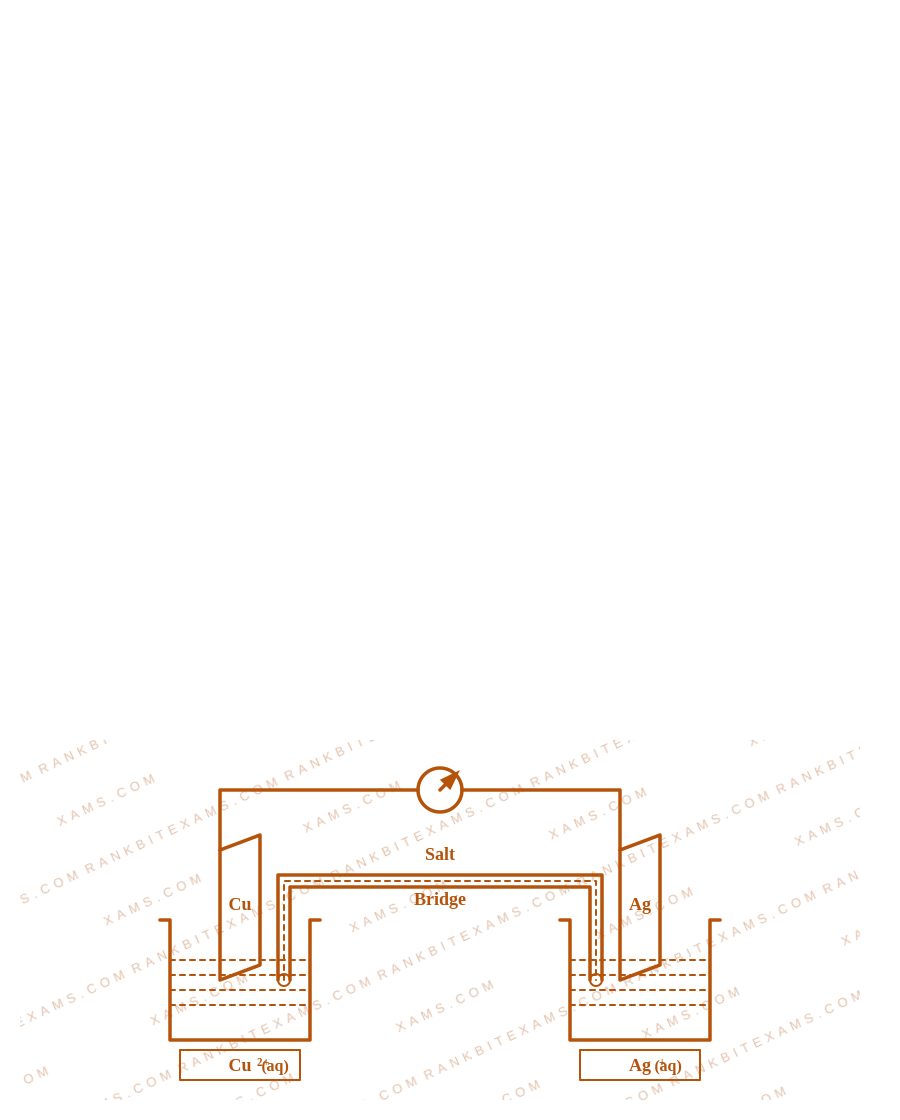
Now, connect the two components into a galvanic cell:
- Anode reaction: Cu(s) arrow Cu²⁺(aq) + 2e^-$\mathrm{Cu(s)} \rightarrow \mathrm{Cu}^{2+}\mathrm{(aq)} + 2\mathrm{e}^-$
- Cathode reaction: 2Ag⁺(aq) + 2e^- arrow 2Ag(s)$2\mathrm{Ag}^{+}\mathrm{(aq)} + 2\mathrm{e}^- \rightarrow 2\mathrm{Ag(s)}$
- Net cell reaction: Cu(s) + 2Ag⁺(aq) arrow Cu²⁺(aq) + 2Ag(s)$\mathrm{Cu(s)} + 2\mathrm{Ag}^{+}\mathrm{(aq)} \rightarrow \mathrm{Cu}^{2+}\mathrm{(aq)} + 2\mathrm{Ag(s)}$
- n = 2$n = 2$
Calculate standard cell potential:
E°cell = E°Ag^+/Ag - E°Cu²⁺/Cu = 0.80 - 0.34 = 0.46 V$$E^{\circ}_{\text{cell}} = E^{\circ}_{\mathrm{Ag}^+/\mathrm{Ag}} - E^{\circ}_{\mathrm{Cu}^{2+}/\mathrm{Cu}} = 0.80 - 0.34 = 0.46 \text{ V}$$
Applying Nernst Equation:
Ecell = E°cell - (0.06)/(2) ( [Cu²⁺][Ag^+]² )$$E_{\text{cell}} = E^{\circ}_{\text{cell}} - \frac{0.06}{2} \log \left( \frac{[\mathrm{Cu}^{2+}]}{[\mathrm{Ag}^+]^2} \right)$$
Ecell = 0.46 - 0.03 ( (1)/((0.1)²) ) = 0.46 - 0.03 (100)$$E_{\text{cell}} = 0.46 - 0.03 \log \left( \frac{1}{(0.1)^2} \right) = 0.46 - 0.03 \log(100)$$
Ecell = 0.46 - 0.03(2) = 0.46 - 0.06 = 0.40 V$$E_{\text{cell}} = 0.46 - 0.03(2) = 0.46 - 0.06 = 0.40 \text{ V}$$
(Note: The potential is 0.4 V$0.4\text{ V}$ or 400 mV$400\text{ mV}$).
Pattern Recognition
Electrolysis modifies the bulk concentrations. First, use Faraday's laws to get the new concentration values ([Cu²⁺] = 1.0 M$[Cu^{2+}] = 1.0\text{ M}$, [Ag^+] = 0.1 M$[Ag^+] = 0.1\text{ M}$). Then plug these straight into standard Nernst equations.
Evaluation Rubric / Model Answer
Requires complete calculations showing concentrations updated by electrolysis, followed by a double-transfer Nernst equation calculation.
Chapter Mix
Class 12 Chemistry: Electrochemistry