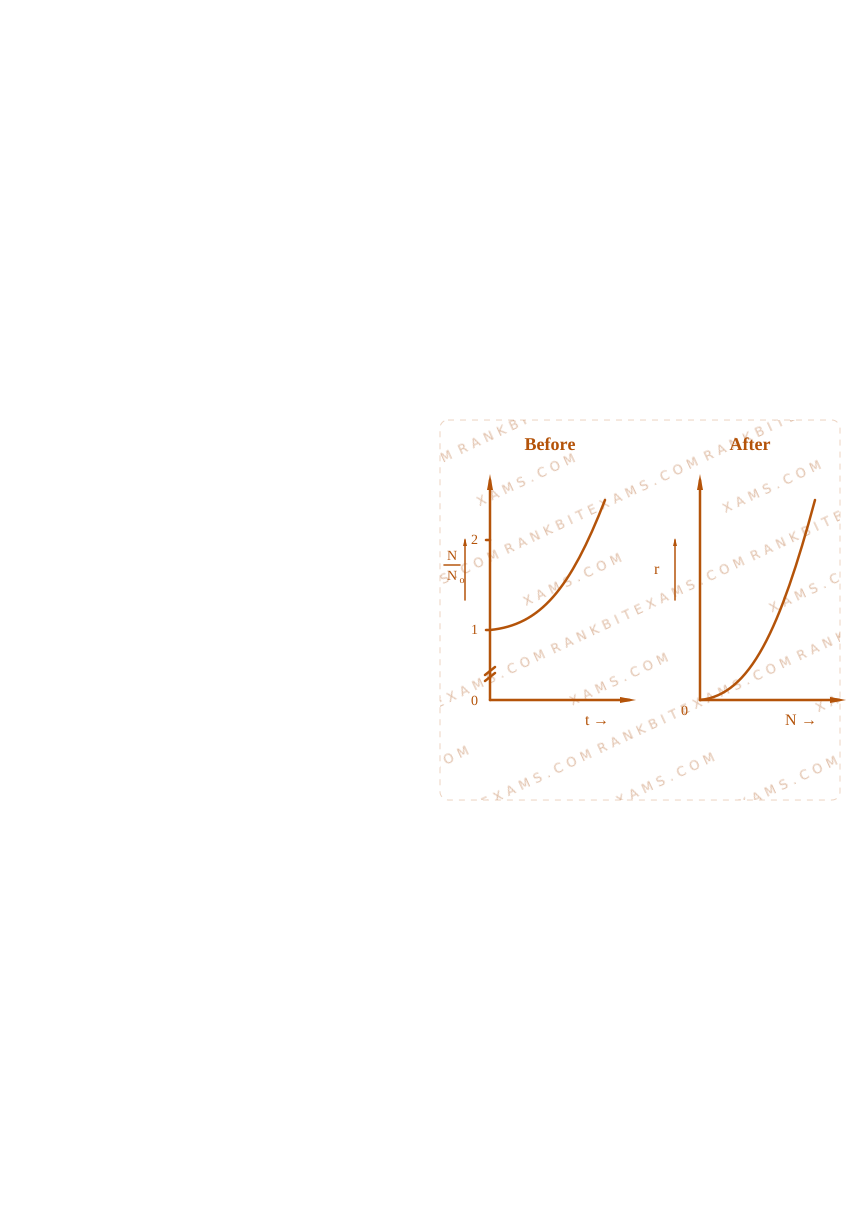
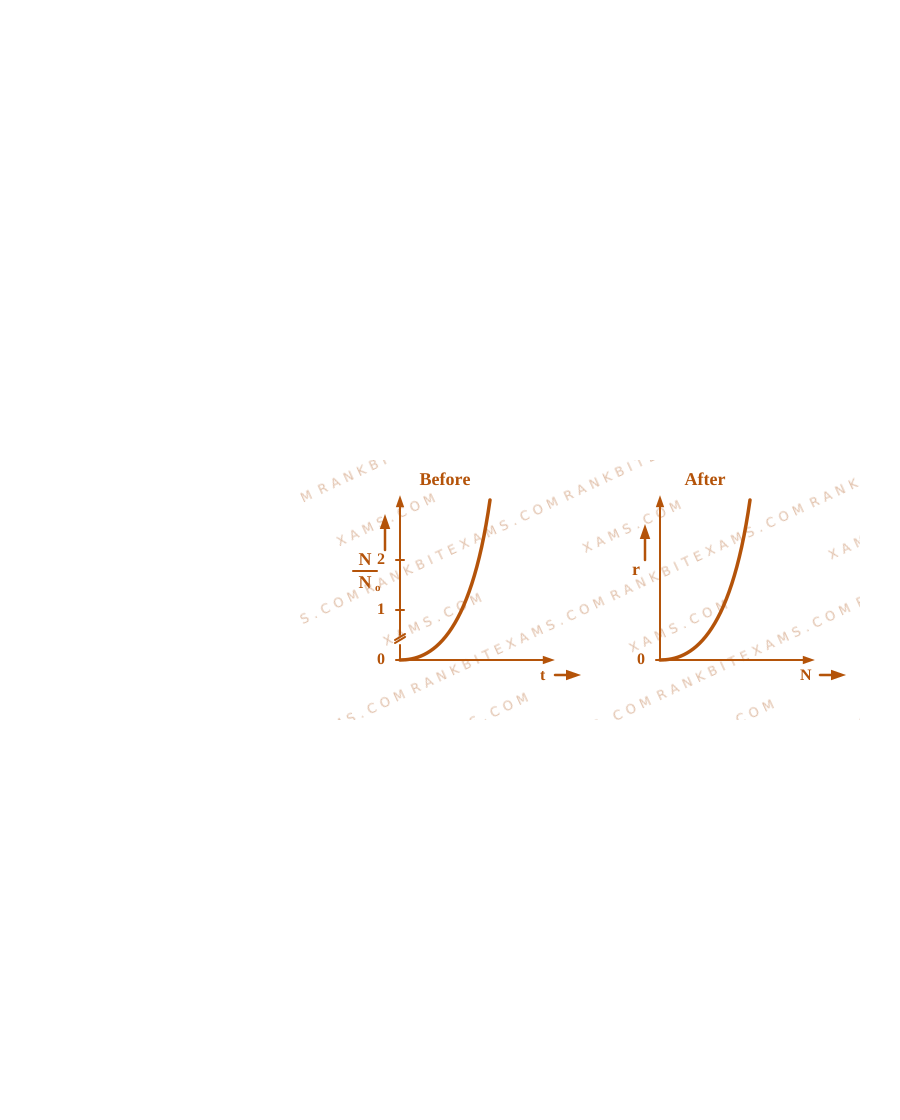
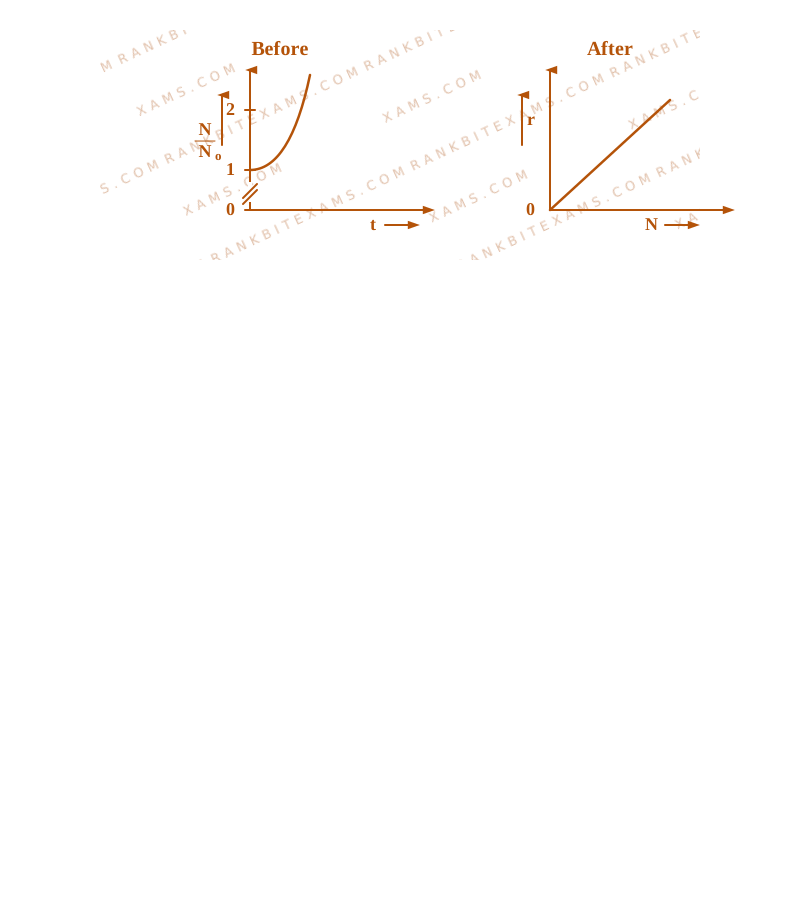
A person's wound was exposed to some bacteria and then bacteria growth started to happen at the same place. The wound was later treated with some antibacterial medicine and the rate of bacterial decay (r) was found to be proportional with the square of the existing number of bacteria at any instance. Which of the following set of graphs correctly represents the 'before' and 'after' situation of the application of the medicine? [Given: mathrmN = textNo. of bacteria, textt = texttime, bacterial growth follows mathrmI^mathrmst order kinetics.]

Solution & Explanation

### Related Formula textBefore: fracdNdt = k_1 N implies N = N_0 e^k_1 t textAfter: -fracdNdt = k_2 N^2 implies frac1N - frac1N_0 = k_2 t ### Core Logic Let's analyze the kinetics for the two stages: 1. **Before applying medicine**: - Bacterial growth follows 1^textst order kinetics: fracdNdt = k_1 N. - Integrating this yields: N(t) = N_0 e^k_1 t. - The graph of fracNN_0 vs t is a rising exponential curve starting from 1 (since at t=0, fracNN_0 = 1). 2. **After applying medicine**: - Reductive rate is proportional to the square of existing bacteria (2^textnd order decay): -fracdNdt = k_2 N^2 implies fracdNN^2 = -k_2 dt - Integrating this yields: -frac1N = -k_2 t + C implies frac1N = k_2 t + frac1N_0 N(t) = fracN_01 + N_0 k_2 t - A plot of N vs t or fracNN_0 vs t for this decay is a hyperbolic curve decreasing gradually. - Option B correctly matches the exponential growth before medicine and the hyperbolic decay after medicine. ### Pattern Recognition First-order growth is an exponential curve (N_0 e^kt), while second-order decay behaves as a rational hyperbolic relationship (1 / (1 + bt)). Option B shows the exact transition from an exponential rise to a hyperbolic decay curve. ### Evaluation Rubric / Model Answer null ### Chapter Mix Class 12 Chemistry: Chemical Kinetics
More Chemical Kinetics Previous-Year Questions — Page 3

Q30 jee_main_2025_03_april_morning First Order Kinetics
In a reaction A+B ightarrow C, initial concentrations of A and B are related as [A]_0=8[B]_0. The half lives of A and B are 10 min and 40 min. respectively. If they start to disappear at the same time, both following first order kinetics, after how much time will the concentration of both the reactants be same?
  • A. 60 min
  • B. 80 min
  • C. 20 min
  • D. 40 min

Solution

### Related Formula For a first-order integrated rate law expression: [A]_t = [A]_0 e^-k_A t quad textwhere k = fracln 2t_1/2 ### Core Logic We require the instantaneous concentration to be identical at time t: [A]_t = [B]_t implies [A]_0 e^-k_A t = [B]_0 e^-k_B t frac[A]_0[B]_0 = e^(k_A - k_B)t ### Step 1: Substituting Parameters Substitute [A]_0 = 8[B]_0 and express rate constants in terms of half-lives: 8 = e^(k_A - k_B)t implies ln 8 = (k_A - k_B)t 3ln 2 = ln 2 left( frac1(t_1/2)_A - frac1(t_1/2)_B ight) times t 3 = left( frac110 - frac140 ight) times t implies 3 = frac340 times t implies t = 40text min. ### Pattern Recognition Shortcut: Express the concentration drop using half-life indices: [A]_t = frac[A]_02^t/10 = frac8[B]_02^t/10 [B]_t = frac[B]_02^t/40 Equating both: 8 cdot 2^-t/10 = 2^-t/40 implies 2^3 = 2^fract10 - fract40 implies 3 = frac3t40 implies t = 40text min. ### Evaluation Rubric / Model Answer null ### Chapter Mix Class 12 Chemistry: Chemical Kinetics

Q40 jee_main_2025_04_april_evening Arrhenius Equation and Activation Energy
Consider the following plots of log of rate constant k (log k) vs frac1mathrmT for three different reactions. The correct order of activation energies of these reactions is
Arrhenius plots of log k vs 1 over T for Q40 - JEE Main 2025 Evening
The graph depicts three linear curves with distinct negative slopes showing the temperature dependence of rate constants.
  • A. mathrmEa_2 > mathrmEa_1 > mathrmEa_3
  • B. mathrmEa_1 > mathrmEa_3 > mathrmEa_2
  • C. mathrmEa_1 > mathrmEa_2 > mathrmEa_3
  • D. mathrmEa_3 > mathrmEa_2 > mathrmEa_1

Solution

### Related Formula log k = log A - fracE_a2.303 R T textSlope of the line = -fracE_a2.303 R implies |textSlope| propto E_a ### Core Logic From the given graph, we look at the steepness (magnitude of the negative slope) of lines 1, 2, and 3: - Line 2 is the steepest, meaning it has the largest slope magnitude. - Line 1 has an intermediate slope. - Line 3 is the flattest, indicating the smallest slope magnitude. Since the activation energy E_a is directly proportional to the magnitude of this slope: |textSlope_2| > |textSlope_1| > |textSlope_3| implies E_a2 > E_a1 > E_a3 ### Pattern Recognition In Arrhenius coordinates, steepness equals barriers. A steeper line means the reaction rate is highly sensitive to temperature because it has a higher activation energy (E_a). ### Evaluation Rubric / Model Answer null ### Chapter Mix Class 12 Chemistry: Chemical Kinetics
Q45 jee_main_2025_04_april_evening Integrated Rate Equations
Half-life of zero order reaction mathrmA rightarrow product is 1 hour, when initial concentration of reaction is 2.0 mathrm~mol mathrmL^-1 . The time required to decrease concentration of A from 0.50 to 0.25 mathrm~mol mathrmL^-1 is:
  • A. 0.5 hour
  • B. 4 hour
  • C. 15 min
  • D. 60 min

Solution

### Related Formula t_1/2 = frac[A]_02k quad text(for Zero-Order रिएक्शन) t = frac[A]_0 - [A]_tk ### Core Logic 1. Find the rate constant k using the given half-life parameters: 1 text hour = 60 text min = frac2.02k implies k = frac2.02 times 60 = frac160 mathrm~M cdot min^-1 2. Calculate the time t to drop from 0.50 mathrm~molcdot L^-1 to 0.25 mathrm~molcdot L^-1: t = frac0.50 - 0.25k = frac0.25left(frac160right) = 0.25 times 60 = 15 text minutes ### Pattern Recognition For zero-order systems, the rate of reaction is entirely independent of concentration. This means the time required to consume a specific quantity of reactant scales linearly with the concentration change (t = fracDelta Ck). ### Evaluation Rubric / Model Answer null ### Chapter Mix Class 12 Chemistry: Chemical Kinetics
Q32 jee_main_2025_04_april_morning Effect of Catalyst
For A_2 + B_2 rightleftharpoons 2AB, E_a for forward and backward reaction are 180 and 200mathrm~kJ~mol^-1 respectively. If catalyst lowers E_a for both reaction by 100mathrm~kJ~mol^-1, which of the following statement is correct?
  • A. textCatalyst does not alter the Gibbs energy change of a reaction.
  • B. textCatalyst can cause non-spontaneous reactions to occur.
  • C. textThe enthalpy change for the reaction is +20mathrm~kJ~mol^-1.
  • D. textThe enthalpy change for the catalysed reaction is different from that of uncatalysed reaction.

Solution

### Related Formula Delta H = E_a(f) - E_a(b) ### Core Logic A catalyst accelerates both forward and backward path steps symmetrically by carving a lower activation energy profile route. * Uncatalyzed values: Delta H = 180 - 200 = -20mathrm~kJ~mol^-1. * Catalyzed values: E_a(f)' = 80mathrm~kJ~mol^-1 and E_a(b)' = 100mathrm~kJ~mol^-1, leading to Delta H' = 80 - 100 = -20mathrm~kJ~mol^-1. Thermodynamic parameters (Delta H, Delta G, Delta S) depend strictly on the initial and final energy states of reactants and products, meaning they are completely unaltered by the presence of a catalyst. ### Pattern Recognition Catalysts alter only kinetic properties (rate, activation barriers). They have zero impact on equilibrium positions or thermodynamic state parameters like Delta G or Delta H. ### Evaluation Rubric / Model Answer null ### Chapter Mix Class 12 Chemistry: Chemical Kinetics
Q33 jee_main_2025_04_april_morning Rate Law and Order
Rate law for a reaction between A and B is given by R = k[A]^n[B]^m. If concentration of A is doubled and concentration of B is halved from their initial value, the ratio of new rate of reaction to the initial rate of reaction left(fracr_2r_1 ight) is:
  • A. 2^(n-m)
  • B. (n-m)
  • C. (m+n)
  • D. frac12^m+n

Solution

### Related Formula r = k [A]^n [B]^m ### Core Logic Let the initial rate relation be: r_1 = k [A]^n [B]^m When concentration parameters shift ([A]' = 2[A] and [B]' = frac[B]2): r_2 = k (2[A])^n left(frac[B]2right)^m = k cdot 2^n [A]^n cdot 2^-m [B]^m r_2 = 2^(n-m) cdot left(k [A]^n [B]^mright) = 2^(n-m) cdot r_1 Taking the ratio yields: fracr_2r_1 = 2^(n-m) ### Pattern Recognition Powers simplify cleanly via exponent rules: doubling a base scales the expression by 2^n, while halving scales it by 2^-m. ### Evaluation Rubric / Model Answer null ### Chapter Mix Class 12 Chemistry: Chemical Kinetics
Rankbit System
JEE Physics: Waves (+15.5%) | Electrostatics: Concentric Shells (-29.7%) | Modern Physics: Photoelectric Clones (+34.2%) | Mathematics: Definite Integrals (+18.1%) | Chemistry: Coordination Splitting (-11.4%) | JEE Physics: Waves (+15.5%) | Electrostatics: Concentric Shells (-29.7%) | Modern Physics: Photoelectric Clones (+34.2%) | Mathematics: Definite Integrals (+18.1%) | Chemistry: Coordination Splitting (-11.4%)