
Solution
Related Formula
t1/2 = (ln 2)/(k) t = (1)/(k) ln((A₀)/(Aₜ))Core Logic
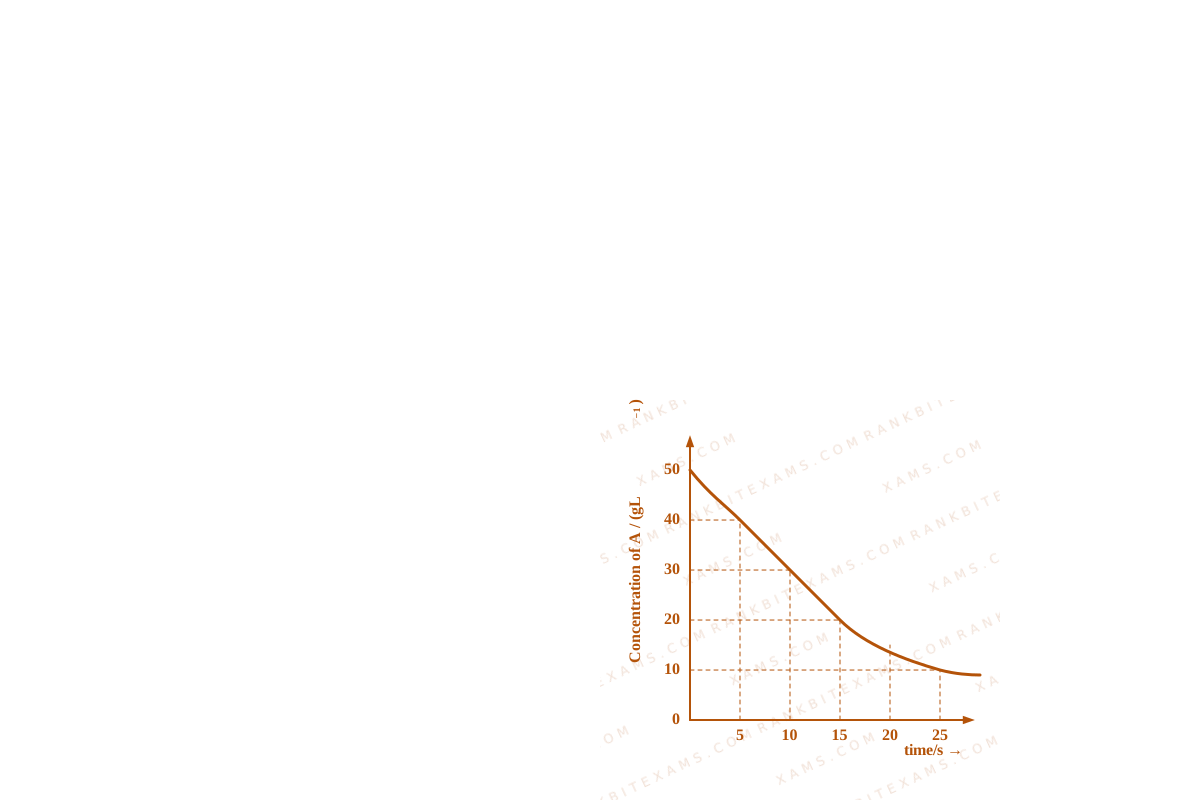
Let's first analyze the order of the reaction using the concentration-time coordinates from the graph:
- At t=5~s, concentration [A] = 40~ g~L⁻¹
- At t=15~s, concentration [A] = 20~ g~L⁻¹
- At t=25~s, concentration [A] = 10~ g~L⁻¹
Notice that the concentration drops to exactly half of its value (40 arrow 20) over a time interval of Δ t = 15 - 5 = 10~s.
Again, the concentration drops to half (20 arrow 10) in another interval of Δ t = 25 - 15 = 10~s.
Since the half-life (t1/2) is constant and independent of the initial concentration, this reaction follows first-order kinetics.
Step 1: Calculate the Rate Constant (k)
The half-life of the reaction is t1/2 = 10~s.
k = (ln 2)/(10) = (2.303 2)/(10) = (2.303 × 0.3010)/(10) ≈ 0.0693~ s⁻¹Step 2: Calculate the Time for Decay to 2.5 g/L
Given initial concentration A₀ = 50~ g~L⁻¹ and target concentration Aₜ = 2.5~ g~L⁻¹:
t = (2.303)/(k) ((A₀)/(Aₜ)) t = (2.303)/((2.303 2)/(10)) ((50)/(2.5)) t = (10)/( 2) (20) t = 10 × ( (10) + (2))/( (2)) t = 10 × ( (1 + 0.3010)/(0.3010) ) t = 10 × ( (1.3010)/(0.3010) ) ≈ 43.22~sRounding to the nearest integer gives 43 seconds.
Pattern Recognition
Shortcut trick: If t1/2 = 10~s, any concentration drop of 2ⁿ times takes n × t1/2 seconds. Here, (50)/(2.5) = 20. Since 2⁴ = 16 (takes 40 s) and 2⁵ = 32 (takes 50 s), a drop of 20 times must take slightly over 40 seconds. This confirms our calculation of 43 seconds.
Chapter Mix
Class 12 Chemistry: Chemical Kinetics
.svg "linear kinetic graph, half-life regression plot, zero order slope profile")
