JEE Main · Chemistry → Steady

Chemical Kinetics appeared 42 times across 3 years — 4.9% of Chemistry. This question is from Integrated Rate Equations.

Year 2026 2025 2024 Total
Questions 14 20 8 42

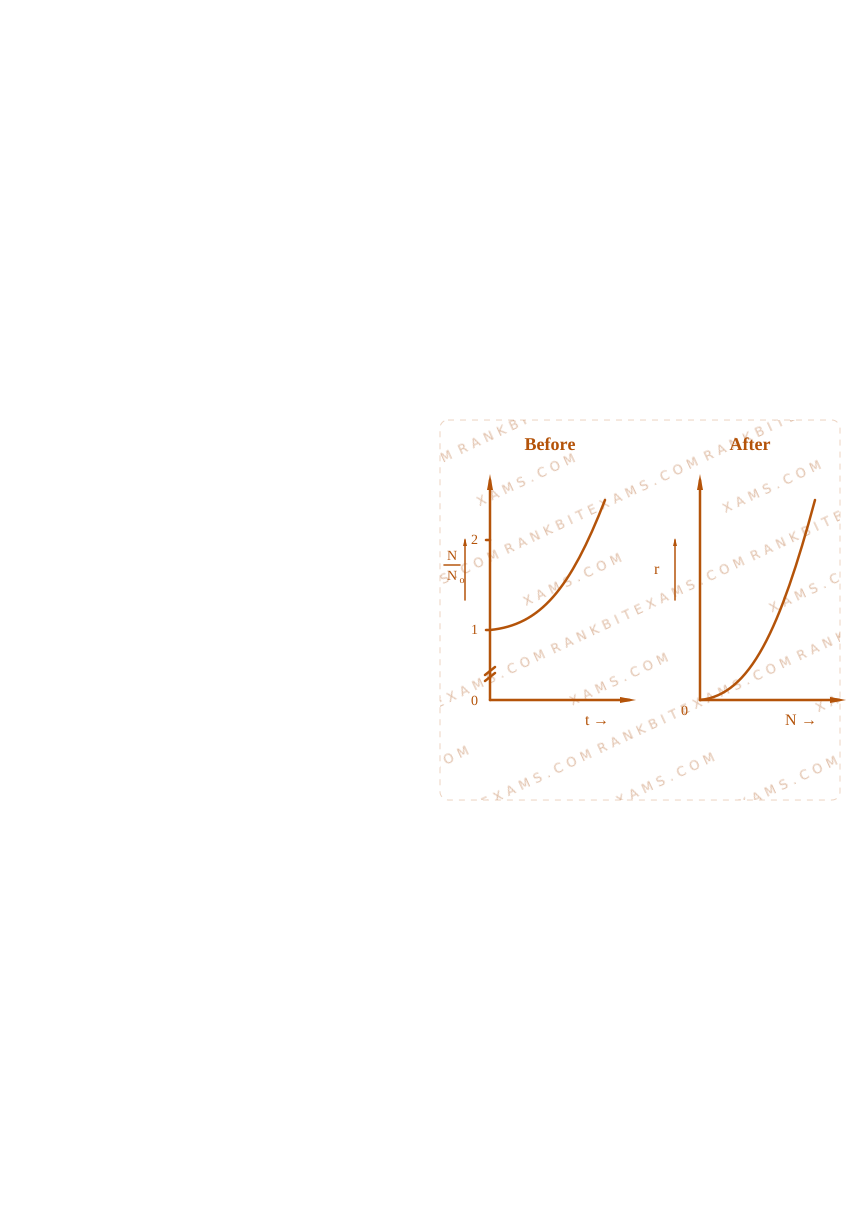
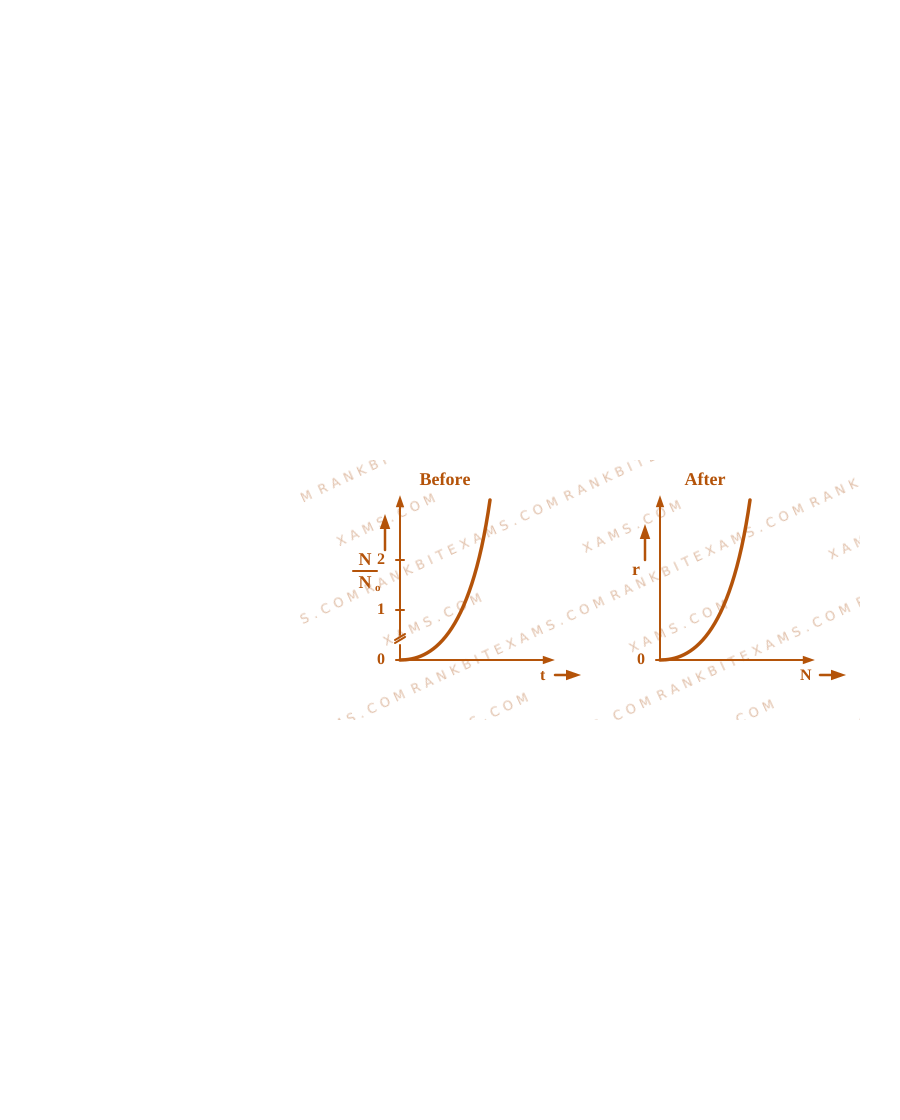
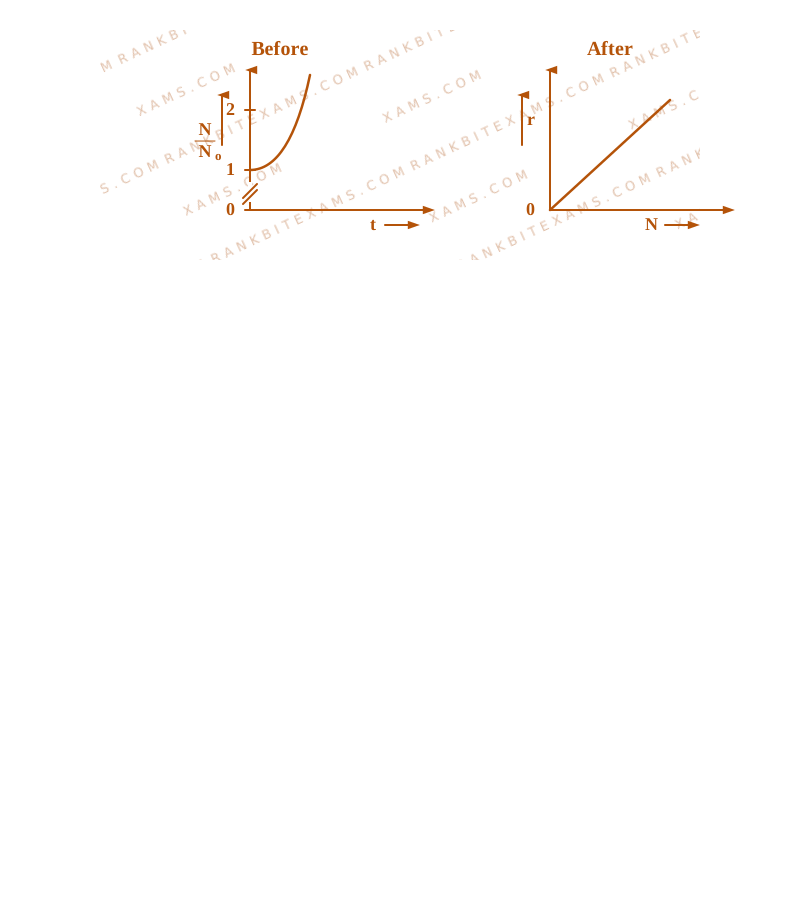
A person's wound was exposed to some bacteria and then bacteria growth started to happen at the same place. The wound was later treated with some antibacterial medicine and the rate of bacterial decay (r) was found to be proportional with the square of the existing number of bacteria at any instance. Which of the following set of graphs correctly represents the 'before' and 'after' situation of the application of the medicine? [Given: N = No. of bacteria, t = time, bacterial growth follows Ist order kinetics.]

Solution & Explanation

Related Formula
Before: (dN)/(dt) = k₁ N N = N₀ ek₁ t After: -(dN)/(dt) = k₂ N² (1)/(N) - (1)/(N₀) = k₂ t
Core Logic

Let's analyze the kinetics for the two stages:

  • Before applying medicine:
  • Bacterial growth follows 1st order kinetics: (dN)/(dt) = k₁ N.
  • Integrating this yields: N(t) = N₀ ek₁ t.
  • The graph of (N)/(N₀) vs t is a rising exponential curve starting from 1 (since at t=0, (N)/(N₀) = 1).
  • After applying medicine:
  • Reductive rate is proportional to the square of existing bacteria (2nd order decay):
-(dN)/(dt) = k₂ N² (dN)/(N²) = -k₂ dt
  • Integrating this yields:
-(1)/(N) = -k₂ t + C (1)/(N) = k₂ t + (1)/(N₀) N(t) = (N₀)/(1 + N₀ k₂ t)
  • A plot of N vs t or (N)/(N₀) vs t for this decay is a hyperbolic curve decreasing gradually.
  • Option B correctly matches the exponential growth before medicine and the hyperbolic decay after medicine.
Pattern Recognition

First-order growth is an exponential curve (N₀ ekt), while second-order decay behaves as a rational hyperbolic relationship (1 / (1 + bt)). Option B shows the exact transition from an exponential rise to a hyperbolic decay curve.

Chapter Mix

Class 12 Chemistry: Chemical Kinetics

More Chemical Kinetics Previous-Year Questions — Page 2

Q75 jee_main_2026_22_january_evening Activation Energy Calculation
Consider A k₁ B and C k₂ D are two reactions. If the rate constant (k₁) of the A arrow B reaction can be expressed by the following equation ₁₀k = 14.34 - 1.5 × 10⁴T/K and activation energy of C arrow D reaction (Eₐ₂) is (1)/(5)th of the A arrow B reaction (Eₐ₁), then the value of (Eₐ₂) is ____ kJ mol⁻¹. (Nearest Integer)
Numerical Answer. Answer: 57 to 57

Solution

Related Formula
₁₀ k = ₁₀ A - (Eₐ)/(2.303 R T) Eₐ₁2.303 R = 1.5 × 10⁴
Core Logic

Step 1: Calculate Eₐ₁ from the Arrhenius equation slope:

Eₐ₁ = 1.5 × 10⁴ × 2.303 × 8.314 J mol⁻¹ Eₐ₁ = 287207 J mol⁻¹ = 287.207 kJ mol⁻¹

Step 2: Calculate Eₐ₂:

Eₐ₂ = Eₐ₁5 = (287.207)/(5) = 57.4414 kJ mol⁻¹ ≈ 57 kJ mol⁻¹
Pattern Recognition

Sees: Arrhenius log equation comparing slopes. Shortcut: Eₐ₁ = 1.5 × 10⁴ × 2.303 × 8.314 = 287.2 kJ; divide by 5 gives 57.44 ≈ 57 kJ/mol.

Chapter Mix

Class 12 Chemistry: Chemical Kinetics
Q71 jee_main_2026_23_january_morning Zero Order Kinetics
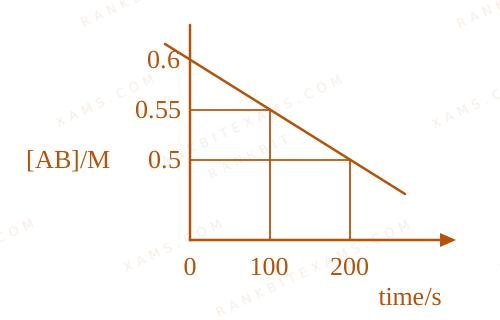
For the thermal decomposition of reaction AB(g), the following is constructed.
Zero Order Kinetics diagram for Q71 - JEE Main 2026 Morning
The image shows a linear downward slope on a graph of concentration vs. time, indicating a zero-order reaction.
The half life of the reaction is 'x' min. x = ____ min. (Nearest integer)
Numerical Answer. Answer: 10 to 10

Solution

Related Formula
[AB]ₜ = [AB]₀ - kt t1/2 = ([AB]₀)/(2k)
Core Logic

The graph of concentration vs time is a straight line with a negative slope, which is the hallmark of a zero-order reaction. The slope of the line equals -k.

Step 1: Finding Rate Constant (k)

From the given graph coordinates: At t = 0, [AB]₀ = 0.60 M At t = 100 s, [AB]₁₀₀ = 0.55 M

k = ([AB]₀ - [AB]ₜ)/(t) k = (0.60 - 0.55)/(100) = (0.05)/(100) = 5 × 10⁻⁴ M/s
Step 2: Calculating Half-Life
t1/2 = ([AB]₀)/(2k) = 0.602 × 5 × 10⁻⁴ t1/2 = 0.6010⁻³ = 600 seconds

Converting to minutes:

x = (600)/(60) = 10 min
Pattern Recognition

Linear [A] vs t plot arrow Zero order. Half-life for zero order is proportional to initial concentration. t1/2 = [A]₀ / 2k.

Chapter Mix

Class 12 Chemistry: Chemical Kinetics
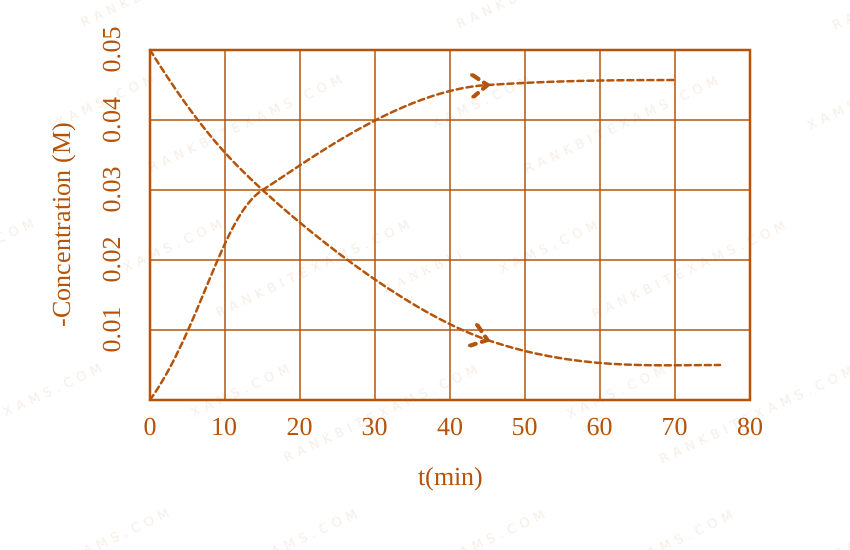
Q51 jee_main_2026_23_january_evening Rate of Reaction
Rate of Reaction diagram for Q51 - JEE Main 2026 Evening
A graph showing concentration vs time for reactant A and product B over an 80 minute period.
Given above is the concentration vs time plot for a dissociation reaction : A arrow nB. Based on the data of the initial phase of the reaction (initial 10 min), the value of n is ____.
  • A. 4
  • B. 3
  • C. 2
  • D. 5

Solution

Related Formula
Rate = -(Δ[A])/(Δ t) = (1)/(n)(Δ[B])/(Δ t)
Core Logic

For the reaction A arrow nB, the stoichiometry determines the relationship between the change in concentration of A and B.

From the graph, at t = 0 min: [A] = 0.05 M [B] = 0 M

At t = 10 min: [A] = 0.04 M Change in [A] = 0.05 - 0.04 = 0.01 M

Since 1 mole of A dissociates to give n moles of B, the concentration of B formed will be n × change in [A]. Δ[B] = 0.01 × n

Step 1: Calculating n

From the graph, at t = 10 min, the concentration of B is 0.03 M.

Equating this to our stoichiometric expression:

0.01 × n = 0.03

n = 3

Pattern Recognition

Visually compare the vertical drops/rises at the first time interval. A drops by 1 unit, B rises by 3 units. The ratio directly gives the stoichiometric coefficient n = 3.

Chapter Mix

Class 12 Chemistry: Chemical Kinetics
Q61 jee_main_2026_23_january_evening First Order Reactions
Observe the following reactions at T(K) I. A arrow products. II. 5Br⁻(aq) + BrO₃⁻(aq) + 6H⁺(aq) arrow 3Br₂(aq) + 3H₂O(l) Both the reactions are started at 10.00 am. The rates of these reactions at 10.10 am are same. The value of - Δ[Br⁻]Δ t at 10.10 am is 2 × 10⁻⁴ mol L⁻¹ min⁻¹. The concentration of A at 10.10 am is 10⁻² mol L⁻¹. What is the first order rate constant (in min⁻¹) of reaction I?
  • A. 2 × 10⁻³
  • B. 10⁻³
  • C. 10⁻²
  • D. 4 × 10⁻³

Solution

Related Formula
Rate of reaction = (-1)/(νᵢ) (d[Reactant])/(dt) Rate of first order reaction = k[A]
Core Logic

At t = 10 minutes (10:10 am): For reaction II: 5Br⁻ + BrO₃⁻ + 6H⁺ arrow 3Br₂ + 3H₂O The overall rate of reaction II is expressed by dividing the rate of disappearance of Br^- by its stoichiometric coefficient:

RateII = -(1)/(5) Δ[Br⁻]Δ t

Given - Δ[Br⁻]Δ t = 2 × 10⁻⁴ mol L⁻¹ min⁻¹, we have:

RateII = (1)/(5) × (2 × 10⁻⁴) = 4 × 10⁻⁵ mol L⁻¹ min⁻¹
Step 1: Equating Rates

The problem states that the rates of both reactions are identical at this time. Therefore, RateI = RateII = 4 × 10⁻⁵ mol L⁻¹ min⁻¹.

For the first-order reaction I (A arrow products):

RateI = k[A]
Step 2: Calculating Rate Constant

Substitute the known values at t = 10 min:

4 × 10⁻⁵ = k × (10⁻²) k = 4 × 10⁻⁵10⁻² = 4 × 10⁻³ min⁻¹
Pattern Recognition

Remember to divide the given rate of disappearance of a species by its stoichiometric coefficient to find the true, normalized "Rate of Reaction" before equating it to another reaction's rate.

Chapter Mix

Class 12 Chemistry: Chemical Kinetics

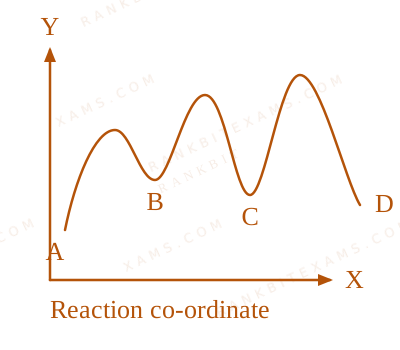
Q52 jee_main_2026_24_january_morning Reaction Profile and Energy Diagram
A arrow D is an endothermic reaction occurring in three steps (elementary). (i) A arrow B Δ Hᵢ = +ve (ii) B arrow C Δ Hᵢᵢ = -ve (iii) C arrow D Δ Hᵢᵢᵢ = -ve Which of the following graphs between potential energy (y-axis) vs reaction coordinate (x-axis) correctly represents the reaction profile of A arrow D ?
  • A. Graph 1
  • B. Graph 2
  • C. Graph 3
  • D. Graph 4

Solution

Core Logic

Given the overall reaction A arrow D is endothermic:

Δᵣ H = +ve ED > EA

Analyzing the mechanism steps: Step (i): A arrow B, Δᵣ H = +ve EB > EA Step (ii): B arrow C, Δᵣ H = -ve EC < EB Step (iii): C arrow D, Δᵣ H = -ve ED < EC

Putting it all together, we must have a profile where the final energy ED is higher than the initial energy EA, with intermediate dips corresponding to B and C as guided by the individual step enthalpies.

Reaction Profile for A to D

Step 1: Final Conclusion

Graph 3 matches all criteria: Overall endothermic (D > A), first step endothermic (B > A), followed by two exothermic steps (C < B and D < C).

Pattern Recognition

Endothermic overall means the tail end (products) sits higher than the origin (reactants). Exothermic intermediate steps mean the curve drops from the previous intermediate well.

Chapter Mix

Class 12 Chemistry: Chemical Kinetics Class 11 Chemistry: Thermodynamics

Rankbit System
JEE Physics: Waves (+15.5%) | Electrostatics: Concentric Shells (-29.7%) | Modern Physics: Photoelectric Clones (+34.2%) | Mathematics: Definite Integrals (+18.1%) | Chemistry: Coordination Splitting (-11.4%) | JEE Physics: Waves (+15.5%) | Electrostatics: Concentric Shells (-29.7%) | Modern Physics: Photoelectric Clones (+34.2%) | Mathematics: Definite Integrals (+18.1%) | Chemistry: Coordination Splitting (-11.4%)