Given below are two statements: Statement I: Dimethyl ether is completely soluble in water. However, diethyl ether is soluble in water to a very small extent. Statement II: Sodium metal can be used to dry diethyl ether and not ethyl alcohol. In the light of given statements, choose the correct answer from the options given below:

Solution & Explanation

### Core Logic Statement I: Dimethyl ether (CH_3OCH_3) is highly soluble in water because its smaller alkyl chain allows substantial hydrogen bonding with water molecules. In contrast, diethyl ether has a larger hydrophobic ethyl group which drastically reduces its water solubility (to about 7.5text g per 100text mL). Thus, Statement I is true. Statement II: Sodium metal (Na) reacts violently with alcohols like ethyl alcohol to release hydrogen gas: 2textC_2textH_5textOH + 2textNa rightarrow 2textC_2textH_5textONa + textH_2uparrow Since diethyl ether has no active acidic hydrogen, it does not react with sodium metal. Hence, sodium can dry diethyl ether but cannot be used for ethyl alcohol. Statement II is true. ### Pattern Recognition Ethers are miscible with water primarily when the non-polar alkyl parts are very small. Active hydrogen presence (-textOH group in alcohols) prevents the use of alkali metals like sodium for moisture removal. ### Evaluation Rubric / Model Answer null ### Chapter Mix Class 12 Chemistry: Alcohols, Phenols and Ethers

Reference Study Guides

More Alcohols, Phenols and Ethers Previous-Year Questions — Page 2

Q72 jee_main_2024_01_february_morning Electrophilic Substitution
Which of the following compound will most easily be attacked by an electrophile?
  • A. Chlorobenzene
  • B. Toluene
  • C. Benzoic acid
  • D. Phenol

Solution

### Core Logic An electrophile seeks electrons. Higher electron density in the benzene ring makes it more susceptible (reactive) to electrophilic attack. The ring's electron density is governed by the inductive (I) and mesomeric/resonance (M) effects of the attached groups. ### Step 1: Evaluate Substituent Effects - Cl (in chlorobenzene): shows weak +M effect but strong -I effect, causing net deactivation. - CH_3 (in toluene): shows +I effect and hyperconjugation, slightly activating the ring. - COOH (in benzoic acid): shows strong -M and -I effect, highly deactivating. - OH (in phenol): shows strong +M effect which dominates its weak -I effect, strongly activating the ring. ### Step 2: Conclusion Phenol has the highest electron density in the ring among the given options due to the strong +M effect of the -OH group. Thus, it is most easily attacked by an electrophile. ### Pattern Recognition Reactivity towards Electrophilic Aromatic Substitution (EAS): Strong +M (-OH, -NH2) > Weak +I/Hyperconjugation (-CH3) > Halogens (-Cl, net deactivating) > Strong -M (-COOH, -NO2). ### Evaluation Rubric / Model Answer null ### Chapter Mix Class 11 Chemistry: Hydrocarbons Class 12 Chemistry: Alcohols, Phenols and Ethers
Q71 jee_main_2024_27_jan_morning Acidity of Phenols and Lucas Test
Given below are two statements: Statement (I): p-nitrophenol is more acidic than m-nitrophenol and o-nitrophenol. Statement (II) : Ethanol will give immediate turbidity with Lucas reagent. In the light of the above statements, choose the correct answer from the options given below :
  • A. Statement I is true but Statement II is false
  • B. Both Statement I and Statement II are true
  • C. Both Statement I and Statement II are false
  • D. Statement I is false but Statement II is true

Solution

### Core Logic Statement I is correct: At the para-position, the -textNO_2 group exerts both powerful -I and -M effects, maximizing electron withdrawal from the phenoxide ion. Intramolecular hydrogen bonding reduces the acidity of o-nitrophenol. Statement II is incorrect: Lucas reagent (textconc. HCl + textanhydrous ZnCl_2) reacts instantly with tertiary alcohols to give immediate turbidity. Primary alcohols like ethanol do not show turbidity at room temperature without prolonged heating. ### Pattern Recognition Para-nitrophenol acidity maximization vs Lucas test thresholds (3^circ > 2^circ > 1^circ). Primary alcohols react very slowly. ### Chapter Mix Class 12 Chemistry: Alcohols, Phenols and Ethers
Q72 jee_main_2024_27_jan_morning Acidity Trends in Phenols
The ascending order of acidity of -OH group in the following compounds is: (A) textBu - OH (B) p-nitrophenol (C) p-methoxyphenol (D) Phenol (E) 2,4-dinitrophenol Choose the correct answer from the options given below:
Acidity compounds structural forms for Q72 - JEE Main 2024 Morning
Structures of molecules P, Q, R, S assigned letters A through E.
Acidity compounds structural forms for Q72 - JEE Main 2024 Morning
Structures of molecules P, Q, R, S assigned letters A through E.
  • A. (A) < (D) < (C) < (B) < (E)
  • B. (C) < (A) < (D) < (B) < (E)
  • C. (C) < (D) < (B) < (A) < (E)
  • D. (A) < (C) < (D) < (B) < (E)

Solution

### Core Logic Aliphatic alcohols (textBu-OH) are least acidic due to +I effects. Among phenols, electron-donating groups like -textOMe (+M effect) reduce acidity relative to plain phenol, while electron-withdrawing groups (-textNO_2, -M and -I effects) significantly enhance stability of the conjugate phenoxide base. Two -textNO_2 groups heighten acidity maximally.
Acidity progression schematic overview for Q72 - JEE Main 2024 Morning
Structures of molecules P, Q, R, S assigned letters A through E.
### Step 1: Order verification textBu-OH (A) < textp-methoxyphenol (C) < textphenol (D) < textp-nitrophenol (B) < text2,4-dinitrophenol (E) ### Pattern Recognition +M groups lower acidity; -M groups raise it. Alcohols are always less acidic than resonant phenols. ### Chapter Mix Class 12 Chemistry: Alcohols, Phenols and Ethers
Q67 jee_main_2024_29_jan_morning Cleavage of C-O Bond in Ethers
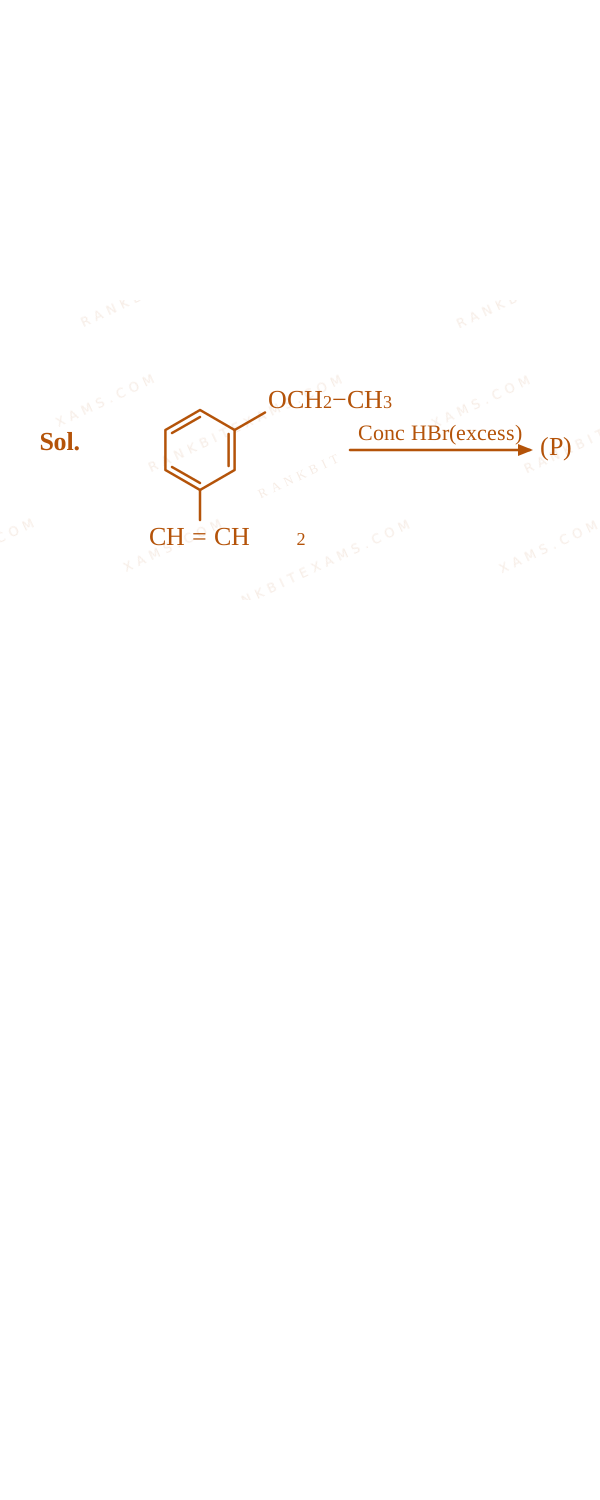
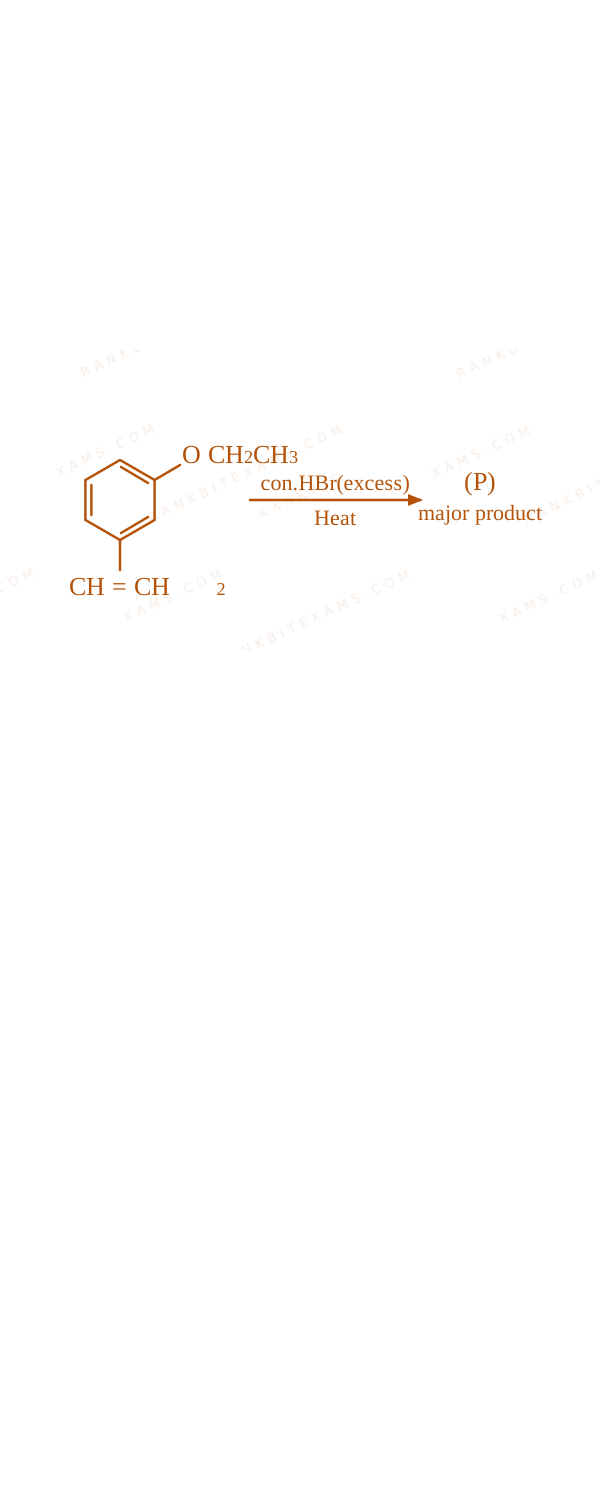
The major product(P) in the following reaction is
Cleavage of C-O Bond in Ethers diagram for Q67 - JEE Main 2024 Morning
Reaction showing an aromatic ether with a vinyl group reacting with excess HBr.
  • A. ""
  • B. ""
  • C. ""
  • D. ""

Solution

### Core Logic The substrate has two reactive functional groups towards HBr (in excess): 1. An aromatic ether (anisole-type) linkage: -O-CH_2-CH_3 2. An isolated alkene (vinyl) group attached to the aromatic ring: -CH=CH_2 **Reaction 1: Ether Cleavage** The ether linkage reacts with HBr. Protonation of the ether oxygen occurs first, forming an oxonium ion. The Br^- ion then attacks the less hindered (and sp^3 hybridized) alkyl group (S_N2 mechanism), specifically the ethyl group. The C(textaryl)-O bond is much stronger due to partial double bond character from resonance, so it does NOT break. This yields a phenol group on the ring and ethyl bromide (CH_3-CH_2-Br). **Reaction 2: Electrophilic Addition to Alkene** The vinyl group (-CH=CH_2) undergoes electrophilic addition with HBr. Protonation yields the more stable secondary benzylic carbocation (Markovnikov's rule). The Br^- then attacks this carbocation to form a 1-bromoethyl group attached to the ring. ### Step 1: Detailed Mechanism
Cleavage of C-O Bond in Ethers diagram for Q67 - JEE Main 2024 Morning
Reaction showing an aromatic ether with a vinyl group reacting with excess HBr.
Cleavage of C-O Bond in Ethers diagram for Q67 - JEE Main 2024 Morning
Reaction showing an aromatic ether with a vinyl group reacting with excess HBr.
Final product: The ring retains an -OH group (phenol) at the original ether position, and the vinyl group is converted into a -CH(Br)-CH_3 group. ### Pattern Recognition Excess HBr with an aryl-alkyl ether always cleaves the alkyl C-O bond to give phenol + alkyl bromide. Never break the aryl C-O bond. ### Evaluation Rubric / Model Answer null ### Chapter Mix Class 12 Chemistry: Alcohols Phenols and Ethers Class 11 Chemistry: Hydrocarbons
Q62 jee_main_2024_30_january_evening Reactions of Phenols
Salicylaldehyde is synthesized from phenol, when reacted with
  • A.
  • B. textCO_2 text, NaOH
  • C. textCCl_4 text, NaOH
  • D. textHCCl_3 text, NaOH

Solution

### Core Logic Salicylaldehyde is synthesized from phenol via the Reimer-Tiemann reaction. In this reaction, phenol is treated with chloroform (CHCl_3 or HCCl_3) and aqueous sodium hydroxide (NaOH) to introduce an aldehyde group (-CHO) at the ortho position of the benzene ring.
Reimer Tiemann reaction mechanism diagram for Q62 - JEE Main 2024 Evening
### Pattern Recognition Reimer-Tiemann = Phenol + CHCl_3 + NaOH rightarrow Salicylaldehyde. Kolbe's = Phenol + CO_2 + NaOH rightarrow Salicylic acid. ### Evaluation Rubric / Model Answer null ### Chapter Mix Class 12 Chemistry: Alcohols Phenols and Ethers

More Alcohols, Phenols and Ethers Questions — jee_main_2025_07_april_morning

Practice all Alcohols, Phenols and Ethers previous-year questions →

Rankbit System
JEE Physics: Waves (+15.5%) | Electrostatics: Concentric Shells (-29.7%) | Modern Physics: Photoelectric Clones (+34.2%) | Mathematics: Definite Integrals (+18.1%) | Chemistry: Coordination Splitting (-11.4%) | JEE Physics: Waves (+15.5%) | Electrostatics: Concentric Shells (-29.7%) | Modern Physics: Photoelectric Clones (+34.2%) | Mathematics: Definite Integrals (+18.1%) | Chemistry: Coordination Splitting (-11.4%)