JEE Main · Physics → Steady

Electrostatics appeared 79 times across 3 years — 9.1% of Physics. This question is from Dielectrics and Capacitance.

Year 2026 2025 2024 Total
Questions 24 39 16 79

A parallel plate capacitor has charge 5×10⁻⁶~C. A dielectric slab is inserted between the plates and almost fills the space between the plates. If the induced charge on one face of the slab is 4×10⁻⁶~C then the dielectric constant of the slab is _______. [cite: 183, 184]

Numerical Answer Type:
Enter a numerical value Answer: 5 to 5 +4 marks

Solution & Explanation

Related Formula

Qind = Q(1 - (1)/(K)) [cite: 813]

Core Logic

Substitute the values given for free surface charge Q = 5 × 10⁻⁶ C and bound induced charge Qind = 4 × 10⁻⁶ C into the equation: [cite: 183, 184, 814]

4 × 10⁻⁶ = 5 × 10⁻⁶ (1 - (1)/(K)) [cite: 814]

(4)/(5) = 1 - (1)/(K) (1)/(K) = 1 - (4)/(5) = (1)/(5) [cite: 815]

K = 5 [cite: 815]

Pattern Recognition

The fraction of charge induced on the dielectric face scales structurally as (K-1)/(K)[cite: 813, 815]. Observing a ratio of 4 parts out of 5 implies that the constant factor K must equal 5 directly[cite: 815].

Chapter Mix

Class 12 Physics: Electrostatics

Reference Study Guides

More Electrostatics Previous-Year Questions — Page 10

Q7 jee_main_2025_04_april_evening Electric Field due to Continuous Charge Distribution
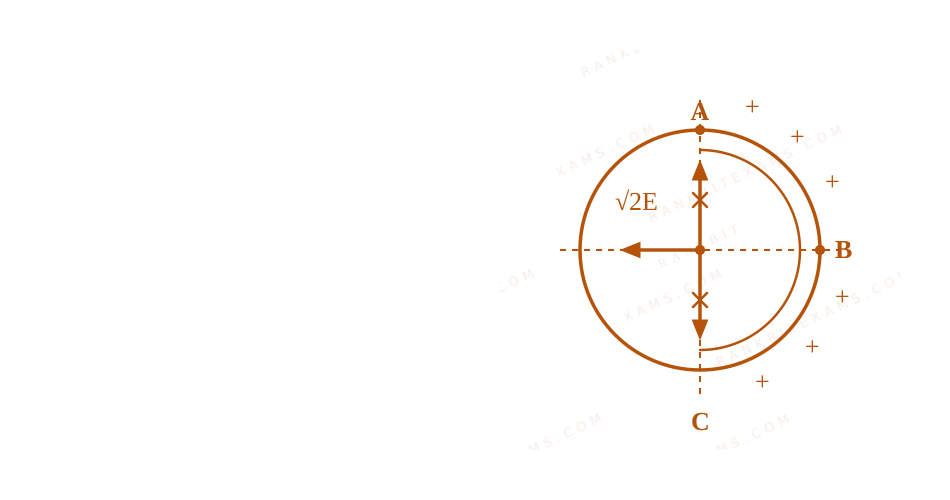
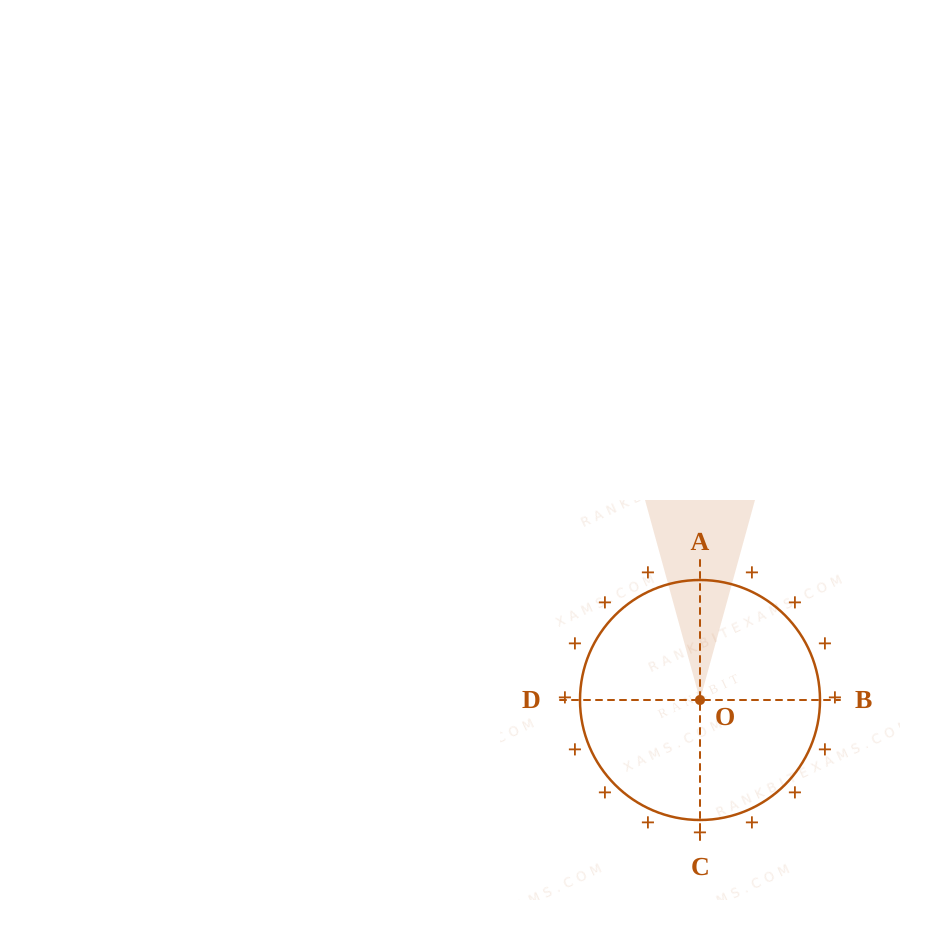
A metallic ring is uniformly charged as shown in figure. AC and BD are two mutually perpendicular diameters. Electric field due to arc AB to 'O' is 'E' is magnitude. What would be the magnitude of electric field at 'O' due to arc ABC?
Uniformly charged ring with perpendicular diameters
A circle showing perpendicular axes AC and BD dividing it into quadrants.
  • A. 2E
  • B. √(2)E
  • C. E/2
  • D. Zero

Solution

Related Formula

The electric field due to a circular arc subtending an angle φ at the center is given by:

Earc = (2kλ)/(R) ((φ)/(2))
Core Logic

Arc AB subtends 90^° (one quadrant) at the center. The electric field due to it is given as E. Arc ABC consists of two independent quadrants: arc AB and arc BC. Each quadrant independently creates an electric field of magnitude E pointing along the bisector of that specific quadrant.

Step 1: Vector Addition

The electric field EAB is directed at 45^° away from both axes into the third quadrant. The electric field EBC is directed at 45^° towards the matching opposite quadrant. Since EAB and EBC are perpendicular to each other, their resultant magnitude is: Eₙₑₜ = √(E² + E²) = √(2)E

Vector field components due to charged arcs
A circle showing perpendicular axes AC and BD dividing it into quadrants.
Vector field components due to charged arcs
A circle showing perpendicular axes AC and BD dividing it into quadrants.

Pattern Recognition

Symmetric components of a ring create orthogonal vector fields. Each 90^° arc produces a field of magnitude E directed along its angular bisector. Two adjacent quadrants have bisectors separated by 90^°, hence use orthogonal vector addition.

Chapter Mix

Class 12 Physics: Electrostatics

Q10 jee_main_2025_04_april_evening Capacitors and Dielectrics
Three parallel plate capacitors C₁, C₂ and C₃ each of capacitance 5 are connected as shown in figure. The effective capacitance between points A and B, when the space between the parallel plates of C₁ capacitor is filled with a dielectric medium having dielectric constant of 4, is:
Capacitor network for Q10
Schematic of three capacitors with a dielectric insertion highlighted on C1.
  • A. 22.5
  • B. 7.5
  • C. 9
  • D. 30

Solution

Related Formula

Capacitance modification by dielectric: C' = K · C Series combination:

Cₛₑᵣᵢₑₛ = (Cₐ Cb)/(Cₐ + Cb)

Parallel combination:

Cparallel = C₁ + C₂
Core Logic

Initial capacitance value C = 5 for all. After dielectric insertion into C₁, its value becomes:

C₁ = 4 × 5 = 20

The values for the others remain constant:

C₂ = 5 , C₃ = 5
Step 1: Circuit Topology Analysis

From the network layout, C₁ and C₂ are configured in a series arm, which is collectively in parallel with C₃. Equivalent of the series arm:

C₁₂ = (20 × 5)/(20 + 5) = (100)/(25) = 4

Adding the parallel branch C₃:

Ceq = C₁₂ + C₃ = 4 + 5 = 9
Pattern Recognition

Identify layout components systematically. Series components simplify via product-over-sum, then combine linearly with parallel components.

Chapter Mix

Class 12 Physics: Electrostatics
Q jee_main_2025_04_april_morning Electric Field Intensity
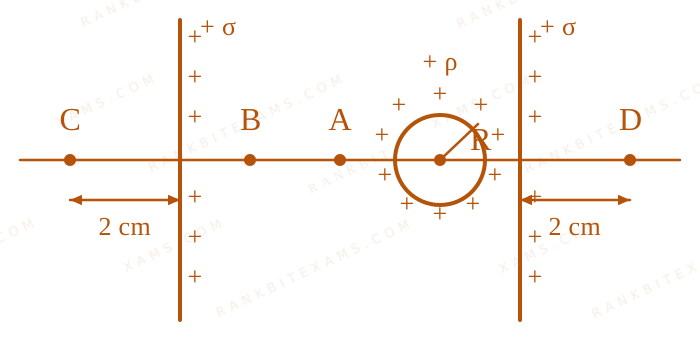
Two infinite identical charged sheets and a charged spherical body of charge density 'ρ' are arranged as shown in figure. Then the correct relation between the electrical fields at A, B, C and D points is :
Electric Field Intensity diagram for Q18 - JEE Main 2025 Morning
The figure illustrates two parallel infinite charged plates with a uniform charge density along with an embedded solid spherical charge mass distributed near reference measurement tags labeled A, B, C, and D.
  • A. EA= EB; EC= ED
  • B. EA> EB; EC= ED
  • C. EC ≠ ED; EA > EB
  • D. | EA|=| EB|; EC> ED

Solution

Related Formula

Principle of superposition for electric fields:

Eₙₑₜ = Esheets + Esphere

Electric field due to an infinite uniformly charged sheet:

Esheet = (σ)/(2ε₀)

Electric field outside a uniformly charged spherical body:

Esphere = (1)/(4πε₀)(q)/(r²) ∝ (1)/(r²)
Core Logic
  • Between the sheets (Points A and B): The two identical infinite parallel sheets produce equal and oppositely directed electric fields that cancel completely (Esheets = 0). Thus, the net electric field is determined entirely by the charged sphere. Because point A is located closer to the center of the sphere than point B (rA < rB):
EA > EB EA > EB
  • Outside the sheets (Points C and D): The planar electric fields reinforce each other in the same direction (E = (σ)/(ε₀)), while the sphere contributes a radial field. Because points C and D lie at different radial distances from the center of the sphere (rD < rC), the net field magnitudes differ:
EC ≠ ED EC ≠ ED

Therefore, the valid relation is EC ≠ ED; EA > EB.

Pattern Recognition

Between two identical positively charged parallel sheets, the sheet fields cancel out completely, making the sphere the sole field source. Outside both sheets, the sheet fields reinforce each other, and asymmetric radial distances to the sphere guarantee unequal net field values.

Evaluation Rubric / Model Answer

Option C: EC ≠ ED; EA > EB

Chapter Mix

Class 12 Physics: Electrostatics
Q jee_main_2025_04_april_morning Torque on an Electric Dipole
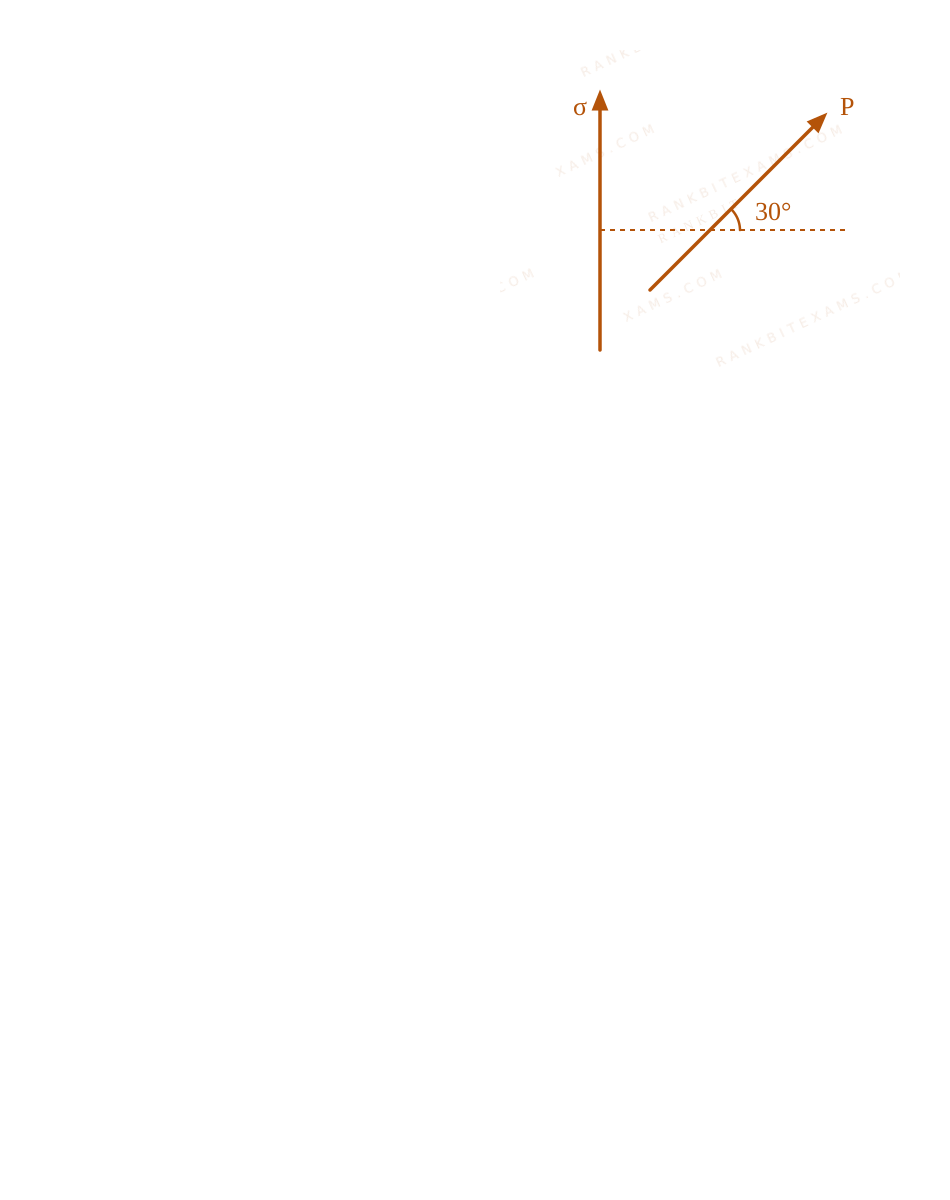
Two small spherical balls of mass 10g each with charges -2mumathrmC and 2mumathrmC, are attached to two ends of very light rigid rod of length 20 cm. The arrangement is now placed near an infinite non-conducting charge sheet with uniform charge density of 100mumathrmC/m² such that length of rod makes an angle of 30° with electric field generated by charge sheet. Net torque acting on the rod is: (Take ε*o = 8.85×10⁻¹²C²/Nm²)
  • A. 112 Nm
  • B. 1.12 Nm
  • C. 2.24 Nm
  • D. 11.2 Nm

Solution

Related Formula

Electric field due to an infinite non-conducting sheet:

E = (σ)/(2ε₀)

Torque on an electric dipole:

τ = pE θ

where p = qd is the magnitude of the electric dipole moment.

Core Logic

Given parameters:

  • Charge magnitude, q = 2 = 2 × 10⁻⁶ C
  • Separation length, d = 20 cm = 0.2 m
  • Surface charge density, σ = 100 /m² = 100 × 10⁻⁶ C/m²
  • Orientation angle with field, θ = 30°
  • Permittivity of free space, ε₀ = 8.85 × 10⁻¹² C²/(N ²)
Step 1: Compute Electric Field and Net Torque

The electric field generated by the infinite non-conducting sheet is uniform:

E = (σ)/(2ε₀) = 100 × 10⁻⁶2 × 8.85 × 10⁻¹² N/C

The dipole moment is:

p = q · d = (2 × 10⁻⁶ C) × (0.2 m) = 4 × 10⁻⁷ C

Substitute p, E, and θ into the torque formula:

τ = pE θ τ = [(2 × 10⁻⁶) × (0.2)] × [ 100 × 10⁻⁶2 × 8.85 × 10⁻¹²] × ((1)/(2)) τ = (10)/(8.85) ≈ 1.12 N

Dipole torque vector field distribution alignment for Q19 - JEE Main 2025 Morning

Pattern Recognition

Equal and opposite charges on a rigid rod constitute an electric dipole. In a uniform field, the net translational force vanishes (Fₙₑₜ = 0), leaving only a pure restoring torque τ = pE θ.

Evaluation Rubric / Model Answer

Option B: 1.12 Nm

Chapter Mix

Class 12 Physics: Electrostatics
Q jee_main_2025_04_april_morning Combination of Capacitors
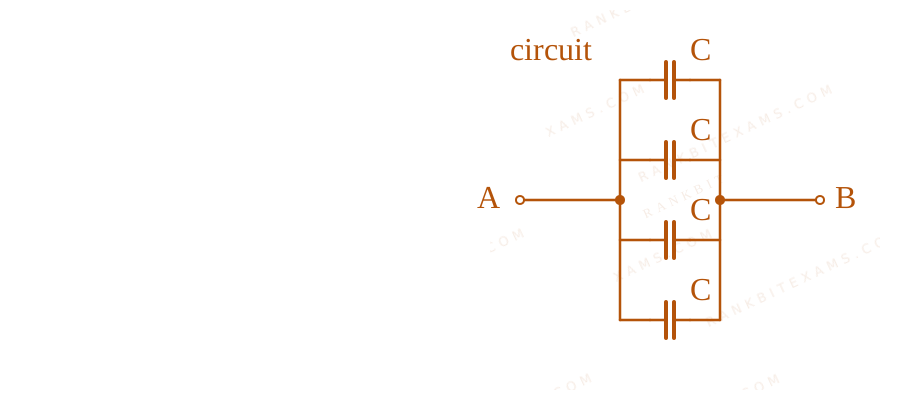
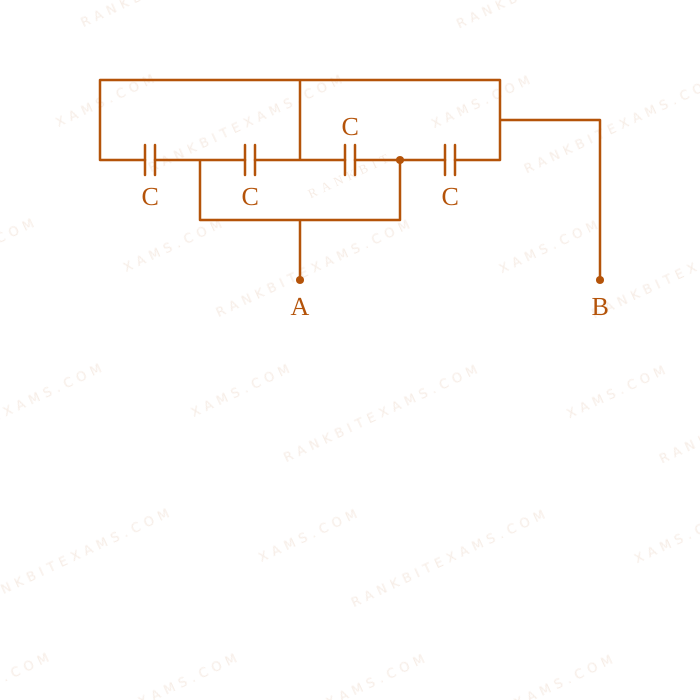
Four capacitor each of capacitance 16mumathrmF are connected as shown in the figure. The capacitance between points A and B is: (in mumathrmF).
Four capacitor network schematic for Q24 - JEE Main 2025 Morning
The figure details an interconnected array layout composed of four identical storage components branching outwards between primary measurement terminals A and B.
Numerical Answer. Answer: 64 to 64

Solution

Related Formula

Equivalent capacitance for capacitors in parallel:

Ceq = C₁ + C₂ + C₃ +
Core Logic

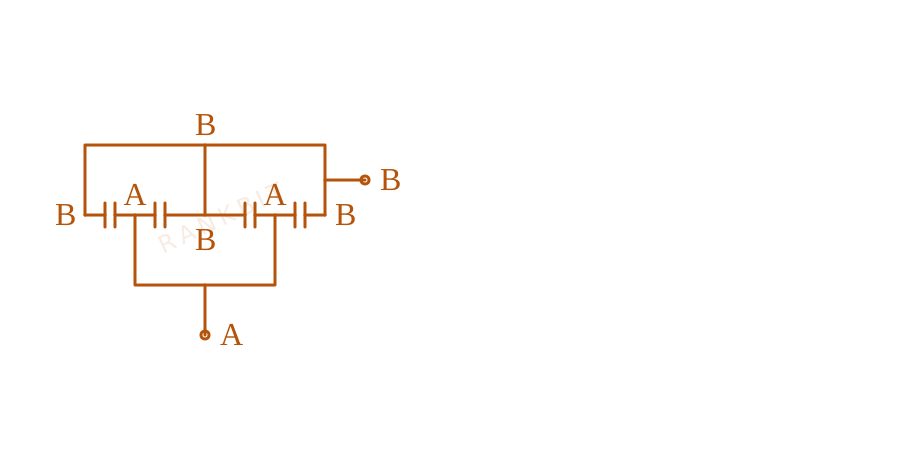
By tracing electric potential along the ideal connecting wires, label the two plates of each capacitor with their connected terminal (A or B).

Node mapping potential re-layout diagram for Q24 - JEE Main 2025 Morning
The figure details an interconnected array layout composed of four identical storage components branching outwards between primary measurement terminals A and B.

Redrawing the circuit reveals that all 4 capacitors are connected directly in parallel across terminals A and B.

Step 1: Calculate Equivalent Value

Since all four identical capacitors are connected in parallel:

Ceq = 4C

Given each capacitor has C = 16:

Ceq = 4 × 16 = 64

Node mapping potential re-layout diagram for Q24 - JEE Main 2025 Morning
The figure details an interconnected array layout composed of four identical storage components branching outwards between primary measurement terminals A and B.

Pattern Recognition

Bridging wires across alternate terminals typically simplifies an apparent ladder into a pure parallel arrangement. Always apply the node-potential labeling method first to identify terminals sharing identical potentials.

Evaluation Rubric / Model Answer

64

Chapter Mix

Class 12 Physics: Electrostatics
More Electrostatics Questions — jee_main_2025_07_april_evening

Practice all Electrostatics previous-year questions →

Rankbit System
JEE Physics: Waves (+15.5%) | Electrostatics: Concentric Shells (-29.7%) | Modern Physics: Photoelectric Clones (+34.2%) | Mathematics: Definite Integrals (+18.1%) | Chemistry: Coordination Splitting (-11.4%) | JEE Physics: Waves (+15.5%) | Electrostatics: Concentric Shells (-29.7%) | Modern Physics: Photoelectric Clones (+34.2%) | Mathematics: Definite Integrals (+18.1%) | Chemistry: Coordination Splitting (-11.4%)