Given below are two statements: one is labelled as Assertion (A) and the other is labelled as Reason (R).
Assertion (A): The outer body of an air craft is made of metal which protects persons sitting inside from lightning-strikes.
Reason (R): The electric field inside the cavity enclosed by a conductor is zero.
In the light of the above statements, chose the most appropriate answer from the options given below:
A.Both (A) and (R) are correct and (R) is the correct explanation of (A)
B.(A) is correct but (R) is not correct
C.Both (A) and (R) are correct but (R) is not correct explanation of (A)
D.(A) is not correct but (R) is correct
Solution & Explanation
Core Logic
According to electrostatic shielding, the electric field inside a cavity of a conductor is always zero, regardless of the size and shape of the cavity and regardless of any charges located outside or on the conductor's surface. Therefore, when lightning strikes a metal aircraft, the entire charge stays on the outer metallic surface and flows down without producing an electric field inside, keeping passengers safe.
Step 1: Statement Evaluation
Assertion (A): Correct, passengers are protected from lightning because of the metallic body shield.
Reason (R): Correct, the field inside a cavity of a conductor is zero.
Explanation: Since the zero field property is precisely why passengers are protected, (R) correctly explains (A).
Pattern Recognition
Metallic shell / shield configuration always establishes Einside = 0$E_{\text{inside}} = 0$. This shielding mechanism directly underpins safety features in lightning scenarios for cars and airplanes.
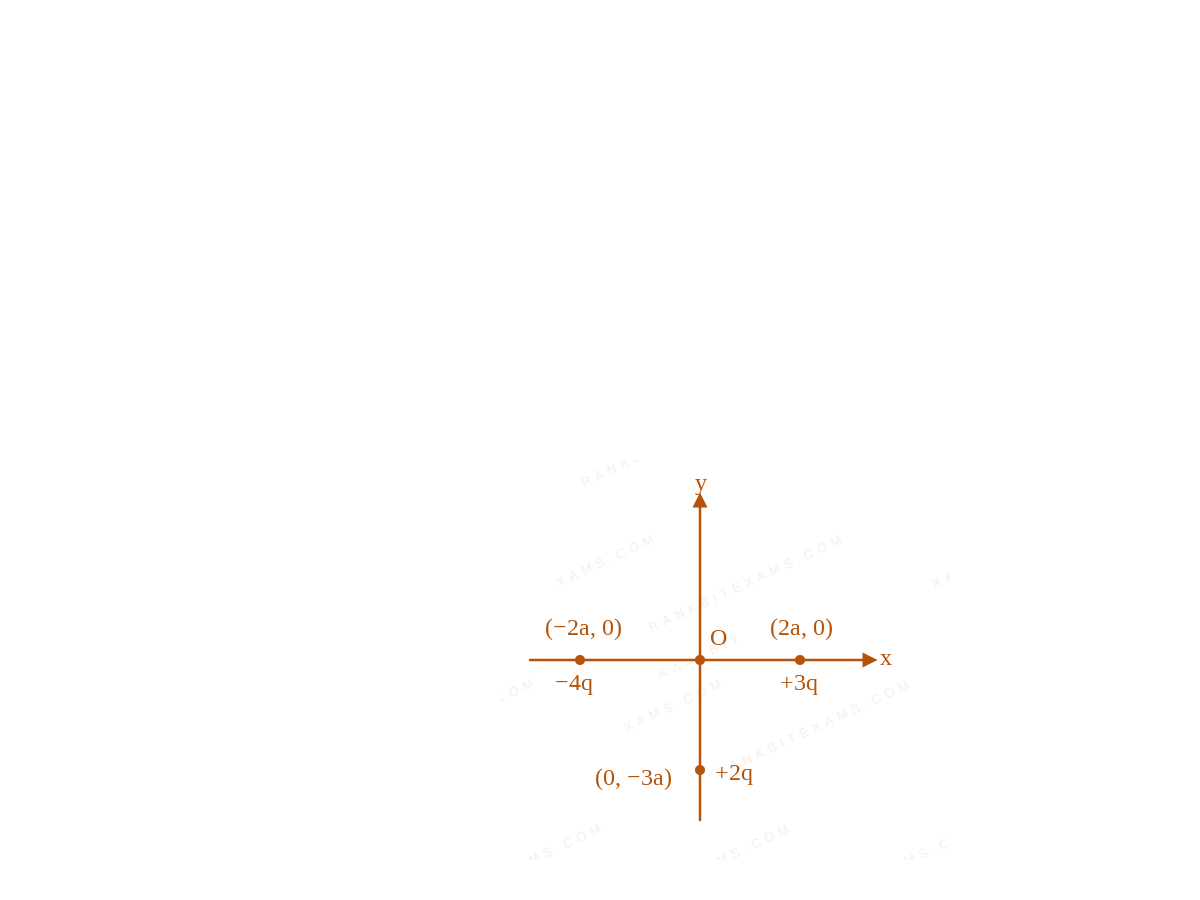
Three charges +2q$+2q$, +3q$+3q$ and -4q$-4q$ are situated at (0,-3a)$(0,-3a)$, (2a, 0)$(2a, 0)$ and (-2a,0)$(-2a,0)$ respectively in the xy plane. The resultant dipole moment about origin is
For a system of point charges where the net charge is non-zero, the dipole moment depends on the origin. However, taking the standard formula Σ qᵢ rᵢ$\sum q_i r_i$ yields the required mathematical expression directly.
Chapter Mix
Class 12 Physics: Electric Charges and Fields
Q40jee_main_2026_24_january_morningGauss's Law
The electrostatic potential in a charged spherical region of radius r varies as V = ar³ + b$V = ar^{3} + b$, where a and b are constants. The total charge in the sphere of unit radius is α × π a in₀$\alpha \times \pi a \in_{0}$. The value of α$\alpha$ is ____. (permittivity of vacuum is in₀$\in_{0}$)
A.-12$-12$
B.-6$-6$
C.-9$-9$
D.-8$-8$
Solution
Related Formula
E = -(dV)/(dr)$$E = -\frac{dV}{dr}$$∮ E · d A = qencε₀$$\oint \vec{E} \cdot d\vec{A} = \frac{q_{\text{enc}}}{\epsilon_0}$$
Core Logic
Gauss law for a spherical region
Given potential V = ar³ + b$V = ar^3 + b$.
The electric field E$E$ is given by the negative gradient of potential:
E = -(dV)/(dr) = -(d)/(dr)(ar³ + b) = -3ar²$$E = -\frac{dV}{dr} = -\frac{d}{dr}(ar^3 + b) = -3ar^2$$
Using Gauss's Law to find the enclosed charge for a spherical region:
Φclosed = E · A = qencε₀$$\Phi_{\text{closed}} = E \cdot A = \frac{q_{\text{enc}}}{\epsilon_0}$$
Step 1: Enclosed Charge Calculation
The surface area of a sphere of radius r=1$r=1$ is A = 4π(1)² = 4π$A = 4\pi(1)^2 = 4\pi$.
The electric field at r=1$r=1$ is:
E = -3a(1)² = -3a$$E = -3a(1)^2 = -3a$$
So,
qenc = ε₀ · E · A = ε₀ (-3a) (4π) = -12π a ε₀$$q_{\text{enc}} = \epsilon_0 \cdot E \cdot A = \epsilon_0 (-3a) (4\pi) = -12\pi a \epsilon_0$$
Comparing with the given expression α × π a ε₀$\alpha \times \pi a \epsilon_0$, we get:
α = -12$\alpha = -12$
Pattern Recognition
For spherical symmetry, extracting total charge enclosed is fastest using Gauss's Law at the boundary surface rather than integrating local charge density ρ(r)$\rho(r)$ using Poisson's equation.
Chapter Mix
Class 12 Physics: Electrostatics
Q44jee_main_2026_24_january_morningElectric Potential of Spherical Shells
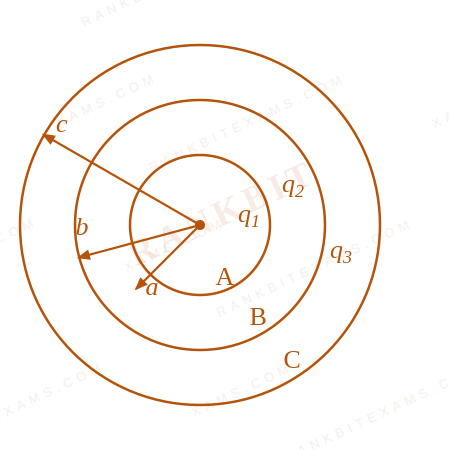
There are three co-centric conducting spherical shells A, B and C of radii a, b and c respectively. The potential of the spheres A, B and C respectively, are :
Potential at surface of middle sphere B (radius b$b$):
For charge q₁$q_1$, this is an outside point. For q₂$q_2$, it's on the surface. For q₃$q_3$, it's inside.
Matching these results shows option (3) represents the potentials perfectly.
Pattern Recognition
Potential on a sphere from inner charges uses its own radius, whereas potential from outer shells uses the outer shell's radius. Inner charges "collapse" computationally to the sphere's center.
Chapter Mix
Class 12 Physics: Electrostatics
Q35jee_main_2026_24_january_eveningCapacitors with Dielectrics
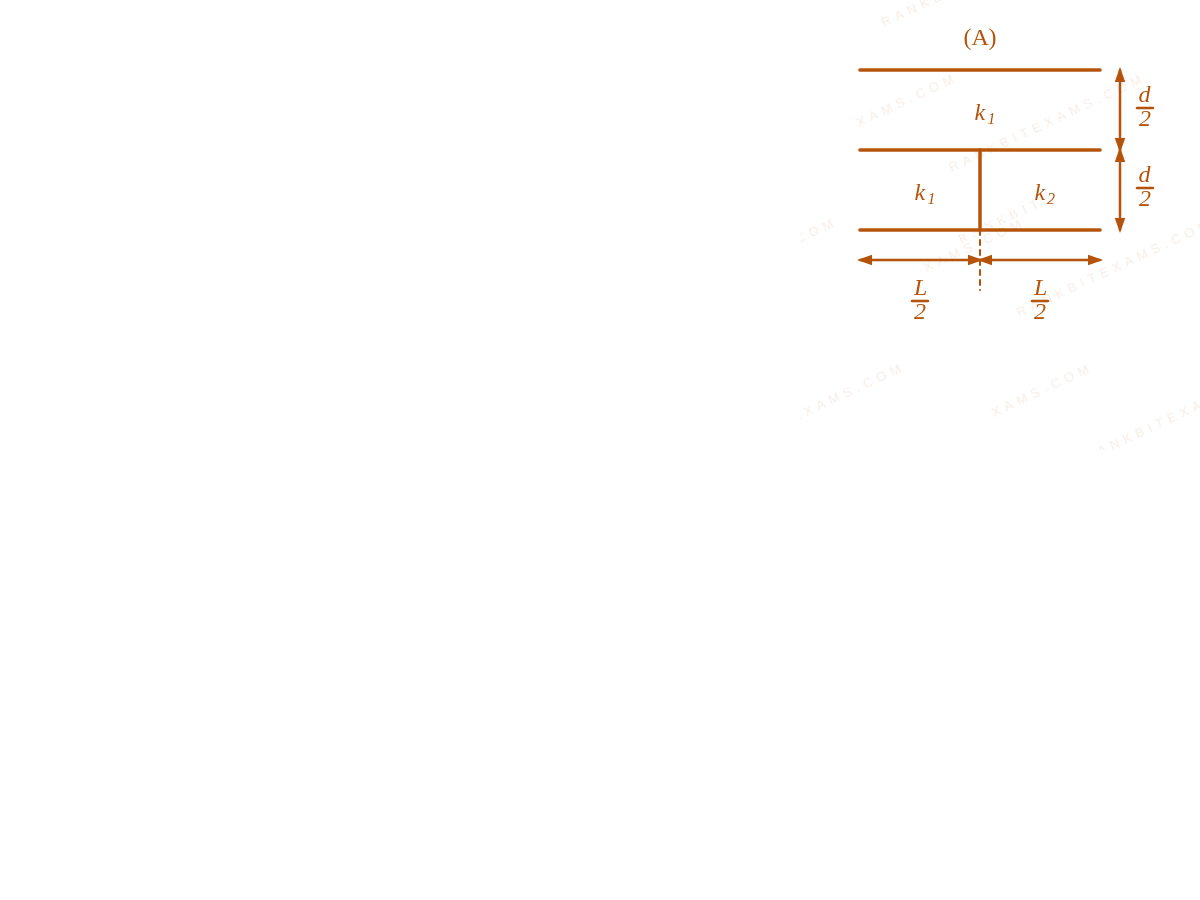
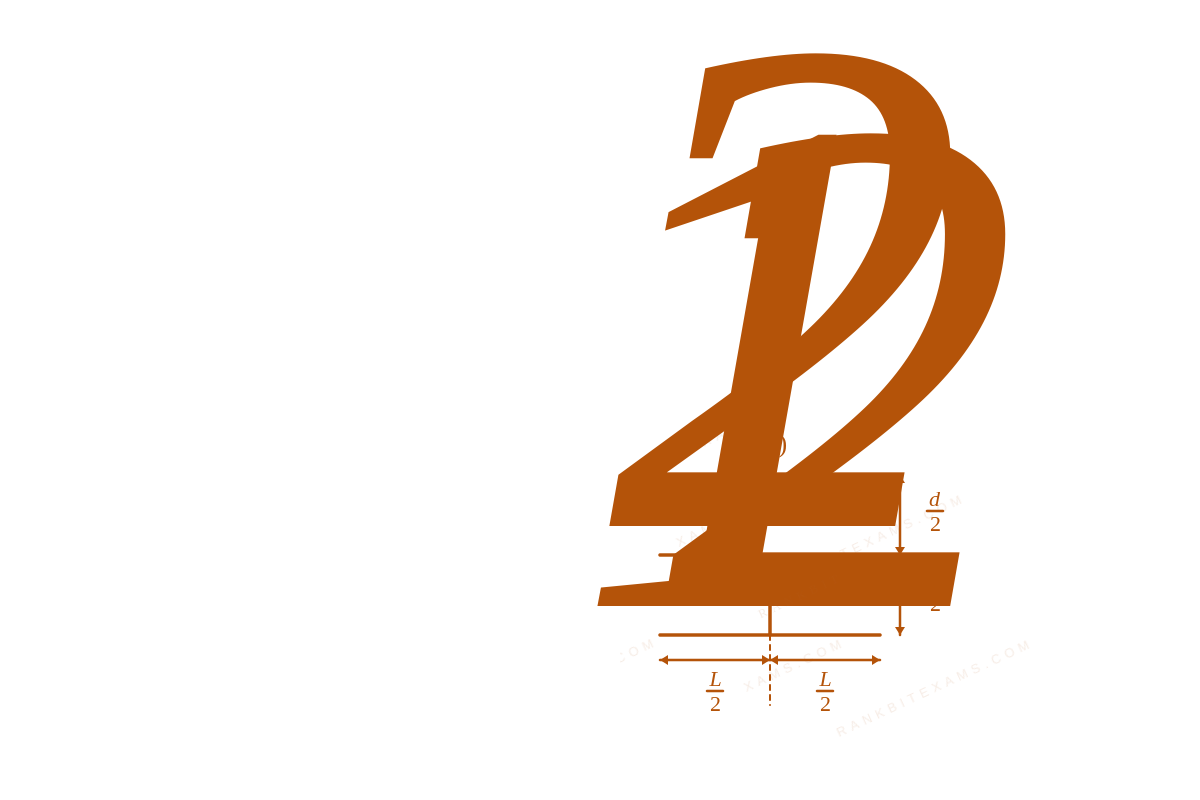
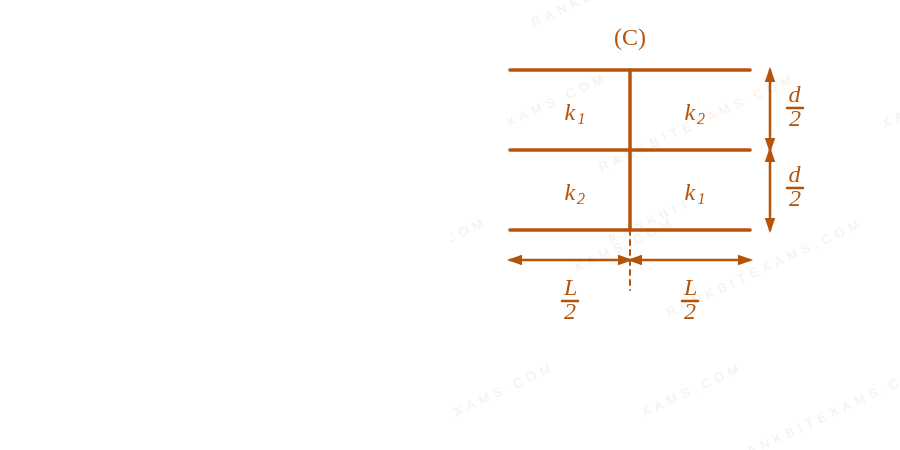
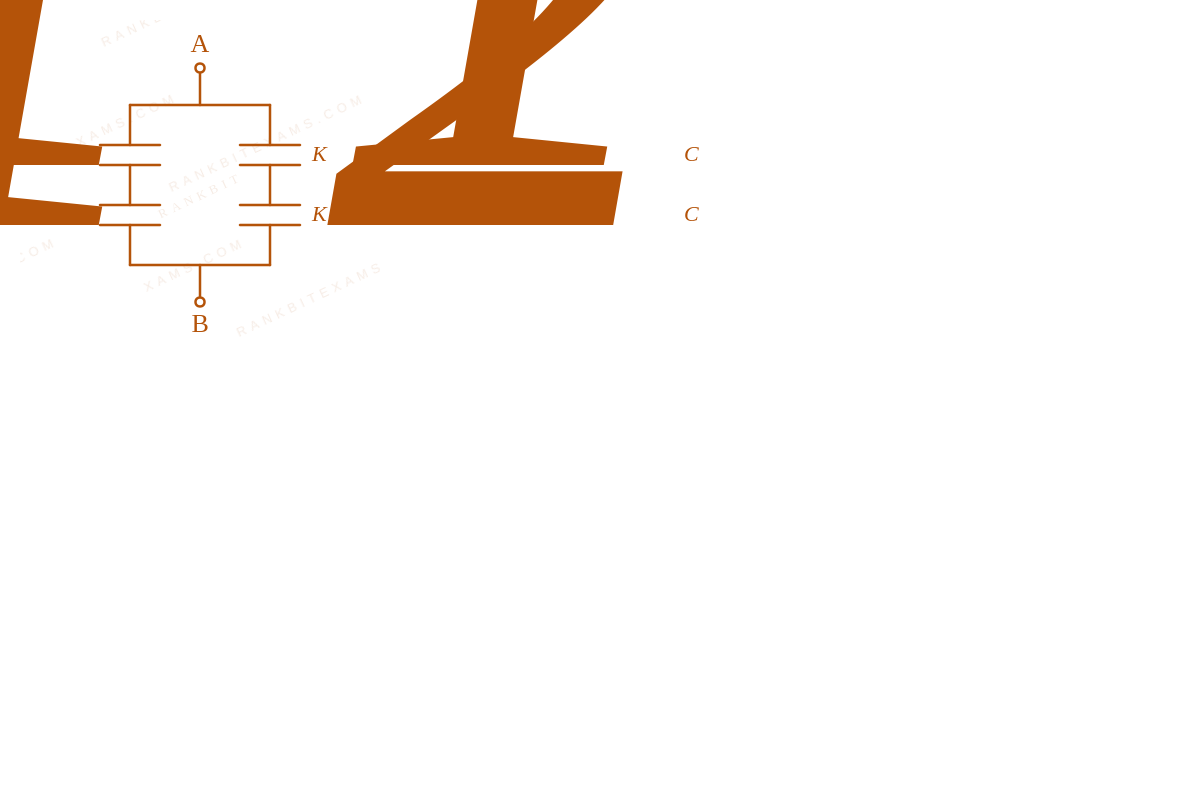
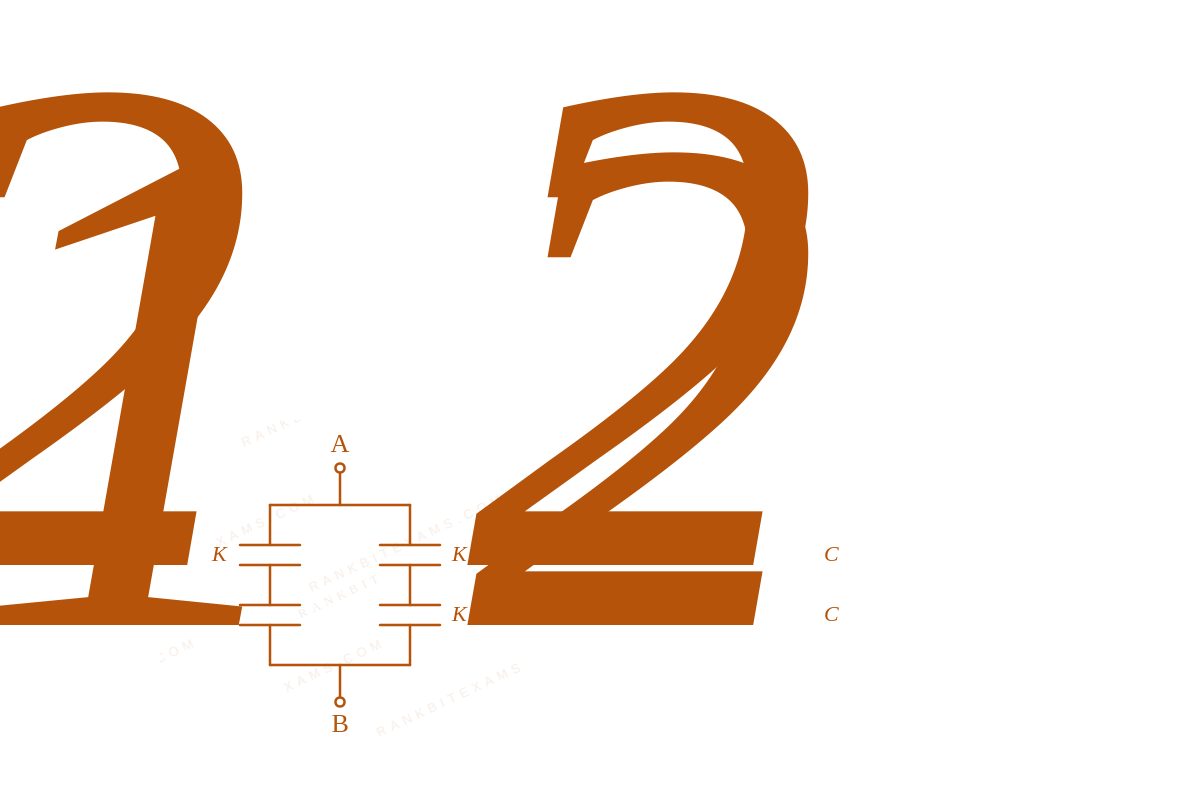
Three parallel plate capacitors each with area A and separation d are filled with two dielectric ( k₁$k_{1}$ and k₂$k_{2}$ ) in the following fashion. Which of the following is true? ( k₁ > k₂$k_{1} > k_{2}$ )
Three different capacitor configurations showing dielectrics k1 and k2 split vertically or horizontally.Three different capacitor configurations showing dielectrics k1 and k2 split vertically or horizontally.Three different capacitor configurations showing dielectrics k1 and k2 split vertically or horizontally.
A.CB > CC > CA$\mathrm{C_B > C_C > C_A}$
B.CC > CB > CA$\mathrm{C_C > C_B > C_A}$
C.CC > CA > CB$\mathrm{C_C > C_A > C_B}$
D.CA > CC > CB$\mathrm{C_A > C_C > C_B}$
Solution
Related Formula
C = (ε₀ A)/(d)$$C = \frac{\epsilon_0 A}{d}$$
Core Logic
Let C = (ε₀ A)/(d)$C = \frac{\epsilon_0 A}{d}$. We decompose the configurations into equivalent circuits.
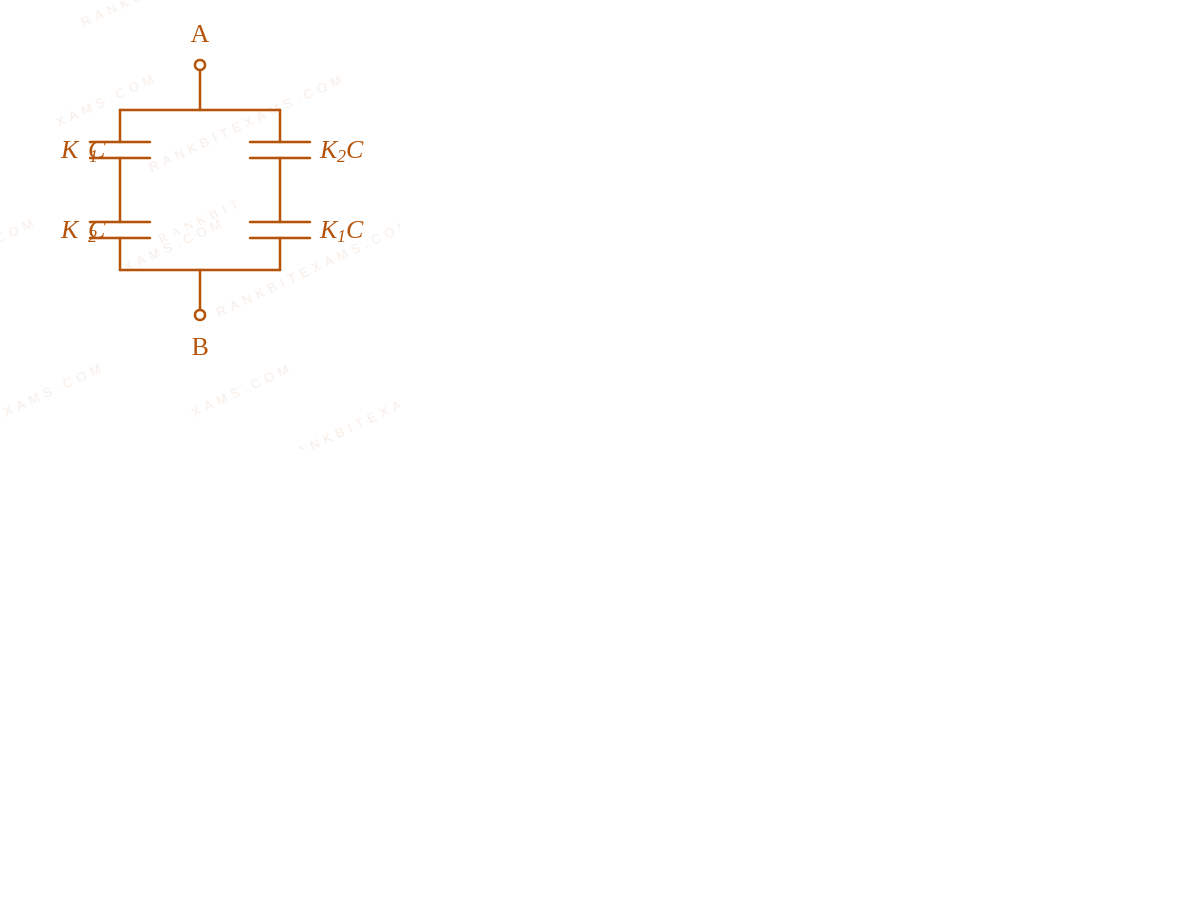
For CA$C_A$:
Three different capacitor configurations showing dielectrics k1 and k2 split vertically or horizontally.
Since K₁ > K₂$K_1 > K_2$:
Comparing CA$C_A$ and CC$C_C$, and CC$C_C$ and CB$C_B$, algebraic manipulation proves:
CA > CC > CB$C_A > C_C > C_B$
Pattern Recognition
Symmetry dictates the capacity. Adding more of the higher dielectric constant material (K₁$K_1$) in parallel paths effectively boosts total capacitance significantly, while stacking lower K₂$K_2$ diminishes it.
Chapter Mix
Class 12 Physics: Electrostatics
Q47jee_main_2026_24_january_eveningCoulomb's Law and Continuous Charge Distribution
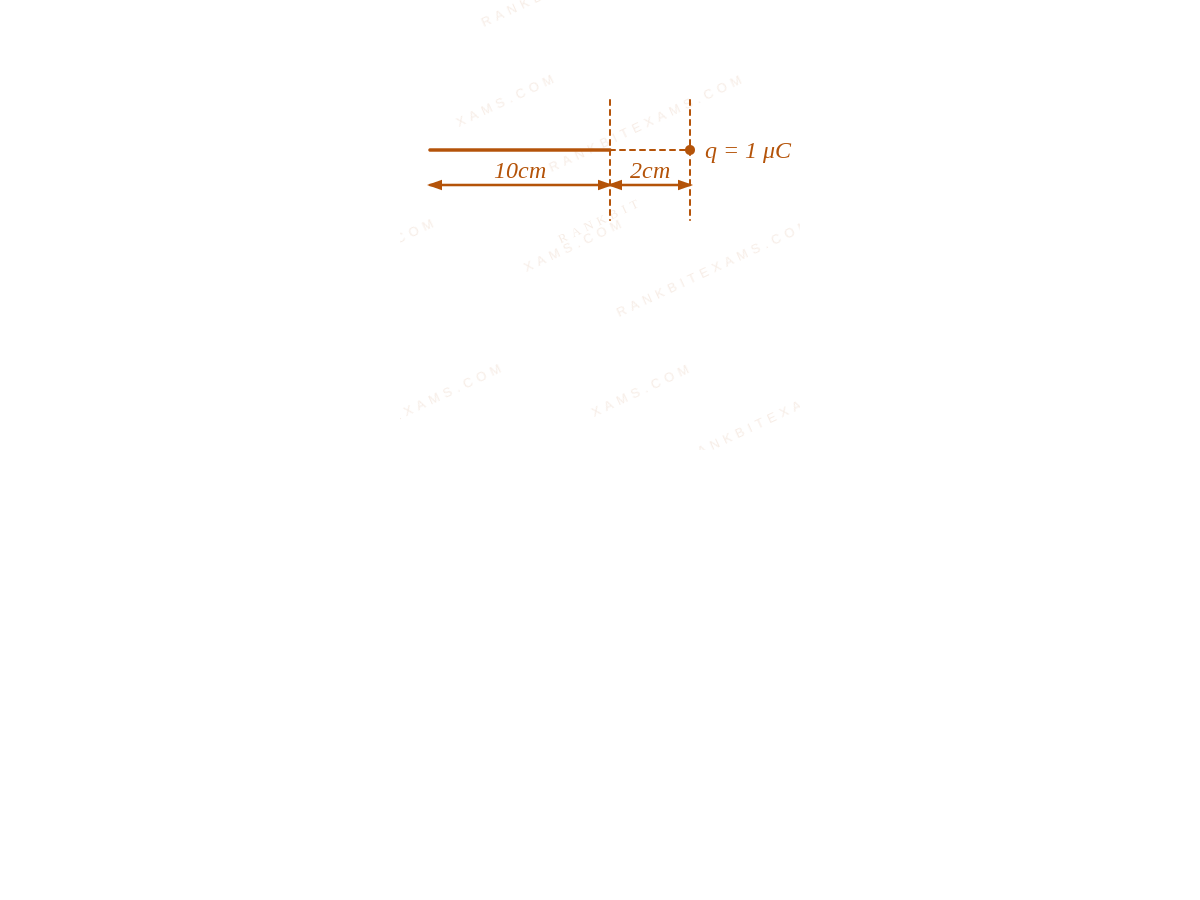
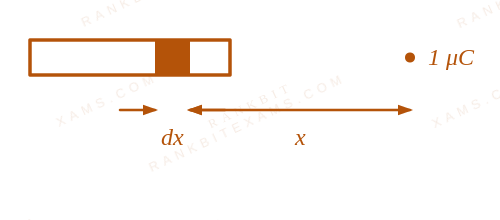
A point charge q = 1 μ C$q = 1 \mu C$ is located at a distance 2 cm from one end of a thin insulating wire of length 10 cm having a charge Q = 24 μ C$Q = 24 \mu C$ , distributed uniformly along its length, as shown in figure. Force between q and wire is ____ N.
( Use 14 π ε_ 0 = 9 × 1 0 ^ 9 N.m ^ 2 / C ^ 2)$\left(\text { Use } \frac {1}{4 \pi \epsilon_ {0}} = 9 \times 1 0 ^ {9} \mathrm{N.m} ^ {2} / \mathrm{C} ^ {2}\right)$A point charge placed 2 cm coaxially from a uniformly charged wire of length 10 cm.
For a point charge q$q$ acting on a line charge of length L$L$ separated by distance a$a$, F = (k q Q)/(a(a+L))$F = \frac{k q Q}{a(a+L)}$. Directly applying this bypasses the integration completely.
Chapter Mix
Class 12 Physics: Electrostatics
More Electrostatics Questions — jee_main_2025_07_april_evening
Practice past-year questions one chapter at a time. Pick an exam → subject → chapter and get every PYQ for that topic — pulled together from all past papers — with the chapter's key formulas alongside.