If the locus of z in C$z \in C$, such that R e ( z - 12 z + i) + R e ( z - 12 z - i) = 2$\operatorname {R e} \left(\frac {z - 1}{2 z + \mathrm {i}}\right) + \operatorname {R e} \left(\frac {\bar {z} - 1}{2 \bar {z} - \mathrm {i}}\right) = 2$, is a circle of radius r$r$ and center (a, b)$(a, b)$ then (15ab)/(r²)$\frac{15ab}{r^2}$ is equal to:
A.24$24$
B.12$12$
C.18$18$
D.16$16$
Solution & Explanation
Related Formula
For a complex number w$w$, Re(w) = Re( w)$\operatorname{Re}(w) = \operatorname{Re}(\bar{w})$. Hence:
Notice that z - 12 z - i$\frac{\bar{z} - 1}{2\bar{z} - i}$ is the exact complex conjugate of (z - 1)/(2z + i)$\frac{z - 1}{2z + i}$.
Thus, the given equation simplifies directly via complex identities to:
Convert standard coordinate complex numbers into Euler form immediately when large powers are present.
Chapter Mix
Class 11 Maths: Complex Numbers
Q9jee_main_2026_24_january_morningLocus in Complex Plane
Let S = z in C : | (z - 6i)/(z - 2i) | = 1 and | (z - 8 + 2i)/(z + 2i) | = (3)/(5)$S = \left\{ z \in \mathbb{C} : \left| \frac{z - 6i}{z - 2i} \right| = 1 \text{ and } \left| \frac{z - 8 + 2i}{z + 2i} \right| = \frac{3}{5} \right\}$. Then Σz in S |z|²$\sum_{z \in S} |z|^2$ is equal to
A.398$398$
B.413$413$
C.423$423$
D.385$385$
Solution
Related Formula
|z - z₁| = |z - z₂| represents the perpendicular bisector of the segment joining z₁ and z₂$$|z - z_1| = |z - z_2| \text{ represents the perpendicular bisector of the segment joining } z_1 \text{ and } z_2$$|x+iy|² = x² + y²$$|x+iy|^2 = x^2 + y^2$$
Core Logic
First condition: |z - 6i| = |z - 2i|$|z - 6i| = |z - 2i|$.
This means z$z$ lies on the perpendicular bisector of (0,6)$(0,6)$ and (0,2)$(0,2)$.
Let z = x + iy$z = x + iy$. Thus, y = 4$y = 4$.
Step 1: Circle Equation
Second condition: 5|z - 8 + 2i| = 3|z + 2i|$5|z - 8 + 2i| = 3|z + 2i|$.
Substitute y = 4$y = 4$ into z$z$: z = x + 4i$z = x + 4i$.
Whenever an absolute value ratio equals 1, immediately map it to a line (perpendicular bisector) and substitute its constraint directly into the second curve equation to reduce dimensionality.
Chapter Mix
Class 11 Maths: Complex Numbers and Quadratic Equations
Q23jee_main_2026_24_january_eveningProperties of Moduli
Let z = (1 + i)(1 + 2i)(1 + 3i) (1 + ni)$z = (1 + \mathrm{i})(1 + 2\mathrm{i})(1 + 3\mathrm{i}) \dots (1 + \mathrm{ni})$, where i = √(-1)$\mathrm{i} = \sqrt{-1}$. If |z|² = 44200$|z|^2 = 44200$, then n$n$ is equal to
The calculated product for n=5$n=5$ exactly matches the prime factorization of 44200$44200$.
Therefore, n = 5$n = 5$.
Pattern Recognition
Modulus is multiplicative. In problems featuring chains of complex multiplications set equal to a huge real magnitude, instantly switch to magnitudes and map to integer factorization.
Chapter Mix
Class 11 Maths: Complex Numbers
Q5jee_main_2026_28_january_morningGeometry of Complex Numbers
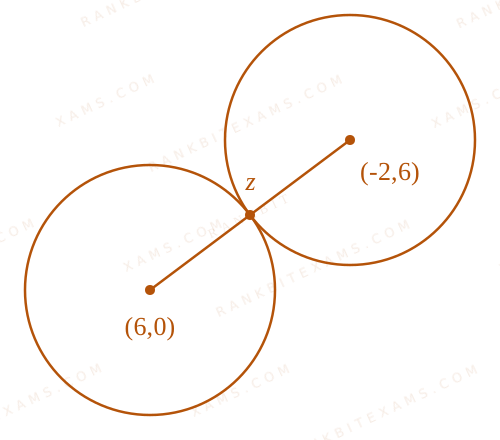
Let z$z$ be a complex number such that |z - 6| = 5$|z - 6| = 5$ and |z + 2 - 6i| = 5$|z + 2 - 6i| = 5$. Then the value of z³ + 3z² - 15z + 141$z^{3} + 3z^{2} - 15z + 141$ is equal to
A.42$42$
B.37$37$
C.50$50$
D.61$61$
Solution
Core Logic
Geometry of Complex Numbers
The given equations represent two circles in the complex plane:
Circle 1: Center C₁(6, 0)$C_1(6, 0)$, radius r₁ = 5$r_1 = 5$
Circle 2: Center C₂(-2, 6)$C_2(-2, 6)$, radius r₂ = 5$r_2 = 5$
When given two complex distance modulus equations |z-z₁|=r₁$|z-z_1|=r_1$ and |z-z₂|=r₂$|z-z_2|=r_2$, always check the distance between centers |z₁ - z₂|$|z_1 - z_2|$. If it exactly equals r₁ + r₂$r_1 + r_2$, the single unique solution is the section formula midpoint.
Chapter Mix
Class 11 Mathematics: Complex Numbers and Quadratic Equations
Q10jee_main_2026_28_january_morningNature of Roots
If α, β$\alpha, \beta$, where α < β$\alpha < \beta$, are the roots of the equation λ x² - (λ + 3)x + 3 = 0$\lambda x^2 - (\lambda + 3)x + 3 = 0$ such that (1)/(α) - (1)/(β) = (1)/(3)$\frac{1}{\alpha} - \frac{1}{\beta} = \frac{1}{3}$, then the sum of all possible values of λ$\lambda$ is:
A.6$6$
B.2$2$
C.4$4$
D.8$8$
Solution
Related Formula
For a quadratic equation ax² + bx + c = 0$ax^2 + bx + c = 0$:
Sum of roots: α + β = -(b)/(a)$\alpha + \beta = -\frac{b}{a}$
Product of roots: αβ = (c)/(a)$\alpha\beta = \frac{c}{a}$
Core Logic
From the given equation λ x² - (λ + 3)x + 3 = 0$\lambda x^2 - (\lambda + 3)x + 3 = 0$:
Practice past-year questions one chapter at a time. Pick an exam → subject → chapter and get every PYQ for that topic — pulled together from all past papers — with the chapter's key formulas alongside.