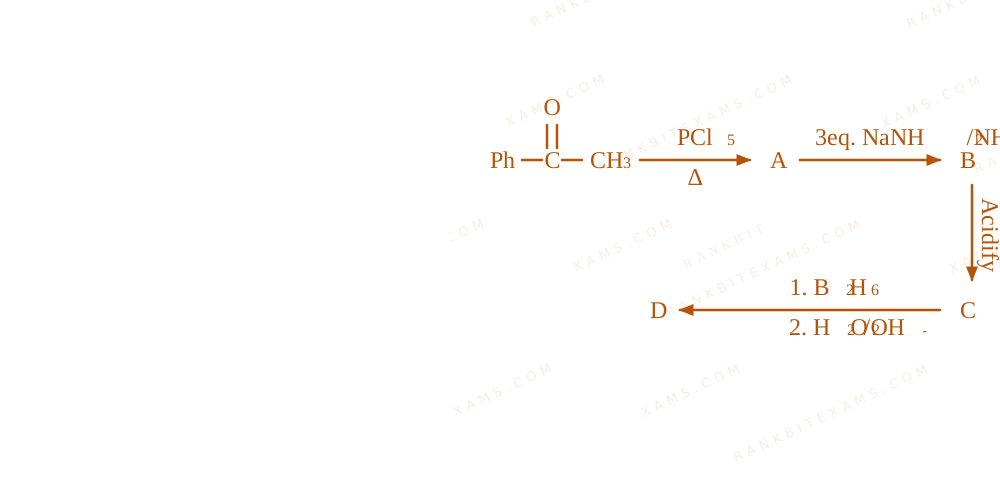
Identify the structure of the final product (D) in the following sequence of the reactions:
Reaction Mechanisms scheme diagram for Q50 - JEE Main 2025 Evening
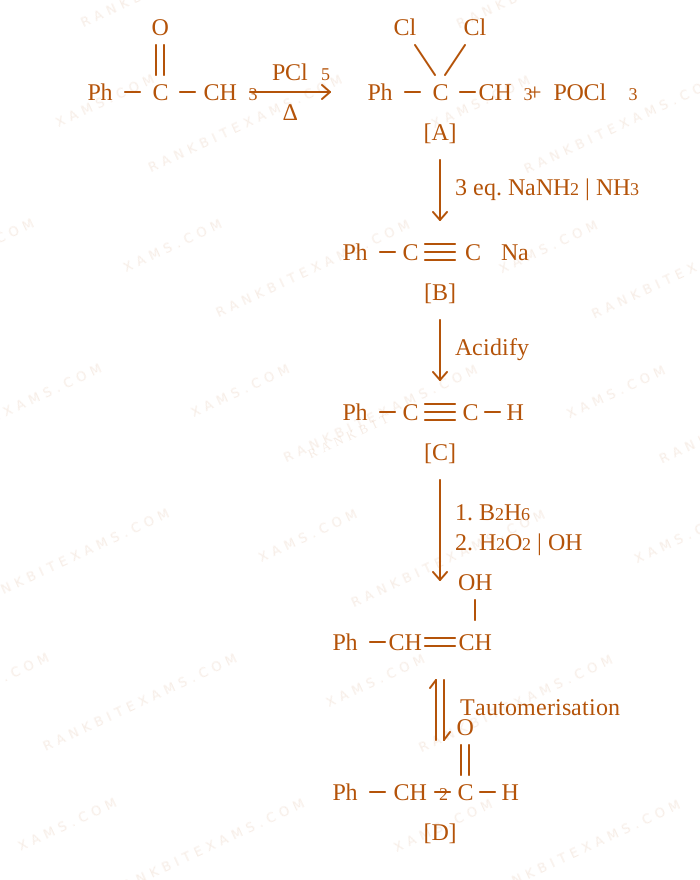
The image maps out a sequential multi-step chemical reaction scheme moving from acetophenone via gem-dichloride to an alkyne, hydroboration, and product D.
Total number of sp^2 hybridised carbon atoms in product D is dots.

Numerical Answer Type:
Enter a numerical value Answer: 6.5 to 7.5 +4 marks

Solution & Explanation

### Related Formula textTerminal Alkyne (textR-CequivtextCH) xrightarrow[2.\,textH_2textO_2 / textOH^-]1.\,textB_2textH_6 textR-CH_2text-CHO quad text(Anti-Markovnikov Hydroboration-Oxidation) ### Core Logic Let's track the molecular changes at every intermediate junction: - Step 1: Acetophenone (textPh-CO-CH_3) reacts with textPCl_5 to generate a gem-dichloride intermediate [A]: textPh-CCl_2text-CH_3. - Step 2: Reaction with 3 equivalents of the incredibly strong base textNaNH_2 triggers dual elimination to form a terminal sodium acetylide salt [B]: textPh-CequivtextC^-textNa^+. - Step 3: Acidification yields phenylacetylene [C]: textPh-CequivtextCH. - Step 4: Hydroboration-oxidation of phenylacetylene leads to anti-Markovnikov water addition forming an enol structure, which immediately tautomerizes to [D] phenylacetaldehyde: textPh-CH_2text-CHO. ### Step 1: Counting Hybridized Carbons The step transformations match the sequential tracking map:
Structural analysis product diagram for Q50 - JEE Main 2025 Evening
The image maps out a sequential multi-step chemical reaction scheme moving from acetophenone via gem-dichloride to an alkyne, hydroboration, and product D.
Let's locate all sp^2 hybridised carbon environments in product D (textPh-CH_2text-CHO): 1. The aromatic benzene ring contains 6 sp^2 carbon atoms. 2. The aldehyde carbonyl carbon (-textCHO) is double-bonded to oxygen, adding 1 sp^2 carbon atom. 3. The aliphatic link carbon (-textCH_2-) is entirely sp^3 hybridized. Total sp^2 carbon count = 6 + 1 = 7. ### Pattern Recognition Alkyne oxidation mapping: Hydroboration-oxidation transforms a terminal alkyne into an aldehyde carbonyl group, while oxymercuration-demercuration yields a ketone carbonyl. Both introduce precisely one extra carbonyl sp^2 site on top of the original aromatic framework. ### Evaluation Rubric / Model Answer null ### Chapter Mix Class 12 Chemistry: Aldehydes, Ketones and Carboxylic Acids Class 11 Chemistry: Hydrocarbons

Reference Study Guides

More Hydrocarbons Previous-Year Questions — Page 5

Q84 jee_main_2024_31_jan_evening Halogenation of Alkanes (Isomers)
Number of isomeric products formed by mono-chlorination of 2-methylbutane in presence of sunlight is ________
Numerical Answer. Answer: 6 to 6

Solution

### Core Logic The structure of 2-methylbutane is CH_3-CH(CH_3)-CH_2-CH_3. It has four different types of hydrogen atoms, which can be substituted to form structural isomers: 1) 1-chloro-2-methylbutane: Chlorination at terminal CH_3 near branch. Yields a chiral center at C2 (2 enantiomers). 2) 2-chloro-2-methylbutane: Chlorination at the tertiary carbon (1 achiral product). 3) 2-chloro-3-methylbutane: Chlorination at the CH_2 group. Yields a chiral center at C2 (2 enantiomers). 4) 1-chloro-3-methylbutane: Chlorination at the far terminal CH_3. No chiral center (1 achiral product).
Halogenation of Alkanes (Isomers) diagram for Q84 - JEE Main 2024 Evening
### Step 1: Counting Stereoisomers Total isomeric products = 2 (from 1st) + 1 (from 2nd) + 2 (from 3rd) + 1 (from 4th) = 6. ### Pattern Recognition When asked for "isomeric products" in halogenation without specifying "structural isomers", you must count stereoisomers (enantiomers) as well. ### Evaluation Rubric / Model Answer null ### Chapter Mix Class 11 Chemistry: Hydrocarbons Class 12 Chemistry: Haloalkanes and Haloarenes
Q87 jee_main_2024_31_jan_morning Kolbe's Electrolysis
Number of alkanes obtained on electrolysis of a mixture of CH_3COONa and C_2H_5COONa is
Numerical Answer. Answer: 3 to 3

Solution

### Core Logic Kolbe's electrolytic method generates free radicals at the anode, which then combine to form alkanes. The given mixture yields two types of carboxylate radicals which decarboxylate to form alkyl radicals: CH_3COONa rightarrow dotCH_3 C_2H_5COONa rightarrow dotC_2H_5 These radicals can couple in three different ways: 1. Cross coupling: dotCH_3 + dotC_2H_5 rightarrow CH_3-CH_2-CH_3 (Propane) 2. Self-coupling 1: dotCH_3 + dotCH_3 rightarrow CH_3-CH_3 (Ethane) 3. Self-coupling 2: dotC_2H_5 + dotC_2H_5 rightarrow CH_3-CH_2-CH_2-CH_3 (Butane) Thus, a total of 3 different alkanes are formed. ### Evaluation Rubric / Model Answer null ### Chapter Mix Class 11 Chemistry: Hydrocarbons

More Hydrocarbons Questions — jee_main_2025_07_april_evening

Practice all Hydrocarbons previous-year questions →

Rankbit System
JEE Physics: Waves (+15.5%) | Electrostatics: Concentric Shells (-29.7%) | Modern Physics: Photoelectric Clones (+34.2%) | Mathematics: Definite Integrals (+18.1%) | Chemistry: Coordination Splitting (-11.4%) | JEE Physics: Waves (+15.5%) | Electrostatics: Concentric Shells (-29.7%) | Modern Physics: Photoelectric Clones (+34.2%) | Mathematics: Definite Integrals (+18.1%) | Chemistry: Coordination Splitting (-11.4%)