Given below are two statements:
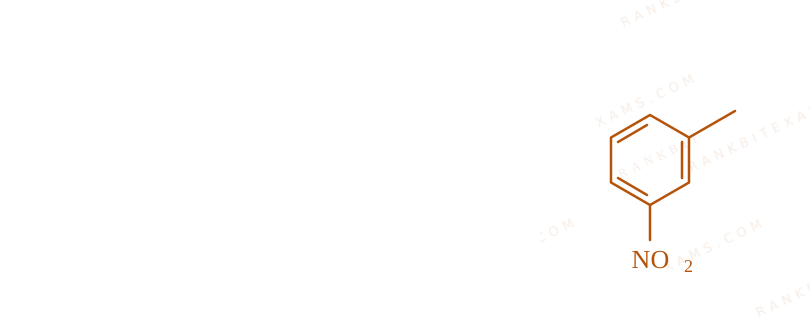
Statement I: Benzene is nitrated to give nitrobenzene, which on further treatment with CH_3COCl / AlCl_3$CH_{3}COCl / AlCl_{3}$ will give
Image depicts m-nitroacetophenone.
Statement II: NO_2$NO_{2}$ group is a m-directing, and deactivating group.
In the light of the above statements, choose the most appropriate answer from the options given below.
A.textStatement I is correct but Statement II is incorrect.$\text{Statement I is correct but Statement II is incorrect.}$
B.textBoth Statement I and Statement II are correct.$\text{Both Statement I and Statement II are correct.}$
C.textStatement I is incorrect but Statement II is correct.$\text{Statement I is incorrect but Statement II is correct.}$
D.textBoth Statement I and Statement II is are incorrect.$\text{Both Statement I and Statement II is are incorrect.}$
Solution & Explanation
### Related Formula
Nitrobenzene + Friedel Crafts Acylation rightarrow$\rightarrow$ No Reaction.
### Core Logic
Statement I claims that nitrobenzene undergoes Friedel-Crafts acylation with CH_3COCl/AlCl_3$CH_3COCl/AlCl_3$ to yield a product. This is strictly false. The -NO_2$-NO_2$ group is highly electron-withdrawing, meaning it severely deactivates the benzene ring toward electrophilic aromatic substitution. Nitrobenzene does not undergo Friedel-Crafts alkylation or acylation.
Statement II correctly states that the NO_2$NO_2$ group is a meta-directing and deactivating group. Because it withdraws electron density, the ring is less reactive than benzene itself, and any substitution that does occur (under harsh conditions) happens at the meta position.
### Step 1: Final Conclusion
Statement I is incorrect but Statement II is correct.
### Pattern Recognition
Highly deactivated rings (e.g., nitrobenzene) act as a solvent in Friedel-Crafts reactions precisely because they are completely unreactive to the alkylating/acylating conditions.
### Evaluation Rubric / Model Answer
null
### Chapter Mix
Class 11 Chemistry: Hydrocarbons
Keywords:#Benzene is nitrated to give nitrobenzene#JEE Main 2026 Morning Q61#Hydrocarbons JEE Main 2026#Electrophilic Aromatic Substitution JEE Main 2026#Benzene ring#nitrobenzene#acylation#Friedel-Crafts
More Hydrocarbons Previous-Year Questions
Qjee_main_2026_21_jan_morningAlkenes Oxidation and Reduction
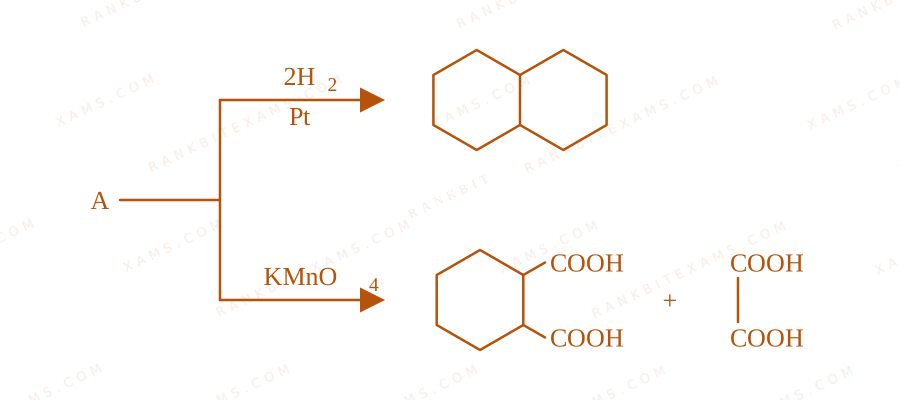
Identify A in the following reaction.
A chemical reaction scheme converting an unknown compound A into different cyclic structures using specific reagents.
A.
B.
C.
D.
Solution
### Core Logic
Let's analyze the given reaction sequences.
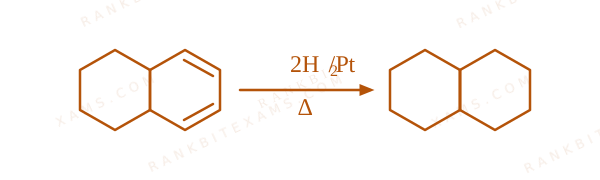
1. Reaction with 2H_2 / Pt$2H_2 / Pt$: Compound A undergoes hydrogenation with 2 moles of hydrogen, suggesting the presence of two double bonds.
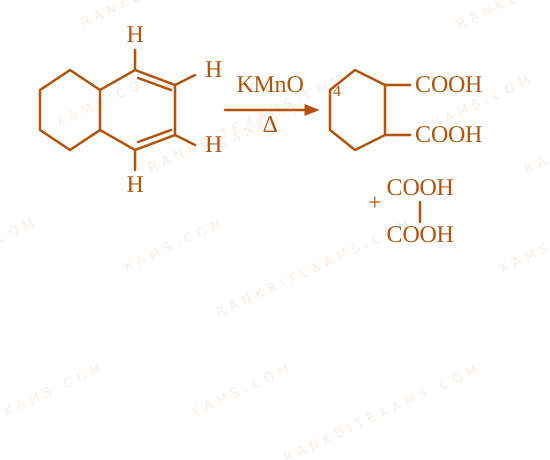
2. Reaction with mathrmKMnO_4 / Delta$\mathrm{KMnO_4} / \Delta$: Compound A undergoes oxidative cleavage to give a substituted dicarboxylic acid (cyclohexane-1,2-dicarboxylic acid) and oxalic acid (HOOC-COOH$HOOC-COOH$).
The structure of A must have a diene system that, when cleaved completely at the double bonds, yields these specific acid fragments.
A chemical reaction scheme converting an unknown compound A into different cyclic structures using specific reagents.
By matching the cleavage points, compound A is identified as 1,2,3,4,4a,5,8,8a-octahydronaphthalene derivative with two isolated double bonds in the ring.
A chemical reaction scheme converting an unknown compound A into different cyclic structures using specific reagents.
### Pattern Recognition
Hot KMnO_4$KMnO_4$ cleaves double bonds entirely, converting =C-H$=C-H$ into -COOH$-COOH$. The formation of oxalic acid indicates a -CH=CH-$-CH=CH-$ fragment caught between two cleavable double bonds in a ring system.
### Evaluation Rubric / Model Answer
null
### Chapter Mix
Class 11 Chemistry: Hydrocarbons
Q71jee_main_2026_22_january_morningAlkenes and Alkynes
The cycloalkane (X) on bromination consumes one mole of bromine per mole of (X) and gives the product (Y) in which C:Br ratio is 3 : 1. The percentage of bromine in the product (Y) is ____%. (Nearest integer)
(Given: Molar mass in gtext mol^-1$g\text{ mol}^{-1}$ H: 1, C: 12, O: 16, Br: 80)
Numerical Answer.Answer: 66 to 66
Solution
### Related Formula
textMass percentage of Br = fractextMass of BrtextMolar mass of compound times 100$$\text{Mass percentage of Br} = \frac{\text{Mass of Br}}{\text{Molar mass of compound}} \times 100$$
### Core Logic
The given compound is a cycloalkane. Since it consumes one mole of bromine and undergoes addition/substitution giving a C:Br ratio of 3:1, let's analyze the formula.
Bromination of an alkane normally requires UV light and is a substitution reaction, yielding mono or dibromo products. But the problem says it "consumes one mole of bromine" to give a product. If it's a cyclopropane or cyclobutane ring, it might undergo ring-opening addition. Let's assume the product has 2 bromine atoms since Br_2$Br_2$ is consumed entirely per mole.
If Br = 2$Br = 2$, then from the C:Br = 3:1$C:Br = 3:1$ ratio, Carbon atoms = 3 times 2 = 6$= 3 \times 2 = 6$.
So the cycloalkane (X) has 6 carbon atoms. Being a cycloalkane, its formula is C_6H_12$C_6H_{12}$.
Wait, the solution provided states C_6H_10 xrightarrowBr_2 C_6H_10Br_2$C_6H_{10} \xrightarrow{Br_2} C_6H_{10}Br_2$. This implies X is cyclohexene (a cycloalkene), not a cycloalkane!
Since we must follow the PDF's logic precisely: The PDF assumes X$X$ is C_6H_10$C_6H_{10}$ (cyclohexene) despite the text saying 'cycloalkane'. It undergoes addition of Br_2$Br_2$ to form C_6H_10Br_2$C_6H_{10}Br_2$.
For C_6H_10Br_2$C_6H_{10}Br_2$:
Number of C = 6, Number of Br = 2. C:Br ratio = 6:2 = 3:1. This perfectly fits the given condition.
### Step 1: Calculate Molar Mass
Molar mass of product (Y) C_6H_10Br_2$C_6H_{10}Br_2$:
M = (12 times 6) + (1 times 10) + (80 times 2)$M = (12 \times 6) + (1 \times 10) + (80 \times 2)$M = 72 + 10 + 160 = 242text g mol^-1$M = 72 + 10 + 160 = 242\text{ g mol}^{-1}$
### Step 2: Calculate Percentage
\% text of Br = frac160242 times 100 approx 66.11\%$$\% \text{ of Br} = \frac{160}{242} \times 100 \approx 66.11\%$$
### Step 3: Rounding
Nearest integer is 66.
### Pattern Recognition
Be prepared to spot exam typos (like 'cycloalkane' instead of 'cycloalkene') when a fixed atomic ratio constraint immediately points to a specific molecular formula.
### Evaluation Rubric / Model Answer
null
### Chapter Mix
Class 11 Chemistry: Hydrocarbons
Class 11 Chemistry: Some Basic Concepts of Chemistry
Q52jee_main_2026_22_january_eveningAlkyne Synthesis and Alkylation
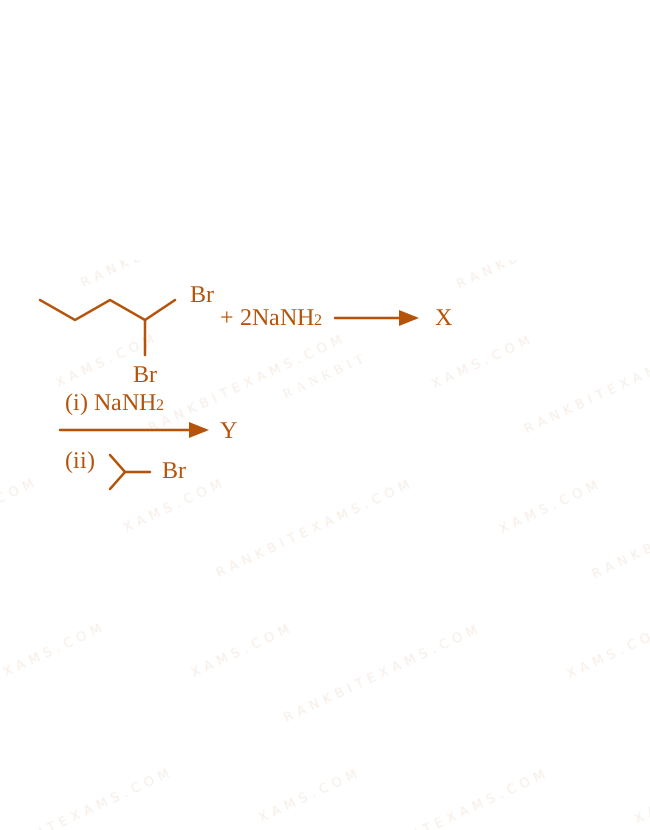
Consider the following reaction:
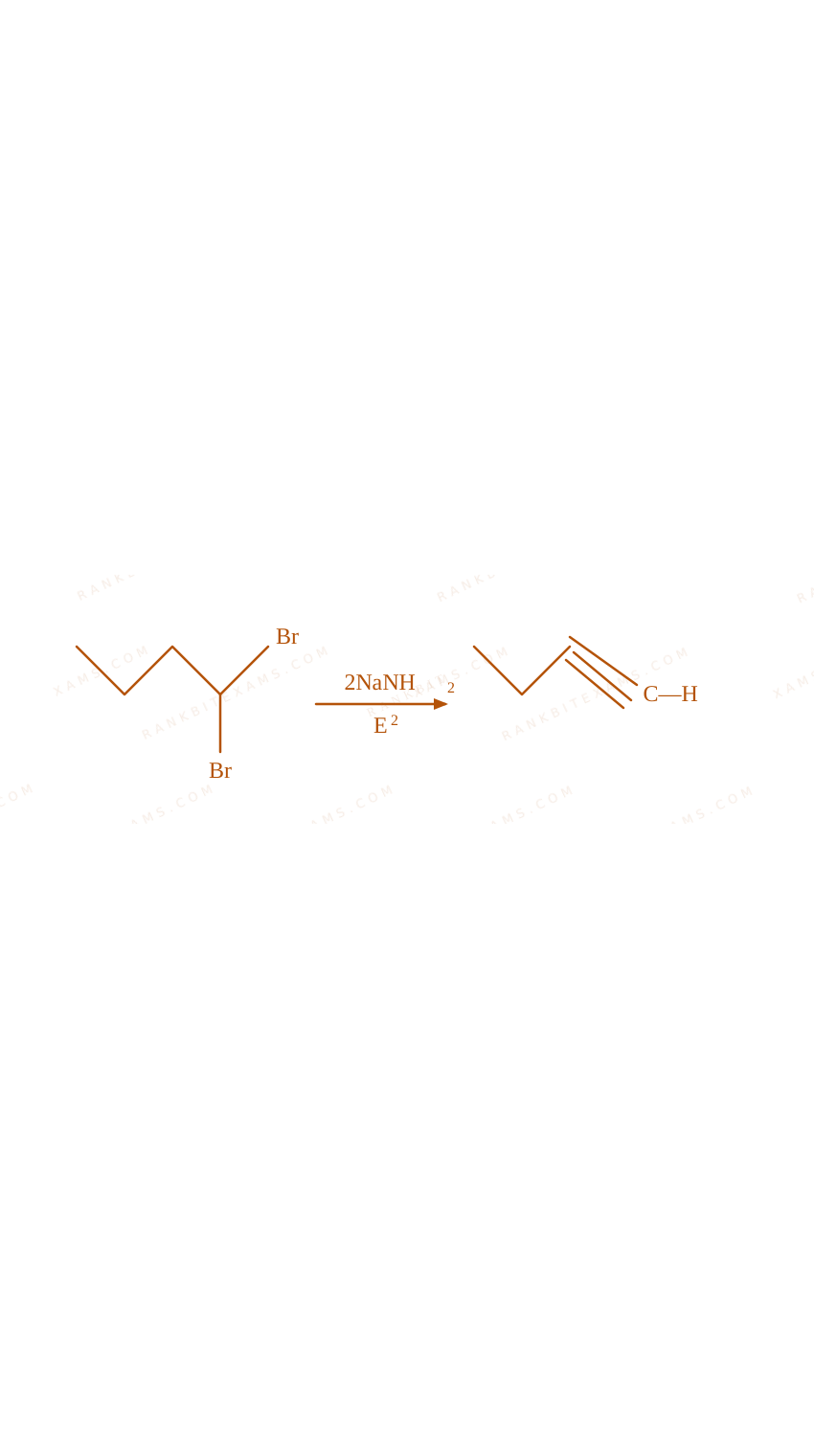
Displays a vicinal dibromide reacting with NaNH2 to form terminal alkyne intermediate X, followed by alkylation to yield product Y.
The product Y formed is:
A. 2-methylhex-2-yne
B. 5-methylhex-2-yne
C. 2-methylhex-3-yne
D. Isopropylbut-1-yne
Solution
### Related Formula
textVicinal Dibromide xrightarrow2textNaNH_2 textTerminal Alkyne (X) xrightarrow[textalkyl halide]textNaNH_2 textInternal Alkyne (Y)$$\text{Vicinal Dibromide} \xrightarrow{2\text{NaNH}_2} \text{Terminal Alkyne} (X) \xrightarrow[\text{alkyl halide}]{\text{NaNH}_2} \text{Internal Alkyne} (Y)$$
### Core Logic
Step 1: Dehydrohalogenation of dibromo compound using textNaNH_2$\text{NaNH}_2$ yields terminal alkyne sodium acetylide intermediate (X)$(X)$.
Step 2: Nucleophilic substitution (S_N2$S_N2$) of acetylide ion with isopropyl bromide yields 2-methylhex-3-yne as final product (Y)$(Y)$.
Displays a vicinal dibromide reacting with NaNH2 to form terminal alkyne intermediate X, followed by alkylation to yield product Y.Displays a vicinal dibromide reacting with NaNH2 to form terminal alkyne intermediate X, followed by alkylation to yield product Y.
### Pattern Recognition
Sees: Double elimination followed by alkylation of acetylide ion.
Shortcut: Count main chain carbon skeleton including the added isopropyl fragment to find IUPAC name: 2-methylhex-3-yne.
### Evaluation Rubric / Model Answer
null
### Chapter Mix
Class 11 Chemistry: Hydrocarbons
Class 12 Chemistry: Haloalkanes and Haloarenes
Qjee_main_2025_02_april_eveningAlkanes and Physical Properties
Given below are two statements:
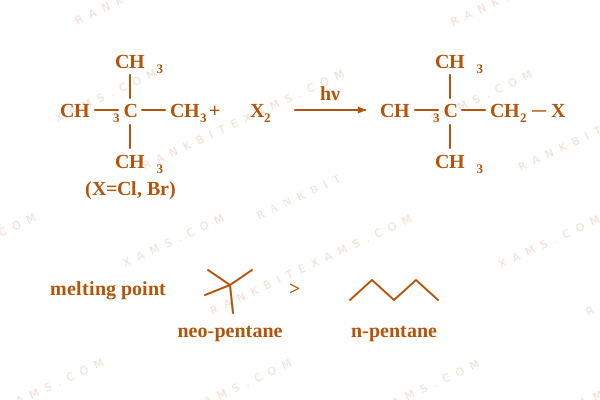
Statement (I): Neopentane forms only one monosubstituted derivative.
Statement (II): Melting point of neopentane is higher than n-pentane
In the light of the above statements, choose the most appropriate answer from the options given below:
A.textStatement I is correct but Statement II is incorrect$\text{Statement I is correct but Statement II is incorrect}$
B.textBoth Statement I and Statement II are correct$\text{Both Statement I and Statement II are correct}$
C.textBoth Statement I and Statement II are incorrect$\text{Both Statement I and Statement II are incorrect}$
D.textStatement I is incorrect but Statement II is correct$\text{Statement I is incorrect but Statement II is correct}$
Solution
### Related Formula
textSymmetric Structure propto textMelting Point (Packing efficiency)$$\text{Symmetric Structure} \propto \text{Melting Point (Packing efficiency)}$$
### Core Logic
**Statement (I) is correct**: Neopentane (2,2-dimethylpropane) contains a quaternary carbon bonded to four methyl groups. There are 12 hydrogen atoms, all of which are primary and chemically equivalent. Halogenation yields exactly one monosubstituted derivative:
mathrm(CH_3)_4C + X_2 xrightarrowhnu (CH_3)_3C-CH_2X + HX$$\mathrm{(CH_3)_4C + X_2 \xrightarrow{h\nu} (CH_3)_3C-CH_2X + HX}$$
Statement (II) is correct: Neopentane has a compact, symmetrical, nearly spherical molecular structure. In the solid crystal lattice, these spherical molecules pack much more efficiently compared to the floppy, linear n-pentane. This robust crystalline packing dramatically increases its melting point (256.4~mathrmK$256.4~\mathrm{K}$) compared to that of n-pentane (143.4~mathrmK$143.4~\mathrm{K}$).
### Step 1: Final Verification
Since both statements are theoretically and experimentally correct, the correct option is (2).
Alkanes and Physical Properties
### Pattern Recognition
While branching *decreases* the boiling point (due to decreased surface area and weaker van der Waals forces), branching that creates a highly symmetric structure *increases* the melting point because of close-packing efficiency in the solid phase.
### Evaluation Rubric / Model Answer
null
### Chapter Mix
Class 11 Chemistry: Hydrocarbons
More Hydrocarbons Questions — jee_main_2026_22_january_morning
We Map Every Repeating Question in Competitive Exams.
Say goodbye to generic mock test fatigue. RankBit uses smart analysis to group past exam questions into their foundational Repeating Question Types. Find chapter weightage, track repeating questions, and score higher with targeted practice.
Select Your Target Exam
Choose an exam track below to find formulas per chapter and patterns.
Syncing Exam Intelligence
Mapping formulas and patterns across all tracks…
PATH A — FULL LENGTH PRACTICE
Full Mock Test Hub
Simulate real NTA exam conditions with fully tracked mocks. Time yourself against past papers.
Practice past-year questions one chapter at a time. Pick an exam → subject → chapter and get every PYQ for that topic — pulled together from all past papers — with the chapter's key formulas alongside.