### Related Formula
textRate of S_NtextAr propto textNumber of electron-withdrawing groups (-I, -M) at ortho/para positions $$\text{Rate of } S_N\text{Ar} \propto \text{Number of electron-withdrawing groups (-I, -M) at ortho/para positions} $$
### Core Logic
Aryl halides are generally unreactive towards nucleophilic substitution due to resonance stabilization of the textC-Cl$\text{C-Cl}$ bond. However, the presence of strong electron-withdrawing groups (-textNO_2$-\text{NO}_2$) at ortho and para positions dramatically increases reactivity by stabilizing the intermediate carbanion:
- (A) Chlorobenzene: Needs extreme conditions: textNaOH at 623text K, 300text atm$\text{NaOH at } 623\text{ K, } 300\text{ atm}$ (Dow's Process)
ightarrow$
ightarrow$ (IV)
- (B) p-Nitrochlorobenzene: One para -textNO_2$-\text{NO}_2$ group softens required temperature to 443text K$443\text{ K}$
ightarrow$
ightarrow$ (III)
- (C) 2,4-Dinitrochlorobenzene: Two electron-withdrawing groups lower needed temperature further to 368text K$368\text{ K}$
ightarrow$
ightarrow$ (II)
- (D) 2,4,6-Trinitrochlorobenzene: Highly activated picryl chloride hydrolyzes smoothly with just warm water
ightarrow$
ightarrow$ (I)
### Step 1: Final Match Alignment
Matching sequences cleanly yields:
(A)-(IV), (B)-(III), (C)-(II), (D)-(I).
### Pattern Recognition
The more -textNO_2$-\text{NO}_2$ groups present on the ring, the less aggressive the reagent/temperature setup required. Count -textNO_2$-\text{NO}_2$ groups: 0
ightarrow 623textK$0
ightarrow 623\text{K}$, 1
ightarrow 443textK$1
ightarrow 443\text{K}$, 2
ightarrow 368textK$2
ightarrow 368\text{K}$, 3
ightarrow textwarm water$3
ightarrow \text{warm water}$.
### Evaluation Rubric / Model Answer
null
### Chapter Mix
Class 12 Chemistry: Haloalkanes and Haloarenes
Keywords:#Dows process chlorobenzene#JEE Main 2025 Evening Q32#nucleophilic aromatic substitution kinetics#picryl chloride hydrolysis
More Haloalkanes and Haloarenes Previous-Year Questions — Page 6
Q67jee_main_2024_31_jan_eveningIUPAC Nomenclature of Haloalkanes
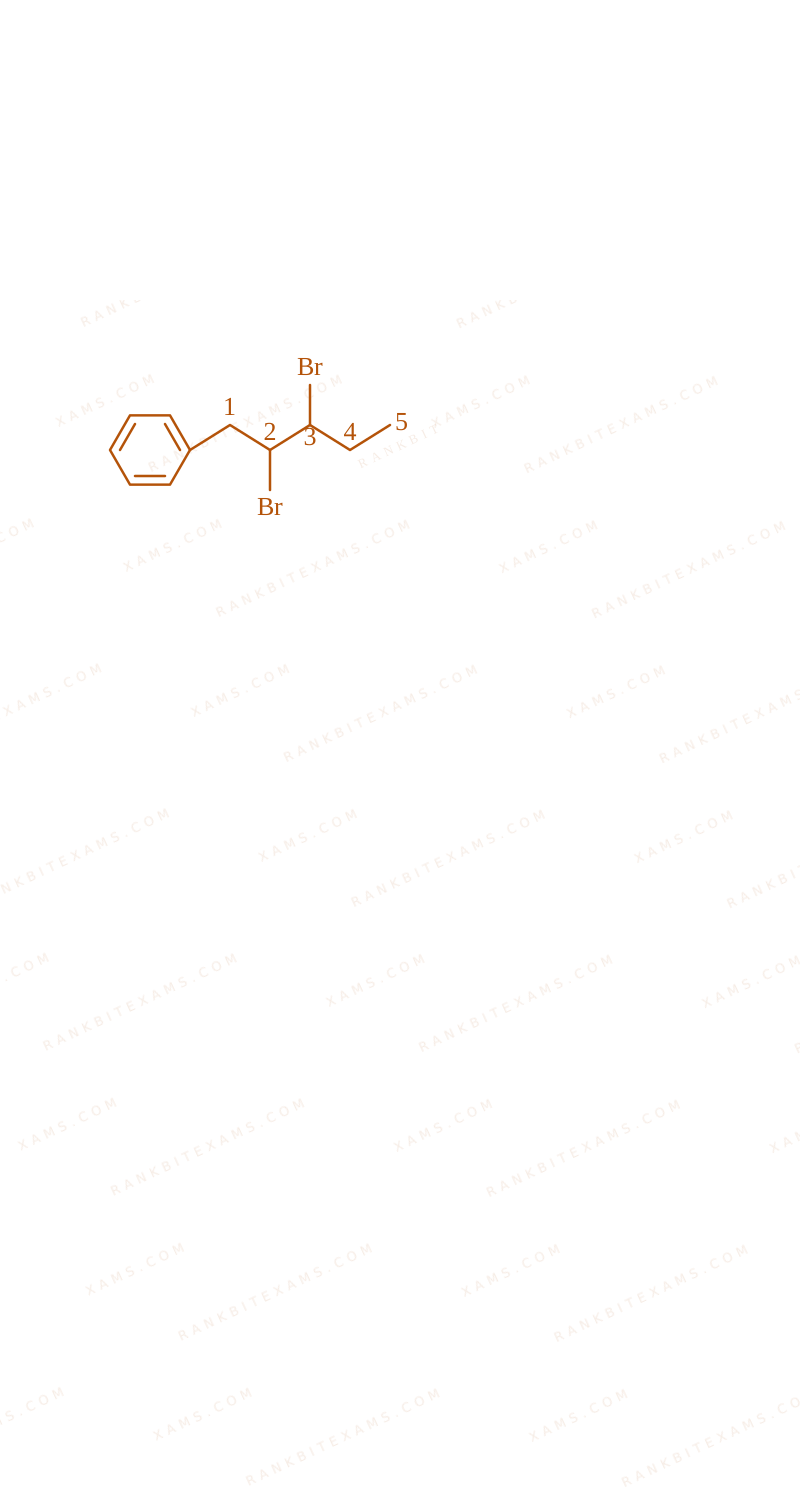
Identify structure of 2,3-dibromo-1-phenylpentane.
A.text(1) Structure A$\text{(1) Structure A}$
B.text(2) Structure B$\text{(2) Structure B}$
C.text(3) Structure C$\text{(3) Structure C}$
D.text(4) Structure D$\text{(4) Structure D}$
Solution
### Core Logic
Decode the IUPAC name: 2,3-dibromo-1-phenylpentane.
1) Parent chain is pentane (5 carbon chain: C1-C2-C3-C4-C5).
2) Substituents:
- Phenyl group at position 1.
- Bromo groups at positions 2 and 3.
Option (3) correctly displays a 5-carbon straight chain. The first carbon attaches to the benzene ring (phenyl group), and the second and third carbons each hold a bromine atom.
IUPAC Nomenclature of Haloalkanes diagram for Q67 - JEE Main 2024 Evening
### Evaluation Rubric / Model Answer
null
### Chapter Mix
Class 12 Chemistry: Haloalkanes and Haloarenes
Q68jee_main_2024_31_jan_morningElimination and Addition Reactions
The product (C) in the below mentioned reaction is:
CH_3-CH_2-CH_2-Br xrightarrow[Delta]KOH_(alc) A xrightarrow[Delta]HBr B xrightarrow[Delta]KOH_(aq) C$$CH_3-CH_2-CH_2-Br \xrightarrow[\Delta]{KOH_{(alc)}} A \xrightarrow[\Delta]{HBr} B \xrightarrow[\Delta]{KOH_{(aq)}} C$$
Q86jee_main_2024_31_jan_morningElimination and Substitution
CH_3CH_2Br + NaOH rightarrow textProduct A$$CH_3CH_2Br + NaOH \rightarrow \text{Product A}$$CH_3CH_2Br + NaOH / H_2O rightarrow textProduct B$$CH_3CH_2Br + NaOH / H_2O \rightarrow \text{Product B}$$
The total number of hydrogen atoms in product A and product B is
Numerical Answer.Answer: 10 to 10
Solution
### Core Logic
Reaction 1:
If the reagent is alcoholic NaOH (implied due to formation of a distinct product A to contrast B), elimination occurs:
CH_3CH_2Br + NaOH (textalc) rightarrow CH_2=CH_2 text (Ethene)$$CH_3CH_2Br + NaOH (\text{alc}) \rightarrow CH_2=CH_2 \text{ (Ethene)}$$
Hydrogen atoms in ethene (C_2H_4$C_2H_4$) = 4.
Reaction 2:
If the reagent is aqueous NaOH (NaOH / H_2O$NaOH / H_2O$), nucleophilic substitution (S_N2$S_N2$) occurs:
CH_3CH_2Br + NaOH (textaq) rightarrow CH_3CH_2OH text (Ethanol)$$CH_3CH_2Br + NaOH (\text{aq}) \rightarrow CH_3CH_2OH \text{ (Ethanol)}$$
Hydrogen atoms in ethanol (C_2H_6O$C_2H_6O$) = 6.
Total hydrogen atoms = 4 + 6 = 10.
### Evaluation Rubric / Model Answer
null
### Chapter Mix
Class 12 Chemistry: Haloalkanes and Haloarenes
More Haloalkanes and Haloarenes Questions — jee_main_2025_07_april_evening
We Map Every Repeating Question in Competitive Exams.
Say goodbye to generic mock test fatigue. RankBit uses smart analysis to group past exam questions into their foundational Repeating Question Types. Find chapter weightage, track repeating questions, and score higher with targeted practice.
Select Your Target Exam
Choose an exam track below to find formulas per chapter and patterns.
Syncing Exam Intelligence
Mapping formulas and patterns across all tracks…
PATH A — FULL LENGTH PRACTICE
Full Mock Test Hub
Simulate real NTA exam conditions with fully tracked mocks. Time yourself against past papers.
Practice past-year questions one chapter at a time. Pick an exam → subject → chapter and get every PYQ for that topic — pulled together from all past papers — with the chapter's key formulas alongside.